MBBS Seats in India State Wise 2026: Complete List, Quota Breakdown & Counselling Guide

Manisha Updated on 03 Oct 2026, 04:27 AM IST
11 minutes read
Click to enlarge
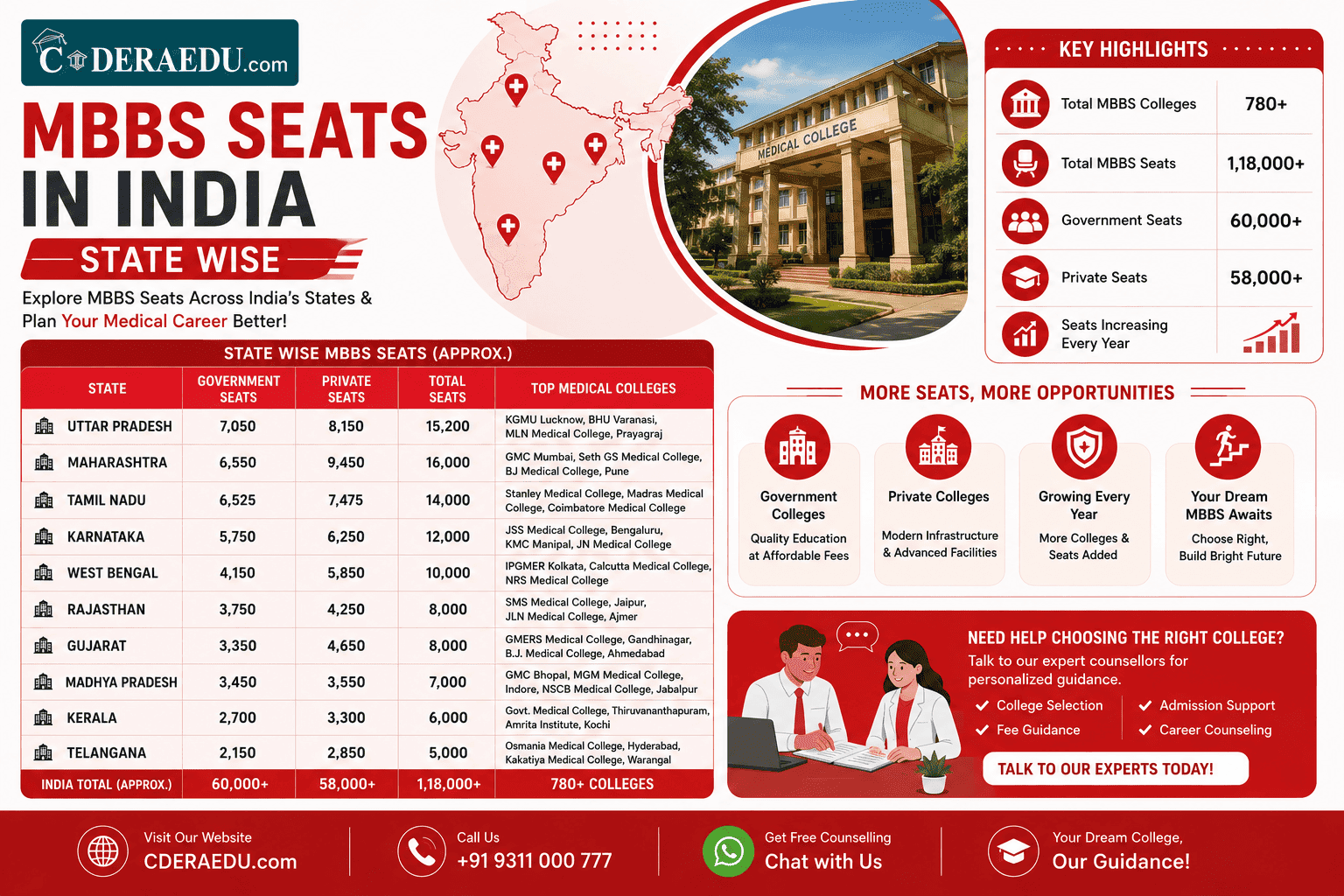
If you're prepping for NEET UG 2026, the one question that probably keeps coming back to you is simple: how many MBBS seats actually exist in your state, and what are your real chances of landing one? With over 22 lakh candidates competing for roughly 1.18 lakh MBBS seats across the country, the seat-to-aspirant ratio is brutal, and it varies wildly depending on which state you call home. A student with a domicile in Karnataka faces a very different competition landscape than one applying from Bihar or Delhi.
This guide breaks down MBBS seats in India state wise, explains how the 15% All India Quota and 85% State Quota actually work, and gives you a state-by-state snapshot of government colleges, approximate seat numbers, and counselling authorities — so you can plan your choice-filling strategy with your eyes open rather than guessing.
How MBBS Seats Are Distributed in India
Before jumping into the state-wise numbers, it helps to understand the structure behind India's medical seat allocation. MBBS admissions in the country are not handled by a single, uniform process. Instead, seats are split between two parallel counselling tracks that run almost simultaneously every year.
The first is the All India Quota (AIQ), which accounts for 15% of seats in every government medical college (except in a few states with special arrangements) plus 100% of seats in central universities, deemed universities, AIIMS, and JIPMER. This quota is open to candidates from anywhere in the country — no domicile certificate required. It is conducted centrally by the Medical Counselling Committee (MCC).
The second, much larger chunk is the State Quota, which covers the remaining 85% of government MBBS seats. These seats are reserved exclusively for candidates who hold a valid domicile certificate for that particular state. Each state runs its own counselling body, its own cutoffs, and often its own reservation rules. This is why a rank that gets you a government seat in one state might not even get you a callback in another.
On top of these two, there are private medical colleges and deemed universities, which run their own management and NRI quota seats, typically at significantly higher fees, and are counselled separately or through the AIQ/state mechanisms depending on the institution type.
If you want a clearer sense of where your rank fits into this picture, it's worth running your numbers through the Medical College Predictor, which uses real MCC, NMC, and state authority cutoff data rather than rough estimates.
MBBS Seats in India: State Wise List 2026
Here's a snapshot of government MBBS seat capacity, approximate number of government colleges, and the counselling authority for each major state. These figures shift slightly every year as the National Medical Commission approves new colleges, so treat them as directional rather than fixed.
Table
| State | Govt. Medical Colleges | Approx. Govt. MBBS Seats | Counselling Authority |
|---|---|---|---|
| Maharashtra | 30+ | 4,800+ | State CET Cell, Maharashtra |
| Tamil Nadu | 38+ | 5,200+ | Directorate of Medical Education (DME), Tamil Nadu |
| Uttar Pradesh | 35+ | 4,300+ | Directorate General of Medical Education (DGME), UP |
| Karnataka | 22+ | 3,100+ | Karnataka Examination Authority (KEA) |
| Rajasthan | 20+ | 3,000+ | RUHS / State Medical Board |
| West Bengal | 25+ | 3,600+ | West Bengal Medical Counselling Committee |
| Madhya Pradesh | 13+ | 2,400+ | Directorate Medical Education (DME), MP |
| Andhra Pradesh | 17+ | 2,500+ | NTRUHS / DME, AP |
| Telangana | 18+ | 2,800+ | Kaloji Narayana Rao University of Health Sciences |
| Gujarat | 16+ | 2,700+ | ACPDC, Gujarat |
| Bihar | 14+ | 1,800+ | Bihar Combined Entrance Competitive Examination Board (BCECEB) |
| Delhi | 7+ | 1,200+ | GGSIPU / DU (FMSC) |
| Punjab | 9+ | 1,500+ | Baba Farid University of Health Sciences |
| Haryana | 8+ | 1,300+ | DGHS, Haryana |
| Kerala | 9+ | 1,400+ | Commissioner for Entrance Examinations (CEE), Kerala |
| Odisha | 11+ | 1,600+ | DMET, Odisha |
| Jharkhand | 7+ | 900+ | Jharkhand Combined Entrance Competitive Examination Board |
| Chhattisgarh | 6+ | 900+ | DME, Chhattisgarh |
| Assam | 8+ | 1,150+ | Director of Medical Education, Assam |
| Uttarakhand | 4+ | 550+ | HNB Uttarakhand Medical Education University |
| Himachal Pradesh | 6+ | 750+ | Himachal Pradesh University |
| Jammu & Kashmir | 6+ | 850+ | Board of Professional Entrance Examinations, J&K |
| Chandigarh | 1 | 150+ | GMCH Chandigarh |
| Puducherry | 2+ | 250+ | Directorate of Health & Family Welfare Services, Puducherry |
4 columns · 25 rows
Figures are approximate and based on NMC seat matrix data; they are subject to change as new colleges receive approval each academic cycle.
To check the exact, currently active seat matrix and cutoffs for your own state, it's far more reliable to use the NEET State Wise College Predictor, which pulls from 22 state authorities' historical data rather than static averages.
State-Wise MBBS Admission: Quota Pattern by Region
Not every state follows the standard 85:15 split. A few regions have unique arrangements worth knowing about before you plan your choice list.
- Jammu & Kashmir runs almost 100% state-domicile-based counselling for its own colleges due to special provisions, alongside participation in AIQ for J&K residents.
- Chandigarh and Puducherry, both Union Territories, allocate seats under a UT-specific quota rather than the standard state quota structure.
- Delhi has a hybrid system — state quota seats are managed jointly through GGSIPU and the Delhi University-affiliated medical colleges, in addition to AIQ.
- North-Eastern states including Assam often see comparatively softer cutoffs due to lower applicant density relative to seat count, which is something many aspirants overlook.
If your domicile falls in any of these regions, it's worth checking the dedicated predictor pages individually rather than assuming the general 85/15 logic applies uniformly.
Top States by Government MBBS Seats
If sheer seat volume matters to you (more seats generally mean comparatively better odds, even after accounting for population and applicant density), these are the states currently leading the count:
- Tamil Nadu — among the highest seat counts in the country, spread across over three dozen government colleges, with admissions handled by the Directorate of Medical Education, Tamil Nadu.
- Maharashtra — a strong mix of older established colleges and newer additions, counselled through the Maharashtra State Quota Predictor.
- Uttar Pradesh — the largest state by population also carries one of the largest seat matrices, accessible via the UP NEET College Predictor.
- West Bengal — home to several of the oldest medical colleges in the country, with consistently high seat allocation.
- Karnataka — a popular open-counselling-friendly state, check your standing through the Karnataka NEET College Predictor.
All India Quota vs State Quota: What Actually Changes Your Odds
A lot of aspirants assume AIQ and state quota are just two separate lists pulling from the same pool, but the dynamics are genuinely different.
Under AIQ, since it's open to candidates nationwide, the cutoffs at top-tier colleges tend to be sharper and more competitive — your home state doesn't give you any edge. This is the route through which all 20 AIIMS campuses, JIPMER, and central universities like AMU, BHU, and DU admit students. You can check your standing specifically for this route using the NEET UG All India Quota Predictor.
Under State Quota, the competition pool shrinks to only candidates who hold a domicile certificate for that state, which is exactly why a rank of, say, 25,000 might be unremarkable in AIQ terms but could be more than enough for a government seat in a state with a smaller applicant base. This is also why having an accurate, state-specific predictor matters more than relying on national averages.
For a side-by-side breakdown of how both quotas function together inside the broader counselling calendar, the Medical Counselling guide is a useful reference point.
State-Wise NEET College Predictor Links
Rather than guessing your chances from a generic table, it's worth running your actual NEET rank and category through the predictor built specifically for your domicile state. Here are the direct links for the major states:
Table
| Region | State-Specific Predictor |
|---|---|
| North | Delhi, Punjab, Haryana, Himachal Pradesh, Jammu & Kashmir, Chandigarh |
| South | Karnataka, Kerala, Andhra Pradesh, Puducherry |
| West & Central | Maharashtra, Gujarat, Rajasthan, Madhya Pradesh, Chhattisgarh |
| East & North-East | West Bengal, Bihar, Jharkhand, Odisha, Assam, Uttarakhand |
2 columns · 5 rows
How Many MBBS Seats Does Your NEET Rank Realistically Get You?
Seat counts only tell half the story — the other half is where your specific rank places you within that seat pool. Here's a rough rank-to-opportunity bracket that applies broadly across most state quota pools, though it shifts depending on category and exact state.
Table
| NEET AIR Range | Realistic Outcome (State Quota) |
|---|---|
| Under 5,000 | Top government colleges in almost any state |
| 5,000 – 15,000 | Strong government college options, especially in higher-seat states |
| 15,000 – 30,000 | Government seats achievable in mid-to-lower cutoff states |
| 30,000 – 60,000 | Newer government colleges or peripheral state quota seats |
| 60,000 – 1,00,000 | Government seat possible only in low-cutoff states; private/deemed more realistic elsewhere |
| Above 1,00,000 | Private medical colleges, deemed universities, or management quota seats |
2 columns · 7 rows
These brackets are generalized. The actual cutoff for your specific state, category, and college type can swing significantly, which is exactly why a one-size-fits-all number is risky to rely on. Run your numbers through the NEET UG College Predictor for a result based on your real category and quota preference rather than a rough bracket.
Government vs Private MBBS Seats: The Real Difference
A common mistake first-time aspirants make is assuming "MBBS seat" means the same thing everywhere. It doesn't.
Government medical college seats are heavily subsidized — annual fees often run between ₹10,000 and ₹1,50,000 depending on the state, with some states charging even less for state quota seats. These are by far the most sought-after, and the cutoffs reflect that.
Private and deemed university seats can carry fees anywhere from ₹10 lakh to ₹25 lakh or more per year, with NRI quota seats often costing significantly higher still. The trade-off is a much wider rank range of eligibility, which makes private colleges a realistic fallback option for candidates who don't make the government cutoff in their state.
If you want a full picture of recognized institutions across both categories, the Top Medical Colleges in India listing is a good starting point, while the NEET exam page covers eligibility, exam pattern, and key dates if you need a refresher before diving into seat-matrix planning.
Step-by-Step: How to Use State-Wise Seat Data for Choice Filling
Knowing the seat numbers is only useful if you translate it into an actual counselling strategy. Here's how experienced counsellors generally recommend approaching it:
- Confirm your domicile eligibility first. Before anything else, verify which state(s) you can legally claim state quota seats in — this single step determines 85% of your available options.
- Run both AIQ and state quota predictions separately. Don't assume your AIQ result and your state quota result will look similar; they often diverge significantly. Use the AIQ Predictor and your relevant state predictor independently.
- Build a tiered list of 30–50 choices. Mix a few ambitious picks, several realistic "probable" options, and a handful of safe backups across both quotas.
- Track round-wise cutoffs, not just Round 1. Many seats open up in Round 2, the mop-up round, and stray vacancy round — don't write off a college just because Round 1 looked tight.
- Don't ignore newer colleges. Recently approved government colleges often carry softer cutoffs in their first few intake years simply because they lack an established reputation yet.
Final Thoughts
MBBS seat availability in India is not a single national number you can plan around — it's a patchwork of 28 states and several union territories, each with its own seat matrix, counselling calendar, and cutoff trends. The smartest way to approach your NEET 2026 counselling strategy is to stop thinking in terms of "how many seats exist in India" and start thinking in terms of "how many seats can I realistically compete for, given my domicile, my category, and my rank."
Once your NEET UG 2026 result is out, run your numbers through the Medical College Predictor for both AIQ and your home state quota, and build a choice list that's realistic, layered, and round-aware rather than based on last year's gossip about cutoffs.
Share this article
Copy
Frequently Asked Questions
How many total MBBS seats are there in India?
India currently has approximately 1.18 lakh MBBS seats across government and private medical colleges combined, spread across more than 700 recognized institutions.
Which state has the highest number of MBBS seats?
Tamil Nadu and Maharashtra currently lead in total government MBBS seat capacity, each offering over 4,500 seats across their respective government college networks.
Can I apply for MBBS seats in a state where I don't have domicile?
Yes, through the All India Quota, which is open to candidates regardless of home state. However, the 85% State Quota seats require a valid domicile certificate for that specific state.
Do all states follow the 85:15 quota split?
Most states follow this standard split, but Union Territories like Chandigarh and Puducherry, along with Jammu & Kashmir, follow slightly different quota structures.
How can I check the exact MBBS seat matrix for my state?
The most reliable way is to use a state-specific NEET predictor that's updated with the current year's NMC-approved seat matrix, rather than relying on previous years' figures.
Are MBBS seats in newly approved colleges counted in the state quota?
Yes, once a college receives NMC approval and is added to the counselling list, its seats are distributed under the same 85:15 (or applicable) quota split as existing colleges in that state.