MD vs MS vs Diploma vs DNB: What Rank You Actually Need for Each (2026 Data)

TanishkaUpdated on 30 Sept 2026, 07:57 PM IST
9 minutes read
Click to enlarge
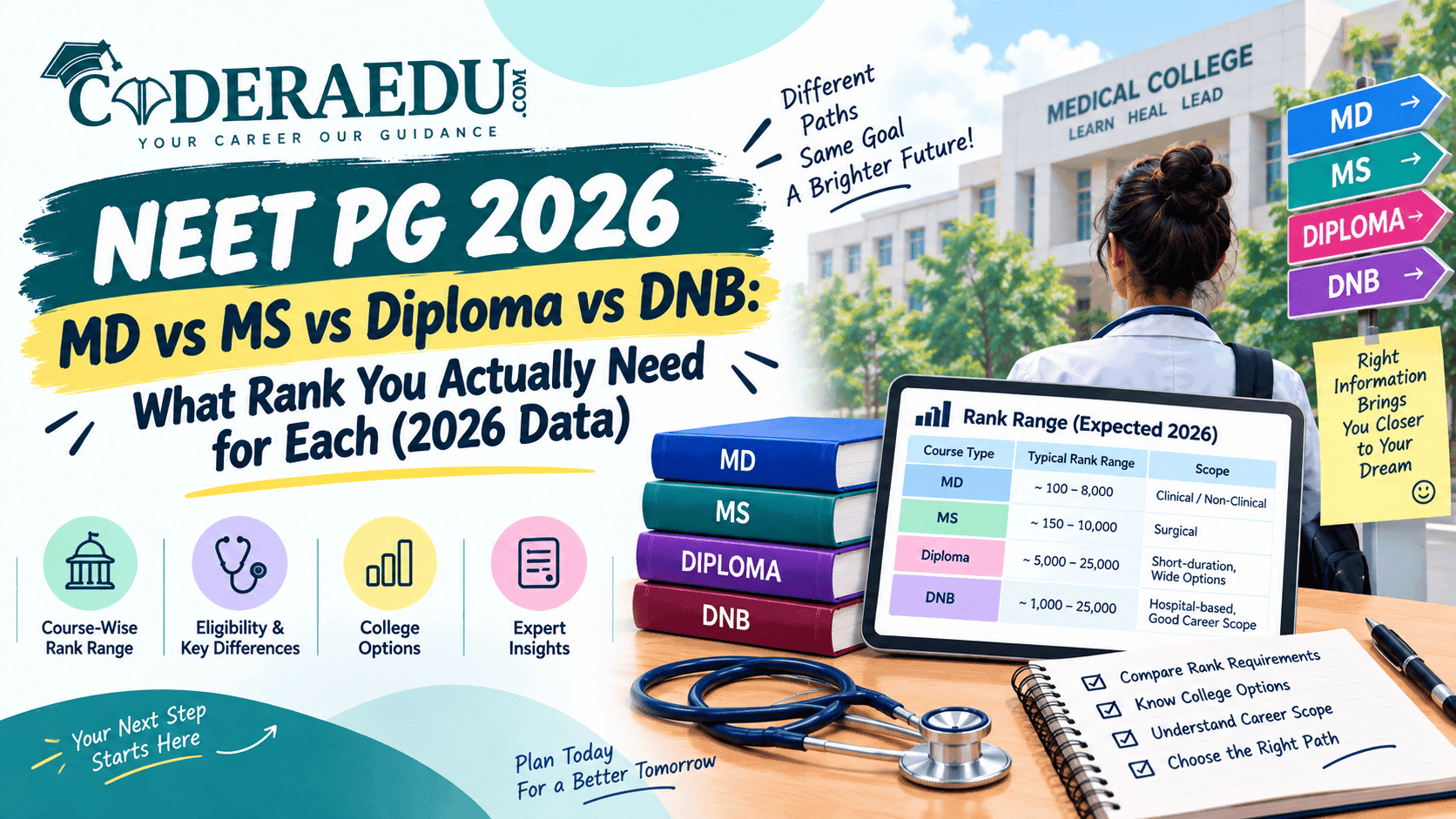
MD, MS, Diploma and DNB all lead to a recognised postgraduate medical qualification, but they are not interchangeable in terms of the rank you need, who conducts admissions, and where you end up training. This guide breaks down what each qualification actually is, and uses branch-wise 2025 NEET PG closing-rank data (the latest full counselling cycle available, since NEET PG 2026 results and counselling are still in progress) to show the realistic rank band for each route. Treat the 2025 figures as a reference trend, not a guaranteed 2026 cutoff, since ranks shift every year with seat matrix changes and candidate numbers.
Quick Snapshot: MD vs MS vs Diploma vs DNB
Table
| Qualification | Full Form | Duration | Who Conducts Admission | Typical Rank Band Needed (2025 GEN reference) |
|---|---|---|---|---|
| MD | Doctor of Medicine (medicine-based specialities) | 3 years | MCC (AIQ) + state authorities, via NEET PG | Under 5,000 for top clinical branches at premier colleges; 15,000-1,00,000+ for other branches/colleges |
| MS | Master of Surgery (surgery-based specialities) | 3 years | MCC (AIQ) + state authorities, via NEET PG | Under 20,000 for popular branches like Orthopaedics/General Surgery at strong colleges; much higher elsewhere |
| PG Diploma | Postgraduate Diploma in select specialities | 2 years | MCC (AIQ) + state authorities, via NEET PG | Comparable to mid-range MD/MS branches, but very few seats/colleges still offer it |
| DNB (Broad Specialty) | Diplomate of National Board, post-MBBS | 3 years | National Board of Examinations in Medical Sciences (NBEMS), via NEET PG rank, mostly at private/corporate hospitals plus some government seats | Roughly 5,000-35,000 for popular clinical branches; over 1,00,000 for some para-clinical DNB branches |
5 columns · 5 rows
What Each Qualification Actually Means
- MD is awarded for medicine-oriented specialities such as General Medicine, Paediatrics, Dermatology, Radiodiagnosis, Psychiatry and the pre-clinical/para-clinical subjects, taught at a medical college attached to a teaching hospital.
- MS covers surgery-oriented specialities such as General Surgery, Orthopaedics, ENT, Ophthalmology and Obstetrics & Gynaecology, also at a medical college.
- PG Diploma is a shorter postgraduate qualification (for example DGO, DCH, DLO) offered at a limited number of institutes; the number of diploma seats has been shrinking over recent cycles as more colleges convert diploma seats into full MD/MS seats.
- DNB (post-MBBS, Broad Specialty) is a national qualification awarded by NBEMS after training at an NBEMS-accredited hospital, which can be a government hospital, a private trust hospital or a corporate hospital. The National Medical Commission recognises DNB as equivalent to MD/MS for academic appointments and eligibility for super-speciality courses.
MD/MS Rank Requirement: What 2025 AIQ and State Data Shows
There is no single national cutoff for MD or MS: the rank required depends on the branch, the specific college, the quota (All India Quota vs state quota), the category, and the counselling round. For the 2025 cycle, MCC's All India Quota round 1 result showed MD General Medicine opening at rank 1 and closing at rank 15 at a top Delhi institute, while the same branch closed well past rank 2,00,000 at some lower-demand colleges in the same round, illustrating how wide the spread is even within one branch.
Looking at state-level government quota data reported for 2025 across several states gives a clearer sense of the range by branch type:
Table
| State/Quota (2025 GEN, Government Seats) | Lowest Closing Rank (most competitive branch) | Highest Closing Rank (least competitive branch) |
|---|---|---|
| Goa Government Quota | AIR 4,892 (MS Orthopaedics) | AIR 1,75,904 (MD Forensic Medicine) |
| Chandigarh Government Quota | AIR 1,066 (MD Radiodiagnosis) | AIR 1,87,440 (MD Microbiology) |
| Assam Government Quota | AIR 7,084 (MD Radiodiagnosis) | AIR 71,647 (MD Pathology) |
| Rajasthan Government Quota | AIR 15,160 (MD Radiodiagnosis) | AIR 1,87,824 (MD Anatomy) |
| Himachal Pradesh State Quota | AIR 1,826 (MD Dermatology, Venereology & Leprosy) | AIR 1,91,431 (MD Anaesthesiology) |
3 columns · 6 rows
The pattern repeats across states: high-demand clinical branches such as Radiodiagnosis, Dermatology, General Medicine and Orthopaedics close within a few thousand to around 20,000-25,000 rank in most government colleges, while pre-clinical and para-clinical branches such as Anatomy, Physiology, Biochemistry, Microbiology and Forensic Medicine regularly stay open well past rank 1,00,000, and sometimes past 1,80,000, because far fewer candidates choose them despite seats being available.
PG Diploma Rank Requirement
PG Diploma courses draw from the same NEET PG merit list as MD/MS and are counselled by MCC and the states through the same rounds, so there is no separate diploma-specific cutoff exam. Because the number of diploma seats is small and shrinking (many colleges have converted their diploma seats to full MD/MS over the last few cycles), the rank needed varies sharply by state and hospital rather than following a national pattern. In counselling records for 2025, a diploma seat such as DCH (Diploma in Child Health) at a state hospital closed around AIR 22,898 in the general category, broadly in line with a mid-competitiveness MD/MS branch at a similar institute. Candidates considering a diploma should treat it as a state-by-state, seat-by-seat decision rather than assuming a fixed rank band.
DNB (Post-MBBS Broad Specialty) Rank Requirement: 2025 Branch-Wise Data
DNB broad-specialty seats after MBBS are allotted using the same NEET PG rank, but through a separate NBEMS counselling process rather than the regular MD/MS state quota process, and the seat pool includes government hospitals along with a large number of private trust and corporate hospitals. Aggregated 2025 allotment data across DNB branches offered in five or more institutes shows the general-category closing rank spread below.
Table
| DNB Branch | 2025 GEN Closing Rank (AIR) |
|---|---|
| DNB Nuclear Medicine | 5,763 |
| DNB Dermatology & Venereology | 7,881 |
| DNB Radiodiagnosis | 12,303 |
| DNB General Medicine | 19,784 |
| DNB Obstetrics & Gynaecology | 23,378 |
| DNB Paediatrics | 23,857 |
| DNB Respiratory Diseases | 24,004 |
| DNB Psychiatry | 26,494 |
| DNB Radiation Oncology | 33,308 |
| DNB General Surgery | 35,354 |
| DNB ENT (Otorhinolaryngology) | 35,691 |
| DNB Biochemistry | 1,80,849 (highest among the 33 branches compared) |
2 columns · 13 rows
Two things stand out compared with MD/MS at government colleges. First, several popular clinical DNB branches (General Medicine, Obstetrics & Gynaecology, Paediatrics, General Surgery) generally need a rank in the 20,000-35,000 range nationally, which is a realistic target for a much larger pool of candidates than the sub-5,000 ranks needed for the same branches at premier government colleges. Second, some niche DNB branches with very few seats, such as Nuclear Medicine, can close at a sharper rank than expected simply because only one or two seats exist nationally, so 'niche' does not automatically mean 'easier rank.' Institute-level records from the 2025 cycle also show individual private-hospital DNB seats closing anywhere from around rank 6,000-10,000 (General Medicine at a well-regarded Delhi hospital) to well past 20,000-45,000 for the same branch at a different hospital, and annual tuition at many private DNB hospitals running around Rs. 1.25 lakh a year alongside a monthly stipend, according to institute-wise 2025 MCC allotment records compiled by counselling-data platforms.
MD/MS vs DNB: Key Practical Differences
Table
| Factor | MD/MS | DNB (Broad Specialty) |
|---|---|---|
| Conducted/recognised by | Medical college, under NMC curriculum | NBEMS; NMC recognises DNB as equivalent to MD/MS |
| Training site | Medical college attached to a teaching hospital | NBEMS-accredited hospital: government, trust or corporate |
| Counselling body | MCC (AIQ) and state authorities | NBEMS, using the same NEET PG rank |
| Typical rank for popular clinical branches (2025 GEN) | Low thousands at top government colleges | Roughly 5,000-35,000 nationally across accredited hospitals |
| Further study eligibility | Eligible for NEET SS / INI-CET super-speciality | Also eligible for NEET SS for DM/MCh super-speciality |
3 columns · 6 rows
How the Counselling Actually Works
- MCC conducts All India Quota (AIQ) counselling for 50% of government medical college seats, plus 100% of seats at deemed universities, AIIMS, JIPMER and central institutes, using the NEET PG rank.
- The remaining 50% of government seats and most private college seats are counselled separately by each state's own authority, generally with domicile or state-eligibility conditions.
- PG Diploma seats are counselled inside the same MCC/state rounds as MD/MS; there is no separate diploma entrance test.
- DNB broad-specialty seats after MBBS use the NEET PG rank but are counselled by NBEMS through its own DNB CET process, generally run alongside or after the MCC/state MD-MS rounds.
- DNB Post-Diploma seats (for candidates who already hold a PG Diploma and want to convert it into a full DNB) are a separate pathway, counselled through DNB PDCET, and are not based on the same-year NEET PG rank.
Which Route Should You Actually Target?
- If your rank comfortably clears the historical sub-5,000-10,000 band for your target clinical branch, government MD/MS at a well-established teaching college is usually the strongest combination of training exposure, low fees and long-term recognition.
- If your rank is in the 10,000-40,000 range, DNB at a reputed private or corporate hospital in your target clinical branch, or MD/MS at a state-quota government college outside the top-tier institutes, are both realistic and worth comparing on fee, stipend and clinical caseload rather than on rank alone.
- If your rank is well beyond 50,000, pre-clinical/para-clinical MD branches (Anatomy, Physiology, Biochemistry, Pharmacology, Microbiology, Forensic Medicine, PSM) at government colleges, or DNB in less sought-after specialities, tend to have seats available and can still lead to a full-fledged academic or public-health career.
- Always cross-check the current year's seat matrix, category-wise closing ranks and reservation rules on mcc.nic.in, your state counselling authority's portal and nbe.edu.in before finalising a choice list, since figures move every counselling round.
Source note: Branch-wise 2025 closing-rank figures for state government quotas (Goa, Chandigarh, Assam, Rajasthan, Himachal Pradesh) and for the national DNB broad-specialty branch comparison are drawn from aggregated MCC/NBEMS 2025 allotment data as compiled and reported. Institute-level DNB fee, stipend and round-wise closing-rank figures for individual hospitals are from institute-wise 2025 MCC allotment records compiled by Formity. NEET PG 2026 was conducted on 30 August 2026 for over 2.65 lakh candidates, with results expected around 30 September 2026 and counselling to follow; the seat-matrix and rank figures above are 2025 reference data and are not confirmed 2026 cutoffs. Always verify current-cycle figures directly on mcc.nic.in and nbe.edu.in before making counselling decisions.
Official Resources
- MCC PG Medical Counselling - Official Portal
- National Board of Examinations in Medical Sciences (NBEMS) - Official Website
- National Medical Commission (NMC) - Official Website
Related Resources
Share this article
Copy
Frequently Asked Questions
Is DNB equal to MD or MS?
The National Medical Commission recognises DNB (Broad Specialty) as equivalent to MD/MS for purposes including academic appointments and eligibility for super-speciality courses such as DM/MCh via NEET SS, even though the training happens at NBEMS-accredited hospitals rather than medical colleges.
What rank is needed for MD General Medicine at a government college?
Based on 2025 AIQ and state government-quota data, MD General Medicine closed within roughly the first few thousand ranks at premier institutes, while at other government colleges across various states it closed anywhere between about 6,000 and 1,00,000, depending on the state, category and round.
Is DNB easier to get than MD/MS in a government college?
For popular clinical branches, 2025 data shows DNB broad-specialty seats nationally closing in roughly the 20,000-35,000 rank range in the general category, which is generally a wider window than the sub-10,000 ranks needed for the same branches at top government MD/MS colleges, though this varies a great deal by hospital.
Are PG Diploma courses being phased out?
The number of PG Diploma seats has been shrinking over recent NEET PG cycles as several colleges convert diploma seats to full MD/MS seats, so the number of institutes offering a diploma in any given speciality can vary from year to year.
Does DNB use a separate entrance exam from NEET PG?
DNB broad-specialty seats after MBBS use the same NEET PG rank as MD/MS, but counselling is conducted separately by NBEMS. A different exam, DNB PDCET, applies only to candidates who already hold a PG Diploma and want to convert it into a full DNB.
Which government quota had the lowest MD/MS closing ranks in 2025?
Among the states compared here, Chandigarh's government quota and Himachal Pradesh's state quota both showed some clinical branches, such as MD Radiodiagnosis and MD Dermatology, closing within roughly the first 1,000-2,000 general-category ranks in 2025, though this reflects a very small number of seats and can shift year to year.