What to Do After NEET 2026 Result? Complete Step-by-Step Guide

Click to enlarge
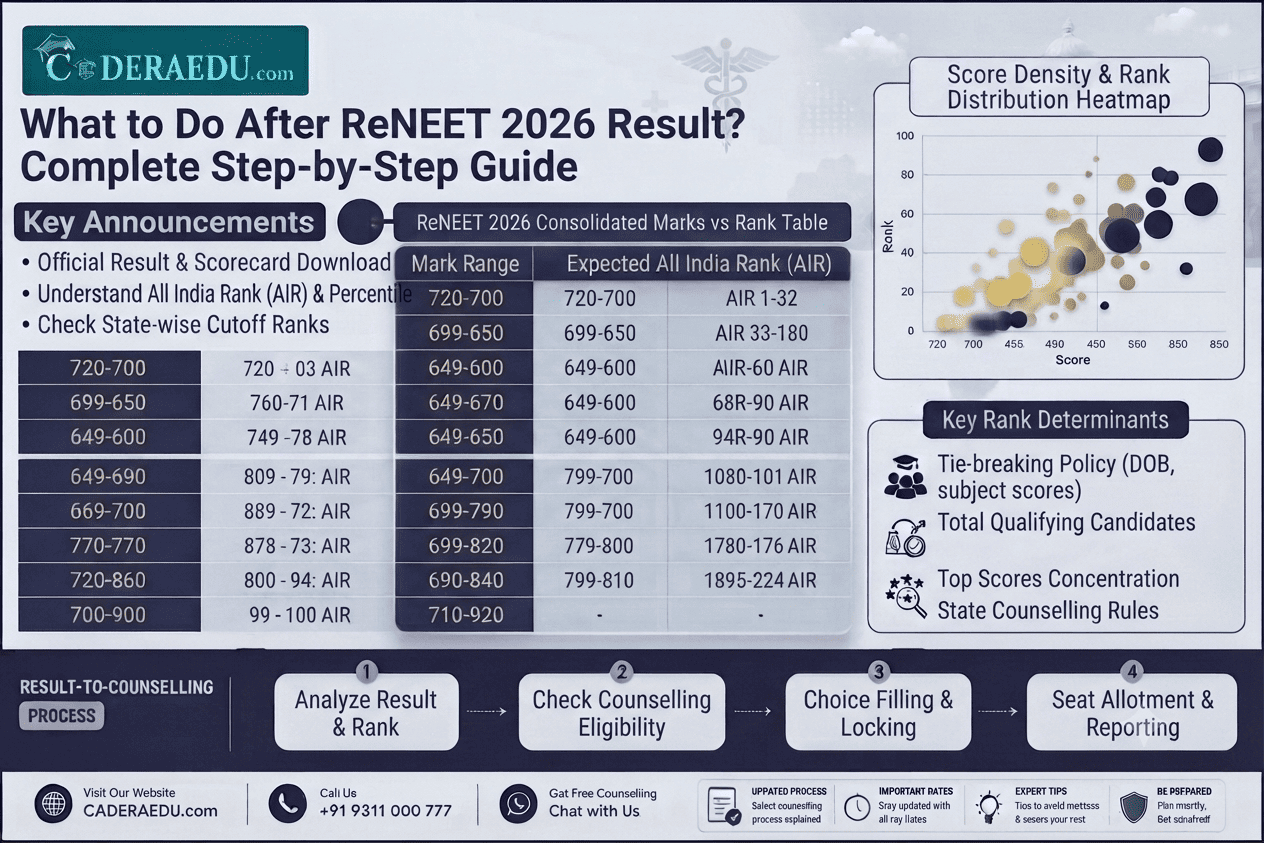
The moment NEET 2026 result is out, the real work begins. This year's cycle has been unusual because the original exam held on 3 May 2026 was cancelled following a paper leak, and a fresh NEET UG re-examination was conducted on 21 June 2026 for the affected candidates. The National Testing Agency is expected to release the Re-NEET 2026 result on or before 20 July 2026. Whether you scored exactly what you hoped for or you are still processing a number that feels lower than expected, the next few weeks decide which medical college you walk into. This guide breaks down everything you need to do after your NEET 2026 result, in the exact order you should do it, so that you do not lose time or a seat because of confusion.
Medical admissions in India move fast once results are out. Choice filling windows open within days, and every round has strict deadlines. Read this guide once from start to finish before you take any action, then come back to each section as you move through the process.
Step 1: Read Your NEET 2026 Scorecard Line by Line
Do not just glance at the total marks and close the tab. Your NEET 2026 scorecard carries several numbers that each play a different role later in counselling, and mixing them up is one of the most common mistakes aspirants make.
- Raw score out of 720, which is your actual marks in the exam
- Percentile score, which tells you how you performed relative to every other candidate who appeared that year
- All India Rank, the number used by MCC for the All India Quota counselling
- Category rank, which applies if you belong to OBC, SC, ST, EWS or PwBD categories
- State merit position, applicable once you register for your home state counselling
- Qualifying status, which confirms whether you have cleared the minimum percentile required for admission
Save at least two digital copies of the scorecard and take a printed copy as well. You will be asked to upload or physically present this document at almost every stage of counselling, from registration on the NEET UG predictor and counselling portal to the final reporting at your allotted institute.
Also double check your personal details on the scorecard, including your name spelling, date of birth and category code, exactly as they appear on your other identity documents. A mismatch here, even a small one, can cause delays or rejection during document verification later. If you spot an error, raise it with NTA through the official correction window as early as possible rather than waiting until counselling registration is already open.
Step 2: Understand Where Your Rank Places You
A rank on its own means very little without context. The same All India Rank can be extremely strong in one state and only moderate in another, depending on the number of seats and the competition in that region. Before you panic or celebrate, look at how your rank compares to the previous year's category wise closing ranks.
Table
| Category | Typical Qualifying Percentile | Approx. Safe Score Range (out of 720) |
|---|---|---|
| General / EWS | 50th percentile | 555 to 575 |
| OBC | 40th percentile | 520 to 550 |
| SC | 40th percentile | 460 to 510 |
| ST | 40th percentile | 440 to 490 |
| PwBD | 45th percentile | 480 to 520 |
3 columns · 6 rows
These figures are indicative and shift slightly every year based on exam difficulty and the number of candidates, so always cross check the official cutoff released alongside your result. What matters more than the raw number is your position relative to seat availability, which is exactly what a good predictor tool calculates for you in the next step.
Step 3: Run Your Rank Through a College Predictor
This is the single most useful thing you can do in the first 48 hours after your result. Manually comparing your rank against dozens of PDFs of previous year cutoffs is slow and error prone. Instead, use a dedicated tool such as the Medical College Predictor, which pulls actual opening and closing rank data from MCC, NMC and state counselling authorities.
If you appeared for the undergraduate exam, head straight to the NEET UG College Predictor and enter your rank, category and preferred quota. The tool will show you colleges where your admission chance is high, moderate or low, covering MBBS, BDS, BAMS, BHMS and BUMS programmes across every round of counselling, not just Round 1.
If you are a medical graduate who appeared for the postgraduate exam instead, the same logic applies through the NEET PG College Predictor, which maps your rank against round wise cutoffs for MD, MS and Diploma seats across government, central, deemed and DNB institutions.
A predictor does not guarantee a seat, but it removes guesswork from choice filling and stops you from wasting choices on colleges that are completely out of reach.
Step 4: Learn the Difference Between AIQ and State Quota
Every MBBS and BDS seat in a government medical college in India is split between two counselling streams, and understanding this split shapes almost every decision you make from here on.
Table
| Aspect | All India Quota (AIQ) | State Quota |
|---|---|---|
| Seats covered | 15% of government seats nationwide | 85% of government seats in that state |
| Conducted by | Medical Counselling Committee (MCC) | State counselling authority |
| Eligibility | Open to candidates from any state | Requires valid domicile of that state |
| Includes AIIMS | Yes, all 20 AIIMS campuses | No |
| Registration | Separate MCC registration | Separate state portal registration |
3 columns · 6 rows
You are allowed, and encouraged, to register for both simultaneously. Use the All India Quota predictor and counselling guide to understand your AIQ chances, and check the dedicated State Quota counselling section to see how your home state process works. Missing one of these two registrations because you assumed only one applies to you is a costly and avoidable error.
Step 5: Collect Every Document Before Registration Opens
Document verification failures cause more seat cancellations than low ranks do. Start gathering these papers the same week your result is announced, well before choice filling begins, so you are not scrambling at the last moment.
- NEET 2026 admit card and scorecard, both original and photocopies
- Class 10 and Class 12 mark sheets and passing certificates
- Date of birth proof such as a birth certificate or Aadhaar card
- Category certificate for OBC, SC, ST or EWS candidates, issued within the valid financial year
- PwBD certificate from an authorised medical board, if applicable
- Domicile or residence certificate for state quota counselling
- Passport size photographs matching the specifications used during NEET registration
- Provisional allotment letter, once issued, printed for reporting
- Migration certificate, required in some states at the time of admission
- Anti Ragging affidavit signed by both the candidate and a parent or guardian
Keep both digital scans and physical originals ready. Some state counselling authorities require notarised or gazetted attestation for certain certificates, so check your specific state's requirement list well in advance.
Understanding Counselling Fees and Security Deposits
Every counselling round requires a registration fee and a security deposit, and the amount varies depending on whether you are applying under AIQ, State Quota, government or management seats. The security deposit is refundable if you do not get allotted a seat or if you withdraw before the reporting deadline for that round, but it is usually forfeited once you accept and confirm an allotted seat and then choose to leave it later.
- AIQ security deposit is generally lower for reserved category candidates compared to general category
- State Quota deposits differ from state to state and are usually collected through the state portal directly
- Management and NRI quota seats at private colleges may require a much larger initial deposit
- Refunds typically take several weeks to process after a round closes, so do not expect an instant reversal
Keep the payment receipt and transaction ID safe for every round you register in, since these are often requested if a refund does not reflect on time. Missing a receipt can delay your refund by weeks during an already busy admission season.
Step 6: Register for MCC and Your State Counselling Portal
Registration for MCC counselling typically opens within a week or two of the result being declared, and state counselling schedules usually follow a similar timeline. Do not wait for one to finish before starting the other, because the windows often overlap.
Each state runs its own portal, its own document list and its own fee structure, so check the process specific to where you hold domicile. CaderaEdu maintains dedicated state predictor and counselling pages for major states including Uttar Pradesh, Bihar, Karnataka, Maharashtra, Rajasthan and Tamil Nadu, each built around that state's own historical cutoff data.
If your domicile state is not listed among these examples, the same principle still applies. Visit your state's official medical counselling website, register early, pay the security deposit on time and keep the receipt safe since it is often required for refunds if you do not get allotted a seat.
Step 7: Decide Which Course and Stream Fits You Best
MBBS is the obvious first choice for most NEET qualifiers, but it is not the only path into a respected medical career, and for many candidates it may not even be the most realistic one this year.
If your rank does not comfortably place you into MBBS, consider BDS, BAMS, BHMS or BUMS programmes, all of which are covered under the same NEET UG counselling process. Candidates interested in the Ayurveda, Yoga, Unani, Siddha and Homeopathy streams should check the AYUSH predictor to see realistic admission chances at reputed institutions.
Nursing is another route worth evaluating, particularly for candidates targeting Delhi based institutions. The GGSIPU BSc Nursing predictor covers admission through NEET marks for nursing seats affiliated with Guru Gobind Singh Indraprastha University.
There is no shame in choosing a stream other than MBBS if the rank does not support it this year. A seat in a good BDS or AYUSH college, or even a strong nursing programme, is often a better outcome than repeating a full year hoping for a marginally better score.
Step 8: Compare Colleges Thoroughly Before You Fill Choices
Once your predictor results give you a realistic shortlist, the next task is comparing those colleges properly instead of relying on hearsay or outdated rankings shared in group chats.
Use the College Compare tool to place two or more shortlisted colleges side by side across parameters like faculty strength, hospital bed capacity, infrastructure, fee structure and past cutoff trends. Cross reference this with the full list of Top Medical Colleges in India and the broader Colleges directory to understand where each option stands nationally, not just within your state.
- Check the college's recognition status with the National Medical Commission
- Review the hospital attached to the college, since clinical exposure matters as much as classroom teaching
- Compare total fees across all years, not just the first year tuition figure quoted publicly
- Look at hostel availability and location if you will be relocating
- Read about faculty vacancy ratios where available, since understaffed departments affect teaching quality
Step 9: Fill Your Choices Strategically, Not Emotionally
Choice filling is where most of the actual decision making happens, and it deserves more time than most candidates give it. A common mistake is filling only five or six choices because the candidate is confident about one particular college. This is risky, since a single missed cutoff can mean sitting out an entire round.
- Fill as many choices as the portal allows, ordered strictly by your genuine preference
- Place your most desired but slightly ambitious colleges at the top, followed by realistic matches, followed by safe backup options
- Never leave a choice out just because you assume you will not get it, since ranks and cutoffs shift between rounds
- Re verify your choice order before locking, since locked choices usually cannot be edited afterward
- Keep a personal spreadsheet of your choice order outside the portal as a backup record
Remember that filling a choice does not commit you to anything. You are only bound once you are allotted a seat and you choose to accept it by reporting. Filling more choices simply gives the algorithm more options to work with in your favour.
Step 10: Track Seat Allotment and Complete Reporting on Time
MCC and most state authorities run counselling across several structured rounds, and understanding this rhythm helps you plan the weeks ahead instead of being caught off guard.
Table
| Round | What Happens |
|---|---|
| Round 1 | Choice filling, locking, seat allotment and reporting or joining at the allotted college |
| Round 2 | Fresh and upgrade choice filling for candidates who did not get a seat or wish to upgrade |
| Mop Up Round | Final structured round, often allowing fresh registration for candidates who missed earlier rounds |
| Stray Vacancy Round | Offline or online allotment of seats that remain vacant after all structured rounds close |
2 columns · 5 rows
If you are allotted a seat and you are satisfied with it, report to the institute within the given deadline with all your original documents. If you wish to try for something better in the next round, most authorities allow you to upgrade while keeping your current allotment safe, though the exact rule varies by state, so read the counselling brochure carefully before deciding.
What to Do If Your Rank Is Lower Than Expected
Not every qualifying candidate secures a government MBBS seat, and that is a normal part of an exam attempted by more than 22 lakh students. If your rank places you outside the government college range, you still have several genuine options worth exploring rather than assuming the year is lost.
Private and deemed medical colleges accept significantly higher rank numbers, particularly for management and NRI quota seats, and many maintain solid clinical training standards despite higher fees. Run your rank through the same NEET UG predictor filtered specifically for private and deemed institutions to see where you realistically stand.
If MBBS still does not work out this year, BDS, AYUSH courses and nursing remain strong, dignified career paths with genuine long term prospects in Indian healthcare. Some candidates also choose to attempt NEET again the following year with a focused revision plan, though this decision should weigh the cost of an extra year against realistic score improvement, not emotion alone.
Common Mistakes Candidates Make After the Result
- Waiting too long to register for counselling, assuming there is plenty of time
- Filling only a handful of choices and missing out on realistic backup options
- Ignoring state quota registration because AIQ was assumed to be sufficient
- Submitting documents in the wrong format or missing an attestation requirement
- Not reading the specific counselling brochure of the authority they are registering with
- Making a final college decision based only on brand name rather than infrastructure or fees
Get Personalised Counselling Guidance
The counselling process involves overlapping deadlines across MCC and state authorities, and even one missed date can affect your options for the entire year. If you would rather have an expert walk you through your specific rank, category and state combination, book a free counselling session and get a plan built around your actual numbers instead of generic advice.
You can also learn more about the team behind these tools and guidance on the About Us page, or browse the FAQ section for quick answers to common counselling and admission queries before reaching out directly.
Final Thoughts
The period right after your NEET 2026 result is short, fast moving and unforgiving of delay, but it is also completely manageable if you follow a clear sequence. Read your scorecard properly, understand your real standing, run your rank through a reliable predictor, gather your documents early, register for both AIQ and state counselling, and fill your choices with a clear strategy rather than emotion. Whatever your rank turns out to be, there is a genuine path forward, whether that is a top government MBBS seat, a strong BDS or AYUSH programme, or a well planned repeat attempt.
Thousands of students go through this exact process every single year, and the ones who come out with the best outcomes are rarely the ones with the highest ranks alone. They are the ones who stayed organised, tracked every deadline, filled their choices thoughtfully and asked for guidance when they were unsure instead of guessing. Take the process one step at a time, lean on reliable tools and expert advice where needed, and you will get through counselling with far less stress than most aspirants experience.
Share this article
Copy
Frequently Asked Questions
When will the NEET 2026 result be declared?
The National Testing Agency is expected to declare the Re-NEET UG 2026 result on or before 20 July 2026, following the re-examination held on 21 June 2026 after the original May exam was cancelled.
What should I do immediately after checking my NEET 2026 result?
Download and save your scorecard, note your rank and percentile, then run your rank through a college predictor to understand realistic admission chances before registration opens.
Should I register for both AIQ and State Quota counselling?
Yes. AIQ covers 15% of government seats nationwide and is open to all candidates, while State Quota covers 85% of seats and requires domicile, so registering for both maximises your chances.
What if I do not get a government MBBS seat?
You can explore private and deemed medical colleges, BDS, AYUSH courses or nursing programmes, or plan a focused attempt at NEET the following year based on a realistic assessment of your score.
How many choices should I fill during counselling?
Fill as many choices as the portal allows, ordered by genuine preference from ambitious to realistic to safe, since filling a choice does not commit you until you accept an allotted seat.
Confused About College Admissions?
Get expert advice on college selection, admission chances, and career path in a personalized counselling session.
Book a Counselling Slot
Select Date
Pick a Slot