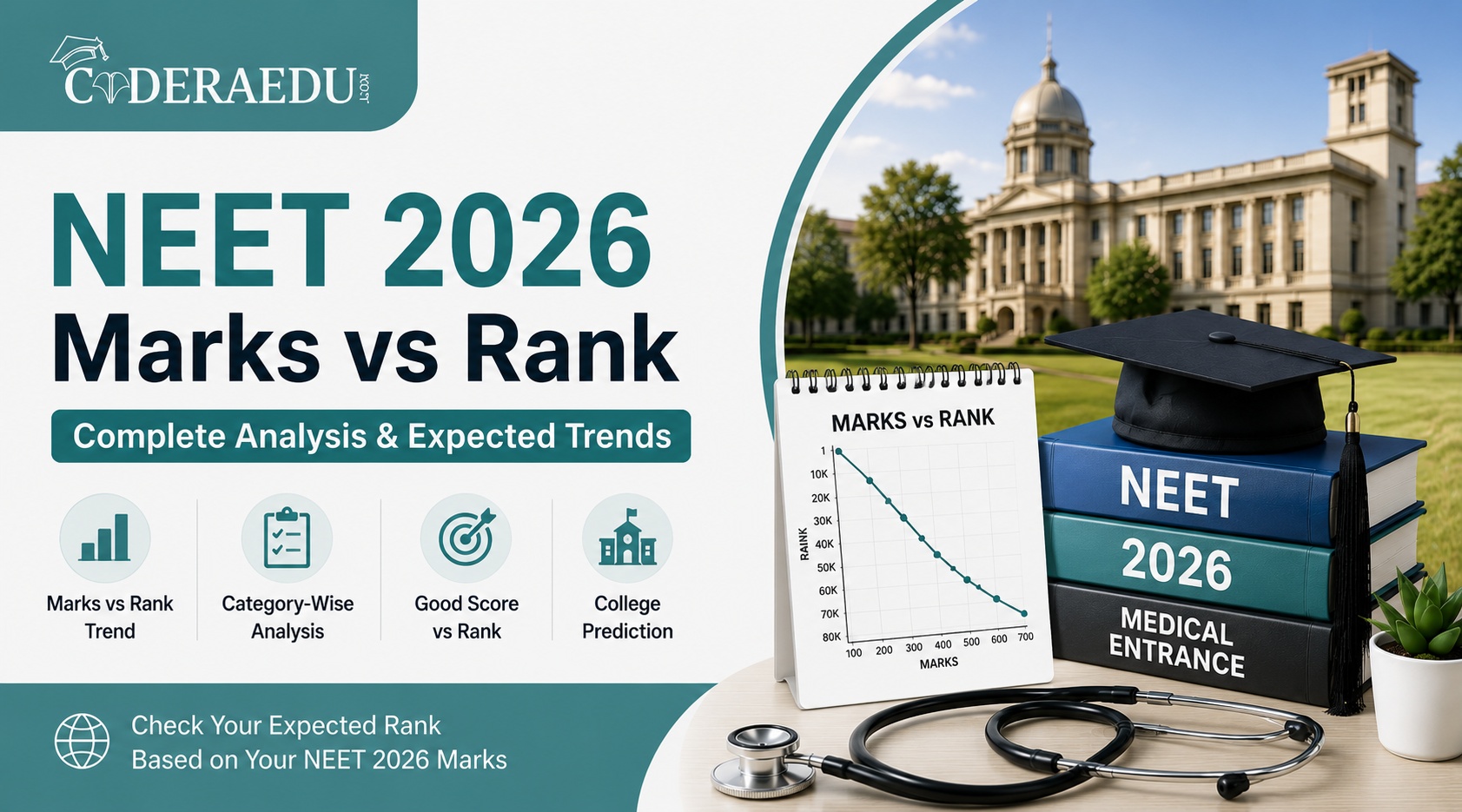
NEET Marks vs Rank 2026: Complete Score to Rank Analysis & What It Means for Your Admission

Click to enlarge
Introduction: Why NEET Marks vs Rank 2026 Is the First Question Every Student Asks
The moment you walk out of the NEET 2026 exam hall, one thought occupies every student's mind — "I attempted this many questions, so what will my rank be?" The relationship between NEET Marks vs Rank 2026 is not straightforward. Two students scoring the same marks can end up with very different ranks depending on how the rest of the 22+ lakh candidates performed. Your marks tell you how much you scored. Your rank tells you where you stand among everyone else. And your rank — not your marks — is what determines your college. Understanding this distinction is the first step toward planning your MBBS admission strategy correctly. In this guide, we break down the expected marks-to-rank mapping for 2026 in detail, explain what each rank range means for your college options, and help you figure out your next move — whether you scored 650 or 250.
How NEET Rank Is Calculated – The Basics You Must Know
Many students assume rank is simply their position based on marks. That is mostly correct, but there are a few important nuances that affect where you land on the merit list. Here is how NTA calculates your NEET rank.
- Your NEET score is calculated as: (Number of correct answers × 4) – (Number of incorrect answers × 1). Unattempted questions carry zero marks.
- The overall merit list is prepared in descending order of scores. The student with the highest score gets Rank 1.
- In case of a tie — i.e., two or more students score exactly the same marks — NTA uses a tie-breaking formula to assign different ranks.
- The tie-breaking order is: (1) Higher marks in Biology, (2) Higher marks in Chemistry, (3) Higher marks in Physics, (4) Lower number of incorrect answers overall, (5) Age — older candidate gets the better rank.
- A separate merit list is prepared for each category: General, OBC, SC, ST, EWS, and PwD. Your rank on the overall list and your rank within your category are both important for counselling.
This means if you and your friend both scored 480 marks, the one who scored more in Biology will get the better rank. Small differences matter enormously at competitive rank boundaries. This is also why two years may show different marks for the same rank — the competition pool changes every year.
NEET Marks vs Rank 2026 – Expected Score to Rank Table (General Category)
Based on previous years' data, the number of candidates expected to appear in 2026, and historical score distributions, the following table gives you a reliable estimate of what rank to expect against each score bracket for General (Unreserved) category students. These are projections — the official rank will be declared when NTA releases the NEET 2026 result.
Table
| Marks Range (Out of 720) | Expected Rank (General – 2026) | Percentile (Approx.) | College Tier Accessible |
|---|---|---|---|
| 700 – 720 | 1 – 10 | 99.99+ | AIIMS New Delhi, Top AIIMS |
| 670 – 699 | 11 – 100 | 99.99 | AIIMS campuses, JIPMER |
| 640 – 669 | 101 – 500 | 99.97 – 99.99 | MAMC Delhi, Lady Hardinge, Top Govt Colleges |
| 610 – 639 | 501 – 2,000 | 99.90 – 99.97 | Top government colleges, state AIQ seats |
| 580 – 609 | 2,001 – 6,000 | 99.70 – 99.90 | Good govt colleges in major states |
| 550 – 579 | 6,001 – 15,000 | 99.30 – 99.70 | State govt colleges, top private (Manipal, Amrita) |
| 520 – 549 | 15,001 – 35,000 | 98.40 – 99.30 | State govt colleges, good private colleges |
| 490 – 519 | 35,001 – 65,000 | 97.00 – 98.40 | State govt colleges (limited), private MBBS |
| 450 – 489 | 65,001 – 1,20,000 | 94.50 – 97.00 | Private MBBS, BDS in good colleges |
| 400 – 449 | 1,20,001 – 2,50,000 | 88.60 – 94.50 | Private MBBS (mid-tier), BDS, AYUSH |
| 350 – 399 | 2,50,001 – 4,50,000 | 79.50 – 88.60 | Private MBBS (lower-tier), BAMS, BHMS |
| 300 – 349 | 4,50,001 – 6,50,000 | 70.40 – 79.50 | Some private MBBS (management quota), AYUSH |
| 250 – 299 | 6,50,001 – 8,50,000 | 61.35 – 70.40 | AYUSH, BDS, B.V.Sc, allied health sciences |
| 145 – 249 | 8,50,001 – 10,00,000+ | 50th percentile cutoff range | Barely qualifying; limited counselling options |
4 columns · 15 rows
These figures are based on 22+ lakh expected candidates for NEET 2026. If the actual number of candidates or the overall difficulty level shifts significantly, rank estimates may vary by 10–20%. Use the NEET UG College Predictor on CaderaEdu for a personalised rank and college estimate based on your actual score.
NEET 2026 Marks vs Rank – Category-Wise Comparison Table
One of the most important things students miss is that rank and counselling eligibility work differently across categories. Reserved category students compete within a smaller pool, which means the same score fetches a much better effective rank. Here is how the same score range translates across different categories.
Table
| NEET Score | General Rank (Est.) | OBC Rank (Est.) | SC Rank (Est.) | ST Rank (Est.) | EWS Rank (Est.) |
|---|---|---|---|---|---|
| 600+ | ~2,000 | ~700 | ~200 | ~80 | ~500 |
| 550 | ~12,000 | ~4,500 | ~1,200 | ~450 | ~3,000 |
| 500 | ~50,000 | ~18,000 | ~5,000 | ~1,800 | ~12,000 |
| 450 | ~1,00,000 | ~38,000 | ~10,500 | ~3,800 | ~25,000 |
| 400 | ~2,00,000 | ~75,000 | ~21,000 | ~7,500 | ~50,000 |
| 350 | ~3,80,000 | ~1,42,000 | ~40,000 | ~14,000 | ~95,000 |
| 300 | ~5,80,000 | ~2,15,000 | ~60,000 | ~21,000 | ~1,45,000 |
6 columns · 8 rows
This table makes one thing very clear: if you belong to SC, ST, OBC, or EWS, your score carries much more weight in counselling than a General category student with the same marks. A score of 450 that fetches rank ~1,00,000 for a General student gives an SC student an effective rank of ~10,500 — a completely different set of college options. Always check your category-specific rank, not just the overall rank.
NEET Marks vs Rank – How It Has Changed from 2022 to 2025
Rank prediction is not an exact science, but historical data provides a very solid foundation. Here is how marks-to-rank mapping has shifted over recent years for the General category, which helps us predict where 2026 will land.
Table
| Score | Approx. Rank 2022 | Approx. Rank 2023 | Approx. Rank 2024 | Expected Rank 2026 |
|---|---|---|---|---|
| 650+ | ~100 | ~120 | ~80 | ~90 – 110 |
| 600 | ~4,000 | ~3,500 | ~2,200 | ~2,500 – 3,000 |
| 550 | ~18,000 | ~15,000 | ~10,500 | ~11,000 – 14,000 |
| 500 | ~65,000 | ~55,000 | ~42,000 | ~45,000 – 55,000 |
| 450 | ~1,40,000 | ~1,20,000 | ~90,000 | ~95,000 – 1,10,000 |
| 400 | ~2,80,000 | ~2,50,000 | ~1,90,000 | ~2,00,000 – 2,30,000 |
| 350 | ~4,50,000 | ~4,00,000 | ~3,20,000 | ~3,30,000 – 3,80,000 |
5 columns · 8 rows
The trend is clear: as the number of candidates grows year over year, the same score is now fetching a better (lower number) rank because more students are appearing but the score distribution is becoming more competitive at the top while spreading wider at the bottom. In 2026, with an estimated 22+ lakh candidates, the mid-range scores (400–550) are expected to see ranks slightly better than 2024 because the paper difficulty is reported to be moderate.
What Rank Do You Need for Government MBBS vs Private MBBS?
This is the most practical question students need answered. Not just "what is my rank" but "what does my rank actually get me?" Here is a clear breakdown of what different rank ranges can realistically achieve in NEET 2026 counselling.
Table
| Rank Range (General) | What You Can Target | Counselling Route |
|---|---|---|
| 1 – 50 | AIIMS New Delhi – almost certain | MCC AIQ – AIIMS/JIPMER round |
| 51 – 500 | Other AIIMS campuses, JIPMER, MAMC Delhi | MCC AIQ Round 1 |
| 501 – 3,000 | Top central govt colleges, state top govt colleges | MCC AIQ + State Quota |
| 3,001 – 15,000 | Good state govt medical colleges, private top-tier | MCC AIQ + State Counselling |
| 15,001 – 50,000 | State govt colleges in home state, Kasturba, Amrita | State Counselling (priority) |
| 50,001 – 1,50,000 | State govt (reserved / later rounds), mid-tier private MBBS | State + Private Counselling |
| 1,50,001 – 5,00,000 | Private MBBS colleges, BDS top colleges | State Private Counselling |
| 5,00,001 – 8,50,000 | BDS, BAMS, BHMS, B.V.Sc, BNYS | State AYUSH Counselling |
| Above 8,50,000 (qualifying) | Very limited; management quota only in some states | Direct college contact |
3 columns · 10 rows
For reserved category students, shift the rank ranges above by a factor of 3x to 8x depending on your category. For instance, an SC student with rank 60,000 (category rank) may still get a state government medical college seat. The CaderaEdu College Predictor helps you check exact college eligibility based on your rank, category, and preferred state — saving you hours of manual research.
Key Insights: What the NEET 2026 Marks vs Rank Data Tells Us
After analysing five years of NEET data and expected 2026 trends, here are the most important insights every student and parent should walk away with.
- The top 1,000 ranks are separated by very few marks — sometimes just 5 to 10 marks can mean a rank difference of 500 to 800 at this level. Accuracy matters far more than speed at the top.
- Between 400 and 550 marks, a single 4-mark question (one correct answer) can shift your rank by 5,000 to 15,000 positions. This is the most competitive zone where small changes have the biggest rank impact.
- The 300–400 score range now has the highest density of candidates. This means rank movement is slowest here — a 20-mark improvement may only improve your rank by 20,000 to 30,000.
- State quota ranks are almost always more valuable than AIQ ranks for getting a government seat, because 85% of government seats fall under state quota. Always prioritise state counselling registration.
- Women-only institutions like Lady Hardinge Medical College (Delhi) have their own merit list within General category. Female candidates should check these separately.
- The NEET rank list includes all 22+ lakh candidates. However, only about 50–55% of registered candidates actually appear, and only the top 12–14 lakh typically cross the qualifying cutoff. Your competition pool for government MBBS seats is much smaller than 22 lakh.
NEET 2026 Marks vs Rank for NRI and Management Quota – A Quick Note
NRI quota and management quota seats at private medical colleges work differently from the merit-based counselling system. For NRI quota seats, a lower NEET score (typically 300+) is sufficient to be eligible, but the fees are substantially higher — often Rs 80 lakh to Rs 2 crore for the full course. Management quota seats are filled by the college directly and do not strictly follow the rank-based merit list, though a minimum qualifying score is required. If you are exploring these options, it is critical to verify the college's NAAC/MCI accreditation status and understand the total cost before committing. Getting unbiased guidance from a counsellor at CaderaEdu before approaching private colleges directly is strongly advisable.
Mistakes Students Make When Using Marks vs Rank Predictors
Rank predictor tools are incredibly useful, but students often misuse them in ways that lead to poor decisions. Here are the most common mistakes to avoid.
- Mistake 1 – Using marks before checking the answer key: Many students calculate their expected score incorrectly by not verifying against NTA's official answer key. Always wait for the official key before using any rank predictor.
- Mistake 2 – Treating the predicted rank as the confirmed rank: Rank predictors give you a range, not a guaranteed outcome. The actual rank depends on how all 22+ lakh candidates performed — data no tool has access to before results.
- Mistake 3 – Only looking at overall rank and ignoring category rank: Your category rank (OBC, SC, ST, EWS) is what actually determines your seat in reserved category counselling. Do not make college shortlists based on overall rank alone.
- Mistake 4 – Not accounting for state quota separately: The rank at which a college closes under AIQ is usually much lower (better) than under state quota. Mixing these up leads to overestimating or underestimating your chances.
- Mistake 5 – Panicking and making quick decisions: A low predicted rank does not mean the end of options. Multiple counselling rounds, stray vacancy rounds, and AYUSH/BDS routes all provide pathways. Rushing into paying for a private college before exploring all options is a costly mistake.
- Mistake 6 – Ignoring the tie-breaking rule: If you and thousands of others scored the same, Biology marks determine the better rank. Students who scored low in Biology but high overall may find their actual rank worse than predicted.
Expert Recommendations: How to Use Your NEET 2026 Rank Wisely
Once you have an estimate of your rank, here is what our counselling experts at CaderaEdu Medical Counselling recommend you do next, in order of priority.
- Step 1 – Cross-verify your score using NTA's official answer key the moment it is released. Do not rely on coaching institute keys alone.
- Step 2 – Use a rank predictor to get a range. Treat this as a planning tool, not a final answer. Assume a ±10% variance in rank.
- Step 3 – Identify both your AIQ counselling eligibility and your state quota eligibility. Register for both MCC counselling (for AIQ) and your state's counselling authority simultaneously — these run in parallel and missing a registration deadline means permanently losing access to those seats.
- Step 4 – Build a college shortlist with three tiers: dream colleges (top 20% of your range), realistic colleges (middle 60%), and safety colleges (bottom 20%). Do not shortlist only dream colleges.
- Step 5 – Research individual college cutoffs from the last 2–3 years to verify which colleges have historically closed at your rank range. Seat availability varies year to year.
- Step 6 – If your rank makes government MBBS unlikely, explore BDS, BAMS, BHMS, B.V.Sc with the same seriousness. These are real career paths with strong job markets — not consolation prizes.
- Step 7 – Do not make fee payments to private colleges before MCC Round 1 results are out. Many students lose both their NEET seat and their deposit amount by acting too hastily.
NEET 2026 Rank vs College: State-Wise Closing Rank Estimate
State quota counselling closes at very different ranks from AIQ counselling. Here is a rough guide to expected state quota closing ranks for government MBBS seats in key states in 2026, for General category students.
Table
| State | State Quota Closing Rank (General, Estimated 2026) | AIQ Closing Rank (General, Last Round) |
|---|---|---|
| Delhi | ~3,000 – 8,000 | ~200 – 500 |
| Maharashtra | ~15,000 – 40,000 | ~2,000 – 6,000 |
| Tamil Nadu | ~20,000 – 50,000 | ~3,000 – 8,000 |
| Karnataka | ~18,000 – 45,000 | ~2,500 – 7,000 |
| Uttar Pradesh | ~30,000 – 80,000 | ~4,000 – 10,000 |
| Rajasthan | ~25,000 – 65,000 | ~3,500 – 9,000 |
| Gujarat | ~20,000 – 55,000 | ~2,500 – 7,500 |
| West Bengal | ~15,000 – 45,000 | ~2,000 – 6,500 |
| Madhya Pradesh | ~35,000 – 90,000 | ~5,000 – 12,000 |
| Kerala | ~10,000 – 30,000 | ~1,500 – 5,000 |
3 columns · 11 rows
State quota seats are your most important resource if you scored in the 450–550 range. Domicile requirements mean less competition within your home state than in AIQ, where students from across India compete for the same seats. For UP students specifically, the UPTAC counselling predictor can help with engineering options, while state NEET counselling handles medical seats separately.
Conclusion: Your NEET 2026 Rank Is a Starting Point, Not a Verdict
The NEET Marks vs Rank 2026 analysis presented here is designed to give you a realistic, data-backed picture of where you stand and what options lie ahead. Whether your expected rank is in the top 100 or the top 5,00,000, there is a path forward — but it requires accurate information and timely action. Do not let rank anxiety push you into panic decisions. Do not let overconfidence make you skip safety options. Use rank predictors as planning tools, register for all relevant counsellings, build a tiered college shortlist, and get expert guidance before making any financial commitment. The students who make the best NEET admissions decisions are not always the ones with the highest ranks. They are the ones who use their rank most intelligently. Start planning today with the NEET UG College Predictor on CaderaEdu, and reach out for personalised medical counselling support if you need one-on-one guidance.
Topics:
Share this article
Copy
Frequently Asked Questions
How is NEET rank calculated from marks in 2026?
NEET rank is calculated by arranging all candidates in descending order of their total marks (out of 720). In case of a tie, NTA uses a tie-breaking formula: Biology marks first, then Chemistry, then Physics, then lower incorrect answers, and finally age (older candidate gets preference). Your overall rank and category-specific rank are both important for counselling.
What rank can I expect if I score 500 marks in NEET 2026?
For a General category student, a score of 500 marks in NEET 2026 is expected to fetch a rank of approximately 45,000 to 55,000. For OBC candidates, the effective category rank would be around 18,000, and for SC/ST candidates it would be significantly better. These are estimates based on historical data and are subject to change depending on the actual difficulty level and score distribution.
What is the difference between overall NEET rank and category rank?
Your overall NEET rank is your position among all candidates regardless of category. Your category rank is your position among candidates from the same category (General, OBC, SC, ST, EWS). For reserved category counselling (OBC, SC, ST, EWS seats), your category rank is what determines eligibility — not your overall rank. This is why reserved category students should always check both ranks.
What NEET rank is needed for a government MBBS seat in 2026?
For a General category student, a rank below 50,000 gives realistic access to government MBBS seats through state quota counselling in most states. For top-tier government colleges like MAMC Delhi or Lady Hardinge, a rank below 500 is typically needed through AIQ. For SC/ST/OBC/EWS students, the rank cutoff is much more lenient — even rank 80,000–1,00,000 can secure a government seat in several states.
Can I get MBBS with a rank of 2,00,000 in NEET 2026?
Getting a government MBBS seat with a rank of 2,00,000 in the General category is very difficult. However, private MBBS colleges in states like UP, MP, Rajasthan, and Chhattisgarh may have seats available at this rank range. For OBC candidates, a rank of 2,00,000 may still be competitive for some state government seats. BDS and AYUSH options (BAMS, BHMS) also remain available at this rank.
Does the NEET rank change if the difficulty level of the paper changes?
Yes, the difficulty level directly affects the marks distribution, which in turn affects what rank a particular score fetches. If the paper is harder, fewer students score high, meaning a score of 500 might fetch a better rank (lower number) than in an easier year. If the paper is easier and everyone scores higher, a 500-mark score will fetch a worse rank. This is why year-to-year rank comparison is important for prediction.
How do I use a NEET rank predictor accurately?
To use a NEET rank predictor accurately: (1) Wait for NTA's official answer key before calculating your score. (2) Enter your marks along with your category. (3) Treat the output as a range with ±10% variance, not a guaranteed rank. (4) Cross-check predicted rank against 2–3 years of historical college closing ranks before shortlisting colleges. CaderaEdu's NEET UG College Predictor gives you a college-wise eligibility view directly based on your score and category.
What should I do if my NEET 2026 rank is not enough for MBBS?
If your rank is insufficient for an MBBS seat, here are practical next steps: (1) Explore BDS (Bachelor of Dental Surgery) — a well-respected healthcare career with strong earning potential. (2) Consider BAMS (Ayurveda), BHMS (Homeopathy), or BNYS (Naturopathy) through AYUSH counselling. (3) Explore B.V.Sc (Veterinary Science) or B.Pharm. (4) Plan a NEET retake in 2027 with a focused, structured preparation strategy. Missing MBBS in one attempt is not the end of a medical career.
Confused About College Admissions?
Get expert advice on college selection, admission chances, and career path in a personalized counselling session.
Book a Counselling Slot
Select Date
Pick a Slot