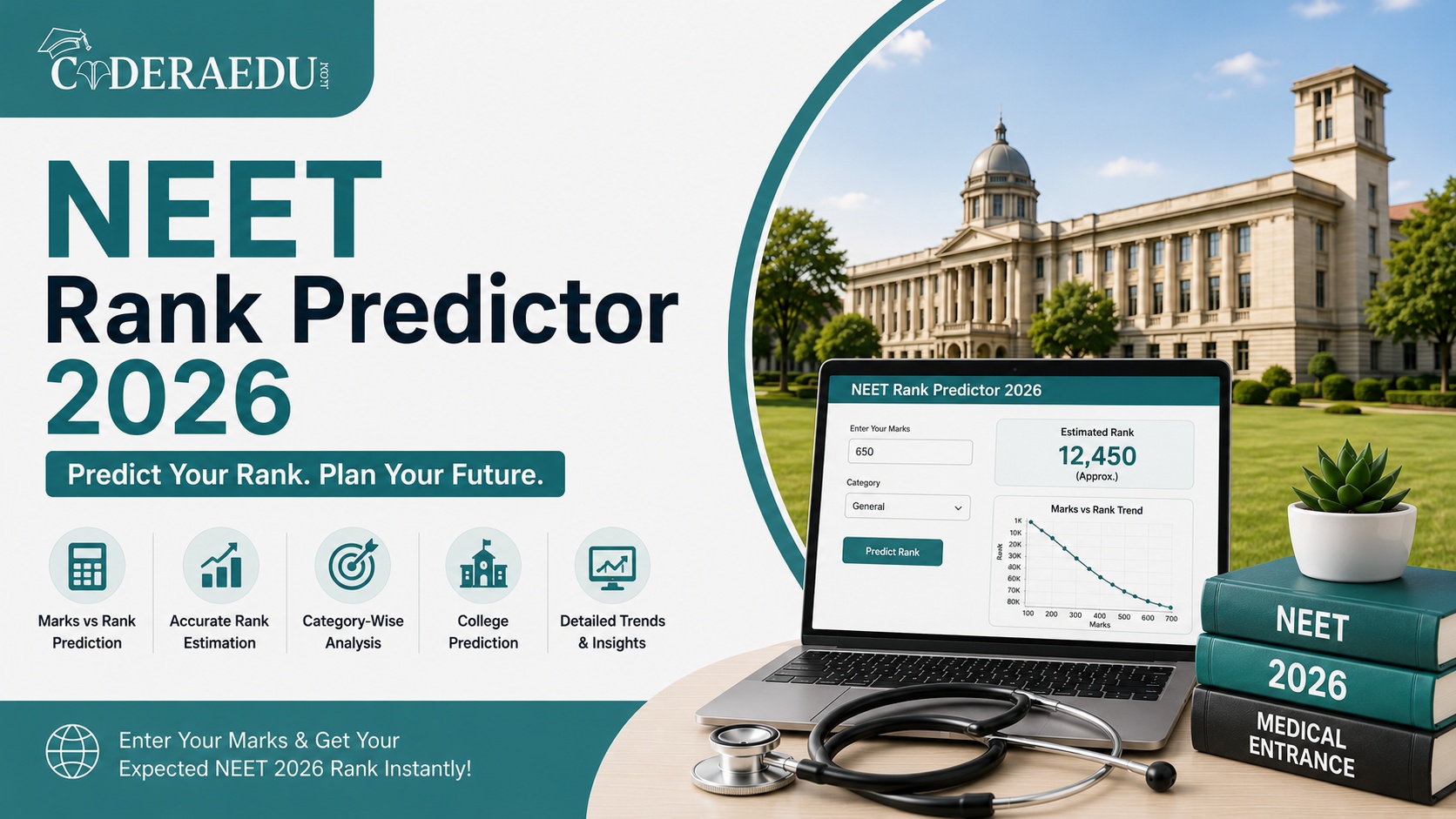
NEET Rank Predictor 2026: Estimate Your All India Rank Based on Score
A
AdminAuthor
8 June 2026
12 minutes read
Click to enlarge
Introduction: Why You Need a NEET Rank Predictor in 2026
Cracking NEET UG 2026 is one thing — understanding where your score places you among lakhs of candidates is another. The NEET Rank Predictor 2026 helps aspirants estimate their All India Rank (AIR) even before the official results are announced. Whether you scored 600, 650, or 700, knowing your predicted rank gives you a crucial head start in planning your MBBS admission strategy and counselling preferences.
Every year, over 20 lakh students appear for NEET UG. The competition is intense, and the gap between getting into a government medical college versus a private one often comes down to a few marks. A rank predictor helps you understand that gap early and make data-driven decisions about which colleges to target during MCC counselling and state quota rounds.
This guide explains how NEET rank prediction works, what factors influence rank calculation, how to interpret your predicted rank across categories, and how to use that information to plan your college choices. We have also included score vs rank comparison tables based on trends from previous years to help you benchmark your performance.
What Is a NEET Rank Predictor and How Does It Work?
A NEET Rank Predictor is an analytical tool that uses your estimated or actual NEET score, category, and historical percentile data to calculate a probable All India Rank. It does not access NTA's official database — instead, it relies on data trends from previous years including the score distribution. Check the detailed NEET Rank Predictor guide, number of candidates, and percentile mapping from NEET UG 2022, 2023, and 2024.
The prediction is based on a straightforward logic: if you score 680 marks, and historically candidates scoring between 670–690 were ranked between 1,500 and 3,500 in the general category, then your predicted rank falls within that bracket. The accuracy of these tools depends heavily on how closely the 2026 exam difficulty and candidate distribution mirrors past years.
- Your self-evaluated NEET score (or official score after result declaration)
- Your category — General, OBC, SC, ST, EWS, or PwD
- Whether you are applying under AIQ (All India Quota) or state quota
- Number of candidates appearing in NEET UG 2026
- Difficulty level of the 2026 paper compared to previous years
NEET 2026 Eligibility Criteria: Who Can Appear?
Before using the NEET Rank Predictor 2026, it is important to confirm that you meet the eligibility conditions set by the National Testing Agency (NTA). Students who do not fulfil these criteria will not be allotted a seat regardless of rank.
- Minimum age: 17 years as on or before December 31, 2026
- No upper age limit (as per Supreme Court directions — subject to any future ruling)
- Must have passed Class 12 with Physics, Chemistry, and Biology/Biotechnology as compulsory subjects
- Minimum qualifying marks: 50% aggregate in PCB for General category; 40% for SC/ST/OBC; 45% for PwD
- Nationality: Indian nationals, NRIs, OCIs, PIOs, and foreign nationals are eligible
- Number of attempts: No cap currently — subject to policy updates by NTA
For detailed eligibility criteria specific to individual state quotas, check the state-wise NEET cutoff guide or the respective state medical counselling authority's official notifications. NEET UG 2026 complete eligibility details including domicile requirements are covered separately.
NEET Score vs Rank 2026: Expected Range by Category
The following table is based on trends observed in NEET UG 2022, 2023, and 2024. These are indicative ranges only. The actual rank in 2026 may vary depending on the difficulty level of the paper and the total number of qualified candidates. Use this as a planning benchmark, not a guaranteed prediction.
Table
| NEET Score Range | Expected AIR (General) | Expected AIR (OBC) | Expected AIR (SC/ST) |
|---|---|---|---|
| 710 – 720 | 1 – 100 | 1 – 50 | 1 – 30 |
| 690 – 710 | 100 – 500 | 50 – 250 | 30 – 100 |
| 670 – 690 | 500 – 2,000 | 250 – 1,000 | 100 – 400 |
| 650 – 670 | 2,000 – 5,000 | 1,000 – 2,500 | 400 – 1,000 |
| 620 – 650 | 5,000 – 12,000 | 2,500 – 6,000 | 1,000 – 3,000 |
| 590 – 620 | 12,000 – 25,000 | 6,000 – 12,000 | 3,000 – 7,000 |
| 550 – 590 | 25,000 – 50,000 | 12,000 – 25,000 | 7,000 – 15,000 |
| 500 – 550 | 50,000 – 1,00,000 | 25,000 – 50,000 | 15,000 – 35,000 |
| 450 – 500 | 1,00,000 – 2,00,000 | 50,000 – 1,00,000 | 35,000 – 70,000 |
| Below 450 | 2,00,000+ | 1,00,000+ | 70,000+ |
4 columns · 11 rows
Note: The above data reflects patterns from NEET UG 2022–2024 and is meant for planning purposes only. Rank depends on multiple dynamic factors. Always refer to the official NEET 2026 result for your actual AIR.
A NEET rank predictor is a planning compass, not a verdict. Use it to shortlist colleges, understand your position, and prepare for counselling — but always wait for the official merit list before making final decisions.
How to Use the NEET Rank Predictor 2026 Effectively
Using a rank predictor is simple, but interpreting the results smartly requires understanding a few nuances. Here is a step-by-step process to get the most out of your NEET 2026 rank prediction.
- Step 1 – Calculate your NEET score: Use the official answer key released by NTA. Add 4 marks for each correct answer and deduct 1 mark for each incorrect one. Unattempted questions carry zero marks.
- Step 2 – Select your category: Choose from General, OBC-NCL, SC, ST, EWS, or PwD. Category affects both the rank bracket and the cutoff score you need to qualify.
- Step 3 – Input the score in the predictor tool: Most rank predictor tools available on reputable medical education portals will generate your predicted rank range within seconds.
- Step 4 – Check the college predictor: Once you have your rank range, use a NEET college predictor to identify colleges where your rank falls within the closing rank of previous years.
- Step 5 – Cross-check with state quota: If you are a state domicile candidate, also check expected closing ranks under state quota which are usually higher (better) than AIQ ranks.
- Step 6 – Plan your counselling choices: Make a list of government colleges, private colleges, and deemed universities that match your predicted rank. This helps you fill counselling choices strategically.
NEET 2026 Counselling Process: AIQ and State Quota Explained
Once the official results are out, MCC counselling 2026 begins for the 15% All India Quota (AIQ) seats in government colleges, 100% seats in central universities (AIIMS, JIPMER, etc.), and all seats in deemed and private universities. State quota counselling (85% of government college seats) is conducted separately by each state authority.
Understanding the difference between AIQ and state quota is critical for planning. Your predicted NEET rank will determine your chances differently in each stream. For state quota seats, only candidates with domicile/residence in that state are eligible, which means competition is lower and the closing rank is often higher than in AIQ.
Table
| Parameter | AIQ Counselling (MCC) | State Quota Counselling |
|---|---|---|
| Seat Percentage | 15% of Government seats | 85% of Government seats |
| Conducted By | Medical Counselling Committee (MCC) | Respective State Counselling Authority |
| Who Can Apply | All India candidates | Only domicile/state residents |
| Private/Deemed Colleges | Yes – 100% seats | Not covered (handled by MCC) |
| Rounds Conducted | Round 1, Round 2, Mop-Up, Stray Vacancy | Varies by state (usually 2-3 rounds) |
| Competition Level | Very high – national level | Moderate – state level only |
| Registration Portal | mcc.nic.in | State-specific portal |
3 columns · 8 rows
Candidates must register separately for AIQ counselling and state counselling. Participating in both is allowed and advisable. Learn more about the complete NEET counselling process 2026 including document requirements, registration fees, and round-wise schedules.
NEET 2026 Expected Cutoffs and Qualifying Marks
The NEET qualifying cutoff is the minimum percentile a candidate must achieve to be eligible for counselling. This is different from the cutoff required to get into a specific college. The official qualifying cutoffs for NEET 2026 will be announced by NTA along with the results, but based on historical data, the following ranges are expected.
- General category (UR): 50th percentile – expected around 137–145 marks
- OBC / SC / ST: 40th percentile – expected around 107–115 marks
- General PwD: 45th percentile – expected around 121–130 marks
- SC/ST/OBC PwD: 40th percentile – expected around 107–115 marks
These are qualifying marks only — they do not guarantee a seat. For admission into a government medical college through AIQ, the closing ranks in previous years have required scores well above 600 for most states. NEET 2026 cutoffs for top government colleges are covered in our dedicated cutoff article.
Top Government Medical Colleges and Expected Closing Ranks 2026
Your predicted rank from the NEET Rank Predictor 2026 becomes most useful when you compare it against closing ranks of colleges you want to target. Below are some of India's top government medical colleges and the approximate closing rank ranges from previous years under AIQ General category. These are indicative and subject to change in 2026.
- AIIMS New Delhi – Closing rank typically within top 50–100 (AIQ/AIIMS quota)
- Maulana Azad Medical College, Delhi – AIQ closing rank around 150–400
- VMMC and Safdarjung Hospital, Delhi – AIQ closing rank around 400–800
- Grant Medical College, Mumbai – AIQ closing rank around 1,500–3,500
- Seth GS Medical College, Mumbai – AIQ closing rank around 800–2,000
- Madras Medical College, Chennai – AIQ closing rank around 3,000–7,000
- JIPMER, Puducherry – Separate JIPMER-category seats; AIQ rank around 200–700
- BJ Medical College, Ahmedabad – AIQ closing rank around 2,000–5,000
- Lady Hardinge Medical College, Delhi (females only) – AIQ closing rank around 500–1,200
- KGMU, Lucknow – AIQ closing rank around 5,000–10,000
For a full college-wise comparison including seat matrix and fee structure, visit our Top Government Medical Colleges in India 2026 guide. If your predicted rank falls outside the AIQ closing ranks, you may still have strong options under state quota or private medical colleges.
Common Mistakes Students Make While Using a NEET Rank Predictor
Rank predictors are powerful planning tools, but they are frequently misused. Here are the most common mistakes NEET aspirants make — and how to avoid them.
- Treating the predicted rank as final: The predicted rank is an estimate. Your actual rank depends on the official NTA calculation. Never reject or accept a college purely based on a predicted rank.
- Not accounting for category: Many students use the General category rank even if they qualify under OBC or SC/ST. Category-specific ranks can significantly improve your college options.
- Ignoring state quota: AIQ seats are highly competitive. A student with a rank of 15,000 may struggle in AIQ but get a government seat easily in their home state quota.
- Over-relying on a single year's data: Using only NEET 2024 data for prediction can be misleading if the 2026 paper is significantly easier or harder. Cross-reference across at least 3 years.
- Not including deemed universities: Deemed universities have separate rounds under MCC. Students with ranks between 30,000–80,000 often overlook these and end up with fewer choices.
- Missing counselling deadlines: Even with a good rank, missing registration windows for MCC or state counselling means forfeiting your seat. Keep track of all important dates.
- Confusing NEET score with marks required for a specific college cutoff: The college cutoff is the closing rank of the last student admitted — not a minimum score requirement.
Expert Guidance: How to Plan Your MBBS Admission Strategy Using Your Predicted Rank
Once you have your predicted rank from the NEET Rank Predictor 2026, the next step is to translate it into a concrete admission strategy. Medical admissions counsellors consistently recommend a three-tier approach: target colleges (those where your rank is comfortably within closing range), match colleges (borderline fits), and safety colleges (where your rank gives you near-certain admission).
For students in the rank range of 1 to 10,000, focus primarily on top government colleges under AIQ and AIIMS/JIPMER institutions. Your AIIMS MBBS admission 2026 chances are strong if your rank is under 1,000. For ranks between 10,000 and 50,000, state quota seats in government colleges and select deemed university admissions should be primary targets.
For ranks above 50,000, private medical college MBBS programs become the realistic pathway. Carefully evaluate the fee structure — private college fees range from 50 lakh to over 1 crore for the full course. Check NMC approval status, NMC recognition, and past placement and result records before committing. Use the NEET college predictor 2026 to shortlist colleges smartly.
NEET Rank Predictor 2026: Frequently Asked Questions (FAQs)
Below are answers to the most commonly asked questions about using the NEET Rank Predictor 2026 and understanding your rank in the context of MBBS admissions.
Conclusion: Use Your Predicted NEET Rank to Plan Smarter
The NEET Rank Predictor 2026 is one of the most valuable pre-result tools available to medical aspirants. Whether you are aiming for AIIMS or a state government college, knowing where you stand before the results gives you precious time to research colleges, understand counselling procedures, and prepare documentation.
Use the score vs rank tables in this guide to estimate your position, understand what category-specific rank means for your counselling options, and start shortlisting colleges using previous year closing ranks. Keep checking for NEET UG 2026 result updates and MCC counselling 2026 schedule announcements as the season progresses.
Remember: your rank is a starting point, not a ceiling. With the right counselling strategy, a thorough understanding of AIQ versus state quota options, and timely registration across all applicable rounds, even students with moderate ranks have secured seats in reputed medical institutions. Start planning today — every hour of preparation before counselling counts.
For more tools and resources, explore our NEET College Predictor 2026, NEET Cutoff 2026, and NEET Counselling Guide 2026 to build a complete admission plan.
Topics:
Share this article
Share this article
Frequently Asked Questions
How accurate is the NEET Rank Predictor 2026?
NEET rank predictors are based on historical data from previous years and give a broad estimated range, not an exact rank. Accuracy depends on how closely the 2026 paper's difficulty and candidate distribution mirrors earlier years. Treat the output as a planning range rather than a precise figure. Your official rank will be declared by NTA along with the NEET UG 2026 results.
What is a good NEET score for MBBS admission in a government college?
For AIQ seats in top government colleges like Maulana Azad Medical College or VMMC Delhi, you typically need a score above 650–670 in the General category. For state quota government seats, the requirement varies significantly by state. In some states, a score of 550–580 can get you into a government college under the OBC or SC/ST category. Always check the previous year's closing ranks for your target colleges.
Can I get MBBS with 500 marks in NEET 2026?
A score of 500 in NEET 2026 may place you in the rank range of approximately 50,000 to 1,00,000 in the General category, depending on the difficulty level. At this rank, AIQ government seats are unlikely. However, state quota seats in some states, seats under SC/ST/OBC reservation, and private medical college admissions remain viable options. Use the NEET College Predictor to identify colleges where this rank has historically been within the closing range.
What is the difference between AIQ rank and state quota rank?
Your AIQ rank is your All India Rank across all candidates and is used for the 15% All India Quota seats in government colleges plus all seats in deemed and private colleges via MCC counselling. Your state quota rank is your rank within the pool of candidates eligible for that state's 85% quota seats, which is restricted to domicile/resident candidates. State quota ranks are generally more favourable because you compete only with students from that state.
How many rounds are conducted in MCC NEET counselling 2026?
MCC typically conducts four rounds for NEET UG counselling: Round 1, Round 2, a Mop-Up Round, and a Stray Vacancy Round. The first two rounds are the main allotment rounds where most seats are filled. The Mop-Up round fills remaining seats and is open to all eligible candidates. The Stray Vacancy Round is the final round for any leftover seats. Exact dates are announced by MCC on mcc.nic.in.
Does NEET rank predictor work differently for OBC and SC/ST categories?
Yes. Category significantly affects rank estimation. OBC-NCL, SC, and ST candidates compete within their respective reservation pools, which means the effective rank within the category is lower and the cutoff score required is also lower. A good NEET rank predictor will allow you to select your category and show the predicted rank within that category bracket alongside the overall AIR.
When should I use the NEET Rank Predictor 2026?
You can use the rank predictor immediately after the exam using the official answer key released by NTA, typically within 1–2 days of the exam. Predict your score first, then use the predictor to estimate your rank. This gives you a 3–4 week window before results are officially declared to research colleges, understand counselling timelines, and prepare your documents.
Is the NEET Rank Predictor useful for NEET PG as well?
Most NEET Rank Predictor tools available are specifically designed for NEET UG. NEET PG has a different exam structure, scoring pattern, and seat distribution for MD/MS admissions. Separate rank predictor tools exist for NEET PG. If you are a final-year MBBS student preparing for NEET PG 2026, refer to dedicated NEET PG rank predictor resources.
What is the minimum NEET score to qualify for counselling in 2026?
The minimum qualifying score to be eligible for counselling is determined by the NEET cutoff percentile announced by NTA. Historically, this has been around 137–145 marks for General category (50th percentile) and around 107–115 marks for OBC/SC/ST (40th percentile). However, merely qualifying does not guarantee a seat — actual college admission cutoffs are much higher.
Can I predict my NEET rank without the official answer key?
Yes, but with lower accuracy. If you remember your responses, you can estimate your score against the expected answer key circulated by coaching institutes before the official key is released. Most major coaching institutes (Allen, Aakash, Resonance, etc.) release unofficial answer keys within hours of the exam. Use these to estimate your score and feed it into the rank predictor. Once the official NTA answer key is released, recheck your score and update your rank prediction.
Get Free Counselling
Fill in your details and our experts will get back to you shortly.