MCC NEET Counselling 2026 Complete Guide (Step-by-Step)

Ishika Updated on 29 Sept 2026, 01:59 PM IST
15 minutes read
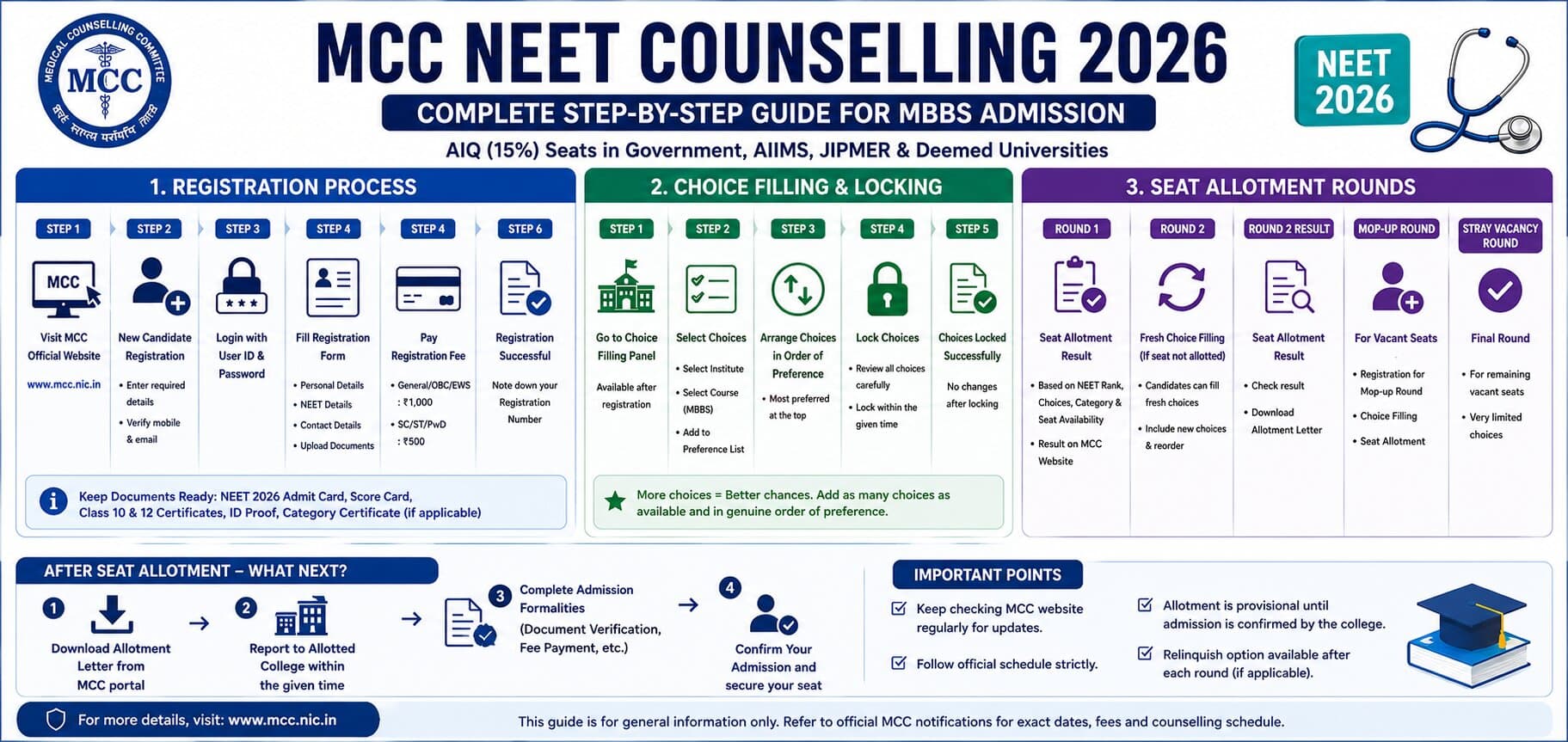
Click to enlarge
You cleared NEET 2026. Now comes the part that actually decides which college you attend. MCC NEET Counselling 2026 is the centralised admission process run by the Medical Counselling Committee for All India Quota seats — and it is the only route to AIIMS, JIPMER, and every deemed university in the country. Over 24 lakh students appeared for NEET 2026, competing for roughly 1,09,000 MBBS seats total. The seats that go through MCC are the most competitive chunk of that pool. This guide walks you through every step — registration, choice filling, seat allotment, reporting, and round-wise strategy — so you go into counselling knowing exactly what to do and when.
What is MCC NEET Counselling 2026?
The Medical Counselling Committee (MCC), functioning under the Directorate General of Health Services, conducts centralised online counselling for MBBS and BDS seats that fall under the All India Quota. It does not handle state quota seats — those 85% of government college seats are managed by individual state authorities like DMER Maharashtra, DMET UP, DGHS Delhi, and KEA Karnataka. What MCC controls is significant though: 15% of seats in every government medical college across India, plus 100% of seats at all 23 AIIMS campuses, JIPMER Puducherry and Karaikal, and all NMC-approved deemed universities. If you want AIIMS New Delhi or any other AIIMS, MCC is your only path. AIIMS New Delhi
One thing students often miss: MCC counselling and state counselling run simultaneously. You need to register for both independently. Waiting for your MCC allotment before registering for state counselling is a mistake that costs seats every single year.
MCC NEET Counselling 2026 — Expected Schedule
The Re-NEET conducted on June 21, 2026 has pushed the counselling calendar back by roughly 6 to 8 weeks from the usual timeline. MCC typically releases the counselling schedule 2 to 3 weeks after the NEET result. All dates below are estimates based on historical MCC patterns. The only authoritative source for confirmed dates is mcc.nic.in — do not rely on WhatsApp forwards or coaching centre updates for this.
Table
| Event | Expected Timeline (2026) |
|---|---|
| NEET UG 2026 Result Declaration | July 2026 |
| MCC Counselling Schedule Notification | July 2026 |
| Round 1 — Registration and Fee Payment | Late July / Early August 2026 |
| Round 1 — Choice Filling and Locking | Late July / Early August 2026 |
| Round 1 — Seat Allotment Result | August 2026 |
| Round 1 — Reporting at Allotted College | August 2026 |
| Round 2 — Registration and Choice Filling | August / September 2026 |
| Round 2 — Seat Allotment and Reporting | September 2026 |
| Mop-Up Round | September / October 2026 |
| Stray Vacancy Round | October 2026 |
2 columns · 11 rows
Who Can Apply for MCC NEET Counselling 2026?
Eligibility for MCC counselling is simpler than state counselling because there is no domicile restriction. Any NEET 2026 qualifier from any state can participate, regardless of where they live. The core requirements are:
- Qualified NEET UG 2026 — General/OBC: 50th percentile (approximately 135 to 140 marks); SC/ST: 40th percentile; PwD: 45th percentile.
- Indian citizen, NRI, OCI, or PIO. NRI and OCI candidates can participate for NRI quota seats at deemed universities.
- Age: minimum 17 years as of December 31, 2026. No upper age limit as per Supreme Court ruling.
- Class 12 with Physics, Chemistry, and Biology/Biotechnology: 50% aggregate for General/OBC; 40% for SC/ST; 45% for PwD.
- Students from J&K, Andhra Pradesh, and Telangana: these states opted out of the 15% AIQ arrangement in their own government colleges, but students from these states can still participate in MCC counselling for AIIMS, JIPMER, and deemed university seats.
Step-by-Step MCC NEET Counselling 2026 Process
Each round of MCC counselling follows the same four-stage process. Missing any single step — particularly locking your choice list — can result in no allotment even with a strong rank. Here is exactly what happens at each stage.
Step 1: Registration and Fee Payment
Go to mcc.nic.in and register using your NEET 2026 roll number and date of birth. You pay two things: a non-refundable registration fee (Rs 1,000 for General/OBC; Rs 500 for SC/ST/PwD in 2025 — confirm 2026 amounts on the portal) and a refundable security deposit (Rs 10,000 for General; Rs 5,000 for SC/ST/PwD). The deposit comes back if you do not receive an allotment or exit freely in Round 1. From Round 2 onward, if you are allotted a seat and do not report to the college, the deposit is forfeited. Register as early in the window as possible — do not wait for the last day.
Step 2: Choice Filling and Locking
This is the most important step in the entire process. After registration, the choice filling window opens for 3 to 4 days. You select colleges and courses from the MCC pool and arrange them in order of preference. There is no cap on how many you can add. The allotment algorithm gives you the highest preference on your list for which your rank qualifies — so a longer, well-ordered list consistently produces better outcomes than a short one.
Before the window opens, do your research. Use the All India NEET UG college predictor on CaderaEdu to get a rank-based shortlist, then go deeper on individual college pages to check round-wise opening and closing ranks from previous years. Put AIIMS New Delhi and other AIIMS campuses at the top if your rank allows, followed by JIPMER, top government colleges, then deemed universities within your fee range. Aim for 40 to 50 choices. Once you are done, lock the list. An unlocked list is treated as empty by the system — no lock means no allotment, regardless of rank. Lock at least 12 hours before the deadline to avoid portal crashes. All India NEET UG college predictor AIIMS New Delhi
Students who fill 40 to 50 choices almost always end up with a better allotment than those who fill 10 to 15 out of brand preference. The system rewards breadth.
Step 3: Seat Allotment Result
MCC publishes the seat allotment result on mcc.nic.in on the scheduled date. Log in with your credentials — do not check on third-party sites. Once the result is out, you have three options. Accept and report: you join the allotted college. Accept and upgrade: you hold the current seat and re-enter the next round hoping for a better allotment. Free exit: available only in Round 1 — you withdraw without losing the security deposit and can re-enter subsequent rounds with a fresh registration. From Round 2 onward, free exit is not available.
Step 4: Reporting to the Allotted College
If you accept a seat, report in person to the college within the reporting window — typically 3 to 5 days. Carry all original documents and self-attested photocopies. The college conducts document verification and issues a provisional admission letter. If you also receive a state quota allotment during the same period, resign from one before the cross-over deadline. Holding two seats simultaneously past that deadline can lead to forfeiture of deposit and cancellation of both allotments. Get your document checklist ready well in advance — see the full documents required for NEET counselling 2026 on CaderaEdu. documents required for NEET counselling 2026
Documents Required for MCC NEET Counselling 2026
Prepare this set before registration opens. The one area where MCC is stricter than state counselling: category certificates must be in the central government format. A state revenue department OBC certificate is not accepted at MCC level — you need the OBC-NCL certificate confirming central list membership. This can take 2 to 3 weeks to get from the issuing authority, so apply early.
- NEET UG 2026 Admit Card and Scorecard / Rank Letter
- Class 10 Mark Sheet and Certificate (date of birth proof)
- Class 12 Mark Sheet and Passing Certificate (PCB marks)
- Transfer Certificate and Migration Certificate
- Government-issued Photo ID: Aadhaar Card, Passport, or Voter ID
- Passport-size photographs: minimum 10, recent, white background
- SC/ST/OBC-NCL Certificate in central government format (state format not accepted for AIQ)
- EWS Certificate: income and asset certificate from a gazetted officer or tehsildar, valid for the current financial year
- PwD Certificate if applicable: issued by a government medical board only
- NRI/OCI/PIO documents if applying under NRI quota at deemed universities
- Medical Fitness Certificate from a registered medical practitioner
MCC Counselling Rounds Explained
MCC runs four rounds in total. A point that catches students off guard every year: your choice list from Round 1 does not carry forward. Fresh registration and fresh choice filling is mandatory for every round you wish to participate in.
Table
| Round | Who Can Participate | Free Exit? | Security Deposit if Allotted and Not Reported |
|---|---|---|---|
| Round 1 | All NEET-qualified candidates | Yes — no penalty | Refunded |
| Round 2 | Fresh candidates, Round 1 free exits, upgrade seekers | No | Forfeited |
| Mop-Up Round | Fresh registration required; candidates who exited or upgraded in Round 2 | No | Forfeited |
| Stray Vacancy Round | College-level process for seats vacant after Mop-Up; 2 to 3 day window | No | Forfeited |
4 columns · 5 rows
The Mop-Up Round is where many students find better colleges than they expected. As candidates with multiple allotments resign from less preferred seats, strong government college seats open up. Always participate in Mop-Up — treat it with the same seriousness as Round 1.
Colleges Covered Under MCC NEET Counselling 2026
MCC is the exclusive admission route for the following institutions. State counselling does not cover any of these.
AIIMS Campuses
All 23 AIIMS campuses — 100% of their MBBS seats — are filled through MCC only. AIIMS New Delhi requires a top-50 AIR for General category. Other campuses like AIIMS Patna and AIIMS Guwahati are more accessible, with General category closing ranks between AIR 800 and 2,500 in recent cycles. Newer campuses (Nagpur, Gorakhpur, Bibinagar, Bilaspur) close between AIR 200 and 600 for General. Explore individual AIIMS college pages on CaderaEdu for seat matrix and round-wise cutoff data. AIIMS New Delhi AIIMS Patna AIIMS Guwahati
JIPMER
JIPMER Puducherry and JIPMER Karaikal both fall 100% under MCC. JIPMER Puducherry historically closes between AIR 50 and 200 for General in AIQ — it is extremely competitive. JIPMER Karaikal is considerably more accessible. Both are strong institutions with excellent infrastructure.
Government Medical Colleges (15% AIQ Seats)
For every 100 MBBS seats in a government college, 15 go through MCC and 85 go through state counselling. The AIQ seats in these colleges are highly competitive because all NEET qualifiers from across India compete for them. AIQ cutoffs are typically 30,000 to 80,000 ranks higher than state quota cutoffs for the same college. Browse top government medical colleges in India on CaderaEdu with AIQ vs state quota cutoff comparisons. top government medical colleges in India
Deemed Universities
All NMC-approved deemed universities participate exclusively through MCC — they have no state quota seats. This includes institutions like Kasturba Medical College Manipal, Sri Ramachandra Institute Chennai, Amrita Institute of Medical Sciences, and JSS Medical College Mysore. Fees at deemed universities range from Rs 12 to Rs 25 lakh per year. Before adding any deemed university to your choice list, research the total 5.5-year cost carefully. The difference between a Rs 12 lakh and Rs 20 lakh per year college is Rs 44 lakh over the full programme. Compare options on CaderaEdu's college comparison tool. CaderaEdu's college comparison tool
MCC vs State Counselling — How to Handle Both
The right approach is not to choose between MCC and state counselling. You register for both simultaneously and let the allotments guide your next step. Here is how each track serves different rank ranges.
Table
| Rank Range (General) | MCC AIQ Outcome | State Quota Outcome |
|---|---|---|
| AIR 1 to 500 | AIIMS New Delhi, top AIIMS, JIPMER Puducherry | Top government colleges in home state |
| AIR 501 to 5,000 | Remaining AIIMS, JIPMER Karaikal, top govt colleges like MAMC Delhi | Strong government colleges in most states |
| AIR 5,001 to 20,000 | Mid-tier government AIQ seats, top deemed universities | Good government colleges in larger states |
| AIR 20,001 to 50,000 | Lower-ranked deemed universities, some AIQ govt seats | Government MBBS realistic in several states |
| AIR 50,001 to 1,00,000 | Deemed universities (higher fee bracket) | Government MBBS possible in states with more seats |
| Above AIR 1,00,000 | Private MBBS, AYUSH through AIQ | Private MBBS, BDS, AYUSH through state quota |
3 columns · 7 rows
Students in states like Maharashtra, UP, Karnataka, and Rajasthan often find state quota delivers a significantly better government college than AIQ at the same rank. Use the state-wise college predictor alongside the All India NEET UG college predictor to see both tracks side by side. Students in Delhi specifically can check the Delhi NEET college predictor — MAMC and UCMS Delhi state quota cutoffs are far more accessible than their AIQ equivalents. state-wise college predictor All India NEET UG college predictor Delhi NEET college predictor
Common Mistakes to Avoid in MCC NEET Counselling 2026
- Not registering for state counselling while waiting for MCC results. Both windows are independent and often overlap. Missing state registration is the single most common and most expensive mistake in NEET admissions.
- Filling only 10 to 15 choices. If all of them close above your rank, you get no allotment despite having a competitive score. Fill 40 to 50 colleges minimum.
- Submitting the choice list without locking it. The system treats an unlocked list as empty. No lock equals no allotment — regardless of how good your list is.
- Using a state-format OBC certificate for AIQ. MCC requires OBC-NCL in central government format only. Apply for this well before registration opens.
- Assuming Round 1 choices carry forward to Round 2. They do not. Fresh choice filling is required every round.
- Skipping the Mop-Up Round after a disappointing Round 2. Strong seats open up in Mop-Up as candidates with multiple allotments resign from less preferred options.
- Checking allotment results on third-party websites. Always use mcc.nic.in only.
- Holding two seats past the cross-over resignation deadline. This can result in both allotments being cancelled.
Tips to Maximise Your Allotment in MCC Counselling
- Start college research now, before the portal opens. The choice filling window is 3 to 4 days — not enough time to research from scratch. Use the medical college predictor on CaderaEdu to build your base shortlist today.
- Look at round-wise closing ranks, not just overall cutoffs. A college that closed at AIR 9,500 in Round 1 may have closed at AIR 13,000 in Mop-Up. That gap matters at your rank.
- For deemed universities, calculate total programme cost before adding them to your list. Annual fee multiplied by 5.5 years is the real number.
- Get your OBC-NCL, EWS, or SC/ST certificate in central government format now. Processing takes 2 to 3 weeks in most states.
- Register simultaneously for both MCC and your state counselling authority on the day registration opens.
- In Round 1, if you receive an allotment you are not fully happy with, accept it and upgrade in Round 2. You hold a confirmed seat while still competing for a better one.
- Lock your choice list at least 12 hours before the deadline. Portal traffic peaks in the final 2 hours and crashes are common.
- Keep checking the NEET UG re-exam updates for any last-minute schedule changes given the Re-NEET 2026 situation.
Conclusion
MCC NEET Counselling 2026 is structured, predictable, and very much navigable if you prepare before the portal opens rather than during it. The students who get the best outcomes are not always the ones with the highest ranks. They are the ones who registered on time for both tracks, filled comprehensive choice lists, locked before the deadline, and showed up for every round including Mop-Up. With the Re-NEET pushing the calendar back by 6 to 8 weeks, you have more preparation time than usual right now. Use it.
Start building your college shortlist on the All India NEET UG college predictor — it is free, covers both AIQ and state quota, and requires no login. Browse MBBS colleges in India for a full directory, or check top medical colleges in India ranked by NIRF and cutoff data. The more informed your choice list, the better your seat. All India NEET UG college predictor MBBS colleges in India top medical colleges in India
Topics:
Share this article
Copy
Frequently Asked Questions
What does MCC control in NEET counselling and what does it not?
MCC controls All India Quota counselling — specifically 15% of seats in all government medical colleges across India (except J&K, AP, and Telangana which have separate arrangements), 100% of seats at all 23 AIIMS campuses, 100% at JIPMER Puducherry and Karaikal, and 100% of seats at all NMC-approved deemed universities. MCC does not handle state quota seats — those 85% of government college seats are managed by each state's own authority (DMER, DMET, DGHS, KEA, etc.) and require separate registration.
Can I participate in both MCC counselling and state counselling at the same time?
Yes, and you should. Both processes run in parallel with completely separate registration portals and independent deadlines. Registering for only one significantly reduces your options. If you receive allotments from both in the same round, you pick one and resign from the other before the cross-over deadline. Not registering for state counselling while waiting for MCC results is the most common and costly mistake students make in NEET admissions every year.
What happens if I forget to lock my choice list in MCC counselling?
An unlocked choice list is treated as completely empty by the MCC system. You will receive no allotment even if your rank is competitive and you spent hours building a perfect list. There is no workaround or appeal for this — the system is automated. This is why locking at least 12 hours before the deadline is non-negotiable. Do not wait for the final hours when portal traffic peaks and crashes become common.
Is the Round 1 choice list automatically used in Round 2 of MCC counselling?
No. Your choice list from Round 1 does not carry forward to any subsequent round. Fresh registration and completely fresh choice filling is mandatory for every round — Round 2, Mop-Up, and Stray Vacancy all require you to start over. Use the interval between rounds productively: check which colleges had remaining seats after the previous allotment and update your list accordingly. MCC publishes this data after each round.
Which is better for MBBS admission — MCC AIQ or state quota?
Both, always. The question is not which to choose but how to use each one strategically at your rank. For ranks within the top 5,000 in General category, AIQ is very productive — AIIMS, JIPMER, and top government colleges are accessible. Between AIR 5,000 and 30,000, state quota often delivers a better government college than AIQ for the same student because state-level competition is lower. Beyond AIR 30,000, state quota is frequently the only realistic route to a government MBBS seat. Register for both on day one and build separate, optimised choice lists for each track.