CAT Exam Pattern 2026: Section-wise Weightage & Marking Scheme

Deeksha MishraUpdated on 05 Sept 2026, 09:01 AM IST
8 minutes read
Click to enlarge
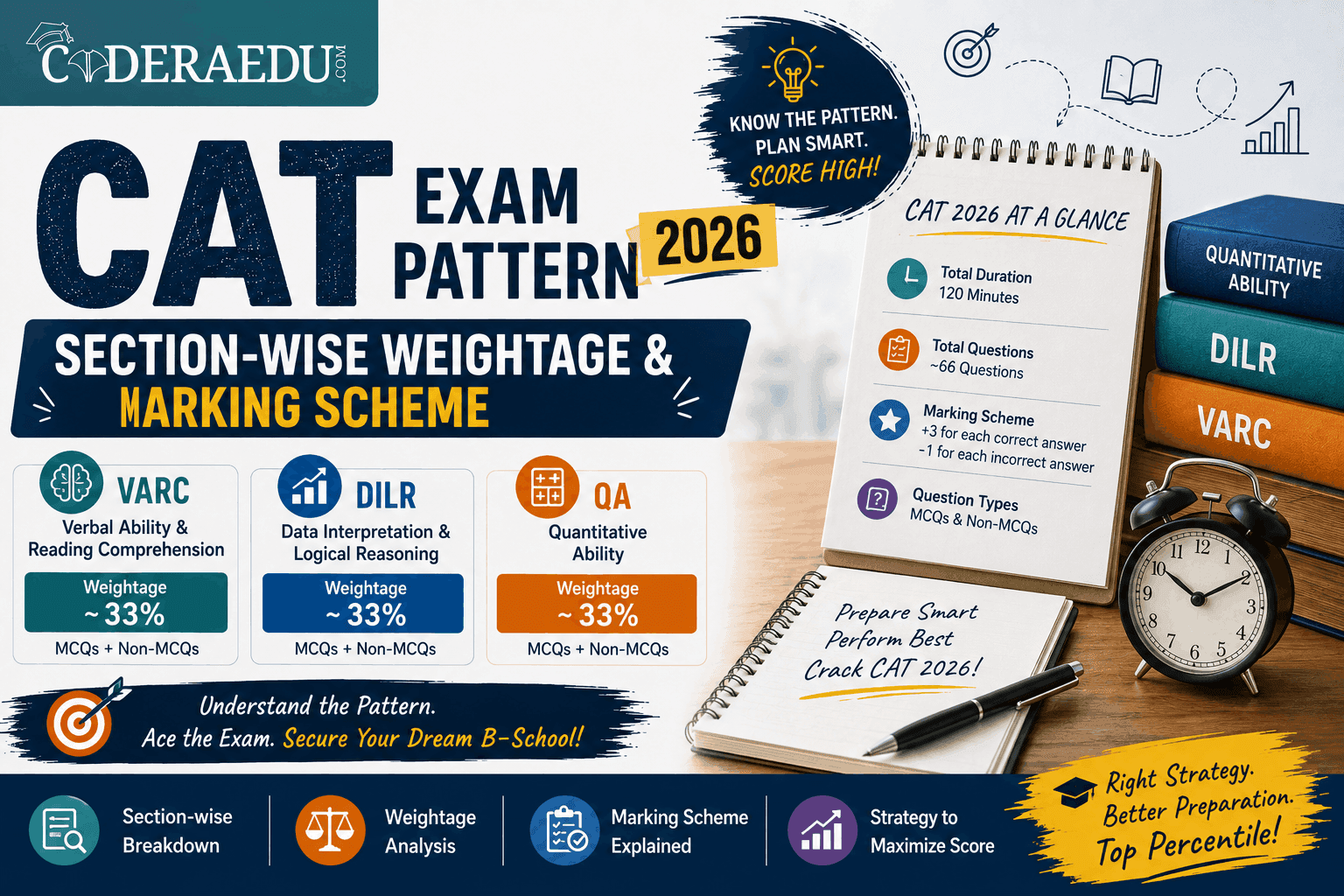
CAT 2026 has not had its exam pattern officially notified yet by IIM Indore, the conducting institute, but the structure has stayed remarkably stable for the last two cycles. Based on the CAT 2025 format, aspirants can expect 68 questions across three sections, VARC, DILR and QA, in a 120-minute computer-based test with a strict 40-minute sectional time limit. This article breaks down the expected section-wise question count, weightage and marking scheme in detail, so you can plan your preparation and time allocation with confidence. Treat every number here as the expected pattern until the official CAT 2026 notification confirms it.
CAT 2026 Exam Pattern: Quick Overview
Table
| Parameter | Expected Detail for CAT 2026 |
|---|---|
| Exam mode | Computer-based test (CBT) |
| Total duration | 120 minutes |
| Number of sections | 3 (VARC, DILR, QA) |
| Sectional time limit | 40 minutes per section, strictly enforced, no switching between sections |
| Total questions | 68 (expected, based on CAT 2025) |
| Total marks | 204 (expected, based on 68 questions at 3 marks each) |
| Question types | Multiple Choice Questions (MCQs) and Type In The Answer (TITA) questions |
| Marking scheme | +3 for every correct answer, -1 for every incorrect MCQ, 0 for unattempted questions and incorrect TITA answers |
2 columns · 9 rows
Section-wise Question Count and Weightage
Based on the CAT 2025 pattern, the 68 questions are expected to be split as 24 in VARC, 22 in DILR and 22 in QA. Since every correct answer is worth 3 marks, the section-wise weightage works out proportionally to the number of questions in each section.
Table
| Section | Expected Questions | Expected Max Marks | Sectional Time |
|---|---|---|---|
| Verbal Ability and Reading Comprehension (VARC) | 24 | 72 | 40 minutes |
| Data Interpretation and Logical Reasoning (DILR) | 22 | 66 | 40 minutes |
| Quantitative Ability (QA) | 22 | 66 | 40 minutes |
| Total | 68 | 204 | 120 minutes |
4 columns · 5 rows
Note that some previous cycles, including certain CAT years before 2024, used a slightly different split such as 24 VARC, 20 DILR and 22 QA, bringing the total to 66 questions and 198 marks. IIM Indore has not announced whether CAT 2026 will retain the 68-question format used in 2024 and 2025 or revert to an earlier structure, so always cross-check the exact figures once the official notification and mock test are released.
VARC: What to Expect
Verbal Ability and Reading Comprehension typically carries the highest weightage of the three sections. In recent years it has combined four to five reading comprehension passages with roughly 15 to 16 questions, alongside standalone verbal ability questions covering para-jumbles, paragraph summary, odd-sentence-out and sentence completion. Most VARC questions are TITA-based for the standalone verbal ability items, while the reading comprehension questions are usually MCQs, which is worth remembering since the two question types carry different negative-marking treatment.
DILR: What to Expect
Data Interpretation and Logical Reasoning is generally organised into four to five sets of four to six questions each, mixing data-heavy caselets, tables, graphs, and logical arrangement or puzzle-based reasoning problems. This section is often considered the most time-intensive because a wrong initial read of a set can cost you several questions at once, so picking the right sets to attempt within the 40-minute window matters as much as solving them correctly.
QA: What to Expect
Quantitative Ability draws from Arithmetic, Algebra, Geometry and Mensuration, Number Systems, and Modern Mathematics, with Arithmetic topics such as percentages, profit and loss, time-speed-distance, and ratios usually carrying the largest share of questions. QA typically has a higher proportion of MCQs compared to VARC, though a meaningful number of TITA questions also appear here, particularly in Algebra and Arithmetic.
CAT Marking Scheme Explained
- Correct answer: +3 marks, regardless of whether the question is an MCQ or a TITA question.
- Incorrect MCQ answer: -1 mark, since MCQs carry negative marking for wrong attempts.
- Incorrect TITA answer: 0 marks, since TITA questions do not carry any negative marking.
- Unattempted question: 0 marks, whether it is an MCQ or a TITA question.
- There is no partial credit for any question type, so every attempt is scored as fully correct, fully incorrect, or unattempted.
Since only MCQs carry negative marking, an educated guess on a TITA question you are unsure about costs you nothing, while guessing blindly on an MCQ can pull your score down.
Worked Example: How CAT Scoring Actually Works
Suppose a candidate attempts 50 questions in total, made up of 32 MCQs and 18 TITA questions. Out of the 32 MCQs, 24 are correct and 8 are incorrect. Out of the 18 TITA questions, 13 are correct and 5 are incorrect. The score would be calculated as follows: correct MCQs contribute 24 times 3, which is 72 marks. Incorrect MCQs deduct 8 times 1, which is minus 8 marks. Correct TITA questions contribute 13 times 3, which is 39 marks. Incorrect TITA questions contribute 0. Adding these up, 72 minus 8 plus 39 gives a raw score of 103 out of the expected total of 204.
How Sectional Time Limits Affect Strategy
Because CAT enforces a strict 40-minute limit per section with no ability to move between sections, your preparation strategy has to be built around three separate 40-minute sprints rather than one continuous 120-minute test. This means a strong QA candidate cannot borrow extra time from QA to compensate for a slower VARC attempt, and vice versa. Most successful candidates spend the first few minutes of each section quickly scanning all questions or sets to identify the easier, high-return ones before committing time to any single question.
How the CAT Pattern Has Evolved Over Recent Years
CAT's format is not frozen, and IIMs have made small adjustments every few years without warning well in advance. Looking at the recent history helps set realistic expectations rather than assuming this year's format is guaranteed to repeat.
Table
| CAT Year | Total Questions | Total Marks | Duration |
|---|---|---|---|
| CAT 2020 to CAT 2022 | 76 | 228 | 120 minutes |
| CAT 2023 | 66 | 198 | 120 minutes |
| CAT 2024 | 68 | 204 | 120 minutes |
| CAT 2025 | 68 | 204 | 120 minutes |
| CAT 2026 (expected) | 68 (unconfirmed) | 204 (unconfirmed) | 120 minutes |
4 columns · 6 rows
The clearest pattern here is that the 120-minute duration and 40-minute sectional split have held steady since 2020, while the exact question count has moved between 66 and 76 depending on the year. This is precisely why treating any single year's numbers as guaranteed for CAT 2026 is risky, and why checking the official notification close to the exam matters more than memorising last year's figures.
Preparation Tips Based on the Expected Pattern
- Practice full-length mocks under strict sectional timing rather than practising each section in isolation, since the inability to switch sections is what makes CAT feel different from most other competitive exams.
- In VARC, build reading speed on unfamiliar, dense passages rather than only practising with topics you already find interesting, since CAT's reading comprehension passages often cover abstract or technical subjects.
- In DILR, spend the first two to three minutes of the section quickly judging which sets look solvable within a reasonable time, and be willing to skip a set entirely if it looks unusually calculation-heavy.
- In QA, prioritise accuracy on Arithmetic and Algebra questions first, since these topics typically carry the largest share of questions and tend to be more time-efficient than Geometry or Modern Math for most candidates.
- Track your MCQ versus TITA accuracy separately in every mock, since a high TITA accuracy with weak MCQ accuracy suggests you may be guessing too aggressively on MCQs and losing marks to negative marking.
How CAT's Pattern Compares With Other MBA Entrance Exams
CAT's 120-minute, three-section format with strict sectional timing is stricter than most other MBA entrance exams. XAT runs for close to three hours and adds a Decision Making section that CAT does not test. SNAP is only 60 minutes long but offered across up to three attempts. NMAT is also 120 minutes but generally considered less difficult in terms of question complexity, though it too enforces sectional time limits. If you are preparing for more than one of these exams alongside CAT, keep in mind that the core Quant, Verbal and Reasoning skills overlap significantly, even though the exact question formats and time pressure differ.
What Should You Do Next
- Treat the 68-question, 204-marks structure described here as the expected pattern and confirm the final details once the official CAT 2026 notification and mock test are released by IIM Indore.
- Build your preparation timetable around three independent 40-minute sections rather than a single continuous block of time.
- Practice distinguishing MCQ and TITA questions quickly during mocks, since only MCQs carry negative marking and this should influence your guessing strategy.
- Once your CAT 2026 score and percentile are declared, use a CAT college predictor to get a realistic view of the IIMs and other B-schools within reach.
- If your percentile lands below the cutoff for your target IIMs, review other CAT-accepting colleges and alternate exams such as XAT, SNAP, NMAT and CMAT to keep your options open.
Useful CaderaEdu Tools and Pages
- CAT college predictor
- XAT college predictor
- SNAP college predictor
- NMAT college predictor
- CMAT college predictor
- MAT college predictor
- GMAT college predictor
- IIFT college predictor
- CAT exam details page
- XAT exam details page
- PGDM programme page
- List of top IIMs in India
- Top management colleges in India
- Top private MBA colleges in India
- CaderaEdu counselling support
Official Sources
Share this article
Copy
Frequently Asked Questions
Is the CAT 2026 exam pattern officially confirmed?
Not yet. As of this writing, IIM Indore, the conducting institute, has not released the official CAT 2026 notification. All section-wise question counts and marking details in this article are expected figures based on the CAT 2025 pattern.
How many questions does CAT 2026 expect to have?
Based on the CAT 2025 structure, CAT 2026 is expected to have 68 questions across VARC, DILR and QA. This should be confirmed once the official notification is released.
Does CAT have negative marking for every question?
No. Negative marking of -1 applies only to incorrect MCQ answers. TITA questions carry no negative marking, so an incorrect TITA answer simply scores zero, the same as leaving it unattempted.
Can I switch between VARC, DILR and QA during the exam?
No. CAT enforces a strict 40-minute sectional time limit, and candidates cannot move to another section until the current section's time is over or they choose to submit it early within their own section.
Which section carries the highest weightage in CAT?
Based on the expected 2026 pattern, VARC carries the highest weightage with 24 questions worth up to 72 marks, followed by DILR and QA, each expected to carry 22 questions worth up to 66 marks.
Is CAT's marking scheme the same for all three sections?
Yes. The same +3 for correct, -1 for incorrect MCQ, and 0 for incorrect TITA or unattempted rule applies uniformly across VARC, DILR and QA.