NEET Choice Filling Strategy 2026 – Expert Guide

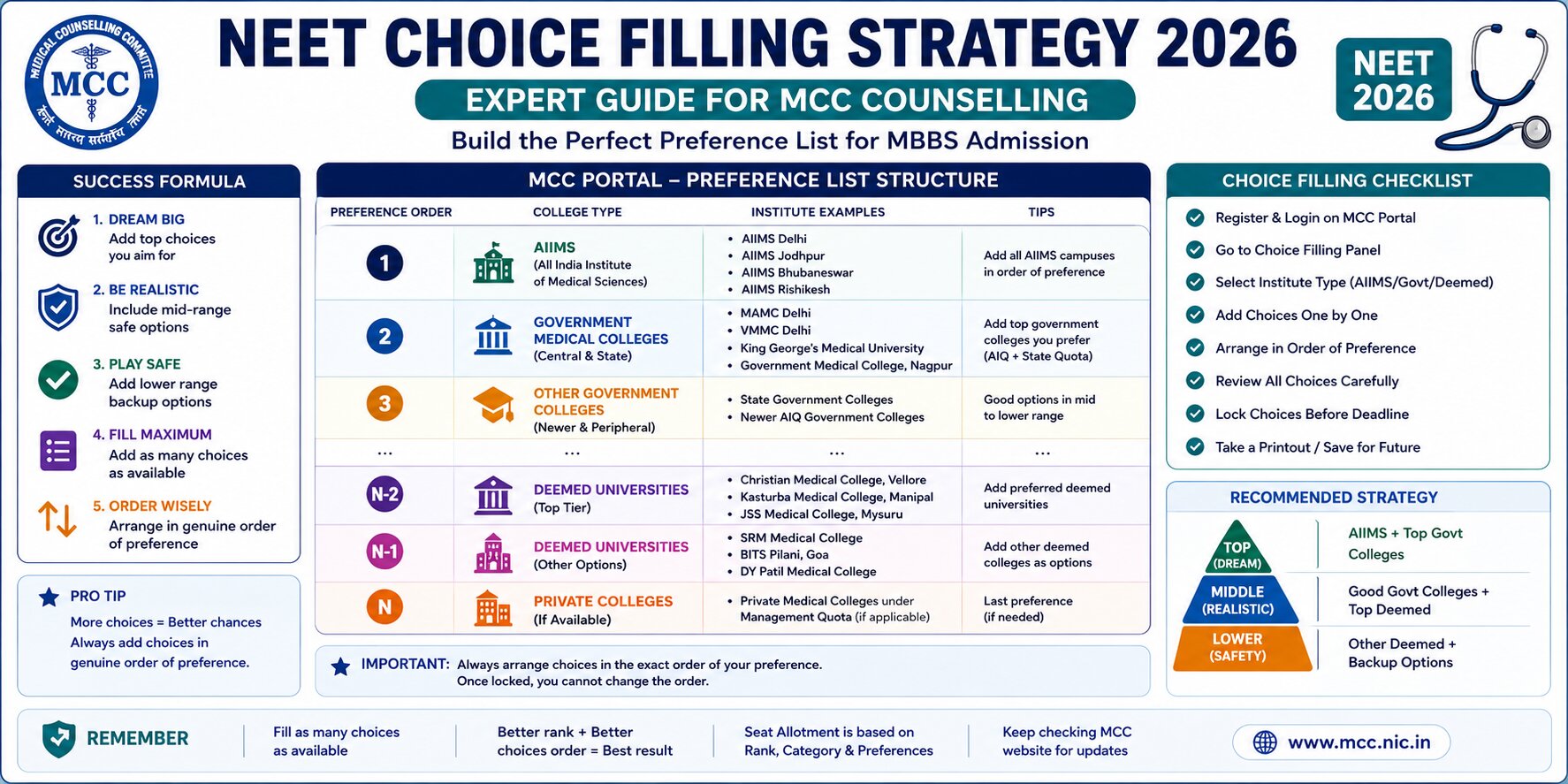
Click to enlarge
Most NEET 2026 students spend months preparing for the exam and about two hours on choice filling. That imbalance is where seats get lost. Your rank gets you to the table, but your choice list decides what you walk away with. Two students with the same AIR can end up in completely different colleges purely based on how they filled their preferences. This expert guide breaks down exactly how to approach your NEET choice filling strategy 2026 — how the algorithm works, how many choices to fill, how to order them correctly, and what mistakes to avoid. Use it before the MCC portal opens, not during.
How the MCC Choice Filling Algorithm Actually Works
Understanding the allotment algorithm is the foundation of any good choice filling strategy. The MCC system is straightforward: it goes through every candidate's list in rank order. For each candidate, it scans their preference list from top to bottom and assigns the first available college for which that candidate qualifies. That is it. No lottery, no randomness. The best available seat from your list based on your rank.
What this means in practice: if you put a college you genuinely want at position 15 because you thought you were being realistic, but a seat was available for your rank there, you will not get it. The algorithm already gave you something at position 3 before it reached position 15. This is why order matters as much as breadth. Put your actual first choice first, your second choice second, and so on — genuinely, not strategically second-guessing the system.
The system also does not penalise you for listing colleges where your rank falls short. If you add AIIMS New Delhi at position 1 and your rank is AIR 5,000, it simply skips AIIMS Delhi and moves to position 2. Nothing is lost by listing it. Use the All India NEET UG college predictor to identify which colleges on your list are realistic vs aspirational, then order accordingly. AIIMS New Delhi All India NEET UG college predictor
How Many Choices Should You Fill?
As many as you possibly can. The MCC portal has no upper limit on the number of choices you can add, and there is zero penalty for listing more. Students who add 40 to 50 colleges almost always get better allotments than those who add 10 to 15. The reason is simple: if your top 15 choices all close above your rank, you get nothing. If you had listed 45 colleges, the algorithm would have found you a seat at number 22 or 30.
The practical floor is around 30 colleges for most rank ranges. For students in the AIR 20,000 to 1,00,000 range where options are tighter, going up to 50 or 60 is worth the extra time it takes. Browse MBBS colleges in India and top government medical colleges in India on CaderaEdu to build a comprehensive longlist before you sit down to fill the portal. MBBS colleges in India top government medical colleges in India
How to Order Your Preferences Correctly
Start With Your Genuine First Choice, Not a Safe Bet
Put what you actually want most at the top. A lot of students psyche themselves out and put their "safe" college at position 1 because they are worried about getting nothing. That is the wrong call. The algorithm protects you — it skips colleges where your rank falls short and gives you the best available option from your list. If AIIMS Jodhpur is your dream and your rank is AIR 800, put it at position 1. Worst case: it closes at AIR 600 and the algorithm skips it and gives you whatever is next.
Government Colleges Before Deemed Universities
For most students, a government MBBS seat is significantly more valuable than a deemed university seat at the same or even slightly better institution — purely because of fees. Government MBBS costs Rs 10,000 to Rs 50,000 per year total. Deemed universities charge Rs 12 to Rs 25 lakh per year. That is a Rs 60 to Rs 130 lakh difference over 5.5 years. Unless a specific deemed university offers something a government college genuinely cannot, list all your government college preferences above deemed options. Use the college comparison tool to weigh specific institutions if you are unsure. college comparison tool
AIQ and State Quota Are Separate Lists — Treat Them That Way
MCC choice filling covers AIQ seats only — AIIMS, JIPMER, 15% government seats, and deemed universities. State quota is a completely separate registration on your state authority's portal. Do not confuse the two or assume one list covers both. Register for state counselling simultaneously — do not wait for MCC results. For state-specific choice filling support, the state-wise college predictor covers all major states. If you are in Delhi, check the Delhi NEET college predictor; in Maharashtra, the Maharashtra NEET college predictor shows you what is realistic at your rank through state quota. state-wise college predictor Delhi NEET college predictor Maharashtra NEET college predictor
Common Choice Filling Mistakes That Cost Seats
- Filling only 10 to 15 colleges. If all of them close above your rank, you get no allotment. There is no fallback. This is the single most common reason students with competitive ranks end up with nothing in Round 1.
- Putting safe choices first out of anxiety. The algorithm does not reward caution. It gives you the highest preference for which your rank qualifies — so your best chance at a top college is to list it at the top.
- Not locking the list. An unlocked choice list is treated as empty by the MCC system. You can spend 3 hours building the perfect list and get zero allotment because you forgot to hit lock. More on this below.
- Skipping deemed universities entirely over fee concerns without checking actual numbers. Some deemed universities offer fee concessions or scholarships. And for certain specialisations or locations, the infrastructure genuinely differs. At least research them before deciding.
- Filling choices the night before the deadline. The MCC portal gets extremely slow in the final 12 hours as lakh of students try to submit simultaneously. Start building your list on day 1 of the window.
- Assuming Round 2 uses the same list as Round 1. It does not. Every round requires fresh registration and fresh choice filling. This surprises students every single year.
Category-wise Choice Filling Strategy
Reserved category candidates often undersell themselves because they benchmark against General cutoffs. That is a mistake. The rank gaps between General and reserved category cutoffs are significant enough to completely change your college landscape.
Table
| Category | Rough Rank Advantage Over General (AIQ) | Key Strategy Note |
|---|---|---|
| OBC-NCL | 8,000 to 20,000 ranks easier | Ensure your certificate is in central government format, not state format — MCC rejects state-format OBC certificates |
| EWS | 5,000 to 12,000 ranks easier | EWS certificate must be from current financial year — an expired certificate means competing as General |
| SC | 40,000 to 70,000 ranks easier | Significantly wider college options; include colleges that seem out of reach at General cutoffs |
| ST | 60,000 to 1,00,000 ranks easier | Broadest advantage; even lower-ranked students can target strong government colleges |
| PwD | Separate horizontal reservation; varies by college | PwD quota is horizontal — it cuts across all categories; list all colleges regardless of rank |
3 columns · 6 rows
OBC-NCL candidates: one critical point. MCC requires your OBC certificate in central government format confirming you belong to the central OBC list. A state revenue department certificate in the state format is rejected at the AIQ level. Get this sorted before registration opens — it takes 2 to 3 weeks in most states. All document requirements are covered in the documents required for NEET counselling 2026 checklist. documents required for NEET counselling 2026
Choice Filling Strategy by Rank Range
AIR 1 to 1,000
At this rank, your primary focus through AIQ is AIIMS campuses and JIPMER. AIIMS New Delhi at position 1, followed by AIIMS Jodhpur, Bhopal, Rishikesh, then AIIMS Patna, AIIMS Guwahati, and the newer campuses. JIPMER Puducherry typically closes between AIR 50 and 200 for General — slot it in accordingly. After AIIMS and JIPMER, add Maulana Azad Medical College Delhi, University College of Medical Sciences Delhi, Grant Medical College Mumbai, and other top government colleges. You have very strong options — do not leave the list short. AIIMS New Delhi AIIMS Patna AIIMS Guwahati Maulana Azad Medical College Delhi University College of Medical Sciences Delhi
AIR 1,000 to 10,000
Newer AIIMS campuses, JIPMER Karaikal, and top government colleges across states are all in play here. Start with any AIIMS campus where your rank is competitive, then work through the top government colleges state by state. Armed Forces Medical College Pune is worth adding if you meet the additional eligibility criteria. Top deemed universities like Kasturba Medical College Manipal and Sri Ramachandra Institute Chennai should appear lower on your list, after all realistic government options. The medical college predictor will help you map out which government colleges fall within your rank range across AIQ and state quota. Armed Forces Medical College Pune Kasturba Medical College Manipal Sri Ramachandra Institute Chennai medical college predictor
AIR 10,000 to 50,000
This is where state quota becomes as important as AIQ in your overall strategy — but for AIQ choice filling specifically, focus on mid-tier government colleges and deemed universities in your fee range. Government AIQ seats at this rank require some luck in the Mop-Up Round, but they do open up. List every government college where closing ranks from previous years came near your AIR, even if they closed slightly above. For UP domicile holders, the UP NEET college predictor will show you what is available through state quota simultaneously. Browse top medical colleges in India filtered by cutoff range to find options you might have missed. UP NEET college predictor top medical colleges in India
Above AIR 50,000
AIQ government MBBS seats are largely out of reach at this rank for General category — though SC and ST candidates have a very different picture here. For General and OBC candidates, AIQ choice filling at this range should include all deemed universities within your financial comfort zone and AYUSH colleges through AACCC. State quota is where a government MBBS seat becomes realistic, so your state counselling choice list is more critical than your MCC list at this rank. Explore top private medical colleges in India for a fee-wise comparison if private MBBS is on the table. top private medical colleges in India
When and How to Lock Your Choices
Locking is the step that makes your list count. Until you lock, your list does not exist in the system. This is non-negotiable.
Build your list over the first 2 days of the window. Review it on day 3. Lock on day 3, at least 12 hours before the deadline. Do not wait for the final evening. The MCC portal routinely slows to a crawl or crashes in the last 4 to 6 hours before closing as thousands of students try to submit simultaneously. A crash with an unlocked list means no allotment. That is a seat lost to a technical issue that was entirely avoidable.
After locking, take a screenshot of your locked list as confirmation. Check that the portal shows your list status as locked before closing the browser. You can edit and re-lock before the deadline if you change your mind — but once the window closes, no changes are possible.
Build early, review carefully, lock early. The choice filling window is not the time to start researching colleges.
Stay updated on any schedule changes given the Re-NEET 2026 situation — check the ReNEET 2026 answer key page and the NEET UG re-exam fee refund notice for any process updates that might affect the counselling timeline. ReNEET 2026 answer key NEET UG re-exam fee refund
Conclusion
Choice filling is not a formality at the end of counselling. It is the decision that determines your college. Spend as much time on it as you would on a mock test. Research your colleges now using the All India NEET UG college predictor and the state-wise college predictor on CaderaEdu so your list is ready before the portal opens. Fill broadly, order honestly, and lock early. That combination consistently produces better outcomes than any other approach. All India NEET UG college predictor state-wise college predictor
Share this article
Copy
Frequently Asked Questions
How many choices should I fill in NEET 2026 MCC counselling?
There is no upper limit on choices and no penalty for listing more, so fill as many as you can — ideally 40 to 50 colleges. Students who fill only 10 to 15 choices risk getting no allotment if all of them close above their rank. A broader list means the algorithm has more options to match you with, which consistently produces better outcomes. Include all realistic government colleges first, followed by deemed universities within your fee range.
Should I put my dream college first even if my rank might not be enough?
Yes. The MCC algorithm skips colleges where your rank falls short and moves to your next preference. There is no downside to listing an aspirational college at position 1. If AIIMS Jodhpur or JIPMER Puducherry is what you genuinely want, put it first. The system will simply skip it if it closes above your rank and give you the next available option on your list. Putting a safe college first out of anxiety can actually backfire — you might end up with a lower preference than you needed to.
What happens if I forget to lock my choice list in MCC counselling?
An unlocked list is treated as completely empty by the MCC system. You will receive no allotment regardless of how good your list is or how strong your rank is. There is no appeal or workaround for this. Always lock your list at least 12 hours before the deadline to avoid portal crashes in the final hours. After locking, take a screenshot of the confirmation so you have proof the list was submitted.
Can OBC and SC candidates fill the same choices as General candidates?
Yes, reserved category candidates can list any college available on the MCC portal. The difference is that the algorithm will match them to reserved category seats at those colleges, which have significantly lower closing ranks than General seats at the same institution. OBC-NCL candidates typically have an advantage of 8,000 to 20,000 ranks over General cutoffs for the same college in AIQ. SC candidates see gaps of 40,000 to 70,000 ranks. This means reserved category students should list colleges that appear out of reach at General cutoffs — they are often very much within reach under their category quota.
Does my Round 1 choice list automatically apply in Round 2 of MCC counselling?
No. Your choice list from Round 1 does not carry forward to Round 2, the Mop-Up Round, or any subsequent round. Fresh registration and completely new choice filling is required for every round you want to participate in. Use the gap between rounds productively — check which colleges had remaining seats after the previous allotment and update your list accordingly before Round 2 opens. Many students who participated in every round with updated lists ended up in significantly better colleges by Mop-Up.
Confused About College Admissions?
Get expert advice on college selection, admission chances, and career path in a personalized counselling session.
Book a Counselling Slot
Select Date
Pick a Slot