MBA in Business Analytics vs Finance vs Marketing: Salary, Skills & Career Scope

DeekshaUpdated on 13 Oct 2026, 07:00 PM IST
11 minutes read
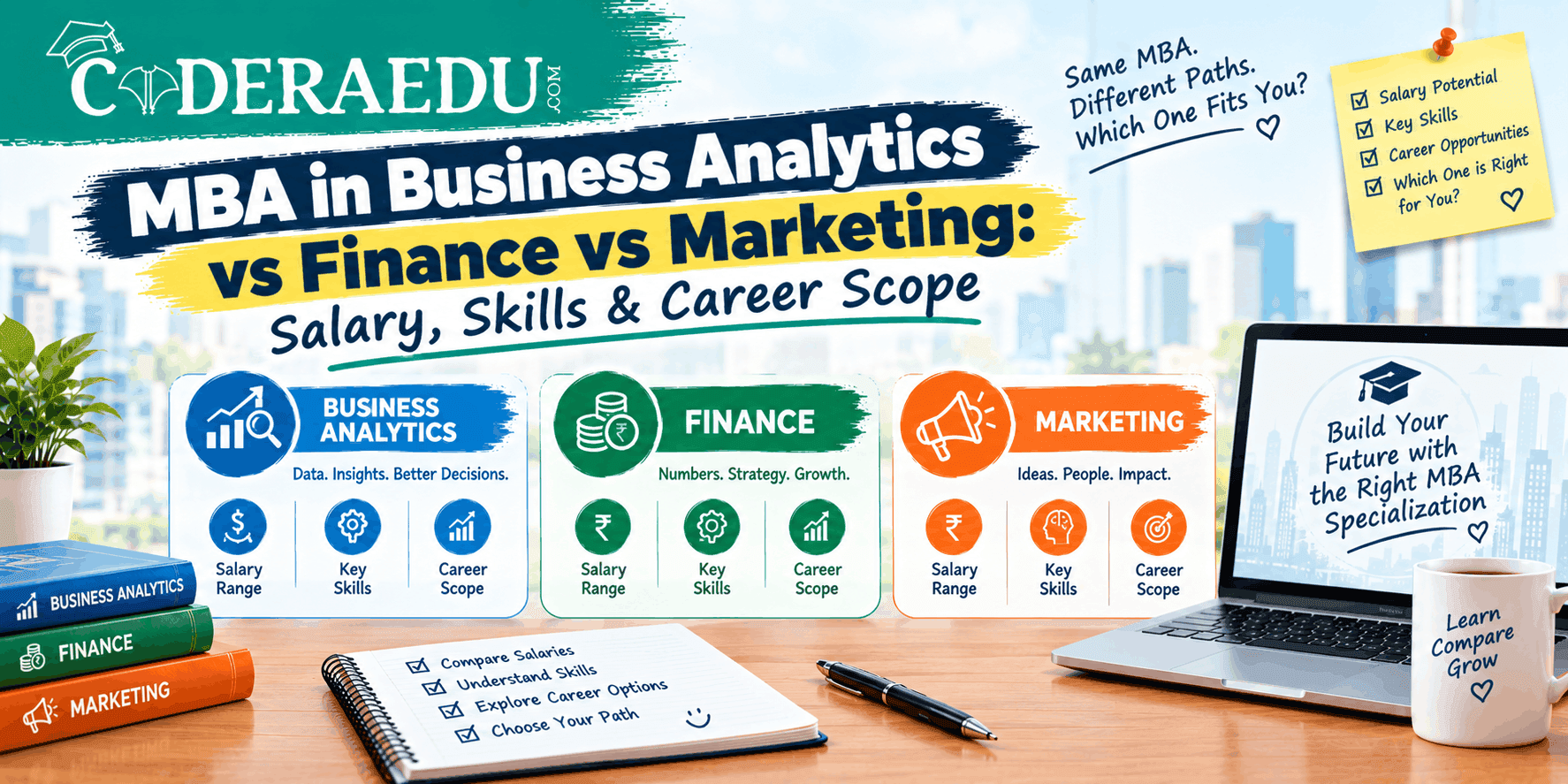
Click to enlarge
If you want the short answer on MBA in Business Analytics vs Finance vs Marketing, it is this. Business Analytics and Finance usually start higher on paper, Marketing gives the widest range of roles, and the college you join often changes your salary more than the specialisation does. The right pick depends on your strengths, your background and the kind of daily work you can enjoy for the next ten years.
This guide compares the three on salary, skills and career scope. It uses official placement figures where institutes publish them and clearly marks other numbers as indicative, because salary data online varies a lot from one source to another.
MBA in Business Analytics vs Finance vs Marketing: quick comparison
Table
| Factor | Business Analytics | Finance | Marketing |
|---|---|---|---|
| Typical roles | Business analyst, analytics consultant, product analyst, data-driven strategy roles | Financial analyst, corporate finance, banking, equity research, risk | Brand manager, product marketing, digital marketing, sales and category roles |
| Indicative fresher pay at mid-tier colleges | Roughly ₹8 to 18 LPA across sources | Roughly ₹8 to 15 LPA across sources | Roughly ₹6 to 12 LPA across sources |
| Core skills | Statistics, SQL, Excel, Python or R, dashboards, business storytelling | Valuation, accounting, financial modelling, markets, risk | Consumer insight, branding, digital channels, pricing, communication |
| Best suited to | Comfortable with numbers and tools, curious about data | Strong with numbers, patient with detail and rules | Creative, people-oriented, good at persuasion |
| Main risk | Needs real technical depth, not just the label | Competitive and cyclical, certain roles favour top colleges | Pay can start lower and depends heavily on brand and sector |
4 columns · 6 rows
Read the pay row carefully. These ranges come from several education portals and are not a promise for any college. Some sources show a much narrower band and others show a wider one. Use them to compare the three fields with each other, and then check the placement report of the exact college you are considering.
How much do these specialisations really pay?
Most portals place Business Analytics and Finance a little ahead of Marketing for fresh MBA graduates. The gap is real in many surveys, but it is usually smaller than people expect and it shrinks or reverses with experience. A strong marketer in a good consumer company can out-earn an average analyst within a few years.
Official placement pages tell a more useful story. The IMI Delhi admission page lists an average CTC of ₹18.08 LPA for its recent batch, and its curriculum is built around six career tracks, including Finance and Capital Markets, Market Expansion and Growth, and Analytics. Goa Institute of Management lists average CTCs of roughly ₹15 to 16 LPA across its four PGDM programmes for the 2024-26 batch, including its Big Data Analytics and Banking, Insurance and Financial Services tracks.
Salary also depends on the city, the sector and the role. Investment banking and consulting roles sit at the top of the range. Sales-heavy marketing roles and support analytics roles sit lower. Always compare median pay with the total fee, because the highest package is earned by a very small group.
MBA in Business Analytics: skills, roles and scope
An MBA in Business Analytics trains you to turn raw data into decisions. You study statistics, data management, forecasting, machine learning basics and visualisation, and you also learn how to present findings to managers who are not technical.
Skills you build
- Data handling with SQL and Excel, which almost every analytics job asks for.
- Programming in Python or R for analysis, automation and simple models.
- Dashboards and reporting using tools such as Power BI or Tableau.
- Statistics and experimentation, including testing whether a change really worked.
- Business storytelling, which means explaining results in plain language to decision makers.
Typical roles and growth
Common first jobs include business analyst, analytics consultant, product analyst, pricing analyst and business intelligence roles. In consulting and technology companies, these roles can grow into product management, data strategy and leadership of analytics teams. Banks, retail, e-commerce, healthcare and manufacturing all hire analytics managers now, so the scope is wide.
Who should choose it, and what to watch
Choose it if you like solving puzzles with data and are ready to learn technical tools. Be careful with programmes that carry the analytics label but teach only basic Excel. Ask what tools are taught, who teaches them and which companies hire from the track. If you come from engineering, statistics or commerce with a quantitative bent, this specialisation often feels natural.
MBA in Finance: skills, roles and scope
Finance remains the classic high-paying MBA track. It covers corporate finance, valuation, financial statements, markets, risk management and investment analysis. Employers include banks, investment firms, consulting firms, fintech companies and finance teams inside large corporates.
Skills you build
- Financial modelling and valuation, usually done in Excel.
- Reading and analysing balance sheets, cash flows and ratios.
- Understanding of capital markets, derivatives and portfolio basics.
- Risk assessment and regulation awareness, especially for banking roles.
- Attention to detail, ethics and the ability to defend your numbers.
Typical roles and growth
Roles include financial analyst, corporate finance executive, investment banking analyst, equity research analyst, credit analyst, risk manager and treasury roles. Some of the best-paid positions, such as investment banking and private equity, recruit mostly from the top colleges. At other institutes, banking, financial services and corporate finance roles are the common route.
Who should choose it, and what to watch
Choose it if you enjoy accounting logic, markets and structured thinking. Finance can be cyclical, which means hiring slows when markets are weak. Professional credentials such as CFA, FRM or CA can strengthen your profile, and several institutes treat them as a plus during admission. You should also be ready for long working hours in some roles.
MBA in Marketing: skills, roles and scope
Marketing is about understanding customers and building products and brands people want to buy. The specialisation covers consumer behaviour, branding, market research, pricing, digital marketing, sales strategy and channel management.
Skills you build
- Consumer insight and market research, including simple survey and data analysis.
- Brand building, positioning and campaign planning.
- Digital channels such as search, social media, performance marketing and marketing automation.
- Pricing, product marketing and go-to-market planning.
- Communication, negotiation and stakeholder management.
Typical roles and growth
Common roles are brand manager, assistant product manager, product marketing manager, digital marketing manager, category manager and sales or business development manager. Consumer goods, e-commerce, telecom, media and technology firms hire heavily. With experience, many marketers move into general management, because they understand customers, revenue and strategy together.
Who should choose it, and what to watch
Choose it if you like people, creativity and commercial thinking. The pay band is wider, and starting salaries can be lower at average colleges, especially in field sales roles. Modern marketing is also very data driven, so a marketer who can read analytics has a clear advantage over one who cannot.
Which skills overlap, and which do not?
The three fields are closer than they look. Marketing now relies on data, analytics relies on business context, and finance depends on both. A good MBA student builds a main skill and a second one.
Table
| Skill | Business Analytics | Finance | Marketing |
|---|---|---|---|
| Excel and data handling | Essential | Essential | Useful |
| Programming (Python, SQL) | Essential | Helpful for fintech and quant roles | Helpful for growth and performance roles |
| Financial modelling | Helpful | Essential | Helpful for pricing and budgeting |
| Consumer and brand understanding | Helpful | Low | Essential |
| Presentation and storytelling | Essential | Important | Essential |
4 columns · 6 rows
A practical combination is Marketing with analytics, Finance with data skills, or Analytics with a domain such as banking or retail. Recruiters value this blend because it shows you can apply tools to a real business problem.
How to choose based on your background
- Engineers and science graduates often find Business Analytics the smoothest fit, since they already know quantitative methods and some coding.
- Commerce and economics graduates often do well in Finance, because the accounting and economics base is already there.
- Arts, media and humanities graduates often thrive in Marketing, where communication and creativity count.
- Candidates with work experience should look at their own domain first. A banker moving into Finance or an IT professional moving into Analytics has an easier story to tell in interviews.
- If you are undecided, choose a college that lets you pick the specialisation later, after you see the courses and speak to seniors.
Do not choose only because a specialisation looks highest in a salary chart. A person who dislikes modelling will struggle in Finance however strong the pay looks. Think about what you want your Monday morning work to be.
Why the college matters more than the specialisation
Placement outcomes depend on recruiters, the batch quality and alumni networks. A finance specialisation from a top-ranked college will usually beat the same specialisation from an average college, and an analytics track at a good institute can beat a finance track at a weaker one.
You can check rankings on the NIRF website, but also read the placement report directly. Look at the number of students placed, the median salary, the sector split and how many offers came from companies that hire for your chosen domain. Some institutes also admit students into focused programmes at the application stage. Goa Institute of Management, for example, runs separate Big Data Analytics and Banking, Insurance and Financial Services programmes, while IMI Delhi offers PGDM in Banking and Financial Services along with its core PGDM and HRM options.
Also note that most of these institutes award a PGDM and not an MBA degree. A PGDM is a diploma from an autonomous institute. It is widely accepted by recruiters, so judge the programme on quality and outcomes, not just on the name.
What score and process do you need?
Most good MBA and PGDM programmes use CAT, XAT, GMAT or similar tests, followed by interviews. CAT 2026 is scheduled for 29 November 2026 and is conducted by IIM Indore. Many institutes also look at your graduation marks and work experience, and several have already opened applications for 2027 batches.
Your percentile decides which colleges you can reach, and your college decides how strong your placement outcomes are. That is why predictors help. Enter your expected percentile, compare the colleges that match, and then pick the specialisation track that suits your goals inside those colleges.
Career growth after five years
Starting pay is only the first chapter. After four to six years, most graduates move into manager roles, and the specialisation matters less than performance, the quality of your employer and the scale of your responsibility.
Analytics professionals often grow into analytics manager, product manager or data strategy lead roles. Finance professionals move toward senior analyst, portfolio, deal or finance business partner roles, and some reach CFO tracks later. Marketers rise to brand head, growth head or business unit roles, and many of them become general managers because they handle customers and revenue together. In all three paths, switching to a better company at the right time usually adds more to your salary than staying loyal to one label.
Common mistakes to avoid
- Choosing a specialisation only because of one salary chart on a website.
- Ignoring the college's actual placement report and relying on the highest package.
- Thinking Analytics needs no coding or Finance needs no math.
- Assuming Marketing is only advertising and sales, when brand, product and data roles are also part of it.
- Skipping internships. A strong summer internship can matter more than the specialisation label.
- Not building a second skill alongside your main one.
Final decision checklist
- List your strengths in numbers, language, tools and people skills.
- Shortlist three to five colleges using your expected percentile and budget.
- Read each college's placement report for median pay, recruiters and role types in your chosen domain.
- Speak to students or alumni from each track about the real workload and the roles they got.
- Pick the specialisation where you can see yourself learning for years, then add one complementary skill.
- Confirm dates, fees and eligibility on the official website of every institute before applying.
The pages listed below can help you move from this comparison to an actual shortlist. They include predictors, college hubs and official sources, so you can check numbers before you decide.
Explore predictors and college pages
- CAT College Predictor to see colleges that match your CAT percentile.
- XAT College Predictor for XAT-accepting institutes.
- SNAP College Predictor for Symbiosis-linked options.
- CMAT College Predictor for CMAT-based admissions.
- NMAT College Predictor for NMIMS and other NMAT-accepting schools.
- Top management colleges in India for a broad list of options.
- Top private management colleges in India to compare private B-schools.
- Top IIMs in India if your percentile and profile are strong.
- MBA courses to understand the degree route.
- PGDM courses to understand the diploma route.
Official sources
- Official CAT website for exam updates and notices.
- IMI Delhi admissions for programme tracks, fees, placement statistics and deadlines.
- Goa Institute of Management admissions for PGDM, Big Data Analytics and Banking, Insurance and Financial Services programmes.
- IMT Ghaziabad PGDM admissions for programmes, eligibility and scholarships.
- NIRF 2025 rankings to check official institute rankings.
Topics:
Share this article
Copy
Frequently Asked Questions
Which is better, MBA in Business Analytics, Finance or Marketing?
None is better in every case. Business Analytics and Finance often start slightly higher, while Marketing offers varied roles and strong long-term growth into general management. Pick the one that matches your strengths and is backed by good placements at your college.
Which MBA specialisation has the highest salary in India?
Finance and Business Analytics are usually reported as the highest-paying, and top-end roles such as investment banking and consulting pay the most. The exact figure depends on your college, city and role, so check the placement report of the institute.
Is an MBA in Business Analytics worth it?
It can be, if the programme teaches real tools such as SQL, Python and dashboards, and if recruiters hire from it. Check the curriculum, faculty and past placements before joining.
Is MBA Finance only for commerce students?
No. Students from engineering, economics and other streams enter finance, but a basic comfort with accounting and numbers helps. Many colleges run bridge courses for non-commerce students.
Does MBA Marketing pay less than Finance and Analytics?
Many surveys show a slightly lower starting band for Marketing, but the gap depends on the sector and company. Marketing roles in consumer, technology and e-commerce companies can pay very well over time.
When do I choose my MBA specialisation?
It varies by institute. Some let you choose after the first term or first year, while some offer separate programmes at the admission stage, such as Goa Institute of Management's analytics and banking-focused programmes. Check the specialisation rules of each college.
Can I switch careers later if I choose the wrong specialisation?
Yes, switching is possible, especially in the first few years. A second skill, a good internship and a clear story in interviews make it easier to move between marketing, finance and analytics roles.
What exam do I need for these MBA specialisations?
Most use CAT, XAT, GMAT or similar tests, followed by interviews. CAT 2026 is on 29 November 2026, and many institutes accept XAT 2027 and GMAT scores too.