NEET 2026 Rank vs College – Expected MBBS Colleges by AIR

Ishika Updated on 02 Oct 2026, 07:15 PM IST
14 minutes read
Click to enlarge
The NEET result drops and within minutes, the first question every student types is some version of: what college can I get? That anxiety is completely normal. Over 24 lakh students appeared for NEET 2026, competing for roughly 1,09,000 MBBS seats. The math alone tells you the pressure is real. But your rank is not the whole story — which quota you apply through, which state you belong to, and which category you fall under all shift the picture significantly. This article breaks it down rank band by rank band, so you know exactly where you stand before counselling even begins. Use the medical college predictor on CaderaEdu to get a personalised list based on your actual rank and category. medical college predictor
How Your NEET Rank Determines Which College You Get
Your All India Rank (AIR) is the starting point, but two parallel systems use it differently. The All India Quota (AIQ), managed by MCC, fills 15% of government college seats plus 100% of AIIMS, JIPMER, and deemed university seats through national competition. State quota fills the remaining 85% of government seats and is restricted to domicile candidates of that state. The practical impact: state quota cutoffs for the same college are typically 30,000 to 80,000 ranks lower than AIQ. A student with AIR 40,000 who cannot touch a government MBBS seat through AIQ might walk into one in their home state through state quota without much trouble.
Category matters just as much. OBC-NCL candidates in the General category competing zone often find cutoffs 8,000 to 15,000 ranks easier in AIQ. SC candidates see that gap widen to 40,000 to 60,000 ranks for the same college. These are not small differences — they change the entire college landscape at your rank. Keep that in mind as you read through the tables below. For a state-specific view, the state-wise college predictor on CaderaEdu does this calculation for you. state-wise college predictor
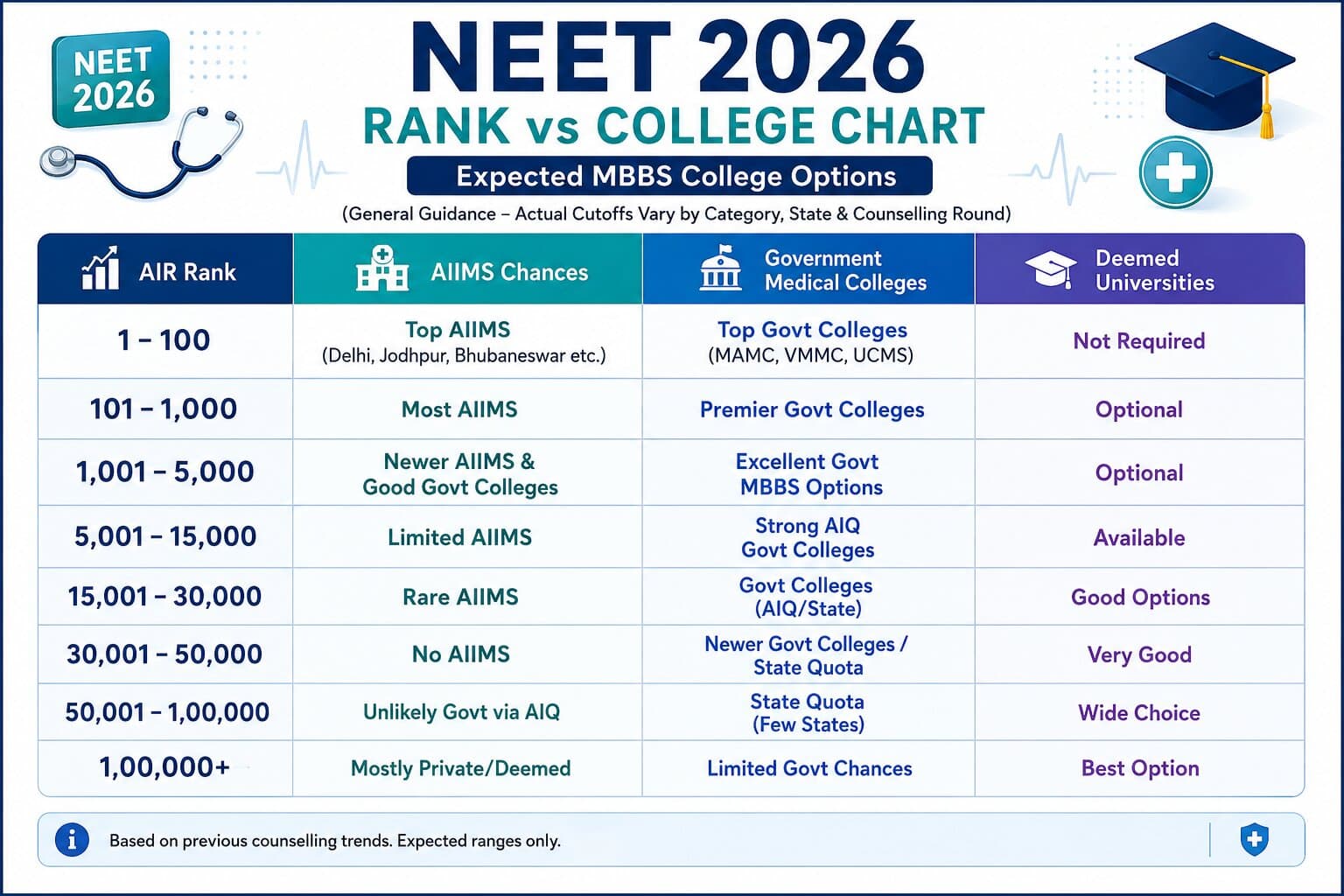
NEET 2026 Rank vs College — Expected MBBS Colleges by AIR
The college ranges below are based on historical AIQ closing ranks from MCC counselling 2023 and 2024, adjusted for the 2026 seat matrix. Treat these as estimates — actual cutoffs shift slightly every year based on total qualifiers and seat availability. That said, the patterns are consistent enough to plan your choice list around.
AIR 1 to 50
Table
| College | Type | Location | Quota |
|---|---|---|---|
| AIIMS New Delhi | Government Autonomous | New Delhi | AIQ (100%) |
| JIPMER Puducherry | Government Autonomous | Puducherry | AIQ (100%) |
| AIIMS Jodhpur | Government Autonomous | Rajasthan | AIQ (100%) |
| AIIMS Bhopal | Government Autonomous | Madhya Pradesh | AIQ (100%) |
| AIIMS Rishikesh | Government Autonomous | Uttarakhand | AIQ (100%) |
4 columns · 6 rows
A top-50 AIR essentially means AIIMS New Delhi is on the table. The General category closing rank for AIIMS Delhi has historically hovered between AIR 40 and 60. If your rank is in this range, you are in rarified territory — congratulations are genuinely in order. AIIMS New Delhi
AIR 51 to 500
Table
| College | Type | Location | Quota |
|---|---|---|---|
| AIIMS Jodhpur, Bhopal, Rishikesh, Patna | Government Autonomous | Multiple states | AIQ (100%) |
| AIIMS Patna | Government Autonomous | Bihar | AIQ (100%) |
| AIIMS Guwahati | Government Autonomous | Assam | AIQ (100%) |
| JIPMER Karaikal | Government Autonomous | Puducherry | AIQ (100%) |
| AIIMS Nagpur, Gorakhpur, Bilaspur (newer campuses) | Government Autonomous | Multiple states | AIQ (100%) |
| Maulana Azad Medical College Delhi (AIQ seats) | Government | New Delhi | AIQ (15%) |
4 columns · 7 rows
This is the band where most AIIMS campuses become realistic. The newer AIIMS campuses (Nagpur, Gorakhpur, Bibinagar, Bilaspur) close somewhere between AIR 200 and 500 for General category in AIQ. Maulana Azad Medical College Delhi and UCMS Delhi start appearing at the tail end of this range in AIQ. If you are in this bracket, your options are genuinely strong. Maulana Azad Medical College Delhi
AIR 501 to 2,000
Table
| College | Type | Location | Quota |
|---|---|---|---|
| Maulana Azad Medical College Delhi | Government | New Delhi | AIQ (15%) |
| University College of Medical Sciences Delhi | Government | New Delhi | AIQ (15%) |
| Grant Medical College Mumbai | Government | Maharashtra | AIQ (15%) |
| Madras Medical College Chennai | Government | Tamil Nadu | AIQ (15%) |
| AFMC Pune (merit + interview) | Government | Maharashtra | AIQ |
| King George's Medical University Lucknow (AIQ) | Government | Uttar Pradesh | AIQ (15%) |
| BJ Medical College Pune | Government | Maharashtra | AIQ (15%) |
| Seth GS Medical College Mumbai | Government | Maharashtra | AIQ (15%) |
4 columns · 9 rows
AIR 501 to 2,000 is where the top government colleges outside Delhi start opening up in AIQ. MAMC and UCMS typically close between AIR 600 and 900 for General in AIQ. Armed Forces Medical College Pune follows a slightly different process — NEET rank plus an interview — so prepare for that if it is on your list. For students in Maharashtra with domicile, the Maharashtra NEET college predictor will show you far better options at this rank through state quota. Armed Forces Medical College Pune Maharashtra NEET college predictor
AIR 2,001 to 10,000
Table
| College | Type | Location | Quota |
|---|---|---|---|
| Stanley Medical College Chennai | Government | Tamil Nadu | AIQ (15%) |
| Lady Hardinge Medical College Delhi | Government (Women) | New Delhi | AIQ (15%) |
| Osmania Medical College Hyderabad | Government | Telangana | State quota only |
| Kasturba Medical College Manipal | Deemed | Karnataka | AIQ |
| Sri Ramachandra Institute Chennai | Deemed | Tamil Nadu | AIQ |
| Vardhman Mahavir Medical College Delhi | Government | New Delhi | AIQ (15%) |
| JNMC Aligarh (AMU) | Central University | Uttar Pradesh | AIQ |
| GMC Thiruvananthapuram | Government | Kerala | AIQ (15%) |
4 columns · 9 rows
This is a wide rank band and the options are genuinely diverse. Top deemed universities like Kasturba Medical College Manipal and Sri Ramachandra Institute Chennai come into play here, though their fees (typically Rs 12 to 20 lakh per year) are a significant consideration. For government seats in this range through AIQ, competition is stiff — but state quota opens up a lot more. Students in Delhi should check the Delhi NEET college predictor since Delhi state quota cutoffs for MAMC and UCMS are considerably lower than AIQ. Kasturba Medical College Manipal Sri Ramachandra Institute Chennai Delhi NEET college predictor
AIR 10,001 to 50,000
Table
| College | Type | Location | Quota |
|---|---|---|---|
| Government Medical College Nagpur | Government | Maharashtra | AIQ (15%) |
| MLN Medical College Prayagraj | Government | Uttar Pradesh | AIQ (15%) |
| Government Medical College Amritsar | Government | Punjab | AIQ (15%) |
| Various NMC-approved Deemed Universities | Deemed | Pan India | AIQ (100%) |
| ESIC Medical Colleges | Government (ESIC) | Multiple states | AIQ (100%) |
| Government Medical College Kota | Government | Rajasthan | AIQ (15%) |
| Pt BD Sharma PGIMS Rohtak | Government | Haryana | AIQ (15%) |
4 columns · 8 rows
A rank between 10,000 and 50,000 does not mean a government MBBS seat is out of reach — it means you need state quota to make it happen. Through AIQ alone, this range is largely deemed university territory. But students with UP domicile, for example, can target KGMU Lucknow and other strong government colleges through state quota at this rank. Check the UP NEET college predictor if that applies to you. The difference is often significant enough to change your entire admission outcome. UP NEET college predictor
AIR 50,001 to 1,00,000
Table
| College | Type | Location | Quota |
|---|---|---|---|
| Government Medical Colleges (state quota, smaller states) | Government | Various | State quota |
| Private Medical Colleges (lower fee bracket) | Private | Pan India | Management / NRI quota |
| Deemed Universities (lower-ranked) | Deemed | Pan India | AIQ |
| AYUSH Colleges (BAMS, BHMS, BUMS) | Government / Private | Pan India | AIQ + State quota |
4 columns · 5 rows
This is a rank range where state quota becomes your primary lifeline for a government MBBS seat. Students from states with a larger number of government medical colleges — Maharashtra, Karnataka, Rajasthan, Tamil Nadu — still have realistic options. AYUSH is also worth a serious look here, particularly BAMS from a good government college, which has strong career prospects. Browse top government medical colleges in India filtered by state to find what is available at your rank. top government medical colleges in India
Above AIR 1,00,000
Table
| Option | Type | Notes |
|---|---|---|
| Private MBBS colleges (management quota) | Private | Fees Rs 50L to Rs 1.5Cr total; NMC approved |
| BDS (government college via state quota) | Government | Same NEET rank used; significantly lower cutoffs |
| MBBS abroad (NMC-recognised universities) | International | Russia, Kazakhstan, Philippines, Georgia; fees Rs 25–50L total |
| BAMS / BHMS / BUMS (government AYUSH) | Government AYUSH | Through AACCC; lower cutoffs than MBBS |
| Repeat NEET 2027 | Exam | No attempts limit; structured gap year with target prep |
3 columns · 6 rows
A rank above 1 lakh is not the end of an MBBS dream. It is a fork in the road. Private MBBS in India at an NMC-approved college is an option if the finances work. BDS from a reputed government college is another — and the MDS pathway is a legitimate high-earning career route. MBBS abroad has become increasingly mainstream, though the NMC screening test (FMGE) pass rates vary significantly by country and university. Whatever path you are evaluating, compare your options carefully on CaderaEdu's college comparison tool before committing. CaderaEdu's college comparison tool
How Category Changes the Picture
Category reservations shift cutoffs dramatically in AIQ. Here is a concrete sense of what that looks like in practice, based on historical MCC data.
Table
| College | General AIQ Closing Rank | OBC-NCL AIQ Closing Rank | SC AIQ Closing Rank | ST AIQ Closing Rank |
|---|---|---|---|---|
| AIIMS New Delhi | ~50 | ~200 | ~700 | ~1,200 |
| MAMC Delhi | ~800 | ~3,500 | ~15,000 | ~25,000 |
| KGMU Lucknow | ~3,500 | ~12,000 | ~45,000 | ~65,000 |
| Govt. Medical College Nagpur | ~18,000 | ~55,000 | ~1,20,000 | ~1,60,000 |
| Kasturba Medical College Manipal (Deemed) | ~8,000 | ~20,000 | ~50,000 | ~80,000 |
5 columns · 6 rows
The gaps are substantial. An OBC-NCL student with AIR 12,000 and a General student with AIR 3,500 are competing for the same KGMU seat, roughly speaking. SC and ST students have even wider windows. If you fall under a reserved category, do not benchmark your options against General category cutoffs — you will significantly underestimate what is available to you. Use the All India NEET UG college predictor with your correct category selected to get an accurate picture. All India NEET UG college predictor
State Quota vs AIQ — Which Track Fits Your Rank Better?
The short answer: both, always. You should register for both MCC AIQ and your state counselling simultaneously — they run in parallel and have separate registration windows. Missing state counselling while waiting for AIQ results is the most expensive mistake students make every year.
That said, knowing which track is more productive at your rank helps you prioritise your choice list. For ranks within the top 5,000, AIQ is extremely productive — AIIMS, JIPMER, and top government colleges are accessible. Between AIR 5,000 and 30,000, state quota often delivers a better government college than AIQ for the same student. Beyond AIR 30,000, state quota is frequently the only realistic path to a government MBBS seat. Students in Maharashtra, Karnataka, and Tamil Nadu benefit especially from this given the large number of government seats in those states. Check the Maharashtra NEET college predictor or the Delhi NEET college predictor if either applies to you. Maharashtra NEET college predictor Delhi NEET college predictor
What to Do If Your Rank Falls Short of Government MBBS
This section is for everyone who is staring at a rank that feels short. First — you are not alone. Only about 10% of NEET qualifiers actually secure a government MBBS seat. The rest either pursue private MBBS, BDS, AYUSH, MBBS abroad, or re-attempt. None of these are consolation prizes if chosen deliberately.
- Private MBBS in India: NMC-approved private colleges range from Rs 40 lakh to Rs 1.5 crore total fees. Quality varies enormously. Research hospital infrastructure and clinical exposure, not just NIRF rankings. Explore the full list of top private medical colleges in India before shortlisting.
- BDS from a government college: The same NEET rank is used, and government BDS cutoffs are significantly lower than MBBS. The MDS route offers strong specialisation and earning potential. Worth considering seriously.
- MBBS abroad: Russia, Kazakhstan, Philippines, and Georgia are the most common destinations. Fees are lower than Indian private colleges, but the FMGE screening test pass rates are a critical filter — research university-specific pass rates before deciding.
- AYUSH (BAMS/BHMS/BUMS): Government AYUSH colleges have lower cutoffs and zero fees comparable to government MBBS. The career path is different but legitimate, especially in integrated medicine.
- Re-attempt NEET 2027: No attempt limit exists. A structured gap year with a clear target is a reasonable choice if your rank missed by a margin you believe you can close.
Before you decide anything, read through the documents required for NEET counselling 2026 so you are prepared regardless of which path you take. Counselling timelines are tight — having your documents ready before registration opens is not optional. documents required for NEET counselling 2026
Tips for Using Your Rank Smartly During Choice Filling
Choice filling is where ranks translate into actual seats. A student with AIR 8,000 who fills 50 well-researched choices will almost always end up with a better college than one with AIR 6,000 who fills 12 choices carelessly. The process rewards preparation.
- Build your choice list before the portal opens. The MCC window is typically 3 to 4 days. That is not enough time to start researching from scratch. Use the medical college predictor now to build a base shortlist.
- Fill 40 to 50 choices minimum. Put aspirational colleges at the top and work downward. There is no penalty for listing more options.
- Look at round-wise closing ranks, not just the overall cutoff. A college that closed at AIR 9,500 in Round 1 may have closed at AIR 11,000 in Round 2 and AIR 13,000 in the Mop-Up. Top medical colleges in India on CaderaEdu shows this round-wise data.
- Do not ignore the Mop-Up Round. Good government seats open up as students with multiple allotments resign from one. Students who participate in every round consistently get better outcomes.
- If you get an allotment in Round 1 that is not your first choice, hold it and re-enter Round 2 for an upgrade. Free exit in Round 1 lets you do this without losing your security deposit.
- Also check what is available if you look at MBBS colleges in India broadly — sometimes a lesser-known government college in a smaller state has strong clinical infrastructure and far lower competition.
Your rank gets you to the table. Your choice list determines what you eat.
Also keep an eye on official updates. The ReNEET 2026 situation has pushed counselling timelines back by several weeks — stay updated via the ReNEET 2026 answer key page and the NEET UG re-exam fee refund notice for any process changes affecting your registration timeline. ReNEET 2026 answer key NEET UG re-exam fee refund
Conclusion
Your NEET 2026 rank is a starting point, not a verdict. The rank bands above give you a realistic sense of where you stand, but the actual seat you get depends on how well you navigate counselling — both AIQ and state quota, across every round. Research your colleges now, build your choice list early, and do not leave state counselling registration as an afterthought. The All India NEET UG college predictor and the state-wise college predictor on CaderaEdu are the fastest way to build that shortlist. Use them. All India NEET UG college predictor state-wise college predictor
Share this article
Copy
Frequently Asked Questions
Which MBBS college can I get with AIR 5,000 in NEET 2026?
With AIR 5,000 in the General category through AIQ, you are in contention for newer AIIMS campuses (Gorakhpur, Nagpur, Bibinagar), top government medical colleges like KGMU Lucknow, Grant Medical College Mumbai, and Madras Medical College Chennai. Top deemed universities like Kasturba Medical College Manipal are also accessible. Through state quota in your home state, the options are typically 30,000 to 50,000 ranks more lenient, so state quota at this rank is highly productive. Use the CaderaEdu college predictor to get a personalised list based on your category.
Is AIR 50,000 enough for a government MBBS seat in NEET 2026?
Through AIQ alone, AIR 50,000 for General category makes it very difficult to secure a government MBBS seat — AIQ government college seats in popular colleges close well within the top 20,000 for General. However, through state quota, several states still offer government MBBS seats at AIR 50,000 for General, particularly in states like Maharashtra, Karnataka, Rajasthan, and UP where government seat numbers are higher. SC and OBC-NCL candidates at this rank have considerably better prospects even in AIQ. State counselling is your primary track at this rank.
How much does category reservation actually affect NEET 2026 college allotment?
Very significantly. For AIIMS New Delhi, the General AIQ closing rank is around AIR 50 while OBC-NCL closes around AIR 200 and SC around AIR 700. For mid-tier government colleges, the gap between General and OBC-NCL is typically 10,000 to 20,000 ranks in AIQ, and SC candidates see gaps of 40,000 to 60,000 ranks for the same institution. This means an SC candidate with AIR 60,000 may be competing for seats that a General candidate would need AIR 8,000 to 15,000 to access. Always use a predictor tool with your actual category selected — benchmarking against General cutoffs will give you a completely wrong picture.
Should I apply for both AIQ and state quota counselling in NEET 2026?
Yes, without exception. Both processes run in parallel with completely independent registration portals and deadlines. Not registering for state counselling while waiting for AIQ results is the most commonly made and most expensive mistake in NEET admissions every year. You can hold one allotment from each as long as you resign from one before the deadline. At almost every rank range, state quota delivers a better or equivalent government college compared to AIQ — so treating it as a backup rather than a simultaneous track costs students real seats.
What are the options if I do not get a government MBBS seat in NEET 2026?
Several realistic paths exist. Private MBBS at an NMC-approved college is one, though total fees range from Rs 40 lakh to Rs 1.5 crore, so financial planning matters. BDS from a government college uses the same NEET rank and has lower cutoffs — the MDS specialisation route offers strong career prospects. MBBS abroad (Russia, Philippines, Georgia, Kazakhstan) is a lower-cost option than Indian private MBBS, but research FMGE pass rates by university carefully before deciding. BAMS and BHMS from government AYUSH colleges have very low cutoffs and zero fees. And a structured re-attempt for NEET 2027 is a legitimate choice if you missed your target by a closeable margin.