AIQ Counselling Process for NEET 2026: Complete Guide
S
Super AdminUpdated on 27 Sept 2026, 06:59 AM IST
14 minutes read
Click to enlarge
Roughly 16,000 MBBS seats in government medical colleges, all 1,700+ seats across 23 AIIMS campuses, and every seat in JIPMER and NMC-approved deemed universities — that is what the All India Quota puts on the table for NEET 2026 qualifiers. AIQ Counselling 2026 is the centralised process through which these seats are filled, managed entirely by the Medical Counselling Committee (MCC). Unlike state quota counselling, which restricts participation to domicile candidates, AIQ is open to every NEET-qualified student from every state. This guide covers everything you need to know about the AIQ counselling process for NEET 2026 — eligibility, registration, choice filling, round-wise allotment, documents, and the strategy decisions that separate a good outcome from a great one. Medical Counselling Committee (MCC)
What is AIQ Counselling?
The All India Quota is a reservation of seats in government medical and dental colleges that is specifically set aside for merit-based national competition. By law, 15% of MBBS and BDS seats in every government college across India — with the exception of Jammu & Kashmir, Andhra Pradesh, and Telangana, which have their own separate arrangements — are designated as AIQ seats. These are not filled by the state; they are filled through a centralised process run by MCC on behalf of the central government.
In addition to the 15% government college seats, AIQ counselling covers 100% of seats at AIIMS campuses, JIPMER Puducherry and Karaikal, and all deemed universities. This makes MCC's AIQ counselling the single most important admission process for any NEET 2026 qualifier targeting a top government or autonomous institution. The National Medical Commission (NMC) maintains the approved list of institutions whose seats are included in MCC counselling. National Medical Commission (NMC)
AIQ Counselling 2026 — Expected Schedule and Important Dates
The NEET 2026 paper leak and subsequent Re-NEET conducted on June 21, 2026 has shifted the entire admission calendar by 6–8 weeks from the usual timeline. MCC typically issues the counselling schedule 2–3 weeks after the NEET result. Based on historical patterns, here is the expected timeline. Verify all dates on mcc.nic.in — this is the only authoritative source.
Table
| Event | Expected Timeline (2026) |
|---|---|
| NEET UG 2026 Result | July 2026 (expected) |
| MCC AIQ Counselling Schedule Notification | July 2026 |
| Round 1 — Registration & Fee Payment | Late July / Early August 2026 |
| Round 1 — Choice Filling & Locking | Late July / Early August 2026 |
| Round 1 — Seat Allotment Result | August 2026 |
| Round 1 — Reporting at College | August 2026 |
| Round 2 — Registration & Choice Filling | August / September 2026 |
| Round 2 — Seat Allotment & Reporting | September 2026 |
| Mop-Up Round | September / October 2026 |
| Stray Vacancy Round | October 2026 |
2 columns · 11 rows
Who is Eligible for AIQ Counselling 2026?
AIQ eligibility is broader than most students realise. There is no domicile restriction — the only requirements are related to NEET qualification and academic background. Check the full NEET eligibility criteria for 2026 on CaderaEdu for detailed category-wise thresholds. The core criteria are: NEET eligibility criteria for 2026
- Must have qualified NEET UG 2026 — General category: 50th percentile (approximately 135–140 marks); OBC/SC/ST: 40th percentile; PwD: 45th percentile.
- Indian citizens, NRIs, OCIs, and PIOs are all eligible. NRI/OCI candidates can participate specifically for NRI quota seats at deemed universities.
- Age: minimum 17 years as of December 31, 2026. No upper age limit as per Supreme Court ruling.
- Class 12 with Physics, Chemistry, and Biology/Biotechnology: minimum 50% aggregate for General/OBC; 40% for SC/ST; 45% for PwD.
- No state domicile required — students from any state can apply for any college under AIQ.
- Candidates from Jammu & Kashmir, Andhra Pradesh, and Telangana: these states have opted out of the 15% AIQ in government colleges but their students can still participate in AIQ for AIIMS, JIPMER, and deemed university seats.
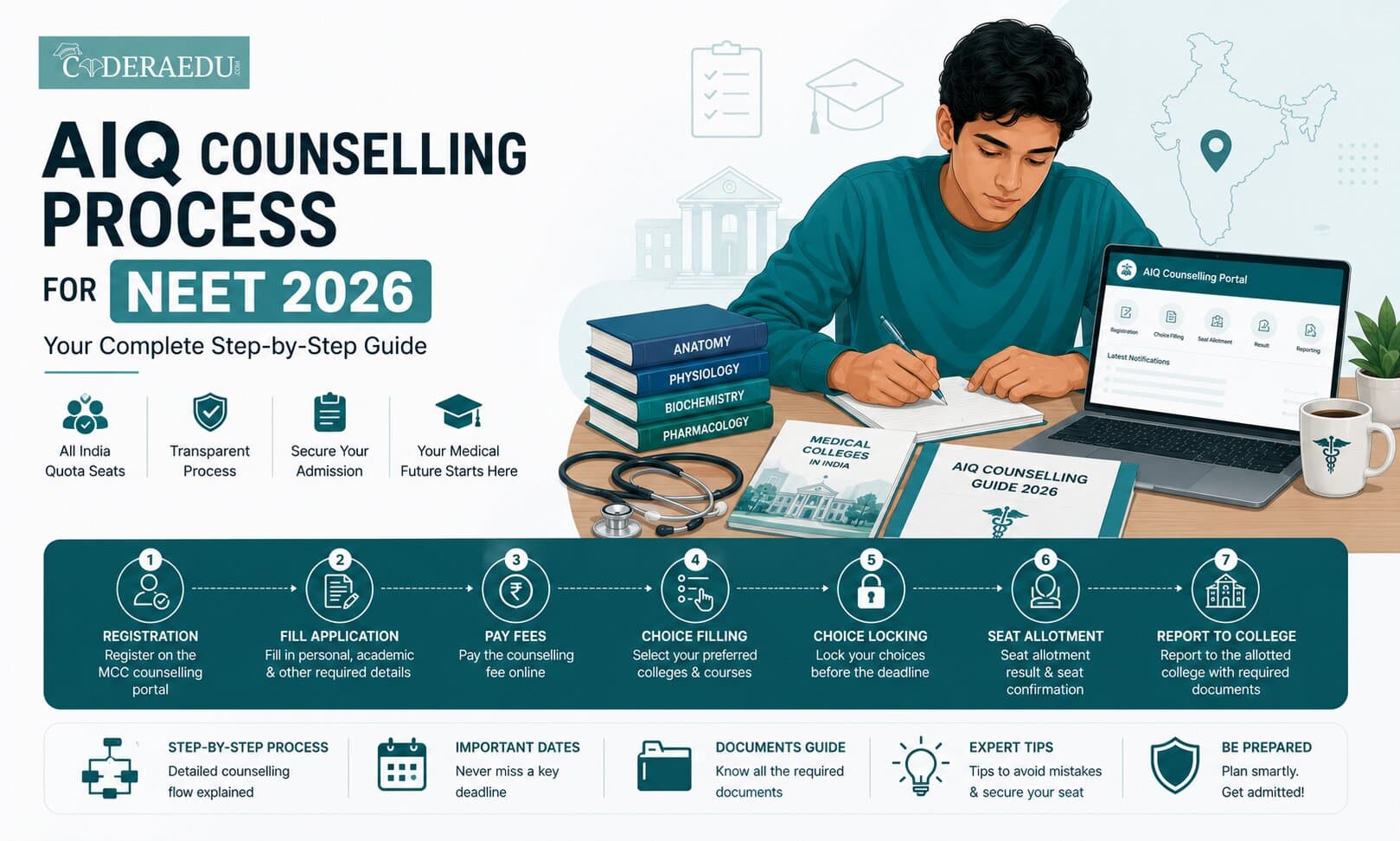
Step-by-Step AIQ Counselling 2026 Process
The AIQ counselling process for NEET 2026 follows four sequential stages within each round. Understanding what happens at each stage — and what can go wrong — is what separates a well-prepared candidate from one who loses a seat to a procedural error.
Step 1: Registration and Fee Payment
Go to mcc.nic.in and register using your NEET UG 2026 roll number and date of birth. Pay two amounts: a non-refundable registration fee (₹1,000 for General/OBC; ₹500 for SC/ST/PwD in 2025 — 2026 amounts subject to revision) and a refundable security deposit (₹10,000 for General; ₹5,000 for SC/ST/PwD). The security deposit is refunded if you do not receive an allotment or take the free exit in Round 1. It is forfeited if you receive a seat from Round 2 onward and do not report to the college. Register as soon as the window opens — do not wait for friends or coaching centre instructions.
Step 2: Choice Filling and Locking
After registration, the choice filling window opens — typically for 3–4 days. This is where you build your preference list by selecting colleges and courses from the MCC pool. You can add as many options as you want; there is no cap and no penalty for listing more. The allotment algorithm assigns you the highest preference on your list for which your rank qualifies. A list of 40–50 colleges consistently produces better outcomes than a list of 10–15. Before the window opens, build your shortlist using top MBBS colleges in India on CaderaEdu, where each college page shows round-wise opening and closing ranks from previous years — the most reliable predictor available. top MBBS colleges in India
Order matters as much as breadth. Place AIIMS New Delhi first if your rank allows, followed by other AIIMS campuses, JIPMER Puducherry, top government colleges in your preferred states, then deemed universities within your fee comfort range. Once your list is finalised, lock it. An unlocked list is treated as empty — no lock means no allotment, regardless of rank. Lock at least 12 hours before the deadline to avoid portal traffic crashes.
Step 3: Seat Allotment Result
MCC publishes the allotment result on mcc.nic.in. Log in with your credentials to check — do not rely on third-party websites or Telegram channels that claim to publish early results. Once the result is out, you have three options: accept and report (join the allotted college), accept and upgrade (hold the current seat while entering the next round for a better allotment), or free exit (only in Round 1 — withdraw without penalty to re-enter subsequent rounds). Check NEET 2026 expected cutoff scores to evaluate whether your allotment is worth holding or worth upgrading. NEET 2026 expected cutoff scores
Step 4: Reporting to the Allotted College
If you choose to join, report to the allotted college within the reporting window — typically 3 to 5 days from allotment. Carry all original documents along with self-attested photocopies of each. The college conducts physical document verification and issues a provisional admission letter. If you are simultaneously allotted a seat through state counselling, you must resign from one before the inter-quota transfer deadline. Holding two seats simultaneously past that deadline can result in cancellation of both.
Documents Required for AIQ Counselling 2026
The document requirements for AIQ are stricter than state counselling in one critical area: category certificates must be in the central government format. A state revenue department OBC certificate in the state format is not accepted at the MCC level — you need the OBC-NCL certificate confirming the candidate belongs to the central list. Prepare all documents before the registration window opens.
- NEET UG 2026 Admit Card and Scorecard / Rank Letter
- Class 10 Mark Sheet and Certificate (date of birth proof)
- Class 12 Mark Sheet and Passing Certificate (PCB marks verification)
- Transfer Certificate and Migration Certificate from last institution
- Government-issued Photo ID: Aadhaar Card / Passport / Voter ID
- Passport-size photographs — minimum 10, recent, white background
- SC/ST/OBC-NCL Certificate — central government format only; state format not accepted for AIQ
- EWS Certificate — income and asset certificate from a gazetted officer / tehsildar; valid for the financial year of admission
- PwD Certificate (if applicable) — issued by a government medical board; not a private doctor's certificate
- NRI/OCI/PIO documents (for NRI quota seats at deemed universities)
- Medical Fitness Certificate from a registered medical practitioner
- Domicile Certificate — not required for AIQ itself but keep it ready for state counselling running in parallel
Colleges and Seats Covered Under AIQ 2026
Understanding exactly which institutions fall under AIQ — and what percentage of their seats are covered — is essential for building an accurate choice list. Many students assume all private colleges are included; they are not. Here is a complete breakdown.
Table
| Institution Type | Seats Under AIQ | Conducting Body | Notes |
|---|---|---|---|
| Government Medical Colleges | 15% of total MBBS/BDS seats | MCC via mcc.nic.in | Excludes J&K, AP, Telangana state quota arrangement |
| AIIMS (all 23 campuses) | 100% of MBBS seats | MCC via mcc.nic.in | No separate AIIMS entrance since 2020; NEET score used |
| JIPMER Puducherry & Karaikal | 100% of MBBS seats | MCC via mcc.nic.in | JIPMER Puducherry highly competitive; ~200 seats total |
| Deemed Universities (NMC-approved) | 100% of AIQ seats (management quota filled separately by institution) | MCC via mcc.nic.in | Fees significantly higher than government colleges — ₹12–25L/year |
| ESIC Medical Colleges | 100% of seats | MCC via mcc.nic.in | Limited campuses; competitive but less known |
| AFMC Pune | Separate process | MCC registration + AFMC interview | Defence background preference; separate merit list |
| State Government Colleges (85% seats) | Not under AIQ | State counselling authorities (DMER, DMET, DGHS, KEA, etc.) | Domicile required; separate registration needed |
| Private Unaided Non-Deemed Colleges | Not under AIQ | State authorities or institution-level | Not part of MCC counselling |
4 columns · 9 rows
For a comprehensive college-wise breakdown of AIQ seats, fees, and cutoff history, explore government medical colleges in India on CaderaEdu. Each college page shows the AIQ opening and closing rank across all categories for the last three counselling cycles — a far more reliable reference than generalised cutoff lists. government medical colleges in India
AIQ vs State Quota — When to Prefer Which Strategy
Both AIQ and state quota counselling run in parallel, and you must register for both independently. The strategic question is not which one to choose — it is how to optimise your choice lists for each, given that they serve very different competitive environments.
When AIQ Works in Your Favour
AIQ is your only route to AIIMS, JIPMER, and deemed universities — state counselling does not cover these at all. If your rank is in the top 5,000–10,000 for General category, AIQ government college cutoffs become realistic and the national competition works in your favour because you are competing purely on merit without state-level reservation layers. Students from states with weaker government medical colleges also benefit significantly from AIQ — they can target better colleges in other states through AIQ where the same rank would not get them in through state quota.
When State Quota Works in Your Favour
State quota cutoffs for government colleges are typically 30,000–80,000 ranks lower than AIQ cutoffs for the same college. A student with an AIR of 25,000 who cannot get a government MBBS seat through AIQ may comfortably secure one in their home state through state quota. State quota also has state-specific reservation categories — NT, SBC, VJNT in Maharashtra; MBC in Tamil Nadu — that provide additional advantages not available in AIQ. Check state-wise NEET 2026 cutoffs on CaderaEdu to see exactly what rank gets you a government seat in your home state through state quota. state-wise NEET 2026 cutoffs
The right strategy is not AIQ or state quota — it is AIQ and state quota. Register for both, build separate choice lists optimised for each track, and let the allotment results tell you which to pursue further.
For students evaluating private and deemed options alongside government seats, top private medical colleges in India on CaderaEdu covers 200+ institutions with fee comparisons, NIRF rankings, and cutoff data. Use the college comparison tool to evaluate two or three deemed university options side by side before adding them to your AIQ choice list. top private medical colleges in India college comparison tool
Common Mistakes to Avoid in AIQ Counselling 2026
Most seat losses in AIQ counselling are not due to rank — they are due to procedural errors that are entirely avoidable. These are the mistakes that recur every year.
- Not registering for state counselling while waiting for AIQ allotment results. Both processes run simultaneously with independent registration windows. Missing state registration costs you 85% of your options.
- Filling only 10–15 choices. Students who do this and narrowly miss all 15 cutoffs end up with no allotment despite a competitive rank. Fill 40–50 choices minimum.
- Submitting the choice list without locking it. An unlocked list is treated as empty by the MCC system — no lock means no allotment, regardless of rank or how well you filled the list.
- Using a state-format OBC certificate for AIQ. MCC requires the OBC-NCL certificate confirming central list membership. State-format certificates are rejected. Apply for the central format well before registration opens.
- Assuming Round 1 choices carry over to Round 2. They do not. Fresh registration and completely fresh choice filling is mandatory for every round.
- Not participating in the Mop-Up Round after a disappointing Round 2. Excellent seats open up in Mop-Up as candidates with multiple allotments resign from less-preferred colleges.
- Reporting to an allotted college without checking the resignation deadline for the other counselling. Holding two seats past the cross-over deadline can result in forfeiture of deposit and cancellation of both allotments.
- Relying on coaching centre result predictions or social media for cutoff data. Use actual previous year round-wise cutoffs from official MCC data or CaderaEdu's verified college pages.
Planning Your AIQ Choice List: Research Tools That Help
The quality of your AIQ allotment is a direct function of how well you research colleges before the choice filling window opens. The window is typically 3–4 days — not enough time to start researching from scratch under pressure. Do the work now.
Start with the free NEET UG College Predictor on CaderaEdu — it converts your rank to a realistic college shortlist covering both AIQ and state quota, no login needed. Then go deeper on individual college pages: the AIIMS New Delhi admission page and other AIIMS campus pages show the full seat matrix, fee structure, hostel details, and round-wise cutoffs. For MBBS abroad as a backup option, CaderaEdu covers country-wise NMC recognition status, screening test requirements, and total cost comparisons — useful context if AIQ and state quota both fall short of your expectations. free NEET UG College Predictor on CaderaEdu MBBS abroad as a backup option
When evaluating deemed university options for your AIQ list, do not go by annual fee alone — MBBS fees across medical colleges on CaderaEdu shows the total 5.5-year cost including hostel and other charges, which is the number that actually matters for financial planning. MBBS fees across medical colleges
Conclusion
The AIQ counselling process for NEET 2026 is wide open to every qualified student regardless of which state they come from — that national reach is both its biggest advantage and its most competitive feature. The students who do well in AIQ are not always those with the highest ranks. They are the ones who register on time, fill comprehensive choice lists, lock before the deadline, hold their nerve through multiple rounds, and treat the Mop-Up Round with the same seriousness as Round 1. With the Re-NEET 2026 pushing the calendar back, you have more preparation time than most years. Use it.
Build your AIQ college shortlist today on CaderaEdu's free NEET UG College Predictor — rank-based, category-aware, and covering both AIQ and state quota in one place. The earlier you start, the better your choice list. The better your choice list, the better your seat. CaderaEdu's free NEET UG College Predictor
Share this article
Copy
Frequently Asked Questions
What is the difference between AIQ and state quota in NEET counselling?
AIQ (All India Quota) covers 15% of government medical college seats and 100% of seats at AIIMS, JIPMER, and deemed universities. It is open to NEET-qualified students from any state — no domicile restriction. State quota covers the remaining 85% of government college seats and is restricted to domicile candidates of that specific state. AIQ cutoffs are significantly higher than state quota cutoffs for the same college because competition is national. Both processes run in parallel and require separate registration — you should participate in both simultaneously.
Can students from Jammu & Kashmir apply for AIQ Counselling 2026?
Yes, with a partial restriction. J&K, Andhra Pradesh, and Telangana have opted out of the 15% AIQ arrangement in their state government colleges — meaning these states' government college seats are not part of the AIQ pool. However, students from J&K, AP, and Telangana can fully participate in AIQ counselling for AIIMS campuses, JIPMER, and deemed university seats. They are not excluded from AIQ entirely — just from the 15% government college seats in those three states.
How many choices should I fill in AIQ counselling?
Fill as many as possible — ideally 40 to 50 colleges, not 10 to 15. There is no penalty for listing more colleges, and the allotment algorithm assigns you the best available option from your list based on your rank. Students who limit their list to a handful of dream colleges risk getting no allotment if all of them close above their rank. Put AIIMS campuses and JIPMER at the top, followed by top government colleges and deemed universities within your fee range. Building this list takes research — start now using previous year round-wise cutoff data.
What is the security deposit in AIQ counselling and is it refundable?
MCC collects a security deposit at the time of registration — ₹10,000 for General/OBC and ₹5,000 for SC/ST/PwD (2025 amounts; 2026 may differ). In Round 1, the deposit is fully refunded if you take the free exit or do not receive an allotment. From Round 2 onward, if you receive a seat allotment and do not report to the college within the stipulated window, the deposit is forfeited. If you join the allotted college and complete the admission process, the deposit is adjusted against your fee payment.
Do I need a domicile certificate for AIQ counselling?
No. AIQ counselling has no domicile requirement — students from any state can apply for any college under AIQ without a domicile certificate. You do not need to prove you are a resident of the state where the college is located. However, if you are simultaneously registering for state quota counselling (which you should), the state authority will require a valid domicile certificate for that process. Get your domicile certificate ready for state counselling even though AIQ does not need it.