Difference Between BTech and BE: Which is Better in 2026?

Click to enlarge
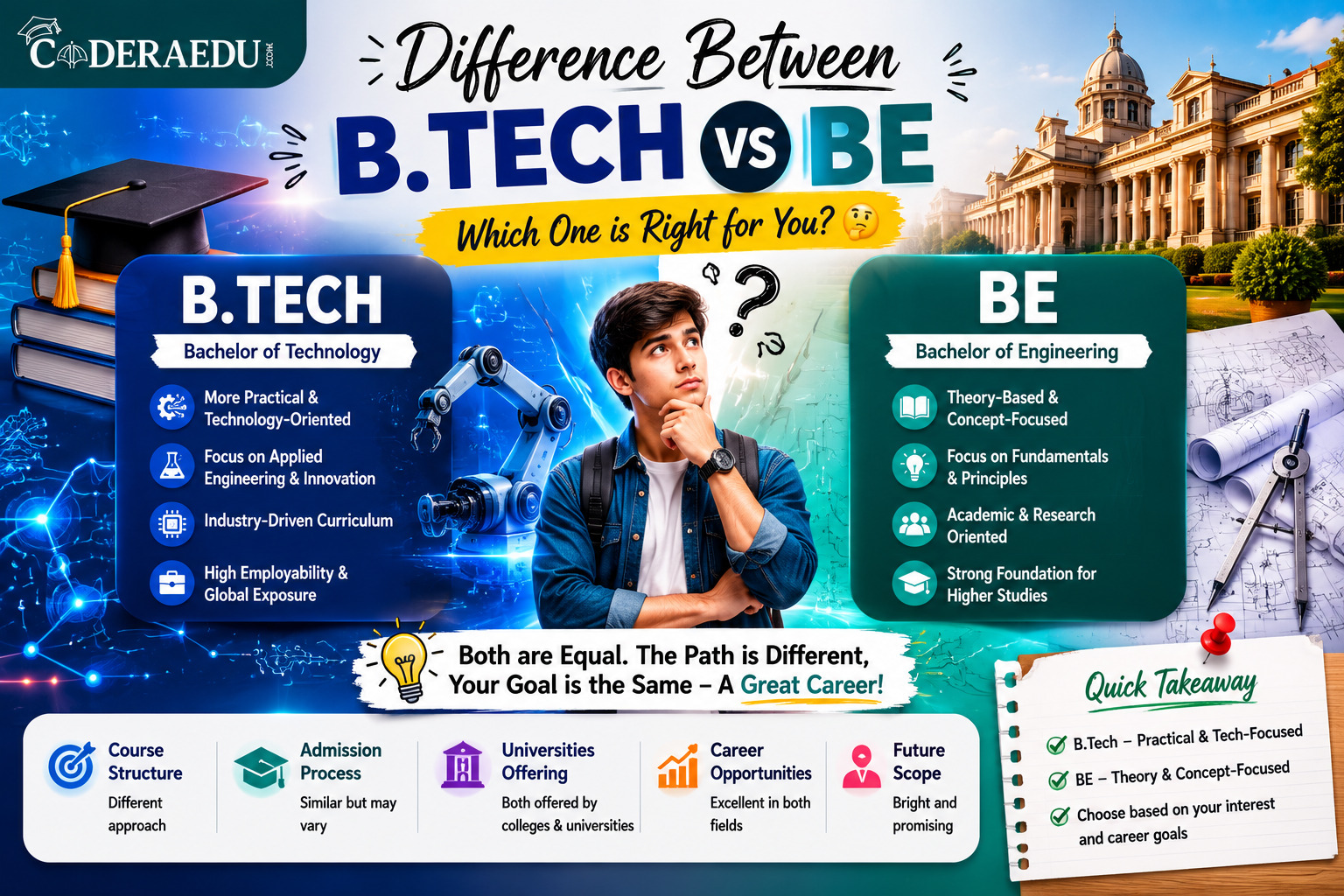
One of the most common questions Class 12 students ask before choosing an engineering college is: what is the difference between BTech and BE? The two degree names appear on admission forms, college brochures, and JoSAA choice-filling pages — and they are often used interchangeably. But they are not quite the same thing, and the distinction matters when you are comparing colleges, planning for higher studies, or targeting specific recruiters. This guide explains the real differences between BTech and BE, which universities offer which, how employers and universities treat them, and which makes more sense for your goals. If you are actively choosing between colleges right now, use the B.Tech & M.Tech College Predictor and JoSAA College Predictor to compare your options with real rank-based data.
BTech vs BE: The Basic Definition
B.Tech stands for Bachelor of Technology. BE stands for Bachelor of Engineering. Both are 4-year undergraduate engineering degrees recognised by the University Grants Commission (UGC) and the All India Council for Technical Education (AICTE). Both are governed by the same broad academic framework and lead to equivalent professional qualifications in the eyes of most employers and regulatory bodies. The degree title — BTech or BE — depends primarily on the type of institution offering it and the university affiliation, not on any fundamental difference in the programme itself. In practice, the distinction often matters less than the institution's quality, NAAC grade, NIRF ranking, and placement record.
Which Institutions Award BTech and Which Award BE?
The degree name follows institutional conventions. IITs, NITs, IIITs, and most deemed universities and autonomous private engineering colleges award the BTech degree. Traditional affiliating universities — like Mumbai University, Anna University (Tamil Nadu), Visvesvaraya Technological University (Karnataka), Osmania University, Rajasthan Technical University, and AKTU (Dr. A.P.J. Abdul Kalam Technical University, UP) — award the BE degree to students studying at their affiliated colleges. The difference is largely historical: older universities established the BE nomenclature following British colonial educational conventions, while newer autonomous institutions adopted BTech as the standard. Both degrees are treated as equivalent under UGC and AICTE norms.
Table
| Parameter | BTech (Bachelor of Technology) | BE (Bachelor of Engineering) |
|---|---|---|
| Full Form | Bachelor of Technology | Bachelor of Engineering |
| Duration | 4 Years (8 Semesters) | 4 Years (8 Semesters) |
| Awarding Institutions | IITs, NITs, IIITs, deemed universities, private autonomous colleges | Affiliating universities (Mumbai Univ, Anna Univ, VTU, AKTU, RTU, Osmania) |
| Curriculum Focus | More applied, practical, and project-oriented | More theoretical, subject-depth oriented; varies by university |
| Industry Recognition | Equal — both recognised by UGC, AICTE, and all employers | Equal — both recognised by UGC, AICTE, and all employers |
| Eligibility for GATE | Yes — both eligible | Yes — both eligible |
| Eligibility for MTech/MS | Yes — both eligible | Yes — both eligible |
| Eligibility for PSU Jobs | Yes — both eligible | Yes — both eligible |
| Global Recognition | BTech sometimes better recognised abroad due to autonomous institutional branding | BE from top affiliating colleges equally accepted; university name matters more |
3 columns · 10 rows
Curriculum Difference: Is BTech More Practical Than BE?
There is a commonly repeated claim that BTech is more practical and industry-oriented while BE is more theoretical. This is partially true but overstated. The curriculum difference, where it exists, comes from the type of institution — not the degree name. IITs, NITs, and autonomous institutions offering BTech have more freedom to design their curriculum — updating syllabi frequently, running labs on modern equipment, incorporating industry projects, and including electives aligned with emerging technologies. Affiliating universities offering BE degrees often have more rigid, centrally mandated syllabi that change slowly. A BE student at COEP Pune (an autonomous institute under Savitribai Phule Pune University that now awards BTech) has a very different curriculum experience than a BE student at a small affiliated college in a tier-3 city. The curriculum quality depends far more on the specific college and university than on whether the degree says BTech or BE. For comparing curricula across engineering colleges by ranking and placement, browse the BTech Colleges in Noida guide and use the B.Tech College Predictor to filter by stream and location.
Key Universities Offering BE Degree in India
Several of India's most prestigious engineering colleges award the BE degree through their affiliated universities. Understanding which top colleges award BE helps clarify that the degree name is no barrier to quality. Anna University, Tamil Nadu awards BE to students at affiliated colleges including the prestigious College of Engineering Guindy (CEG), Chennai. Visvesvaraya Technological University (VTU), Karnataka awards BE to students at colleges affiliated with it — including some top-ranked private engineering colleges in Bangalore. Mumbai University awards BE through its affiliated engineering colleges. Osmania University, Hyderabad awards BE. AKTU (Dr. A.P.J. Abdul Kalam Technical University) in Uttar Pradesh awards BTech to most colleges under its affiliation. The NIT Calicut, NIT Srinagar, and NIT Delhi all award BTech — and serve as strong benchmarks for understanding how autonomous institutions differ from affiliating universities in terms of curriculum flexibility.
Does the Degree Name Affect Job Placements?
In the vast majority of campus placement scenarios, recruiters do not distinguish between BTech and BE. TCS, Infosys, Wipro, Accenture, Amazon, and most other top corporate recruiters accept both degrees equally. The eligibility criteria for most engineering campus drives specify "B.E./B.Tech" — treating them as equivalent. Where a distinction sometimes appears is in very specific public sector job notifications, some government PSU recruitment advertisements, and a small number of international universities with specific degree name requirements for graduate admissions. In these cases, verifying the specific requirement with the relevant organisation is important. For most students, the institution's NIRF rank, NAAC grade, and placement record matter far more to a recruiter than whether the degree title reads BTech or BE. Use the JoSAA College Predictor and BITSAT Predictor to compare colleges across both BTech and BE awarding institutions by rank and placement.
BE vs BTech for GATE and Higher Studies
Both BTech and BE graduates are fully eligible to appear for GATE (Graduate Aptitude Test in Engineering) and apply for MTech or MS programmes at IITs, NITs, and other technical institutions. The GATE eligibility criteria explicitly state "BE/BTech or equivalent" — no preference is given to one over the other. For admission to IIT MTech programmes, the degree name is irrelevant — GATE score is the deciding factor. Similarly, for international MS or PhD programmes, foreign universities evaluate the institution's ranking and the applicant's academic record, not the degree abbreviation. The GATE Predictor can help you map your GATE score to MTech programme options regardless of whether your undergraduate degree is BTech or BE.
Autonomous vs Affiliated: The Real Distinction That Matters
The distinction that actually matters in engineering education is not BTech vs BE — it is autonomous institution vs affiliating university college. Autonomous institutions (IITs, NITs, IIITs, and private colleges with UGC autonomous status) design their own syllabi, conduct their own exams, and can update curriculum in real time. They tend to have more modern, industry-relevant content and more flexibility in teaching methods. Affiliated colleges follow a centrally mandated syllabus set by the affiliating university — which changes slowly and may lag behind industry needs. Most top autonomous institutions award BTech. Most affiliated colleges award BE. So the BTech-vs-BE distinction partially tracks the autonomous-vs-affiliated distinction — but not perfectly. Some autonomous colleges award BE, and some top affiliating university colleges have strong outcomes. The takeaway: when choosing a college, prioritise autonomy status, NAAC grade, and NIRF rank over the degree name. JIIT Noida, VIT Vellore, and IILM University School of Engineering, Greater Noida are examples of autonomous private institutions awarding BTech with their own curriculum and placement infrastructure.
BTech vs BE: Which Is Better for You?
The honest answer: the degree name is one of the least important factors in your decision. What you should actually compare when choosing between colleges offering BTech vs BE is NIRF ranking and NAAC grade, placement record including median salary and recruiter quality, faculty qualifications and research output, laboratory and infrastructure quality, industry partnerships and internship programmes, and total fee relative to expected starting salary. A BE from Anna University at CEG Chennai with a median placement of INR 8–12 LPA is a far better outcome than a BTech from an unrecognised private institution with poor placements. Focus your energy on evaluating the institution, not the degree abbreviation. Browse and compare colleges through the B.Tech & M.Tech College Predictor, the JoSAA Predictor, the VITEEE College Predictor, and the IPU Delhi College Predictor to find the best college for your rank — regardless of whether it awards BTech or BE.
How Admission Works: BTech and BE Both Enter via JEE or State CETs
Admission to BTech programmes at IITs is through JEE Advanced. Admission to BTech at NITs, IIITs, and GFTIs is through JEE Mains via JoSAA counselling. Admission to BTech at private colleges is through JEE Mains or institutional entrance exams like VITEEE (VIT), BITSAT (BITS), and state CETs. Admission to BE programmes at affiliated university colleges is through state-level CETs — MHT-CET for Maharashtra, TNEA for Tamil Nadu, KCET for Karnataka, and UPCET/JEE Mains for UP. The JAC Chandigarh Predictor, CUSAT Predictor, and IPU Delhi Predictor cover state-level and institutional counselling routes that lead to BTech seats at strong private and state colleges. The JEE Mains 2026 Session 2 Result guide explains how JEE scores translate to AIR and which colleges become accessible at different rank bands.
Quick Comparison: Top Colleges and Their Degree Names
Table
| College | Degree Awarded | Affiliated To / Type |
|---|---|---|
| IIT Delhi, IIT Madras, IIT Bombay | BTech | Autonomous (Institute of National Importance) |
| NIT Trichy, NIT Warangal, NIT Calicut | BTech | Autonomous (NIT Act) |
| IIIT Allahabad, IIIT Delhi, IIIT Hyderabad | BTech | Autonomous (Deemed/IIIT Act) |
| VIT Vellore, BITS Pilani | BTech | Deemed University (Autonomous) |
| JIIT Noida, Amity University Noida | BTech | Deemed/Private University (Autonomous) |
| College of Engineering Guindy (CEG), Chennai | BE | Anna University affiliated |
| COEP Technological University, Pune | BTech (recently changed from BE) | Autonomous University |
| Affiliated colleges under VTU, Karnataka | BE | VTU affiliated |
| Affiliated colleges under AKTU, UP | BTech | AKTU affiliated |
3 columns · 10 rows
Topics:
Share this article
Copy
Frequently Asked Questions
Is BTech better than BE in India?
Neither BTech nor BE is inherently better than the other — both are 4-year engineering degrees fully recognised by UGC and AICTE. The degree name follows institutional convention. IITs, NITs, and autonomous colleges award BTech; affiliating universities like Anna University and VTU award BE. What matters far more is the institution's NIRF rank, NAAC grade, placement record, and curriculum quality — not the degree abbreviation.
Is BE and BTech the same?
Yes, for most practical purposes BE (Bachelor of Engineering) and BTech (Bachelor of Technology) are equivalent 4-year engineering degrees. Both are recognised by UGC and AICTE. Both make graduates eligible for GATE, MTech admissions, PSU jobs, and campus placements. The nomenclature difference is historical — older affiliating universities use BE; newer autonomous institutions use BTech.
Which universities offer BE and which offer BTech?
IITs, NITs, IIITs, BITS Pilani, VIT, and most private autonomous universities offer BTech. Traditional affiliating universities like Anna University (Tamil Nadu), Visvesvaraya Technological University (Karnataka), Mumbai University, and Osmania University offer BE. AKTU in Uttar Pradesh awards BTech to its affiliated colleges. Both degrees carry equal weight in the job market.
Can BE graduates apply for IIT MTech or GATE?
Yes, absolutely. BE graduates are fully eligible to appear for GATE and apply for MTech or MS programmes at IITs, NITs, and other institutions. GATE eligibility criteria explicitly state 'BE/BTech or equivalent' — there is no distinction between the two for graduate study purposes.
Do recruiters prefer BTech over BE?
No. Recruiters do not distinguish between BTech and BE graduates. Campus placement eligibility criteria at virtually all companies — TCS, Infosys, Amazon, Microsoft, Deloitte, and others — specify 'BE/BTech' as interchangeable. The recruiter's decision is based on the college's ranking, the student's CGPA, skills, and interview performance — not the degree abbreviation.
Confused About College Admissions?
Get expert advice on college selection, admission chances, and career path in a personalized counselling session.
Book a Counselling Slot
Select Date
Pick a Slot