NEET College Predictor 2026: Predict Your MBBS College by Rank, Category & State

Click to enlarge
Introduction: NEET College Predictor 2026 – Your Admission Compass
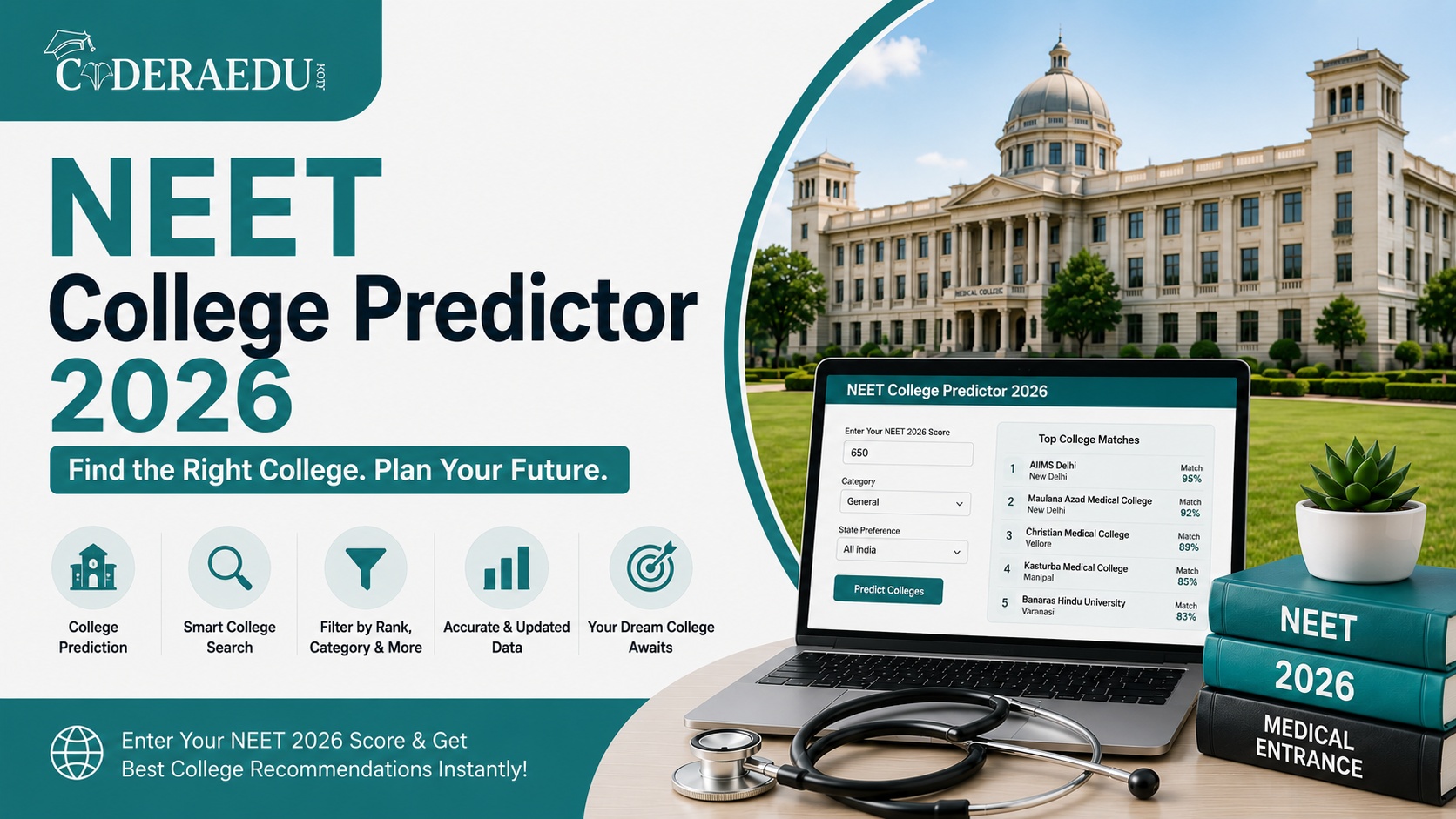
The NEET College Predictor 2026 is one of the most essential tools available to MBBS aspirants after they appear for the national entrance exam. With over 24 lakh students having appeared in NEET UG 2026 and the Re-NEET exam scheduled for June 21, 2026 following the cancellation of the May 3 exam, the competition for roughly 1.08 lakh MBBS seats across India has never been more intense. Knowing which colleges are within your reach — before counselling begins — gives you a decisive planning advantage.
A college predictor works by mapping your NEET rank against previous years' closing ranks across government, private, and deemed medical colleges under both All India Quota (AIQ) and state quota counselling. It does not replace the official MCC seat allotment — but it helps you build a realistic, data-backed college shortlist before you fill counselling choices.
This guide covers how the NEET College Predictor 2026 works, what inputs it needs, how to interpret its output, and how to align the results with the current 2026 counselling timeline. Given the Re-NEET development, MCC counselling 2026 is now expected to begin end-July 2026, with state counselling from mid-August. This makes early preparation even more critical.
2026 Update: Re-NEET, Revised Timeline, and What It Means for College Prediction
The NEET UG 2026 exam conducted on May 3 was cancelled by NTA following reports of paper irregularities at certain exam centres. The Re-NEET UG 2026 has been officially scheduled for June 21, 2026 (2:00 PM – 5:00 PM). Results are expected by mid-July 2026, after which the MCC will open counselling registration around end-July 2026. State and UT counselling is expected to begin from mid-August 2026 onwards.
This revised timeline means students now have more time to use the NEET College Predictor 2026 effectively. If you appeared in the May 3 exam and your result is being considered, or if you are appearing in the Re-NEET on June 21, you can begin predicting colleges as soon as you have your estimated score using the answer key. For NEET rank prediction, refer to the official NTA answer key once released.
The Re-NEET 2026 development has delayed the counselling calendar by roughly 6–8 weeks compared to previous years. As confirmed by NTA, the <a href="https://caderaedu.com/blog/will-re-neet-2026-syllabus-change-official-nta-update">Re-NEET syllabus remains unchanged</a>. Students who use this window productively to research college options, understand cutoff trends, and prepare counselling strategies will have a clear edge when MCC registration opens.
What Is a NEET College Predictor and How Does It Work?
A NEET College Predictor is a data-driven tool that cross-references your NEET rank, category, domicile state, and quota preference with the opening and closing ranks of medical colleges from previous counselling years. The output is a personalised list of colleges — government, private, deemed, or AIIMS/JIPMER — where your rank falls within or near the historical admission range.
The best predictors in the market today analyse at least 3 years of closing rank data from MCC counselling rounds (Round 1, Round 2, Mop-Up, and Stray Vacancy) and state-level counselling data for 25+ states. Some advanced tools like those from CaderaEdu, Careers360, and Shiksha claim accuracy of up to 98% based on their historical data sets covering 822+ NMC-approved MBBS colleges.
- Your NEET 2026 rank or score (estimated or official)
- Category: General, OBC-NCL, SC, ST, EWS, PwD (General-PwD / SC-ST-OBC-PwD)
- Quota preference: AIQ (15% seats) or State Quota (85% seats)
- Domicile state (required for state quota prediction)
- Course preference: MBBS, BDS, BAMS, BHMS, BUMS, or BSMS
- College type preference: Government / Private / Deemed / Central University
NEET 2026 Eligibility for Counselling: Who Can Participate?
Before using the college predictor, confirm that you meet the basic NEET 2026 eligibility for counselling participation. Simply appearing in NEET is not enough — you must have qualified with the minimum percentile cutoff as declared by NTA.
- Must have qualified NEET UG 2026 with the minimum qualifying percentile (50th for General, 40th for OBC/SC/ST, 45th for General-PwD)
- Age: Minimum 17 years as on or before December 31, 2026
- Must have passed Class 12 with Physics, Chemistry, and Biology/Biotechnology
- Minimum 50% marks in PCB aggregate for General; 40% for SC/ST/OBC; 45% for PwD General
- For state quota: domicile/residence requirement as per that state's rules
- For AIQ counselling: registration on MCC official portal at mcc.nic.in is mandatory
- Candidates who appeared in Re-NEET on June 21, 2026 are eligible once results are declared
How to Use the NEET College Predictor 2026: Step-by-Step
Using a college predictor effectively requires more than just entering your rank. Here is a structured approach to get maximum value from your prediction and convert it into a solid counselling strategy.
- Step 1 – Estimate or confirm your NEET rank: Use the official NTA answer key to calculate your score. Then use a NEET Rank Predictor to get your estimated AIR. For Re-NEET candidates, this step applies after the June 21 exam.
- Step 2 – Identify your category and quota: Select your correct category (General, OBC-NCL, SC, ST, EWS, or PwD). Choosing the wrong category is one of the most common errors — it completely changes the output.
- Step 3 – Choose your domicile state: For state quota prediction, select your state of domicile. For AIQ prediction, you compete nationally.
- Step 4 – Run the predictor for AIQ and State Quota separately: Always run two separate predictions — one for AIQ colleges (through MCC) and one for state quota colleges (through your state's counselling authority). Compare both lists.
- Step 5 – Filter by college type: Sort results by government colleges first, then deemed, then private. This helps prioritize fee-friendly options.
- Step 6 – Check 3-year closing rank trend: Do not rely on a single year's closing rank. Check if a college's closing rank has been consistently within your range across 2022, 2023, and 2024.
- Step 7 – Build a 3-tier college list: Categorise shortlisted colleges as — Target (rank comfortably within range), Match (borderline fit), and Safety (rank clearly within closing range). Fill counselling choices in this order.
- Step 8 – Cross-verify with NMC approval status: Confirm that every college on your list is approved by the National Medical Commission (NMC) and has no regulatory issues. Avoid colleges under MCI/NMC derecognition orders.
NEET 2026 Counselling Process: AIQ vs State Quota – Complete Overview
The college predictor output covers two parallel admission pathways. Understanding both is essential for building a complete strategy. The MCC NEET UG Counselling 2026 for AIQ seats is expected to begin around end-July 2026, while state counselling will start from mid-August 2026 — both timelines delayed due to the Re-NEET.
Table
| Parameter | AIQ via MCC Counselling | State Quota Counselling |
|---|---|---|
| Seat Share | 15% of Government MBBS seats | 85% of Government MBBS seats |
| Conducting Body | Medical Counselling Committee (MCC) | State Medical/Dental Counselling Authority |
| Portal | mcc.nic.in | State-specific portal (e.g., DMER, CEE) |
| Eligibility | All India – open to all NEET qualified candidates | Only state domicile / resident candidates |
| Courses Covered | MBBS, BDS, BAMS, BHMS, BUMS, BSMS, BSc Nursing | MBBS, BDS, AYUSH (varies by state) |
| Institutions Covered | AIIMS, JIPMER, Central Universities, Deemed, Private | State Govt and Private Medical Colleges |
| Number of Rounds | 4 rounds: Round 1, Round 2, Mop-Up, Stray Vacancy | Usually 2–3 rounds (varies by state) |
| Expected Start (2026) | End-July 2026 (delayed due to Re-NEET) | Mid-August 2026 (tentative) |
| Competition Level | National – very high for top colleges | State-level – relatively lower competition |
3 columns · 10 rows
Students should register for both AIQ and state counselling simultaneously wherever possible. Many candidates miss state quota deadlines while waiting for MCC results — a common and costly mistake. Always track both portals. Students planning ahead can also explore the NEET PG Predictor for future specialisation planning. Detailed state-wise information is available in our NEET State Counselling 2026 guide.
Top Government Medical Colleges: Approximate AIQ Closing Ranks (Previous Year Trends)
The following table gives approximate AIQ closing rank ranges for the General (UR) category based on trends from NEET counselling rounds in 2022–2024. These figures are indicative and meant for college predictor cross-referencing only. Actual 2026 cutoffs will vary based on Re-NEET difficulty, candidate count, and seat matrix. Always verify on NEET 2026 official cutoff data once released.
Table
| College Name | State | Type | Approx. AIQ Closing Rank (General) | Annual Fees (Approx.) |
|---|---|---|---|---|
| AIIMS New Delhi | Delhi | Central Govt | Top 50–100 | ~₹1,628/year |
| JIPMER Puducherry | Puducherry | Central Govt | 200–700 | ~₹5,000/year |
| Maulana Azad Medical College | Delhi | State Govt (AIQ) | 150–400 | ~₹25,000/year |
| VMMC & Safdarjung Hospital | Delhi | Central Govt | 400–800 | ~₹25,000/year |
| Lady Hardinge Medical College | Delhi | State Govt (Females) | 500–1,200 | ~₹25,000/year |
| Seth GS Medical College, Mumbai | Maharashtra | State Govt (AIQ) | 800–2,000 | ~₹40,000/year |
| Grant Medical College, Mumbai | Maharashtra | State Govt (AIQ) | 1,500–3,500 | ~₹40,000/year |
| BJ Medical College, Ahmedabad | Gujarat | State Govt (AIQ) | 2,000–5,000 | ~₹30,000/year |
| Madras Medical College, Chennai | Tamil Nadu | State Govt (AIQ) | 3,000–7,000 | ~₹20,000/year |
| KGMU, Lucknow | Uttar Pradesh | State Govt (AIQ) | 5,000–10,000 | ~₹30,000/year |
| SMS Medical College, Jaipur | Rajasthan | State Govt (AIQ) | 6,000–12,000 | ~₹30,000/year |
| Govt Medical College, Kozhikode | Kerala | State Govt (AIQ) | 4,000–9,000 | ~₹20,000/year |
5 columns · 13 rows
For a complete list including private and deemed universities, visit our Top Government Medical Colleges India 2026 and Top BDS Colleges 2026 pages. For private college fee structures, check our dedicated Private Medical College Fees 2026 guide.
NEET College Predictor 2026: Rank-wise College Options at a Glance
Different rank ranges open up different types of colleges. Here is a practical breakdown based on the NEET 2026 Score vs Rank analysis of what to target based on your predicted AIR in the General category. Category candidates (OBC/SC/ST/EWS) can expect proportionally better options within their reservation pool.
- Rank 1–500: AIIMS (New Delhi, Mumbai, Bhopal, Jodhpur etc.), JIPMER, top Delhi government colleges. Focus 100% on AIIMS and premier central institutions.
- Rank 500–5,000: Top government colleges in Delhi, Mumbai, Pune, and Chennai under AIQ. JIPMER is within range. Excellent state quota options in home state.
- Rank 5,000–20,000: Mid-tier government colleges under AIQ. Strong options in state quota for states like UP, Bihar, Rajasthan, and Karnataka. Some deemed universities are viable.
- Rank 20,000–50,000: State quota government seats in many states remain accessible. Deemed universities and select private colleges should be included in your list.
- Rank 50,000–1,00,000: State quota government seats become limited. Private MBBS colleges, deemed universities (check fees carefully), and management quota seats are the primary pathway.
- Rank above 1,00,000: Government seats are largely inaccessible except via SC/ST/OBC reservations. Private college MBBS with NMC approval and affordable fee structure should be the focus. BDS, BAMS, BHMS remain viable options.
Seat Matrix Overview: How Many MBBS Seats Are Available in 2026?
Understanding the total seat availability helps put your predicted rank in context. The NEET UG 2026 seat matrix will be officially released by MCC before counselling begins. Based on current NMC-approved data, the approximate seat distribution across India is as follows.
- Total NMC-approved MBBS seats in India: approximately 1,08,000+ across 706+ medical colleges
- Government medical college MBBS seats: approximately 42,000–45,000
- Private medical college MBBS seats: approximately 55,000–60,000
- Deemed university MBBS seats: approximately 15,000–18,000
- AIIMS total MBBS seats across 22 AIIMS institutes: approximately 1,900+
- JIPMER MBBS seats (Puducherry + Karaikal): approximately 250
- BDS seats (government + private): approximately 26,000+
- AYUSH UG seats: approximately 52,000+ (BAMS, BHMS, BUMS, BSMS)
Common Mistakes Students Make While Using a NEET College Predictor
College predictors are powerful — but misused predictors lead to poor counselling choices. Here are the most frequent errors aspirants make during this stage, and how to avoid them.
- Using General category rank for OBC/SC/ST prediction: Category-wise reservation pools are separate. An OBC candidate with AIR 25,000 may have a category rank of 8,000, which opens up far better college options.
- Ignoring the Mop-Up round data: Many students shortlist colleges only based on Round 1 closing ranks. But Mop-Up round closing ranks are often higher (better for candidates) as seats remain unfilled. Always include Mop-Up round data.
- Not applying for both AIQ and state quota: These are parallel processes. Missing state quota registration while waiting for AIQ allotment is a commonly reported error with no remedy after the deadline.
- Relying only on a single predictor tool: Different tools use different datasets. Run your prediction on at least two reliable tools and compare the overlap.
- Not verifying NMC approval: A few private colleges listed in predictor results may have pending regulatory issues. Always cross-check with the NMC website before adding them to your counselling list.
- Ignoring BDS and AYUSH options: Candidates who narrowly miss MBBS cutoffs often overlook BDS, BAMS, and BHMS options that can lead to equally rewarding healthcare careers.
- Waiting for official results before beginning research: The college predictor can be used the moment you have an estimated score. Waiting costs you 3–4 weeks of crucial research time.
Expert Guidance: How to Build Your Final NEET 2026 College List
Medical admissions experts consistently recommend that candidates build a list of at least 15–20 colleges across all preference categories before filling counselling choices. Here is a proven framework used by top counselling advisors.
For candidates targeting government medical colleges under AIQ, prioritise colleges where your predicted rank is comfortably within the Round 2 closing rank (not just Round 1), as Round 2 is more predictive of actual admission. For state quota, always include 4–5 government colleges in your home state as safety picks before adding private colleges.
Deemed university admissions through MCC's deemed university counselling deserve serious attention for candidates in the 30,000–80,000 rank range. Deemed universities like Kasturba Medical College (Manipal), Sri Ramachandra Institute (Chennai), and Amrita Institute of Medical Sciences have consistently high NEET closing ranks and strong academic outcomes — though fees are significantly higher than government colleges.
For complete college shortlisting by rank and state, use our NEET College Predictor tool along with our NEET counselling choice filling tips 2026 to finalize your preference order before the registration window opens.
Conclusion: Use the NEET College Predictor 2026 to Plan Ahead of Counselling
With the Re-NEET scheduled for June 21, 2026, results expected in mid-July, and MCC counselling 2026 set to begin end-July, every student has a narrow but valuable window to prepare. The NEET College Predictor 2026 is your most reliable tool for making that preparation count.
Use your estimated score and predicted rank to run category-wise and quota-wise predictions. Build a 3-tier college list covering target, match, and safety options. Register for both AIQ and state counselling without waiting for one result to act on the other. And most importantly, verify every college's NMC recognition status before adding it to your counselling choices.
For more resources to support your 2026 admission journey, explore our NEET Rank Predictor 2026, NEET 2026 State-wise Cutoffs, MCC Counselling 2026 Complete Guide, and Top Government Medical Colleges India 2026. Together, these resources give you a complete admission planning toolkit for NEET UG 2026.
Topics:
Share this article
Copy
Frequently Asked Questions
What is a NEET College Predictor and how accurate is it?
A NEET College Predictor is a data-driven tool that uses your NEET rank, category, state, and quota preference to show colleges where your admission chances are high, based on previous years' closing ranks. Accuracy depends on the quality and breadth of the historical data used. Good predictors covering 3+ years of MCC and state counselling data are generally 85–95% accurate for planning purposes. Always treat predictions as a reference range, not a guarantee.
Can I use the NEET College Predictor before official results are declared?
Yes. You can estimate your NEET score using the official NTA answer key (released within 1–2 days of the exam) and then use a Rank Predictor to get your approximate AIR. Feed this estimated rank into the College Predictor to begin shortlisting colleges. This gives you 3–4 weeks of research time before official results are out — a significant advantage when counselling moves quickly.
Does Re-NEET 2026 affect the college predictor data?
The Re-NEET on June 21, 2026 does not change the historical closing rank data used by college predictors, which is based on past years. However, it has pushed the counselling timeline back by 6–8 weeks — MCC counselling is now expected from end-July 2026 and state counselling from mid-August 2026. The predictor itself remains fully usable once you have your Re-NEET estimated score.
What is the difference between using a college predictor for AIQ versus state quota?
For AIQ prediction, the tool compares your rank against national-level closing ranks for 15% AIQ seats in government colleges and 100% seats in deemed and private colleges via MCC. For state quota prediction, it compares your rank against state-level closing ranks for 85% seats in your home state's government colleges — where you only compete with other state domicile candidates. State quota predictions typically show better (lower cutoff) options for most students.
Which category should I select in the NEET College Predictor if I have multiple category certificates?
Always select the most beneficial category you are eligible for. If you hold an OBC-NCL certificate, use OBC — your category rank will be significantly lower than your General AIR, opening up better college options. If you have an EWS certificate and qualify under General category, running predictions under both and comparing results helps identify the best choice.
How many colleges should I shortlist using the NEET College Predictor?
Most counselling experts recommend shortlisting 15–25 colleges across three tiers: 5–8 target colleges (rank safely within closing range), 5–8 match colleges (borderline fit), and 5–8 safety colleges (rank clearly within range). This gives you enough options to fill counselling choices without spreading too thin. Remember, MCC allows multiple choice filling, and a well-researched list maximises your chances in every round.
Are deemed university seats included in the NEET College Predictor output?
Yes. Reputable NEET College Predictors include deemed university seats, which are filled through MCC's separate deemed university counselling rounds. Deemed universities like Manipal, Sri Ramachandra, Amrita, and Symbiosis are included. However, fees at deemed universities are significantly higher (often ₹15–25 lakh per year). Filter by college type in the predictor to view deemed options separately from government seats.
What happens if my predicted college is different from my actual MCC allotment?
This is expected. A predictor gives probability-based estimates — the actual allotment depends on real-time factors like how many candidates with similar ranks fill which choices, seat availability per round, and whether candidates from earlier rounds upgrade or exit. Use the predictor for strategic planning, not as a confirmed allotment. Keep your counselling list flexible and check allotment results after every MCC round.
Can I use the NEET College Predictor for BDS, BAMS, or BHMS admissions too?
Yes. Most comprehensive NEET College Predictors in 2026 cover BDS (MCC and state dental councils), BAMS (Ayurveda via CCIM-approved colleges), BHMS (Homeopathy), BUMS (Unani), and BSMS (Siddha) in addition to MBBS. Select your preferred course in the predictor input to get course-specific college recommendations. AYUSH courses often have lower closing ranks than MBBS, giving students with moderate ranks more options.
Is there any fee to use the NEET College Predictor 2026?
Many major education portals like Shiksha, Careers360, and others offer a basic free version of the NEET College Predictor with limited results. Premium versions with detailed analysis, round-wise closing rank trends, fee comparison, and NMC verification may require payment. For official seat allotment, always rely on the MCC portal at mcc.nic.in — that is free and authoritative.
Confused About College Admissions?
Get expert advice on college selection, admission chances, and career path in a personalized counselling session.
Book a Counselling Slot
Select Date
Pick a Slot