NEET UG Counselling 2026 – Complete Guide
NishaUpdated on 01 Oct 2026, 12:59 PM IST
12 minutes read
Click to enlarge
You cleared NEET UG 2026. Now comes the part nobody tells you is actually harder — counselling. Between MCC rounds, state quota registrations, mop-up seats, and stray vacancy rounds, the process has more moving parts than the exam itself. Miss one deadline and you could lose a seat you genuinely earned. This guide cuts through that noise and tells you exactly what to do, step by step.
What Is NEET UG Counselling 2026?
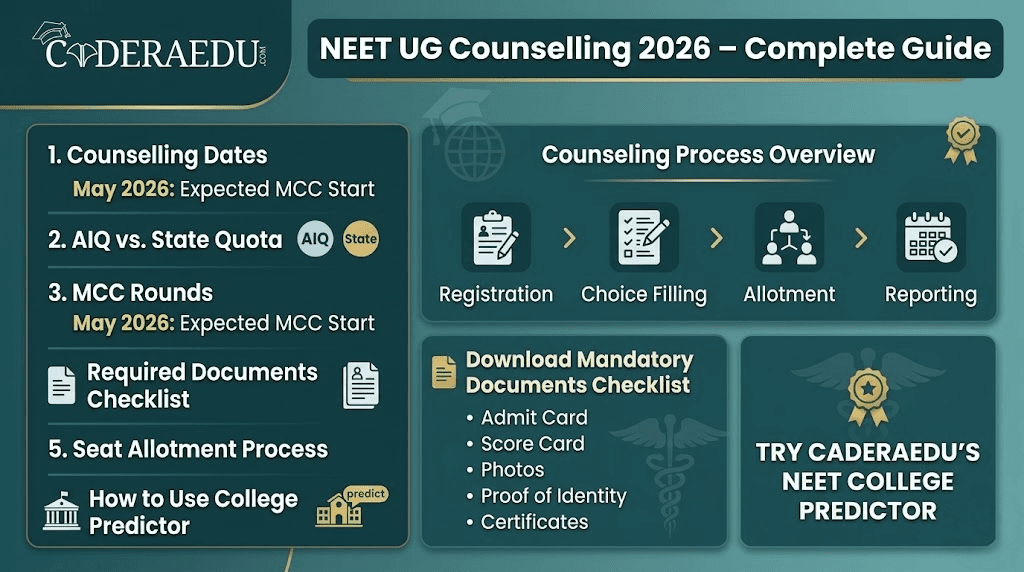
NEET UG counselling is the admission process through which MBBS, BDS, and AYUSH seats are allotted across India based on your NEET rank. Two separate systems run in parallel. The Medical Counselling Committee (MCC) manages the All India Quota (AIQ) — that's 15% of government college seats plus 100% of seats at AIIMS and JIPMER institutions. State counselling bodies handle the remaining 85% of government seats and all private/deemed university seats within their state. You need to register for both separately if you want to maximise your options. Check your MBBS admission chances using the free NEET UG College Predictor 2026 — it covers both AIQ and state quota in one place.
NEET UG Counselling 2026 – Expected Schedule
The MCC typically announces its counselling schedule within 3–4 weeks of NEET UG results. Based on past patterns, here's what to expect for 2026:
Table
| Round | Activity | Approx. Timeline |
|---|---|---|
| Round 1 | MCC Registration + Choice Filling + Seat Allotment | July 2026 (Week 2–3) |
| Round 2 | Fresh Registration / Upgradation + Allotment | August 2026 (Week 1–2) |
| Mop-Up Round | Remaining AIQ seats filled | August 2026 (Week 3–4) |
| Stray Vacancy Round | Final leftover seats | September 2026 |
| State Quota Rounds | Varies by state (typically 3–4 rounds) | July–September 2026 |
3 columns · 6 rows
These are based on 2024–25 timelines. The MCC publishes the official schedule on mcc.nic.in, so bookmark it. Do not rely on WhatsApp forwards for dates.
MCC AIQ Counselling – How It Works
AIQ is the route to the most competitive seats in the country — AIIMS New Delhi, JIPMER Puducherry, and the top government medical colleges. Here's the MCC process in plain English:
- Register on mcc.nic.in and pay the registration fee (General: ₹1,000; SC/ST: ₹500).
- Fill and lock your college choices in order of preference. You can fill up to 50+ options — use them all.
- MCC runs the allotment algorithm based on your rank, category, and choices.
- Check your allotment result. You have three options: Accept & freeze (stop here), Accept & upgrade (stay in the pool for Round 2), or Reject.
- Rejected or unallotted candidates can participate in Round 2.
- Mop-up and stray vacancy rounds fill remaining seats — these are open to fresh candidates too, so stay registered.
- Report to your allotted college with original documents within the reporting deadline. Miss it and the seat cancels automatically.
For AIIMS institutions specifically, even a single rank inside the top 50 is usually needed for AIIMS Delhi. If your rank is in the 1,000–5,000 range, other new AIIMS campuses are realistic targets. See the AIIMS Patna admission details and explore all AIIMS Bhubaneswar ranking and cutoffs to calibrate your choices.
State Quota Counselling – What's Different
State quota covers 85% of government MBBS/BDS seats — and for most students outside the top 10,000 rank, this is where they'll actually get admitted. Each state runs its own process. Some key differences from MCC:
- You usually need domicile proof or state residency documents. States like Maharashtra and Tamil Nadu are strict about this.
- Reservation norms vary by state — OBC creamy layer rules, EWS documentation, and PwD certificate formats differ.
- Private and deemed university seats within the state fall under state counselling or the specific college's management quota.
- Registration windows are often shorter than MCC — sometimes just 5–7 days.
- Multiple counselling bodies can operate within the same state (e.g., DGME for government seats, separate bodies for private colleges).
Before choosing your state quota colleges, run a NEET rank prediction filtered to your state to see realistic options. The tool shows opening and closing ranks from previous years so you're not guessing.
Documents Required for NEET UG Counselling 2026
Missing documents at the reporting stage is one of the most avoidable ways to lose a seat. Prepare these before counselling even starts:
- NEET UG 2026 admit card
- NEET UG 2026 scorecard / rank letter
- Class 10 mark sheet and certificate (for DOB proof)
- Class 12 mark sheet and pass certificate
- Photo ID proof (Aadhaar card preferred)
- Category certificate (OBC/SC/ST/EWS) — issued by the appropriate authority, not older than 1 year for OBC
- PwD certificate (if applicable) — must be from a government hospital's medical board
- Domicile / residence proof (for state quota)
- 8–10 passport-size photographs (recent, white background)
- Provisional allotment letter (downloaded from MCC or state counselling portal)
OBC certificates need to be on the central government format for AIQ counselling — state-issued OBC certificates are not accepted by MCC. This catches a lot of students off guard.
How to Fill College Choices Smartly
This is where most students make their biggest mistake — either being too conservative (not filling enough choices) or too ambitious (ignoring realistic cutoffs). Here's a method that works:
- Use a college predictor first. Input your NEET rank and category into the CaderaEdu NEET College Predictor to get a shortlist with admission probability labels.
- Sort into three buckets: Reach (closing rank better than yours by 5–10%), Realistic (closing rank close to yours), and Safe (closing rank comfortably below yours). Fill at least 5 colleges in each bucket.
- Put AIIMS, JIPMER, and top government colleges at the top — you can always decline a seat.
- Don't skip private/deemed colleges if you're open to them. Seats at institutions like DY Patil Medical College Kolhapur fill up fast in later rounds.
- Lock your choices before the deadline. Do NOT wait until the last hour — portal traffic spikes crash it every year.
Understanding Seat Types: AIQ vs State vs Management vs NRI
A lot of confusion comes from not understanding that the same college can have different seat pools with completely different cutoffs.
Table
| Seat Type | Who Fills It | Typical Fees | Reservation |
|---|---|---|---|
| AIQ Government | MCC (15% of govt seats) | ₹50,000–₹1,00,000/year | Central reservation norms apply |
| State Quota Government | State counselling body (85% of govt seats) | ₹50,000–₹1,50,000/year | State reservation norms apply |
| Deemed University (AIQ) | MCC Deemed round (100% of deemed seats) | ₹15L–₹25L/year | No SC/ST/OBC/EWS reservation |
| Management Quota | College management directly | ₹15L–₹30L/year | No merit-based reservation |
| NRI/OCI Quota | College management (15% of seats) | USD fees apply | Open to NRI/OCI/Foreign nationals |
4 columns · 6 rows
For students targeting top MBBS colleges in India, government AIQ seats are the gold standard. But if your rank makes deemed or private colleges a real option, compare fees carefully before deciding. Five years of fees add up to a very different number.
NEET Cutoff 2026 – What Rank Gets You Where?
Based on 2024–25 counselling data, here's a rough rank-to-college mapping for the General (UR) category:
- Rank 1–50: AIIMS New Delhi (highly competitive; most years even Rank 30–40 gets through). See AIIMS New Delhi admission details.
- Rank 50–2,000: Other AIIMS campuses, JIPMER, Maulana Azad, Lady Hardinge, VMMC New Delhi.
- Rank 2,000–10,000: Top government colleges in metro states — Grant Medical Mumbai, Madras Medical College, KGMU Lucknow.
- Rank 10,000–50,000: Good state government colleges through state quota. NEET score of ~550 marks typically corresponds to this range.
- Rank 50,000–1,50,000: State government colleges in smaller states and mid-tier private colleges through AIQ Deemed.
- Rank 1,50,000+: Still a real chance at government seats under reserved categories, and private/deemed colleges remain available.
These numbers shift every year based on the number of qualified candidates and seat availability. The accurate way to check is to filter by your actual rank on the NEET rank and college predictor it uses previous year closing ranks as the baseline.
Reserved Categories – How Cutoffs Work Differently
Reserved category candidates (OBC, SC, ST, EWS) often have significantly lower closing ranks for the same seat. A rank of 1,50,000 under OBC-NCL can still secure a government MBBS seat in several states. The qualifying percentile itself is lower too 40th percentile for OBC/SC/ST vs 50th for General. What matters is ensuring your certificate is valid, current, and in the right format before counselling starts. For state quota, an OBC certificate issued by the state revenue department works — but for MCC AIQ, you need the central government format. Get both issued well in advance.
Top Government Medical Colleges to Target in 2026
If you're building your choice list, these are the colleges that consistently rank at the top. Explore their individual cutoff pages to see year-wise closing ranks:
- AIIMS New Delhi – Rank 1 in India; needs a top-50 rank for General category.
- AIIMS Nagpur – Newer campus, closing ranks more accessible.
- AIIMS Patna – Good clinical exposure; closing rank typically in 2,000–5,000 range.
- AIIMS Raipur – Cutoff data available to check your chances.
- AIIMS Bhubaneswar – Strong faculty; East India's top choice after Kolkata.
- AIIMS Kalyani – Newer campus with expanding infrastructure.
- Top Private Medical Colleges in India – If government seats aren't possible, this list is your next step.
NEET PG – What Comes After MBBS?
You're applying for MBBS now, but it helps to understand where this road goes. After completing your MBBS, NEET PG is the entrance exam for MD/MS specialisations. The NEET PG college predictor is something you'll want to bookmark for 5–6 years from now but it also gives you a sense of which MBBS colleges produce graduates who get into competitive PG seats.
Common Mistakes Students Make During Counselling
I've seen these patterns repeat year after year. Avoid them:
- Not registering for both MCC and state counselling simultaneously. They run in parallel — missing state registration because you were waiting for MCC results is a real and common mistake.
- Filling only 5–10 college choices. You're allowed to fill many more. Use the full list. A broader choice set means better allotment outcomes.
- Ignoring mop-up rounds. Many students give up after Round 2. Mop-up and stray vacancy rounds fill real seats — sometimes at colleges that didn't fill in earlier rounds.
- Not verifying college NMC approval status before filling choices. Seats in colleges with lapsed recognition can't be used for further education or licensing.
- Waiting to report. The reporting window is short — often 3–5 days. Book travel and accommodation before the allotment result, not after.
- Over-relying on coaching centre rank predictions. Use actual data from a rank-based college predictor instead.
How to Use a College Predictor Effectively
A college predictor is only as useful as the inputs you give it. Here's how to use it well:
- Input your rank, not your marks. Predictors work on rank. Convert marks to rank using previous year mark-vs-rank data.
- Select your correct category. Don't check General if you're OBC — you'll see inflated cutoffs.
- Run it twice — once for AIQ and once for state quota. The results will be very different.
- Note the admission probability labels: High means your rank is clearly below the closing rank. Moderate means you're in the zone. Low means it's a stretch.
- Export or screenshot the results before your choice filling window opens. Portals slow down near deadlines.
The CaderaEdu NEET Predictor requires no login and covers all major states. If you need 1-on-1 guidance on interpreting results or building your choice list, the platform's counselling team is available for free sessions.
State-Wise Counselling Bodies – Quick Reference
Every state has its own body managing NEET state quota counselling. Here are some of the major ones and what to know about each:
Table
| State | Counselling Body | Key Feature |
|---|---|---|
| Maharashtra | DMER Maharashtra | Domicile requirement strict; OBC-SBC categories have separate pools |
| Tamil Nadu | TNMGRMU / Health dept | State rank list used; NEET merit order within state |
| Uttar Pradesh | DGME UP / UPTAC | Large seat pool; private colleges also under UPTAC for some categories |
| Karnataka | KEA | NEET rank used directly; OBC sub-category reservations apply |
| Kerala | CEE Kerala | Centralised for govt and some private; NRI seats allocated separately |
| Rajasthan | RUHS / State Medical Board | Domicile proof required; separate rounds for private colleges |
3 columns · 7 rows
After Seat Allotment – Reporting and Fee Payment
Getting a seat allotted is not the same as securing admission. You have to physically report to the college (or in some cases to the state facilitation centre) within the stipulated window. Here's what happens at reporting:
- Carry all original documents plus three sets of photocopies. Always self-attest copies.
- Pay the admission fee as directed — usually via demand draft or online payment. Keep the receipt.
- College officials will verify your documents. If there's a discrepancy, they may provisionally admit you and ask you to resolve it within a fixed window.
- Collect your provisional admission letter from the college. This is your proof of admission until the final letter is issued.
- Follow up on hostel and orientation dates — these often aren't communicated proactively.
Should You Appear for NEET UG Again?
If this year's rank didn't land you where you wanted, the question of a drop year comes up. It's not a simple yes or no. A drop year can make sense if you were close (rank in the 10,000–30,000 range) and genuinely believe you underperformed. It rarely makes sense if the gap is massive or if you've already scored in the 500+ range and have a decent option available. More important: explore all your current options fully before deciding. Run the predictor across every quota and state. Talk to someone who has navigated this process. CaderaEdu has free expert counselling sessions — use them before making any decision about a gap year. You can explore all science exam pathways on the platform to understand alternatives like BDS, BAMS, and other allied health programmes as well.
Useful Resources for NEET UG Counselling 2026
- NEET UG College Predictor 2026 – Check your college chances free, no login needed
- Top MBBS Colleges in India – Full list with fees, rankings, and admission details
- Top Private Medical Colleges in India – Private and deemed options with data
- AIIMS New Delhi – Admission Details
- NEET PG College Predictor – Plan your post-MBBS path
- CaderaEdu Blog – Latest updates on medical admissions and exam news
- All Science Exam Pathways – Explore NEET, FMGE, and more
Topics:
Share this article
Copy
Frequently Asked Questions
When does NEET UG Counselling 2026 start?
MCC typically begins AIQ counselling 3–4 weeks after NEET UG results are declared. Based on past patterns, Round 1 registration is expected in July 2026. Check mcc.nic.in for the official schedule once results are out.
Do I need to register separately for MCC and state counselling?
Yes. MCC and state counselling run in parallel and have separate registration processes, fees, and deadlines. You must register for both independently to maximise your admission options.
What is the difference between AIQ and state quota?
AIQ (All India Quota) is 15% of government MBBS seats and 100% of AIIMS/JIPMER seats, managed by MCC. State quota is the remaining 85% of government seats, managed by each state's own counselling body. Private and deemed colleges fall under a separate MCC Deemed round.
Which documents are mandatory for NEET UG 2026 counselling?
NEET scorecard, Class 10 and 12 mark sheets, photo ID (Aadhaar), category certificate (if applicable), domicile proof for state quota, PwD certificate (if applicable), and passport-size photographs. Always carry originals plus multiple sets of photocopies.
Can I participate in counselling with a low NEET rank?
Yes. Reserved category candidates (OBC/SC/ST/EWS) qualify at the 40th percentile, and there are state government and private college seats available at various rank levels. Use the NEET UG College Predictor at caderaedu.com/predictor/free-Neet-UG-Predictor to see realistic options at your specific rank.
What happens if I miss the reporting deadline after seat allotment?
Your seat is automatically cancelled. The reporting window is typically 3–5 days and is non-negotiable. Book travel in advance and do not wait for the allotment result before making travel arrangements.
Is it possible to upgrade my seat in Round 2?
Yes. If you choose 'Accept and Upgrade' in Round 1, you stay in the Round 2 pool. If a better seat is allotted, your previous seat is automatically cancelled. If no better seat is available, you retain your Round 1 allotment.