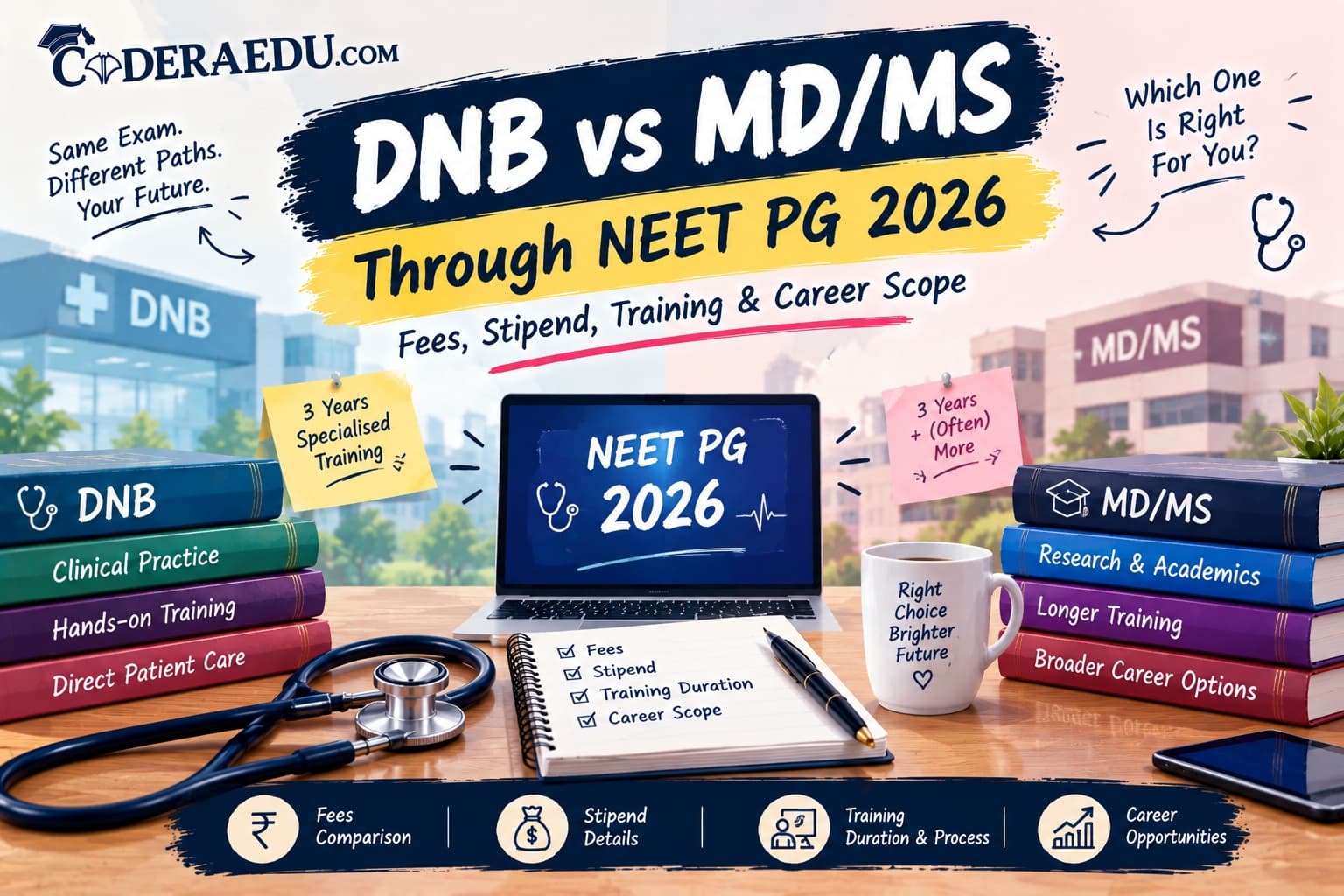
DNB vs MD/MS Through NEET PG 2026: Fees, Stipend, Training & Career Scope

AditiUpdated on 08 Nov 2026, 11:49 AM IST
7 minutes read
Click to enlarge
Rank in hand, seat matrix open, and now the real dilemma: take the MD/MS seat in a smaller city, or the DNB seat at a well-known private hospital in a metro. Both are counselled through NEET PG, both lead to a postgraduate medical qualification, but the fee, the stipend, the training environment and the paperwork after you finish are genuinely different. Here is what actually separates DNB from MD/MS, without the usual oversimplified "DNB is the same as MD" line.
DNB, MD and MS: Who Awards What
MD (Doctor of Medicine) and MS (Master of Surgery) are university degrees. They are awarded by the specific medical university or deemed university your college is affiliated to, under NMC regulations. DNB (Diplomate of National Board) is not a university degree at all. It is a diploma awarded directly by the National Board of Examinations in Medical Sciences (NBEMS), earned through training at an NBEMS-accredited hospital rather than a university-affiliated medical college.
This distinction in awarding body is the root of most practical differences between the two paths, from where you train to how your final exam is structured.
Admission Route Through NEET PG 2026
Both MD/MS and DNB broad-specialty seats are filled using your NEET PG rank, but through different counselling layers.
- MD/MS seats in government and private medical colleges are counselled through the 50% All India Quota (AIQ) via MCC, and the remaining 50% through respective state counselling authorities.
- DNB (Diploma) seats that fall under the central pool are counselled through MCC alongside MD/MS in the same combined matrix.
- Standalone DNB broad-specialty seats at NBEMS-accredited hospitals, outside the MCC matrix, are counselled separately by NBEMS through its own portal.
- Which seats you actually see in your choice list depends on your NEET PG rank, category, quota and the specific round you are registering in, exactly as with any other counselling cycle.
Duration and Training Environment
Both broad-specialty DNB and MD/MS run for three years. The difference is where that training happens. MD/MS students train inside a university-affiliated medical college, typically alongside undergraduate MBBS teaching activity. DNB residents train inside an NBEMS-accredited hospital, which can be a large government hospital, a corporate multi-speciality hospital, or a smaller standalone centre, depending on where the seat is located.
This matters for day-to-day exposure. A DNB seat at a busy corporate hospital can offer excellent case volume, while a smaller accredited centre may offer far less. University hospitals usually carry a more standardised academic structure, with scheduled teaching rounds and a larger cohort of co-residents.
Exit Examination: How MD/MS and DNB Differ
MD and MS candidates clear their university's own exit examination, typically comprising theory papers, a thesis, and a practical/clinical examination, with the exact pattern set by that university.
DNB candidates appear for the NBEMS-conducted DNB Final Examination, with theory, practical/clinical components, and a thesis that must be accepted before the final exam. The DNB final exam has at times shown lower first-attempt pass rates in some specialties than university MD/MS exams, but this varies by year and specialty, so check the latest DNB Information Bulletin on the NBEMS exam portal rather than treating it as fixed.
DNB vs MD/MS: Fees and Stipend
Fees and stipends vary sharply by institution, state, specialty and quota, so treat the ranges below as general, education-platform-reported figures rather than a fixed official rate card. Always confirm the exact fee and stipend directly with the specific institute before accepting a seat.
Table
| Parameter | Government MD/MS | Private MD/MS (Deemed University) | DNB (Government-run hospital) | DNB (Private/Corporate hospital) |
|---|---|---|---|---|
| Typical annual fee | Low, largely subsidised | Can run into several lakhs per year, especially in clinical branches | Minimal to low institutional fee | Generally lower than private MD/MS, but varies widely by hospital |
| Typical monthly stipend | Competitive, among the higher brackets | Often lower than government MD/MS | Comparable to government MD/MS at many centres | Varies by hospital; can be lower at smaller accredited centres |
| Bond requirement | Common in several states, terms vary by state | Less common, but check specific college rules | Varies by hospital and state; not uniform | Varies by hospital; private bonds can carry a financial penalty clause |
5 columns · 4 rows
As a rule of thumb reported across several education sources, DNB at a private or corporate hospital tends to work out cheaper than an MD/MS seat in a private deemed university, while a government MD/MS seat usually remains the most subsidised route of all. This is a general pattern, not a guarantee for any specific institute, so verify the actual fee notice before counting on it.
Recognition and Equivalence: What's Actually Settled
Under the National Medical Commission Act, 2019, and a Gazette of India notification issued by the Ministry of Health and Family Welfare, DNB, DrNB and FNB qualifications are recognised as equivalent to the corresponding MD, MS and DM/MCh qualifications for the purpose of registration and medical practice in India. This equivalence for registration and practice is settled policy.
Teaching eligibility is a separate, more specific question with ongoing clarification between NBEMS, the NMC and the Ministry of Health. Parliamentary panels and regulatory notifications have at different points taken different positions on whether DNB holders are automatically eligible for medical college faculty posts on the same footing as MD/MS holders, or whether conditions like specific senior residency experience apply. If this affects your decision, check the current Teachers' Eligibility Qualifications Regulations on the NMC or NBEMS website rather than relying on any single older article.
Career Scope After DNB and MD/MS
For clinical practice, private practice, and government service, DNB and MD/MS holders broadly compete in the same job market once registered, since both are recognised postgraduate medical qualifications.
- Both DNB broad-specialty and MD/MS graduates are eligible to appear for NEET-SS to pursue a super-specialty, subject to the specific super-specialty's feeder-specialty rules, which should be checked each cycle since they can be revised.
- NBEMS also runs its own super-specialty programme, DrNB, as a parallel track to the university-based DM/MCh route.
- Hospital employers, particularly in the private sector, generally evaluate candidates on hands-on experience and case exposure during residency more than on whether the qualification is a DNB or an MD/MS, though some institutions have historically shown a preference in specific contexts.
- For an academic career inside a medical college, teaching eligibility rules matter more directly, so revisit the point above before assuming either path guarantees a faculty position later.
When Might an MD/MS Seat Be the Better Choice?
- If a government MD/MS seat is available at a reasonably ranked university hospital with a strong academic reputation, the heavily subsidised fee and standardised structure usually make it the safer financial choice.
- If you specifically want to pursue academic medicine and teaching eligibility is a near-term priority, an MD/MS from a recognised university currently carries less regulatory ambiguity than DNB on this specific point.
- If your target specialty has very few DNB-accredited centres with strong case volume, an MD/MS seat with a larger, more established department may offer more consistent training.
When Might a DNB Seat Be the Better Choice?
- If the alternative is a very expensive private MD/MS seat and a DNB seat is available at a well-regarded, high-volume hospital, DNB can offer comparable clinical training at a meaningfully lower cost.
- If a DNB seat is at a large corporate or government hospital with heavy patient load in your chosen specialty, the hands-on exposure can match or exceed a lower-volume university MD/MS department.
- If your priority is clinical practice or private-sector employment rather than an academic teaching career, the recognised equivalence for registration and practice makes DNB a genuinely competitive option.
Internal Resources to Explore
These CaderaEdu pages cover related NEET PG counselling, seat matrix and admission details.
- NEET PG Exam Overview
- NEET PG 2026 Eligibility and Important Dates
- NEET PG Counselling 2026: AIQ and State Quota Schedule
- NEET PG Counselling 2026: MCC AIQ Rounds and Stray Vacancy
- MD Courses, Fees and Admission Guide
- MS Courses, Fees and Admission Guide
- Medical College Predictor
- CaderaEdu College Predictor (All Streams)
- Top Medical Colleges in India
- Medical Counselling Guidance Programme
- Latest Medical Counselling Updates
- Browse All Entrance Exams
- Book a Free Counselling Session
Official External Resources
Always confirm fees, stipends, exam structure and current regulations directly on these official sources before making a decision.
Topics:
Share this article
Copy
Frequently Asked Questions
Is DNB equal to MD or MS in India?
For registration and medical practice, DNB is recognised as equivalent to MD/MS under the NMC Act, 2019, and a related Gazette of India notification. However, teaching eligibility is a separate, more specific issue that has seen regulatory clarification over time, so check the current Teachers' Eligibility Regulations before assuming full equivalence on that particular point.
What is the main difference between MD/MS and DNB?
MD and MS are university degrees awarded after training at a university-affiliated medical college, with the exit exam set by that university. DNB is a diploma awarded by NBEMS after training at an NBEMS-accredited hospital, with a centrally conducted DNB Final Examination that includes theory, practical and thesis components.
Is DNB cheaper than MD/MS?
Government MD/MS seats are usually the most subsidised option overall. Among private options, DNB at a private or corporate hospital is generally reported to be less expensive than an MD/MS seat at a private deemed university, though exact fees vary by hospital and specialty, so confirm the current fee directly with the institute.
Does DNB stipend differ from MD/MS stipend?
Stipends vary by institution rather than by qualification type alone. Government MD/MS and government-linked DNB stipends are often in a similar, relatively higher bracket, while private MD/MS and smaller private DNB centres can both pay less, depending on the specific hospital's policy.
Can DNB doctors become teaching faculty in medical colleges?
DNB holders can be eligible for certain teaching faculty positions, but the exact conditions have been subject to ongoing regulatory clarification between NBEMS, the NMC and the Ministry of Health and Family Welfare. Rather than treating this as a fixed yes or no, check the current Teachers' Eligibility Qualifications Regulations on the NMC or NBEMS website for your specific specialty and post before making a decision based on this factor.
Which is better for NEET-SS, DNB or MD/MS?
Both DNB broad-specialty and MD/MS qualifications make you eligible to appear for NEET-SS, subject to each super-specialty's specific feeder-specialty eligibility rules. Neither path has a blanket advantage, so check the current NEET-SS eligibility criteria for your exact target super-specialty each cycle.
Should I choose a DNB seat or wait for an MD/MS seat in a later NEET PG round?
This depends on the specific seats on offer. A DNB seat at a high-volume, well-regarded hospital can be a strong choice, while a significantly better-ranked MD/MS seat might be worth waiting for in a later round. Compare the actual training environment, fee, and stipend of the specific seats in front of you rather than deciding on the DNB-versus-MD/MS label alone.