MCC Counselling 2026 Explained: Everything You Need to Know
S
Super AdminAuthor
22 June 2026
15 minutes read
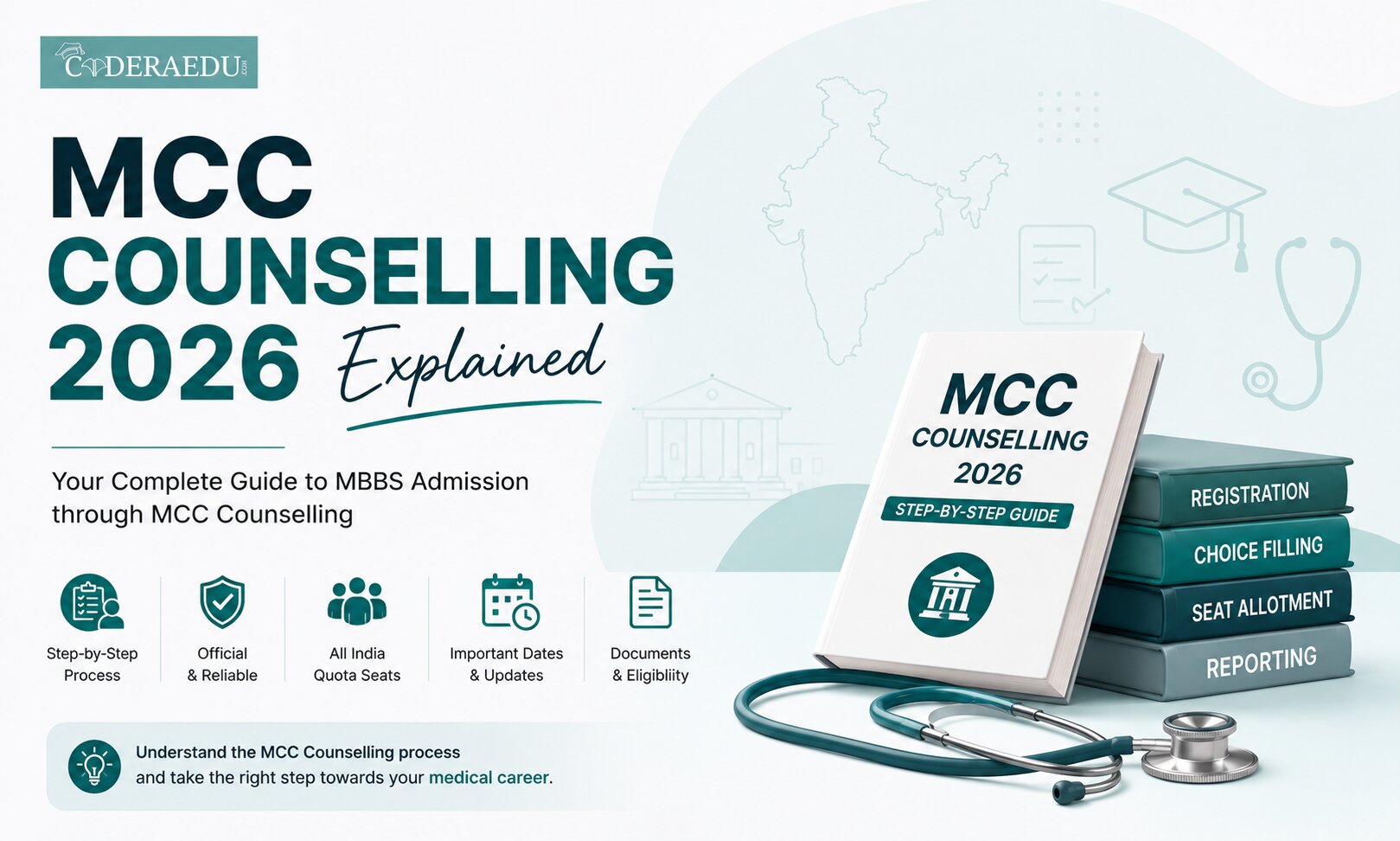
Click to enlarge
Over 1,09,000 MBBS and BDS seats are up for grabs across India in 2026 — and the gateway to the most sought-after chunk of them runs through a single portal: mcc.nic.in. The Medical Counselling Committee (MCC) controls All India Quota seats in every government medical college, every AIIMS campus, JIPMER, and all deemed universities. If you have cleared NEET UG 2026, understanding exactly how MCC Counselling 2026 works is not optional — it is the difference between a well-planned admission and a missed seat. This guide walks you through every stage: eligibility, registration, choice filling, round-wise allotment, and the documents you need to carry on reporting day. Medical Counselling Committee (MCC)
What is MCC Counselling 2026?
The Medical Counselling Committee is a body under the Directorate General of Health Services (DGHS), Ministry of Health and Family Welfare, Government of India. It conducts centralised online counselling for MBBS, BDS, and AYUSH (through AACCC) seats that fall under the All India Quota. MCC does not conduct state quota counselling — those 85% of government seats are managed separately by each state's own authority.
Under MCC Counselling 2026, seats are filled across four categories of institutions: government medical colleges (15% AIQ seats), all 23 AIIMS campuses (100% seats), JIPMER Puducherry and JIPMER Karaikal (100% seats), and all MCI/NMC-approved deemed universities (100% seats). Private unaided colleges that are not deemed universities do not fall under MCC — they conduct their own counselling or participate through state authorities. For a full list of colleges under MCC's jurisdiction, the National Medical Commission (NMC) publishes an updated approved college list annually. National Medical Commission (NMC)
MCC Counselling 2026 — Expected Schedule and Important Dates
The NEET 2026 cancellation and Re-NEET held on June 21, 2026 has pushed the counselling calendar by approximately 6–8 weeks from the standard timeline. Based on historical MCC patterns — where counselling typically begins 3–4 weeks after the NEET result — the following dates are expected. Bookmark mcc.nic.in and check it daily once the result drops; the official notification supersedes any schedule shared on social media.
Table
| Event | Expected Timeline (2026) |
|---|---|
| NEET UG 2026 Result | July 2026 (expected) |
| MCC Counselling 2026 Schedule Notification | July 2026 |
| Round 1 — Registration & Fee Payment | Late July / Early August 2026 |
| Round 1 — Choice Filling & Locking | Late July / Early August 2026 |
| Round 1 — Seat Allotment Result | August 2026 |
| Round 1 — Reporting at Allotted College | August 2026 |
| Round 2 — Registration & Choice Filling | August / September 2026 |
| Round 2 — Seat Allotment & Reporting | September 2026 |
| Mop-Up Round — Registration & Allotment | September / October 2026 |
| Stray Vacancy Round | October 2026 |
2 columns · 11 rows
Who is Eligible for MCC Counselling 2026?
Eligibility for MCC Counselling 2026 is straightforward compared to state counselling, which often has strict domicile requirements. The core criteria are as follows:
- Must have appeared in and qualified NEET UG 2026 — i.e., scored at or above the qualifying percentile (50th percentile for General/OBC, 40th for SC/ST/PwD).
- Must be an Indian citizen, NRI, OCI, or PIO. NRI and OCI candidates can participate in NRI quota seats at deemed universities through MCC.
- Age: minimum 17 years as of December 31, 2026. There is no upper age limit for MBBS admission as per the Supreme Court ruling.
- Class 12 with Physics, Chemistry, and Biology/Biotechnology as core subjects with at least 50% aggregate (General); 40% for SC/ST/OBC; 45% for PwD.
- No domicile restriction for AIQ seats — any NEET-qualified student from any state can apply through MCC regardless of which state they belong to.
- For AIIMS campuses, the same NEET UG score is used — no separate AIIMS entrance exam exists since 2020.
Check the detailed NEET eligibility criteria for 2026 on CaderaEdu if you have any doubts about qualification thresholds, especially for reserved categories or PwD candidates where the norms differ. NEET eligibility criteria for 2026
Step-by-Step MCC Counselling 2026 Process
The MCC process follows four well-defined stages in each round. Missing any one of them — particularly choice locking — can result in no allotment even if your rank is competitive. Here is a detailed breakdown.
Step 1: Registration and Fee Payment
Visit mcc.nic.in and register using your NEET UG 2026 roll number and date of birth. Once registered, pay the non-refundable registration fee and a refundable security deposit. For 2025, MCC charged ₹1,000 registration fee for General/OBC and ₹500 for SC/ST/PwD, plus a security deposit of ₹10,000 (General) and ₹5,000 (SC/ST/PwD) — 2026 amounts may be revised, confirm on the official portal. The security deposit is refunded if you do not receive an allotment or choose to exit after Round 1. It is forfeited if you receive a seat from Round 2 onward and do not report.
Step 2: Choice Filling and Locking
Choice filling is the most consequential step in MCC Counselling 2026. You can add as many colleges and courses as you want from the MCC list — there is no upper limit and no penalty for listing more. The system allots you the highest preference for which your rank qualifies, so a longer, well-ordered list always produces better outcomes than a short one. Before the choice filling window opens, research your options thoroughly using top MBBS colleges in India on CaderaEdu — individual college pages show round-wise opening and closing ranks across all categories from previous years, which is the most reliable predictor of this year's cutoffs. top MBBS colleges in India
Order your list with your most preferred options at the top — typically AIIMS New Delhi, other AIIMS campuses, JIPMER, and top government colleges — followed by deemed universities and private colleges. Once you are satisfied, lock your choices. An unlocked list is treated as empty by the system. The MCC portal experiences heavy traffic in the final hours before the deadline — lock your list at least 12 hours early.
Fill 40–50 choices minimum. Students who restrict themselves to 10–15 colleges out of brand preference routinely end up with no allotment when all 15 close above their rank.
Step 3: Seat Allotment Result
MCC publishes the seat allotment result on mcc.nic.in on the scheduled date. The algorithm matches each candidate to the highest-ranked preference on their list for which their rank and category qualifies, subject to seat availability. Check your allotment only on the official portal — third-party sites publish results that are sometimes incorrect or delayed. After checking, you have three options: accept the seat and report to the college, accept and upgrade (participate in the next round hoping for a better allotment while holding this seat), or exit the process freely (only in Round 1).
Step 4: Reporting to the Allotted College
If you decide to join your allotted college, report in person within the stipulated window — typically 3 to 5 days from the allotment date. Carry all original documents and self-attested photocopies. The college conducts physical document verification and confirms your admission. If you are simultaneously allotted a seat through state counselling, you must resign from one before the cross-over deadline. Holding seats in both simultaneously past the deadline invites penalty and possible cancellation of both allotments.
Documents Required for MCC Counselling 2026
Prepare this document set before registration opens — some certificates, particularly EWS and OBC-NCL in central government format, can take 2–3 weeks to obtain from the issuing authority. For AIQ, state-format OBC certificates are not accepted; you need the central list OBC-NCL certificate.
- NEET UG 2026 Admit Card and Scorecard / Rank Letter
- Class 10 Mark Sheet and Certificate (date of birth proof)
- Class 12 Mark Sheet and Passing Certificate (PCB marks verification)
- Transfer Certificate and Migration Certificate
- Government-issued Photo ID: Aadhaar Card / Passport / Voter ID
- Passport-size photographs — minimum 10, recent, white background
- Category Certificate (SC/ST/OBC-NCL/EWS) — must be in central government format for AIQ; state format not accepted at MCC level
- PwD Certificate (if applicable) — issued by a government medical board, not a private doctor
- Domicile Certificate (not mandatory for AIQ but keep it ready for state counselling running in parallel)
- Income Certificate for EWS category — issued by a gazetted officer or tehsildar
- NRI/OCI/PIO documents (if applying under NRI quota at deemed universities)
- Medical Fitness Certificate from a registered medical practitioner
MCC Counselling 2026 Rounds Explained
MCC AIQ counselling runs across four distinct rounds, each with its own registration window, choice filling period, and allotment result. A critical point that catches many students off guard: your choice list from Round 1 does not carry forward. Fresh registration and fresh choice filling is required in every round.
Table
| Round | Who Can Participate | Exit Without Penalty? | Security Deposit |
|---|---|---|---|
| Round 1 | All NEET-qualified candidates | Yes — free exit permitted | Refunded on exit |
| Round 2 | Fresh candidates + Round 1 free exits + upgrade seekers | No — deposit forfeited if allotted seat not joined | Forfeited on non-reporting |
| Mop-Up Round | Fresh registration required; candidates who exited or upgraded in Round 2 | No — deposit forfeited on non-reporting | Forfeited on non-reporting |
| Stray Vacancy Round | Conducted at college level for seats vacant after Mop-Up; very short window of 2–3 days | No | Forfeited on non-reporting |
4 columns · 5 rows
The Mop-Up Round is often underestimated. Seats at excellent colleges — including some AIIMS campuses and top government colleges — open up in the Mop-Up Round as candidates who received those allotments in Rounds 1 or 2 upgrade to a better option. Students with mid-range ranks who missed a desired college in earlier rounds should always participate in Mop-Up with a fresh, strategically updated choice list.
Colleges Covered Under MCC Counselling 2026
MCC Counselling 2026 is the only route to seats at the following categories of institutions — state counselling does not cover these.
AIIMS Campuses
All 23 AIIMS campuses are exclusively under MCC — 100% of their MBBS seats are filled through AIQ counselling. AIIMS New Delhi remains the most competitive, requiring a top-50 All India Rank for General category. Other campuses — AIIMS Bhopal, AIIMS Jodhpur, AIIMS Rishikesh, AIIMS Patna, AIIMS Bhubaneswar, and newer campuses — are accessible at progressively lower cutoffs, with several reachable at AIR 1,500–3,000 in General category. Explore the full AIIMS New Delhi admission details and individual AIIMS campus pages on CaderaEdu for fee structure, seat matrix, and previous year cutoffs. AIIMS New Delhi admission details
JIPMER
JIPMER Puducherry and JIPMER Karaikal both fall entirely under MCC. JIPMER Puducherry is among the most competitive institutions after AIIMS New Delhi, with General category cutoffs around AIR 50–200 in recent years. JIPMER Karaikal is considerably more accessible.
Government Medical Colleges (AIQ Seats)
15% of seats in every state government medical college are reserved for All India Quota and filled by MCC. This means that for every 100 MBBS seats in a government college, 15 go through MCC and 85 go through state counselling. These AIQ seats are highly competitive because all NEET qualifiers across India compete for them — the cutoffs are typically 30,000–80,000 ranks higher than the same college's state quota cutoff. Browse the government medical colleges in India on CaderaEdu to see AIQ vs state quota cutoff comparisons by institution. government medical colleges in India
Deemed Universities
All NMC-approved deemed universities participate exclusively in MCC counselling — they have no state quota seats. This includes institutions like Kasturba Medical College Manipal, Sri Ramachandra Institute Chennai, Amrita Institute of Medical Sciences, and JSS Medical College Mysore. Deemed university seats are split into management quota (filled by the institution directly) and AIQ seats filled through MCC. Fees at deemed universities are significantly higher than government colleges — typically ₹12–25 lakh per year. Research top private medical colleges in India on CaderaEdu for a fee comparison across all 5.5 years before adding deemed university options to your choice list. top private medical colleges in India
Tips to Maximise Your Seat Allotment Through MCC Counselling 2026
The MCC process rewards preparation done before the portal opens, not during the 48-hour choice filling window. These are the habits that separate well-allotted candidates from those who settle for less.
- Research colleges now, before the portal opens. Use round-wise previous year cutoffs on CaderaEdu — not just the college's overall rank. Opening and closing ranks in Round 1 differ significantly from Round 2 and Mop-Up for the same college.
- Register for state counselling simultaneously. MCC and state counselling run in parallel with separate portals and independent deadlines. Not registering for state counselling while waiting for MCC results is the single most costly mistake in NEET admissions.
- Fill 40–50 choices, not 10–15. Put AIIMS campuses and JIPMER at the top, followed by top government colleges, then deemed universities in your fee comfort range. There is no penalty for listing more options.
- For deemed universities, shortlist based on total 5.5-year fee, not annual fee. A ₹15L/year college costs ₹82.5L total — a meaningful difference from a ₹12L/year option at ₹66L total.
- Get your category certificates in central government format well before registration opens. OBC-NCL certificates for central list must come from the state revenue department in the prescribed format — processing takes 2–3 weeks in many states.
- Lock your choice list at least 12 hours before the deadline. MCC portal traffic peaks in the final 2 hours before closing. A server crash with an unlocked list means no allotment.
- In Round 1, if you receive an allotment that is not your first choice, do not exit immediately. Accept the seat and participate in Round 2 for an upgrade — you have the security of a confirmed seat while still competing for a better one.
- Participate in the Mop-Up Round even if Round 2 did not go as expected. Strong seats open up as candidates with multiple allotments resign from less-preferred ones. Update your choice list based on what opened in Round 2 before filling for Mop-Up.
Using CaderaEdu to Prepare for MCC Choice Filling
The quality of your MCC choice list is directly proportional to the quality of research you do before the window opens. CaderaEdu's college database covers every institution under MCC — with round-wise cutoff data, fee breakdowns, infrastructure details, and admission outcomes in one place.
Use the free NEET UG College Predictor to convert your rank into a realistic college shortlist — it covers both AIQ and state quota, so you can plan both counselling tracks simultaneously. For students evaluating MBBS abroad as a backup, CaderaEdu's abroad section covers country-wise eligibility, NMC screening test requirements, and fee structures so you have a complete picture before committing to any path. You can also compare medical colleges side by side on fees, cutoffs, infrastructure, and NIRF rankings to make an informed choice rather than going by name recognition alone. free NEET UG College Predictor MBBS abroad as a backup compare medical colleges
For students who do not secure an MBBS seat through MCC but have a competitive NEET score, BDS admissions use the same rank — top BDS colleges in India are accessible at cutoffs significantly below MBBS for the same government institutions, and the MDS pathway remains a strong career route. Similarly, state-wise NEET 2026 cutoffs on CaderaEdu show exactly what rank is needed for government MBBS in your home state through state quota — often far more achievable than the AIQ equivalent. top BDS colleges in India state-wise NEET 2026 cutoffs
Conclusion
MCC Counselling 2026 is not a lottery — it is a process that rewards candidates who understand the rules, prepare their documents early, research colleges before the portal opens, and fill their choices strategically. With the counselling calendar shifted by 6–8 weeks due to Re-NEET 2026, you have more preparation time than usual. Use it to build a well-researched 40–50 college preference list, verify your category certificates are in the right format, and plan your state counselling registration alongside MCC so you are not leaving options on the table.
Start your college research today on CaderaEdu's free NEET UG College Predictor — no login required, covers AIQ and all major state quotas. The more informed your choice list, the better your allotment. All the best for MCC Counselling 2026. CaderaEdu's free NEET UG College Predictor
Topics:
Share this article
Copy
Frequently Asked Questions
What is MCC Counselling and which seats does it cover?
MCC Counselling is the centralised online admission process conducted by the Medical Counselling Committee (under DGHS, Ministry of Health) for All India Quota MBBS and BDS seats. It covers 15% of seats in all government medical colleges across India, 100% of seats in all 23 AIIMS campuses, 100% of seats at JIPMER Puducherry and JIPMER Karaikal, and 100% of seats at all NMC-approved deemed universities. State quota seats (85% of government college seats) are not covered by MCC and are managed by individual state counselling authorities.
Can students from any state apply for MCC Counselling 2026?
Yes. MCC AIQ counselling has no domicile restriction — any NEET UG 2026 qualified student from any Indian state can register and participate, regardless of which state they belong to. This is one of the key differences from state quota counselling, which is restricted to domicile candidates of that specific state. NRI, OCI, and PIO candidates can also participate in MCC counselling for NRI quota seats at deemed universities.
What happens if I do not report to my allotted college after Round 2?
If you are allotted a seat in Round 2 or later (Mop-Up, Stray Vacancy) and do not physically report to the college within the stipulated window, your security deposit is forfeited. In Round 1, a 'free exit' is permitted — you can choose not to join without losing the deposit, and you can re-enter subsequent rounds. From Round 2 onward, however, non-reporting means losing the deposit. You may still participate in the next round by paying fresh registration, but the forfeited deposit is not returned.
Does my Round 1 choice list automatically carry over to Round 2?
No. This is one of the most commonly misunderstood aspects of MCC Counselling. Your choice list from Round 1 does not carry forward to Round 2 or any subsequent round. Fresh registration and completely fresh choice filling is mandatory for every round you wish to participate in. Use the interval between rounds to update your list based on which colleges had seats remaining after the previous round — this information is published by MCC after each allotment.
What is the difference between the Mop-Up Round and the Stray Vacancy Round?
The Mop-Up Round is a full centralised round conducted by MCC online — candidates register on mcc.nic.in, fill choices, and receive allotment through the standard process. It covers seats left vacant after Rounds 1 and 2. The Stray Vacancy Round, by contrast, is conducted at the individual college level for seats that remain vacant after the Mop-Up Round. It has a very short window of 2–3 days, no online choice filling, and candidates must report directly to the college. Both rounds are equally valid for admission — the Mop-Up Round in particular often sees good seats open up as candidates with multiple allotments resign from less-preferred institutions.
Confused About College Admissions?
Get expert advice on college selection, admission chances, and career path in a personalized counselling session.
Book a Counselling Slot
Select Date
Pick a Slot