Re-NEET 2026 Expected Cutoff: General, OBC, SC, ST & EWS

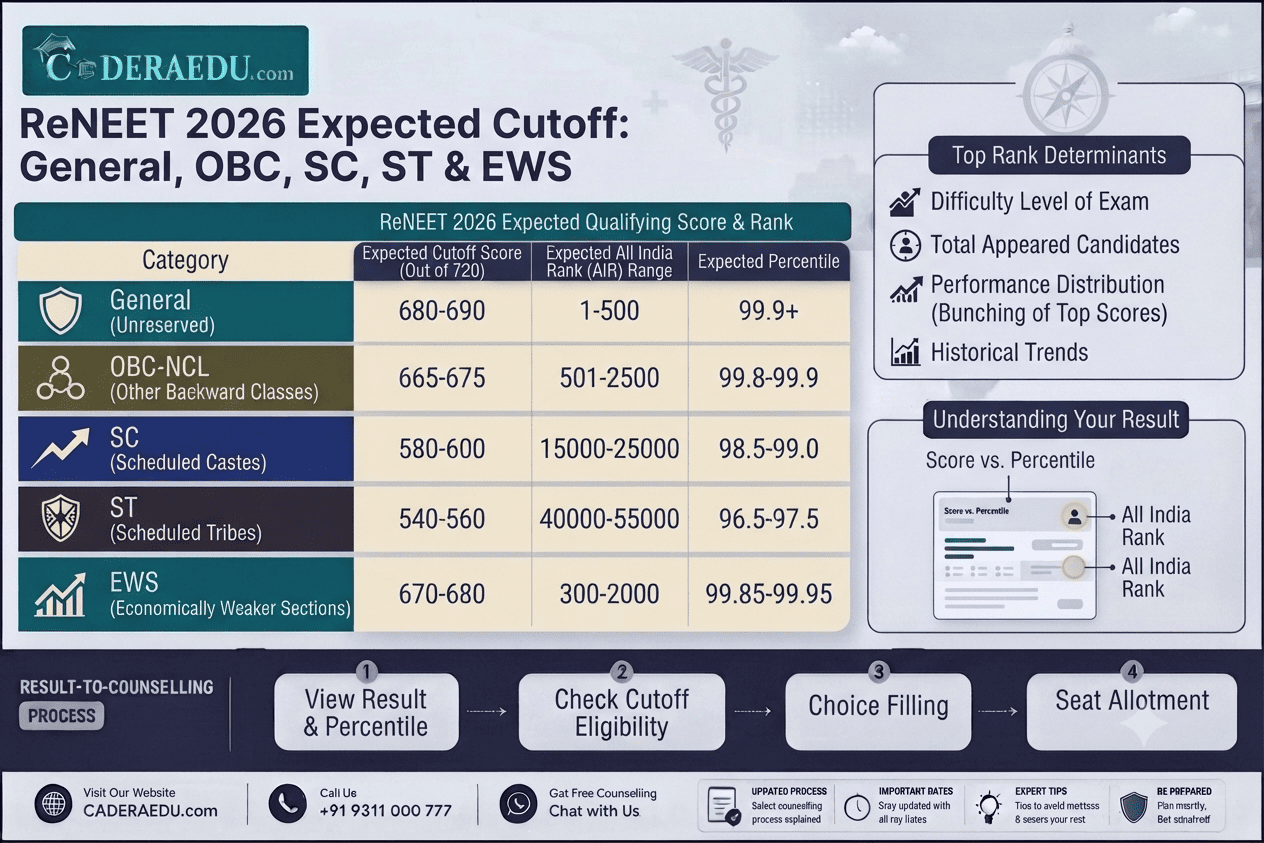
Click to enlarge
The Re-NEET 2026 exam has changed the timeline for lakhs of medical aspirants, but it has not changed the one question every candidate keeps coming back to: what score will actually get me a seat this year? With a fresh exam date, a slightly different candidate pool and a compressed admission calendar, the cutoff conversation for 2026 needs a second look. This guide walks through the expected Re-NEET 2026 cutoff category wise, covering General, OBC, SC, ST and EWS candidates, so you know where your score is likely to stand before the official result arrives. If you want a personalised read on your own marks rather than a general range, you can run them through CaderaEdu once your scorecard is out.
Why Re-NEET 2026 Makes the Cutoff Harder to Predict
NEET UG 2026 was originally held in May and was later cancelled following a paper leak controversy, with the Supreme Court directing a fresh test. Re-NEET 2026 was conducted on a rescheduled date with the same syllabus, same pattern and the same 720 mark structure. On paper, nothing changed about how the exam works. In practice, cutoffs move with two things: how the paper was set and how many candidates actually sat for it, and a re-exam disturbs both. Some students who wrote the original paper skipped the re-test, some borderline candidates prepared harder in the extra weeks, and the difficulty level of a freshly written paper is rarely identical to the one that got cancelled. All of this means the 2026 cutoff will track close to past years but should not be read as a copy paste of any single previous year.
How the Percentile System Actually Decides Your Qualifying Mark
A lot of confusion around NEET cutoffs comes from treating the qualifying mark as a fixed number that stays the same every year. It is not. NTA sets the qualifying cutoff as a percentile, not a raw score, which means the actual marks that meet the 50th percentile for General category can move up or down depending entirely on how that year's candidates performed. In an easier year, more students cross higher marks, so the percentile line sits at a higher raw score. In a tougher year, the same percentile line sits lower. This is exactly why the 2024 qualifying cutoff jumped noticeably compared to nearby years, purely because that paper was rated easier than usual. For Re-NEET 2026, this percentile based system is unchanged, so once results are out, the raw marks needed will simply reflect how the rescheduled paper actually played out for the roughly 22 to 24 lakh candidates who appeared.
Qualifying Cutoff vs Admission Cutoff: The Two Numbers Students Mix Up
Before looking at category numbers, it helps to separate two things that get confused constantly. The qualifying cutoff is the minimum percentile the National Testing Agency sets for a candidate to be declared NEET qualified at all. It is a pass mark, nothing more. The admission cutoff is the actual mark of the last candidate who secured a seat in a specific college, course and round, and it is almost always far higher than the qualifying mark. Clearing the qualifying cutoff makes you eligible to sit through counselling. It does not promise you a government MBBS seat anywhere. Students who confuse the two often end up either overconfident about a borderline qualifying score or unnecessarily anxious about a genuinely strong one. To see where your exact marks land once results are declared, the NEET Medical College Predictor gives a category and state specific read rather than a national average.
Table
| Category | Qualifying Percentile | Expected Qualifying Marks (out of 720) |
|---|---|---|
| General | 50th percentile | 137 - 147 |
| EWS | 50th percentile | 137 - 147 |
| General - PwD | 45th percentile | 125 - 135 |
| OBC-NCL | 40th percentile | 107 - 118 |
| SC | 40th percentile | 107 - 118 |
| ST | 40th percentile | 100 - 112 |
| SC/ST/OBC - PwD | 40th percentile | 100 - 112 |
3 columns · 8 rows
Re-NEET 2026 Expected Cutoff, Category Wise
Below is a category wise read on what qualifying and what a realistic admission range could look like this year. Treat these as planning ranges rather than guaranteed numbers. The official cutoff is announced by NTA along with the result, and admission cutoffs firm up only after each round of MCC and state counselling. It also helps to remember that these ranges are built on how the last several NEET cycles behaved, adjusted for what is currently known about the rescheduled paper. A change of even a handful of marks at the very top of the scale can shift thousands of candidates up or down in rank, so treat the numbers below as a sensible starting point for planning rather than a promise.
General Category
For the unreserved General category, the qualifying bar sits at the 50th percentile, which is expected to translate to roughly 137 to 147 marks out of 720 this year, depending on how the re-scheduled paper is finally rated. That number only opens the door to counselling. The real competition for General category candidates starts much higher up the scale. A government MBBS seat through All India Quota typically needs somewhere between 580 and 650 plus marks, and the very top government colleges close well above that. Anything from 650 upward puts you in genuine contention for AIIMS campuses and the most sought after state government colleges. If your expected score sits anywhere in this band, it is worth running your numbers through the free NEET UG College Predictor as soon as the answer key comes out, since even a handful of marks can shift your realistic shortlist noticeably at this level.
OBC-NCL Category
OBC-NCL candidates qualify at the 40th percentile, which usually works out to a lower mark threshold than the General category, roughly 107 to 118 this year on current estimates. Once qualified, OBC candidates compete within their own reservation pool for AIQ seats, which means the admission cutoff for a government MBBS seat tends to run somewhat below the General category number, often in the 560 to 620 range for the more competitive government colleges. The gap between qualifying and admission is still wide here, so a mark just above the qualifying line should not be mistaken for a government seat guarantee. It is still the entry ticket, not the seat itself.
SC Category
SC candidates also qualify at the 40th percentile, with an expected mark range close to 100 to 118 this year. Because the SC reservation pool is smaller than the general applicant base, the same raw score tends to convert into a noticeably better rank for SC candidates than it would for a General or unreserved candidate. In practical terms, an SC candidate scoring in the 450 to 550 range has a real shot at a government MBBS seat through state quota, and scores above 550 open up several central government institutions through AIQ as well.
ST Category
ST candidates share the 40th percentile qualifying threshold, generally settling a touch lower than SC in raw marks, close to 95 to 112 this year on early estimates. The ST applicant pool is the smallest among the major reserved categories, so admission cutoffs for ST candidates are usually the most accessible in absolute mark terms, though seat numbers reserved for ST candidates also tend to be fewer per college. Candidates in this category scoring 400 plus should seriously explore both AIQ and their home state quota rather than assuming one route is enough, since the two can open up very different sets of colleges.
EWS Category
EWS candidates are assessed under the same 50th percentile threshold as the General category, so the qualifying marks land in a similar 137 to 147 band. The difference shows up later, in the admission cutoff, since EWS candidates compete within a reserved 10 percent quota for their marks rather than the fully open pool. That usually puts the EWS admission cutoff a shade below the General category number for the same college, roughly in the 560 to 620 range for government AIQ seats. It is worth remembering that deemed universities do not apply EWS, SC, ST or OBC reservation under MCC rules, so every seat there is filled purely on open merit regardless of category, which changes the calculation if you are considering a private deemed option like an institute along the lines of Amaltas Institute of Ayurveda, Dewas for an AYUSH pathway instead.
Table
| Category | AIQ Safe Score (approx.) | Approx. AIR Range for Govt. MBBS |
|---|---|---|
| General | 650+ | Within ~18,000 |
| EWS | 620 - 650 | Within ~35,000 |
| OBC-NCL | 600 - 630 | Within ~40,000 |
| SC | 480 - 520 | Within ~90,000 |
| ST | 440 - 480 | Within ~1,20,000 |
3 columns · 6 rows
AIQ vs State Quota: Why the Same Score Opens Different Doors
Every government MBBS seat in the country is split into two pools. Fifteen percent goes into the All India Quota, open to any NEET qualified candidate regardless of home state, and the remaining eighty five percent stays with State Quota, restricted to candidates who can prove domicile in that state. AIQ is where the highest scorers concentrate, since a student from any part of India can compete for it, which is exactly why AIQ cutoffs run higher than state quota cutoffs for the same college in most cases. State quota, by contrast, only pits you against candidates from your own state, so the competition pool shrinks considerably and cutoffs typically sit 30,000 to 80,000 ranks lower than the equivalent AIQ number. For a full walkthrough of how to register for both correctly and in the right order, the step by step AIQ vs State Quota guide is worth reading before counselling forms open.
- AIQ covers 15% of government MBBS/BDS seats plus 100% of seats at AIIMS, JIPMER and deemed universities
- State Quota covers the remaining 85% of government seats and requires proof of domicile
- Category reservation applies fully under State Quota, but deemed universities fill purely on merit under AIQ
- Registering for only one of the two tracks is the single most common mistake during counselling
- Both tracks run in parallel with independent fees, deadlines and document requirements
State quota cutoffs also vary quite a bit from one state to another, and this is where a lot of students underestimate their own chances. A General category candidate in a seat-rich state like Uttar Pradesh or Rajasthan can sometimes secure a government MBBS seat at a rank that would not go far in a smaller, more competitive state such as Delhi or Maharashtra, purely because of how many colleges and seats exist locally versus how many candidates are competing for them. This is exactly why relying on a single all India cutoff figure, without checking your own state's historical closing ranks, tends to give a misleading picture. Reserved category candidates see this effect even more strongly, since a smaller competing pool within the state can push effective ranks well below what the same marks would produce nationally.
Top Government Institutes and What Re-NEET 2026 Scores Might Fetch
At the very top of the pyramid sits AIIMS New Delhi, where the General category closing rank has historically stayed within the top 50 to 70 AIR, meaning a near perfect score close to 690 or above is usually needed. You can check the exact round wise numbers on the AIIMS New Delhi cutoff page before shortlisting. The newer AIIMS campuses are considerably more accessible while still being highly competitive. AIIMS Jodhpur and campuses like AIIMS Kalyani typically close between AIR 500 and 2,500 for General category candidates, which is a realistic target zone for students scoring in the 650 to 690 range. For Delhi based candidates, Maulana Azad Medical College, New Delhi remains one of the strongest state government options and is worth comparing alongside AIIMS while building your choice list.
Government Medical Colleges Beyond the Big Names
Not every government seat is at an AIIMS or a metro city college, and that is actually good news for candidates in the middle of the score range. State run and municipal medical colleges across smaller cities and towns often close at ranks that are far more forgiving than the numbers coaching institutes tend to publicise. Institutes such as SMIMER, Surat and newer state medical colleges like Mahatma Vidur Autonomous State Medical College, Bijnor offer government fee structures with steadily improving infrastructure, and are genuinely worth comparing before you write off a government seat entirely. Private and self-financed institutes that admit through state counselling, such as Mayo Institute of Medical Sciences, Barabanki, also sit in a more accessible score band and can be a sensible option if a fully government seat does not work out at your rank.
If MBBS Does Not Happen This Year, Real Alternatives Exist
Scoring in the 350 to 500 range does not close the door on a medical career, it simply changes the route. BDS remains one of the most stable healthcare careers available through NEET, with government dental colleges typically closing 60,000 to 1,40,000 ranks below MBBS in the same tier. AYUSH courses such as BAMS, BHMS and BUMS also qualify through the same NEET score and are administered separately through AACCC for central seats and state AYUSH counselling for the rest, with options across the country. Before locking a decision, it helps to browse a full list of MBBS colleges filtered by state and fee structure alongside a directory of top private medical colleges in India, so the comparison between a modest private MBBS seat and a strong BDS or AYUSH seat is based on real numbers rather than guesswork.
Cutoffs are a moving target every single year. Students who track their own score against category and state specific data, rather than a single national number they saw on social media, are the ones who make calmer and better counselling decisions.
Factors That Could Push the Re-NEET 2026 Cutoff Up or Down
- Paper difficulty of the rescheduled exam compared to the cancelled May paper
- Total number of candidates who actually appeared for Re-NEET versus original registrations
- Any grace marks or answer key revisions granted by NTA during the challenge window
- New medical college seats or increased MBBS intake approved for the 2026-27 session
- Regional shifts in how many candidates opted out of the retest entirely
Score Range Wise Action Plan
Table
| Score Range (out of 720) | What It Likely Means | What To Do Next |
|---|---|---|
| 650 and above | Strong shot at AIIMS and top government colleges | Shortlist AIIMS campuses and top state colleges through AIQ |
| 550 - 649 | Government MBBS realistic, mainly through state quota | Research home state closing ranks and register for both AIQ and state counselling |
| 450 - 549 | State quota government MBBS possible for reserved categories, private MBBS realistic for General/EWS | Compare fees across private and deemed colleges alongside state quota options |
| 350 - 449 | Government MBBS unlikely except reserved category state quota | Seriously evaluate BDS and AYUSH alongside private management quota MBBS |
| Qualifying mark - 349 | MBBS through regular counselling is out of reach this year | Explore BDS, AYUSH, allied health courses or plan a focused NEET 2027 attempt |
3 columns · 6 rows
What To Do the Moment Your Re-NEET 2026 Result Is Out
- Cross check your score against the official NTA answer key before trusting any coaching institute estimate
- Note your All India Rank as well as your State Rank from the scorecard, both matter for different counselling tracks
- Register for MCC AIQ counselling and your home state counselling authority at the same time, do not wait for one result before applying to the other
- Keep category certificates ready in the correct central government format for AIQ, since state format OBC certificates are not accepted by MCC
- Run your marks through a category and state specific predictor rather than relying on a single national cutoff figure
Common Mistakes Students Make While Reading Cutoff Data
Every counselling season, the same handful of mistakes cost genuinely qualified students good seats. Most of them have nothing to do with marks and everything to do with how the cutoff numbers are interpreted and acted on.
- Treating a single year's cutoff as a fixed benchmark instead of a range that shifts with paper difficulty and candidate turnout
- Comparing your marks only against the national cutoff while ignoring your own state's much more relevant closing ranks
- Assuming a qualifying score guarantees a seat, when it only guarantees eligibility for counselling
- Registering for AIQ or state counselling but not both, and losing access to seats that were genuinely within reach
- Waiting for one round's result before registering for the next track, instead of running both in parallel from day one
- Ignoring the tie-breaking rule on Biology marks when two candidates land on an identical total score
Final Word
The Re-NEET 2026 cutoff will follow the broad pattern of past years across General, OBC, SC, ST and EWS, but the re-exam adds enough variables that a single headline number should never be your only planning tool. Use the category ranges here as a working estimate, wait for the official NTA cutoff alongside your result, and then move quickly into checking your specific rank against AIQ and your home state's counselling data. Whether your score points toward AIIMS, a solid state government college, a private MBBS seat or a BDS and AYUSH route, the sooner you map your realistic options, the calmer the rest of your counselling season will be. Keep your documents ready in advance, register for every counselling track you are eligible for, and let your actual rank rather than rumours on social media guide your final choice list.
Cutoffs will keep shifting a little every year, and Re-NEET 2026 is no exception. What stays constant is the value of planning early: knowing your category's realistic range, checking both AIQ and state quota numbers for your home state, and keeping BDS or AYUSH as a genuine option rather than a last resort. That combination, more than any single predicted number, is what actually gets students into a seat that fits their score.
Topics:
Share this article
Copy
Frequently Asked Questions
Will the Re-NEET 2026 cutoff be different from the originally scheduled NEET UG 2026 exam?
The qualifying percentile rule stays the same, but the exact marks that meet each percentile can shift slightly because a rescheduled paper and a changed candidate turnout both affect the marks distribution.
What is the expected qualifying cutoff for General category in Re-NEET 2026?
Based on the 50th percentile rule and current difficulty estimates, the General category qualifying cutoff is expected to fall roughly between 137 and 147 marks out of 720, though the official figure is released by NTA with the result.
Do SC, ST and OBC candidates qualify at a lower percentile than General category?
Yes. SC, ST and OBC-NCL candidates qualify at the 40th percentile compared to the 50th percentile for General and EWS, and General-PwD candidates qualify at the 45th percentile.
Is the EWS cutoff the same as the General category cutoff?
The qualifying percentile is the same for EWS and General, but the admission cutoff for a government seat is usually slightly lower for EWS candidates since they compete within a separate 10% reserved pool.
Does the admission cutoff mean the same thing as the qualifying cutoff?
No. The qualifying cutoff only makes you eligible for counselling. The admission cutoff is the actual score of the last candidate who secured a seat in a specific college, course and round, and it is almost always much higher.
What should I do if my Re-NEET 2026 score is below the government MBBS range?
Register for both AIQ and your state counselling regardless, since state quota often closes lower than AIQ, and seriously compare BDS, AYUSH and private MBBS options rather than assuming your only path is a drop year.
Why does the same NEET score sometimes give a much better rank to a reserved category candidate?
Reserved category ranks are calculated within a smaller competing pool of candidates from that category, so the same raw marks convert into a proportionally better category rank than they would in the fully open General pool.
Confused About College Admissions?
Get expert advice on college selection, admission chances, and career path in a personalized counselling session.
Book a Counselling Slot
Select Date
Pick a Slot