Re-NEET 2026 Marks vs Rank: Expected Rank for 720 to 100 Marks

Click to enlarge
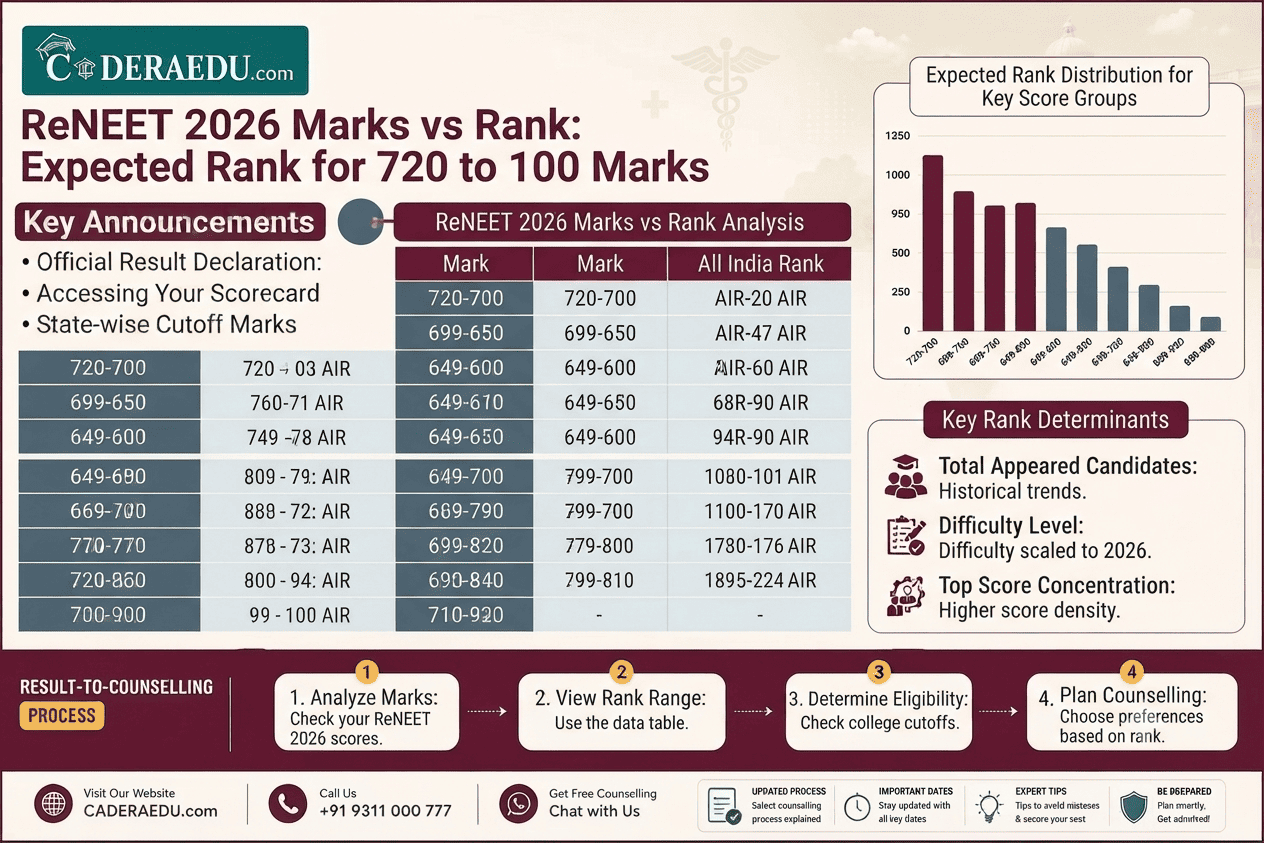
The moment Re-NEET 2026 answer keys start circulating, every student runs the same mental exercise: I scored this much, so what rank am I probably looking at? Marks alone do not tell you much on their own. A 550 in an easy year and a 550 in a tough year can sit thousands of ranks apart, because your All India Rank depends on how everyone else performed too, not just your own score. This guide lays out an expected marks to rank picture for Re-NEET 2026, running from 720 all the way down to 100, so you can place your own number on a realistic scale before the official result lands. For a reading based on your exact marks, category and state rather than a general band, you can also run your numbers through CaderaEdu once your scorecard is out.
Why Marks Do Not Convert to Rank in a Straight Line
NEET is scored out of 720, with roughly 22 to 24 lakh candidates appearing each year, and the relationship between your marks and your rank is anything but linear. At the very top of the scale, between 700 and 720, the density of candidates is thin, so a single mark can move you fifty or a hundred ranks. In the crowded middle of the distribution, roughly 400 to 550, thousands of students often land on the exact same score, so a single extra correct answer can shift your rank by several thousand positions in one direction or the other. Lower down the scale, past 300, the number of candidates scoring in that band actually starts thinning out again, since fewer students end up there relative to the middle zone. This uneven spread is exactly why a flat rule like every ten marks equals five thousand ranks breaks down the moment you apply it across the full scale, and why a proper marks vs rank table needs to bend with the actual shape of the distribution rather than following a straight line.
Why Candidate Volume Changes the Curve Every Year
The number of students who actually sit for the exam matters just as much as how hard the paper was. NEET registrations have climbed steadily over the years, moving from under 15 lakh candidates in the earlier cycles to well above 22 lakh in recent years, and Re-NEET 2026 sits at the higher end of that trend given how large the original registration pool was before the cancellation. More candidates competing for a broadly similar number of government seats means the same raw score tends to produce a slightly higher, or worse, rank number than it would have in a smaller pool. This is a separate factor from paper difficulty entirely. A paper can be exactly as hard as last year's, yet if a lakh more students appear this time, ranks across the board shift outward simply because there are more people sharing the same score bands. Keeping both variables in mind, difficulty and volume together, gives a far more realistic read on where your marks are likely to land than looking at either one in isolation.
How This Marks vs Rank Table Was Built
The ranges below are built by looking at how NEET marks have historically converted to All India Rank over the last several years, then adjusting for what is currently known about Re-NEET 2026, including the total number of candidates who appeared for the rescheduled exam and the difficulty level reported by students and coaching experts after the test. Because Re-NEET followed a fresh paper on a new date, some of the usual year to year comparison gets slightly noisier than normal, so treat every number here as an expected band rather than a fixed value. Once your actual score is confirmed against the official answer key, running it through the NEET Medical College Predictor will give you a sharper, category specific estimate than any general table ever can.
Re-NEET 2026 Expected Rank: 720 to 600 Marks, the Top Tier
This band is where AIIMS New Delhi, JIPMER and the most competitive government medical colleges in the country close their seats. Every mark here counts heavily, and the rank gaps at the very top are small in absolute terms but enormous in outcome.
Table
| Marks (out of 720) | Expected AIR Range | What This Band Typically Means |
|---|---|---|
| 715 - 720 | 1 - 10 | Historic AIIMS New Delhi top rank territory |
| 700 - 714 | 10 - 60 | AIIMS New Delhi and JIPMER realistic range |
| 690 - 699 | 60 - 200 | AIIMS New Delhi still in range for General category |
| 670 - 689 | 200 - 700 | Other AIIMS campuses, Maulana Azad Medical College |
| 650 - 669 | 700 - 2,000 | Newer AIIMS campuses, top state government colleges |
| 630 - 649 | 2,000 - 5,500 | Strong government colleges through AIQ |
| 600 - 629 | 5,500 - 14,000 | Good government MBBS through AIQ and top state quota |
3 columns · 8 rows
If your expected score sits anywhere in this band, your first stop should be checking round wise closing data on individual college pages rather than relying on a national average. The AIIMS New Delhi admission page and its dedicated AIIMS New Delhi cutoff history are the most useful starting points, since AIIMS Delhi cutoffs move in a narrower band than almost any other institute in the country and a small shift in the national difficulty level can noticeably change what rank the last seat closed at. It is also worth remembering that this top tier band rewards accuracy over speed. Students obsessing over a fast rank estimate right after the exam often overlook the fact that even one or two marks of miscalculation on Physics numericals can shift a predicted rank by several hundred positions at this level, which is a difference that genuinely changes which college ends up on your realistic list.
Re-NEET 2026 Expected Rank: 600 to 450 Marks, the Competitive Government Zone
This is the widest and most contested band on the entire scale. Government MBBS seats are still genuinely reachable here, but almost entirely through state quota rather than AIQ, and the gap between AIQ and state quota closing ranks becomes very visible in this zone.
Table
| Marks (out of 720) | Expected AIR Range | What This Band Typically Means |
|---|---|---|
| 580 - 599 | 14,000 - 26,000 | Government MBBS through AIQ still possible in reasonable states |
| 560 - 579 | 26,000 - 42,000 | State quota government MBBS becomes the primary route |
| 540 - 559 | 42,000 - 62,000 | Government MBBS through state quota in seat-rich states |
| 520 - 539 | 62,000 - 90,000 | Mid-tier government colleges, private deemed becomes a serious option |
| 500 - 519 | 90,000 - 1,25,000 | Private and deemed MBBS become the more realistic route |
| 480 - 499 | 1,25,000 - 1,70,000 | Private MBBS through management or AIQ deemed quota |
| 450 - 479 | 1,70,000 - 2,40,000 | Reserved category government seats possible, General leans private |
3 columns · 8 rows
This band is exactly where checking both counselling tracks properly matters the most, since a rank that looks unremarkable nationally can still be quite strong within your own state's pool. The AIQ vs State Quota step by step guide walks through exactly how to register for both tracks in the correct order so you do not accidentally lock yourself out of a seat you were genuinely eligible for.
Re-NEET 2026 Expected Rank: 450 to 300 Marks, the Private and Deemed Zone
Below 450, government MBBS through AIQ for General category becomes very unlikely, though reserved category candidates still have real options in this zone through state quota. This is also where the private and deemed university landscape genuinely opens up.
Table
| Marks (out of 720) | Expected AIR Range | What This Band Typically Means |
|---|---|---|
| 420 - 449 | 2,40,000 - 3,30,000 | Private MBBS in deemed universities, BDS in strong government colleges |
| 400 - 419 | 3,30,000 - 4,30,000 | Private MBBS management quota, BDS through AIQ or state quota |
| 380 - 399 | 4,30,000 - 5,40,000 | BDS becomes a strong primary option alongside limited private MBBS |
| 360 - 379 | 5,40,000 - 6,60,000 | BDS in private colleges, entry level AYUSH options open up |
| 340 - 359 | 6,60,000 - 7,90,000 | AYUSH courses (BAMS, BHMS, BUMS) become the more realistic route |
| 320 - 339 | 7,90,000 - 9,20,000 | AYUSH and allied health courses through state counselling |
| 300 - 319 | 9,20,000 - 10,60,000 | AYUSH remains open; MBBS/BDS extremely unlikely at this rank |
3 columns · 8 rows
If your expected score is settling into this band, it is worth building your shortlist around BDS and AYUSH from the start rather than treating them as a fallback decided in a hurry after results. Comparing a full directory of MBBS colleges by course and state against a list of top private medical colleges in India will show you exactly where the realistic fee and seat combinations sit for a score in this range, rather than relying on rumours about which private colleges are still accepting applications.
Re-NEET 2026 Expected Rank: Below 300 Marks, BDS, AYUSH and Alternatives
This is the zone where the qualifying cutoff itself starts to matter more than the rank. For General and EWS candidates, the qualifying cutoff is expected to sit close to 137 to 147 marks this year, so scores meaningfully below that line do not produce a valid counselling rank at all for those categories. Reserved category candidates qualify at a lower percentile, so SC, ST and OBC-NCL candidates scoring in the 100 to 140 range may still be technically qualified even though a General category candidate at the same marks would not be.
Table
| Marks (out of 720) | Expected AIR Range | What This Band Typically Means |
|---|---|---|
| 250 - 299 | 10,60,000 - 13,50,000 | AYUSH and allied health remain open; qualifying for General is borderline |
| 200 - 249 | 13,50,000 - 17,00,000 | General category unlikely to qualify; reserved categories may still qualify |
| 150 - 199 | 17,00,000 - 20,50,000 | Below General qualifying cutoff; check category specific percentile |
| 100 - 149 | 20,50,000 and above | Close to or below reserved category qualifying threshold as well |
3 columns · 5 rows
If your expected score falls in this final band, the practical move is to check the qualifying percentile for your specific category before assuming anything about MBBS or BDS at all. It is also worth exploring accessible private options at this stage, since some self-financed institutes such as Mayo Institute of Medical Sciences, Barabanki and AYUSH focused colleges like Amaltas Institute of Ayurveda, Dewas admit through state level counselling with comparatively accessible cutoffs, and can be a genuinely worthwhile route into a healthcare career even from this end of the scale.
Category Wise Adjustment: How SC, ST, OBC and EWS Ranks Differ From General
Every number above is calculated as an All India Rank across the full candidate pool, which is what General and EWS candidates compete on directly. Reserved category candidates additionally get a category rank, calculated only within their own reservation pool, and that number is what actually decides seat allotment under reservation. Because the reserved pools are smaller than the overall candidate base, the same marks typically produce a noticeably better category rank than the raw AIR would suggest. A score that gives a General candidate an AIR of around 1,00,000, for instance, might land an SC candidate a category rank closer to 10,000 to 15,000, simply because SC candidates are being ranked only against other SC candidates rather than the entire applicant pool.
Working through one example end to end makes the pattern clearer. Say two candidates both score 460 marks in Re-NEET 2026. A General category candidate at that score might see an All India Rank somewhere around 2,00,000, which realistically points toward private or deemed MBBS options and limited government seats depending on the state. An ST candidate scoring the exact same 460 marks, however, is ranked separately within the smaller ST applicant pool, and could plausibly see a category rank in the 15,000 to 25,000 range, which opens up genuine government MBBS seats through both AIQ and state quota that would simply not be on the table for a General category candidate at that mark. This is precisely why two students with identical scores can walk away from the same counselling season with completely different outcomes, and why checking category rank rather than only overall AIR is not optional for reserved category candidates.
Table
| Category | Typical Category Rank vs General AIR at Same Marks | Practical Effect |
|---|---|---|
| OBC-NCL | Roughly 1.3x to 1.8x better than General AIR | Meaningfully better state quota and AIQ options at the same score |
| SC | Roughly 3x to 6x better than General AIR | Government seats reachable at scores that would not work for General |
| ST | Roughly 5x to 9x better than General AIR | Smallest competing pool, most favourable rank conversion |
| EWS | Close to General AIR, slightly better within EWS quota | 10% reserved pool gives a modest edge over open category |
3 columns · 5 rows
What Your Marks vs Rank Actually Means for College Choice
A rank number by itself is not useful until you connect it to specific institutes and their historical closing data. Candidates landing in the 500 to 2,500 range should seriously compare newer AIIMS campuses such as AIIMS Jodhpur and AIIMS Kalyani against strong state government colleges like Maulana Azad Medical College, New Delhi, since all three sit in a broadly similar competitive band depending on the year. Further down the scale, government and municipal colleges outside the metro cities, such as SMIMER, Surat or newer state institutions like Mahatma Vidur Autonomous State Medical College, Bijnor, often close at ranks considerably more forgiving than what a national cutoff headline suggests, purely because state quota shrinks the competing pool down to candidates from that state alone.
A rank in isolation tells you very little. The same number can mean a top government seat in one state and a private management quota seat in another. Always read your rank against actual college closing data, not a single national benchmark.
Common Mistakes While Reading a Marks vs Rank Table
- Assuming the same marks will always produce the same rank every year, when total candidates and paper difficulty shift the conversion each time
- Applying a flat marks to rank formula across the entire scale instead of accounting for how thin or dense the crowd is at different score levels
- Ignoring the difference between overall AIR and category rank when checking eligibility for a reserved seat
- Comparing your expected rank only against AIQ cutoffs while ignoring your own state's usually more accessible state quota numbers
- Treating a rank predictor's output as an exact number rather than a range with some genuine variance built in
- Forgetting that Biology marks act as the tie-breaker when total scores are identical, which can separate two candidates with the same marks by a meaningful rank gap
Marks vs Rank Action Plan by Score Band
Table
| Marks Band | Expected AIR Zone | Recommended Next Step |
|---|---|---|
| 650 and above | Up to 2,000 | Shortlist AIIMS campuses and top government colleges through AIQ |
| 550 - 649 | 2,000 - 42,000 | Register for AIQ and state quota together, compare closing ranks by state |
| 450 - 549 | 42,000 - 2,40,000 | Weigh state quota government seats against private and deemed MBBS |
| 350 - 449 | 2,40,000 - 6,60,000 | Build a serious BDS and AYUSH shortlist alongside private MBBS options |
| Below 350 | Above 6,60,000 | Confirm qualifying status for your category, focus on AYUSH and allied health |
3 columns · 6 rows
What to Do Right After Your Re-NEET 2026 Result
- Match your response sheet against the official NTA answer key before trusting any coaching institute's self-assessment
- Note both your overall All India Rank and your category rank from the scorecard, since they answer different eligibility questions
- Run your confirmed marks through a category and state specific predictor rather than relying only on this general table
- Register for MCC AIQ counselling and your home state counselling authority at the same time
- Keep category certificates ready in the central government format required for AIQ, since state format certificates are rejected by MCC
- Shortlist colleges across at least three tiers, reach, realistic and safe, rather than filling only a handful of choices
Final Word
A marks vs rank table is only ever a starting estimate, and Re-NEET 2026 comes with slightly more uncertainty than a normal year because of the rescheduled exam and shifted candidate turnout. Use the bands above to get a realistic sense of where your score is likely to land, keep both AIQ and state quota tracks active regardless of your rank, and treat BDS or AYUSH as genuine options rather than fallback plans decided under pressure. The students who navigate this admission season calmly are almost always the ones who checked their real numbers early instead of anchoring on a single headline rank they saw somewhere online.
Whatever band your Re-NEET 2026 score falls into, the same principle holds. Rank is only useful once it is checked against actual, category specific and state specific closing data rather than a flat national figure, and the earlier you do that comparison, the more time you have to plan every counselling round properly instead of reacting to it at the last minute.
Share this article
Copy
Frequently Asked Questions
Is a marks vs rank table for Re-NEET 2026 exactly accurate?
No table can be exact, since the actual conversion depends on how all candidates performed this specific year. Treat any marks vs rank table, including this one, as an estimated range rather than a guaranteed number.
Why does the same score sometimes give very different ranks in different years?
Rank depends on relative performance, not just your own marks. A paper that is easier overall pushes more candidates to higher marks, which can push your rank higher in number for the same score compared to a tougher year.
Does category rank matter more than overall AIR for reserved candidates?
Yes. Reserved category seat allotment is primarily decided by category rank, calculated within that category's own applicant pool, which is usually a considerably smaller and more favourable number than the overall AIR.
What rank is needed for a government MBBS seat through state quota?
This varies significantly by state. Seat-rich states with fewer applicants per seat can have state quota government MBBS closing ranks well beyond what a similar rank would achieve in a highly competitive state, so always check your specific state's historical data.
If my expected marks fall below the General qualifying cutoff, is there still an option?
Check the qualifying percentile for your specific category before concluding anything. SC, ST and OBC-NCL candidates qualify at a lower percentile than General, so a score that does not qualify for General may still be valid for a reserved category.
Should I trust a single rank predictor tool completely?
Use a rank predictor as a planning range rather than a final answer, and cross check the output against at least one more source or against actual previous year college closing data before making any financial decision.
Confused About College Admissions?
Get expert advice on college selection, admission chances, and career path in a personalized counselling session.
Book a Counselling Slot
Select Date
Pick a Slot