Documents Required for MBBS College Reporting 2026: Complete Checklist

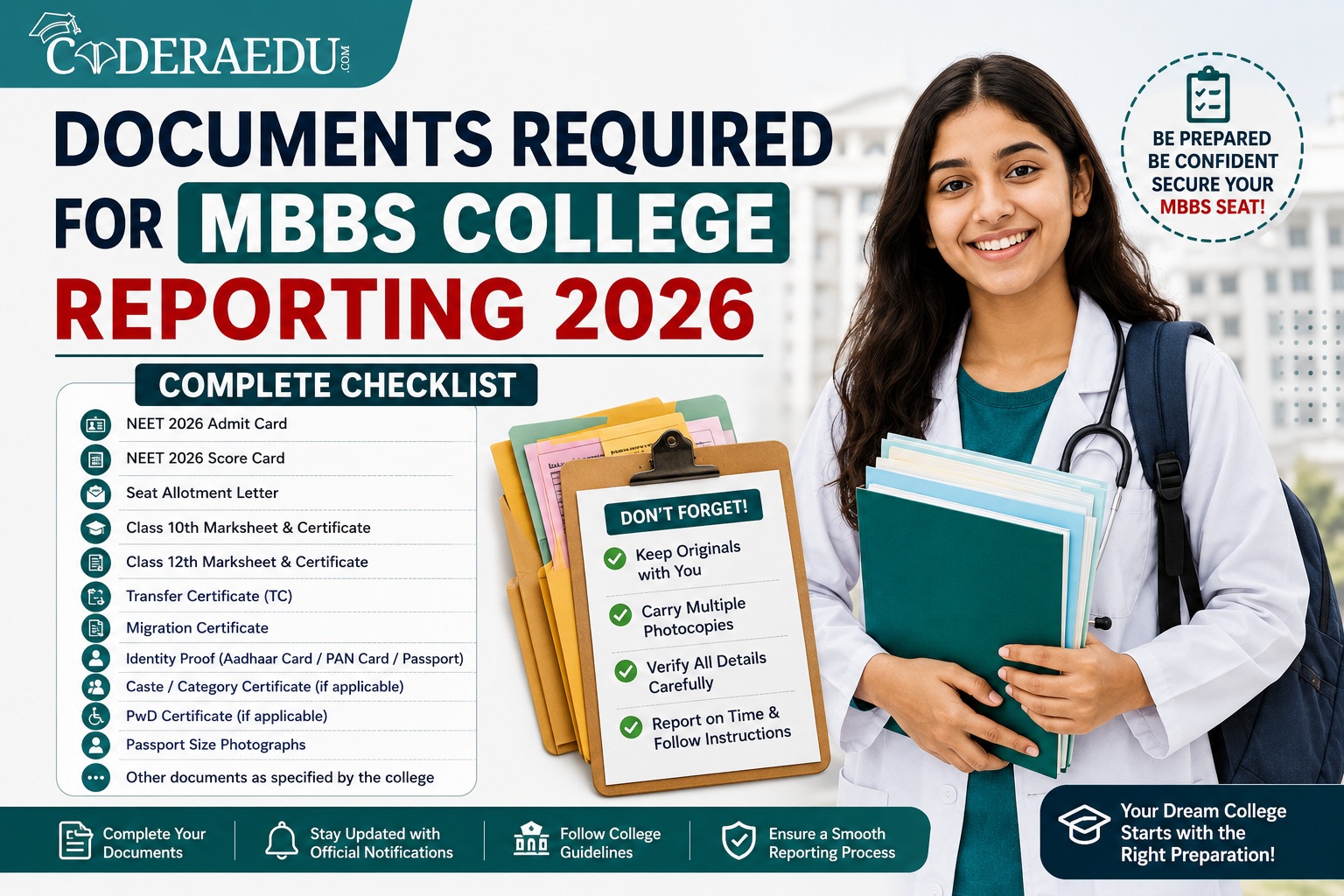
Click to enlarge
Getting a seat through NEET counselling is only half the process. The other half is showing up at the allotted institute with every required document, in the correct format, within a deadline that's often just 48 to 72 hours. Missing even one document, or carrying a certificate in the wrong format, can hold up your admission or cost you the seat entirely. This checklist covers exactly what you need, in what format, for both All India Quota and state quota MBBS reporting.
Before you get to this stage, you'll already have gone through your NEET UG 2026 result at neet.nta.nic.in, registered for counselling, filled and locked your choices, and checked your seat allotment result. Reporting is the final confirmation step in that chain, and it's the one that requires the most physical paperwork rather than a few clicks online.
This guide walks through the full document list, explains why category, domicile, and PwD certificates trip up so many candidates, breaks down what's different between AIQ, state quota, and private college reporting, and gives you a pre-reporting checklist to run through the night before you travel.
Document requirements shown here follow the pattern used by MCC for All India Quota reporting and the general pattern followed by most state counselling authorities. Always cross-check the exact list published for your specific round and college, since requirements can vary slightly by institute and by year.
Why Document Preparation Matters So Much
Reporting is the only step in the entire NEET counselling process that happens offline. Registration, choice filling, and checking your seat allotment result are all done online, but confirming your admission requires you to be physically present at the college with original documents. There is no provision to email or upload documents instead of showing up in person for most rounds.
Reporting windows are short by design, usually a couple of days, so colleges can move on to the next round quickly if seats go unfilled. That means there's little room to fix a missing document once you're already there. Getting everything ready in advance, ideally before your result is even out, is the single biggest thing you can do to avoid losing time or, worse, losing the seat.
Complete Document Checklist for MBBS College Reporting
Table
| Document | Applicable To | Notes |
|---|---|---|
| NEET UG 2026 admit card | All candidates | Original plus 2-3 photocopies |
| NEET UG 2026 scorecard/result | All candidates | Downloaded from neet.nta.nic.in |
| Counselling allotment letter | All candidates | Downloaded from MCC or state portal |
| Class 10 mark sheet and certificate | All candidates | Proof of date of birth and basic education |
| Class 12 mark sheet and certificate | All candidates | Must show required subjects: Physics, Chemistry, Biology/Biotechnology, English |
| Photo ID proof | All candidates | Aadhaar card, passport, or voter ID |
| Passport-size photographs | All candidates | 6-8 copies, matching NEET application photo |
| Category certificate (OBC/SC/ST/EWS) | Reserved category candidates | Central government format required for AIQ |
| Domicile certificate | State quota candidates | Issued by competent state authority |
| PwD certificate | PwD candidates | From a government-authorised medical board |
| Migration certificate | As required by institute | From previous board or university |
| Provisional/permanent NMC registration | As applicable | Not usually needed at UG reporting stage |
3 columns · 13 rows
Core Documents Every Candidate Needs
Regardless of category, quota, or which state you're reporting in, a base set of documents is non-negotiable. These prove your identity, your exam performance, and your eligibility to be at that reporting desk in the first place.
- NEET UG 2026 admit card, downloaded and printed from neet.nta.nic.in
- NEET UG 2026 scorecard showing your marks, percentile, and All India Rank
- Counselling allotment letter for the specific round you're reporting in
- Class 10 mark sheet and passing certificate, as proof of date of birth
- Class 12 mark sheet and passing certificate, showing the required science subjects
- A valid government-issued photo ID, such as Aadhaar, passport, or voter ID
- Six to eight recent passport-size photographs, ideally matching the one used in your NEET application
Keep at least two to three photocopies of every document in this base set, since some colleges retain a set for their records while returning your originals after verification. Running out of copies mid-verification is a common, entirely avoidable delay.
The scorecard and admit card deserve particular care. These are the documents that establish your eligibility in the first place, and any mismatch between the name or date of birth on them versus your other certificates gets flagged immediately during verification. If you spot an error on your scorecard, it's worth resolving that with NTA before your reporting date rather than trying to explain it at the college desk.
Category Certificate: The Document Most Candidates Get Wrong
If you're applying under OBC, SC, ST, or EWS reservation, your category certificate needs to be in the specific format accepted by the counselling authority you're reporting to. This is where a lot of candidates lose time, because a certificate that's perfectly valid for one purpose isn't automatically accepted for another.
OBC certificates need to be on the central government format for AIQ counselling — state-issued OBC certificates are not accepted by MCC.
In practical terms, this means a candidate reporting for an All India Quota seat needs an OBC-NCL certificate issued in the Government of India format, not the state government format that might work for a job application or a state-level exam. State quota reporting, on the other hand, generally accepts the state-issued format. The AIQ vs State Quota step-by-step guide covers this distinction in detail, including how it applies across different states.
EWS certificates similarly need to be current and issued within the validity period specified for the counselling year, typically within the same financial year as your application. An expired or outdated EWS certificate is treated the same as not having one at all, so check the issue date carefully before your reporting day.
It's worth understanding why this format distinction exists at all. Category certificates are issued by state governments, but AIQ counselling is administered centrally, so MCC only recognises certificates that follow the Government of India's prescribed template with specific wording and authority signatures. A certificate that's genuinely valid for state purposes can still be rejected at AIQ reporting purely on formatting grounds, which is exactly why so many candidates get caught out by this. The NEET 2026 expected cutoff guide also touches on how category reservation affects your effective rank, which is useful context alongside the certificate requirement itself.
Domicile Certificate for State Quota Seats
If you're reporting for a state quota seat, you'll need a domicile certificate proving your residency in that state, issued by the competent authority, usually the Sub-Divisional Magistrate or District Collector's office. Domicile rules vary significantly by state, and getting this wrong, or applying too late, is one of the more common reasons candidates miss a state counselling window.
- Uttar Pradesh: typically requires 3 to 5 years of residence, or parental government employment in the state
- Rajasthan: Class 10 or 12 education from a Rajasthan-based school is often accepted, or 3 years of residence
- Maharashtra: a more involved requirement, generally 15 years of residence or birth within the state
- Delhi: 3 years of residence, or a parent's employment with the Delhi government
- Haryana: 3 years of residence, or a parent's employment with the Haryana government
These rules differ enough between states that candidates who've moved recently, or whose parents work government jobs across state lines, should verify the exact requirement with the relevant state authority well before counselling begins. Applying for a domicile certificate at the last moment, when SDM or Collector offices are already dealing with a surge of counselling-season applications, can mean missing your registration window entirely.
State quota cutoffs and domicile rules go hand in hand, since your effective competition depends entirely on how many candidates hold domicile in that state. The NEET 2026 state-wise cutoff guide breaks down how domicile-linked competition varies across states like UP, Maharashtra, Rajasthan, Haryana, and Uttarakhand, which is worth reading alongside your domicile certificate preparation.
PwD Certificate Requirements
Candidates applying under the PwD category need a disability certificate issued by a government-authorised medical board, not a private hospital or an individual doctor's certificate. This certificate typically needs to specify the percentage and nature of disability, and in many cases needs to be reassessed closer to the admission year if the original certificate is old.
Some counselling rounds require a fresh disability assessment at a designated PwD assessment centre as part of the admission process itself, separate from any certificate you already hold. Check the specific instructions for your round rather than assuming your existing certificate is automatically sufficient.
The percentage of disability recorded on your certificate matters directly for eligibility, since PwD reservation under NEET counselling generally applies to candidates within a specified disability range for the relevant course. Carrying an outdated certificate that doesn't clearly state this percentage, or one issued by a non-authorised board, is one of the more disruptive document issues to run into on reporting day, precisely because it usually can't be resolved on the spot.
Migration Certificate and Other Institute-Specific Documents
Some colleges, particularly those affiliated with a different state board or university than the one you studied under, ask for a migration certificate from your previous board or university. This isn't universally required, but it's worth carrying if you studied Class 12 through a board different from the state you're now seeking admission in.
Individual colleges occasionally add their own institute-specific requirements, such as an anti-ragging affidavit, a medical fitness certificate, or a bonafide certificate. These are usually listed on the specific institute's admission notice, so checking your allotted college's website a day or two before reporting is worth the extra few minutes.
Anti-ragging affidavits, in particular, are now a fairly standard requirement across most medical colleges, both government and private, and are usually needed from both the candidate and a parent or guardian. These are typically submitted through the UGC's anti-ragging portal or a similar national platform, and colleges often expect the printed acknowledgement as part of your reporting document set, alongside your academic and category paperwork.
Document Checklist by Quota Type
Table
| Quota | Extra Documents Needed Beyond the Base Set |
|---|---|
| All India Quota (AIQ) | Category certificate in central government format, where applicable |
| State Quota | Domicile certificate, category certificate in state format, where applicable |
| Deemed/Central University | Base set only; reservation policy generally doesn't apply, so category certificates are usually not required |
| Management/NRI Quota (private colleges) | Additional institute-specific documents, sometimes NRI status proof or sponsor documents |
2 columns · 5 rows
This is a useful distinction to keep in mind: deemed and central universities filled through AIQ generally admit on open merit without reservation, so the category certificate requirement that applies to government college AIQ seats often doesn't apply here. Always confirm this against your specific allotted institute rather than assuming it's the same across every AIQ seat.
How to Organise Documents Before Reporting Day
- Make a single checklist based on your specific quota and category, not a generic list
- Collect originals first, since certificates like domicile and category can take weeks to issue
- Photocopy every document at least twice, and keep them in a separate folder from the originals
- Arrange documents in the order the institute is likely to request them, usually starting with admit card and scorecard
- Get passport photos printed well in advance, matching your NEET application photo as closely as possible
- Check your allotted college's specific admission notice for any additional requirements
- Keep both physical and scanned digital copies as a backup, in case anything gets misplaced during travel
It's worth starting this process the moment you clear the qualifying cutoff, not after seat allotment. Certificates like domicile and category can take real time to process through government offices, and by the time reporting deadlines arrive, there's rarely enough slack to fix a missing certificate.
What Happens During Document Verification
At the college, a verification desk checks your original documents against the photocopies and against the information submitted during NEET registration and counselling. Discrepancies, such as a name spelled differently across documents or a mismatched date of birth, get flagged here and can delay confirmation until resolved.
Once verification is complete, you'll typically be asked to pay the admission or confirmation fee specified in your allotment letter, sign any required declarations, and receive confirmation of your seat. Only after this is your admission considered finalised for that round.
It helps to know your standing going into this stage rather than being surprised by it. Checking your AIR against the NEET Marks vs Rank 2026 analysis ahead of reporting gives you a sense of whether your allotted seat matches typical closing ranks for that college and category, which is useful context if you're deciding whether to freeze this seat or float for a future round.
Common Mistakes That Delay Reporting
- Carrying a state-format category certificate for an AIQ seat that requires the central government format
- Applying for a domicile certificate only after seat allotment instead of well in advance
- Not carrying enough photocopies, assuming the college will make copies on-site
- Ignoring an expired or outdated EWS certificate
- Forgetting institute-specific documents like anti-ragging affidavits or medical fitness certificates
- Mismatched names or dates across Class 10, Class 12, and NEET application documents
- Arriving without a backup digital copy of documents in case originals are misplaced during travel
Name mismatches deserve special mention. Even small differences, like a middle name present on one certificate and missing on another, can trigger extra scrutiny during verification. If you know of any inconsistency across your documents, it's worth getting an affidavit correcting it before reporting day rather than explaining it on the spot.
Documents for Private and Deemed College Reporting
If your allotment is at a private or deemed medical college, the base document set stays the same, but expect additional institute-specific paperwork around fee agreements, bonds, or sponsor declarations, particularly for management or NRI quota seats. Review options across the top 20 best medical colleges in India 2026 list to understand which institutes fall into this category before your round begins, so you're not caught off guard by extra requirements.
Fee structures and additional documentation can vary considerably between private colleges, so it's worth checking your specific allotted institute's admission cell directly, in addition to the general MCC or state counselling instructions, a day or two before reporting.
Before You Report: Quick Pre-Reporting Checklist
Use this as a final check the night before you travel to your allotted institute.
- Allotment letter downloaded and printed
- NEET admit card and scorecard, original plus copies
- Class 10 and 12 certificates and mark sheets, original plus copies
- Category, domicile, and PwD certificates as applicable, in the correct format
- Photo ID proof and passport photographs
- Admission or confirmation fee arranged, as specified in the allotment letter
- Confirmation of the exact reporting location and time at the institute
- Travel and accommodation booked in advance if the college is in another city or state
If you're still finalising which colleges to target across future rounds, running your AIR through the NEET College Predictor 2026 and cross-checking against the NEET 2026 expected cutoff guide helps you know in advance whether you're likely reporting under AIQ, state quota, or a private seat, so you can prepare the right document set ahead of time rather than figuring it out after allotment. The full round-by-round process, including how reporting fits into the bigger picture, is covered in the NEET UG Counselling 2026 complete guide.
Related Reading Before You Report
A few more resources worth reading through before your reporting date, especially if you're still deciding between multiple allotted options or planning ahead for later rounds.
- Understand how the seat allotment result itself works, including provisional vs final lists, in our NEET Seat Allotment Result 2026 guide
- Track your admission timeline against the NEET 2026 result date tracker if you're still early in the process
- Compare state-specific closing ranks and college options in the NEET 2026 state-wise cutoff guide
- If you're already thinking beyond MBBS, bookmark the NEET PG College Predictor for later

Click to enlarge
Topics:
Share this article
Copy
Frequently Asked Questions
What documents are needed for MBBS college reporting?
NEET admit card, scorecard, counselling allotment letter, Class 10 and 12 certificates, photo ID, passport photographs, and category, domicile, or PwD certificates as applicable, all with photocopies.
Is the OBC certificate format the same for AIQ and state quota?
No. AIQ counselling through MCC requires OBC certificates in the central government format. State-issued OBC certificates are typically accepted only for state quota reporting.
How many photocopies of documents should I carry?
At least two to three photocopies of every document, since colleges usually retain a set for their records after verifying the originals.
Do deemed and central universities require a category certificate?
Generally no. Deemed and central universities filled through AIQ typically admit on open merit without reservation, so category certificates are usually not required unless the institute specifies otherwise.
What if there's a name mismatch across my documents?
Get a correction affidavit before reporting day if you're aware of any inconsistency across your Class 10, Class 12, and NEET application documents, since mismatches can delay verification.
Can documents be submitted online instead of reporting in person?
No. Institute reporting is the only offline step in NEET counselling, and candidates must be physically present with original documents for verification.
How long is the reporting window after seat allotment?
Reporting windows are typically short, often 48 to 72 hours, so documents should be organised well before the allotment result is out.
Are anti-ragging affidavits required for MBBS reporting?
Yes, most colleges require an anti-ragging affidavit from both the candidate and a parent or guardian, usually submitted through an official anti-ragging portal, along with the printed acknowledgement.
What should I do if my domicile certificate isn't ready before reporting?
Apply for domicile and category certificates as early as possible, ideally right after clearing the qualifying cutoff, since government offices take time to process these during the busy counselling season.
Confused About College Admissions?
Get expert advice on college selection, admission chances, and career path in a personalized counselling session.
Book a Counselling Slot
Select Date
Pick a Slot