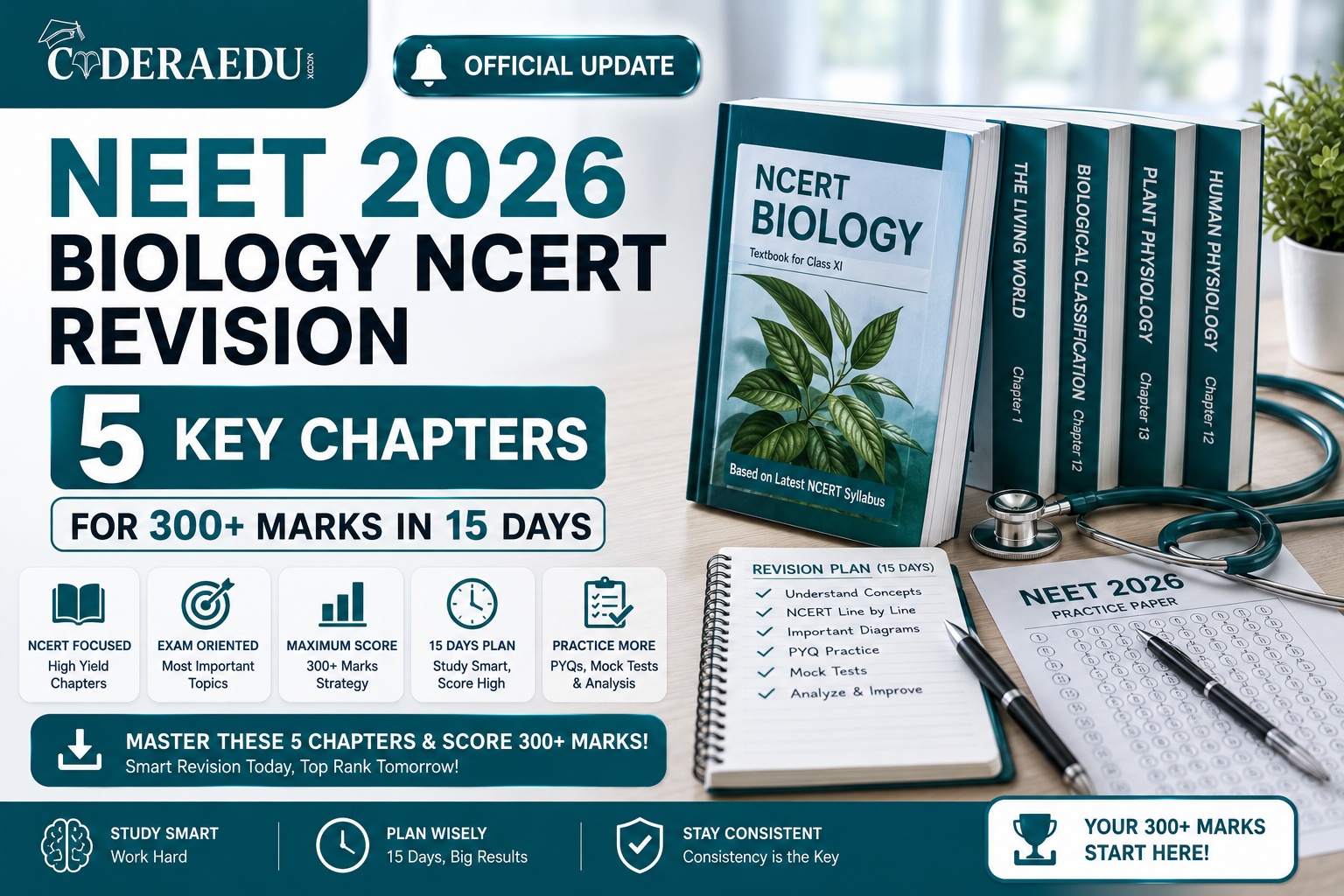
NEET 2026 Biology NCERT Revision: 5 Key Chapters for 300+ Marks in 15 Days

Click to enlarge
Introduction: Why NEET 2026 Biology NCERT Revision Is Your Highest-Return Strategy
Biology carries 360 out of 720 marks in NEET — that is exactly half the paper. No other subject offers a comparable return on focused revision. With Re-NEET 2026 scheduled for June 21, 2026, students now have a defined window to close the gap between where they are and where they need to be. This guide focuses on one thing: how to maximise your NEET 2026 Biology NCERT revision in 15 days and target 300+ marks out of 360.
The data across NEET previous year papers consistently shows that 85–90% of Biology questions are directly or indirectly drawn from NCERT Class 11 and Class 12 textbooks. Not reference books. Not coaching material. NCERT. If your NCERT is weak, no amount of objective practice will fix it. If your NCERT is strong, scoring 300+ becomes a structured, achievable goal — not a hope. Before diving into the chapter strategy, check the NEET 2026 Chapter-wise Weightage Guide to understand exactly which topics carry the highest question frequency.

Click to enlarge
Why These 5 Chapters? Understanding NEET Biology Weightage
Not all Biology chapters are equal in NEET. Some chapters have appeared in every paper for the past 9 years. Others are tested lightly or through a single question type. The 5 chapters selected in this guide are based on actual NEET PYQ frequency data and account for an estimated 60–70 questions out of 90 in a typical NEET Biology section. According to the NEET 2026 Paper Analysis, Biology remained the most scoring section — with approximately 50% easy and 35% moderate questions — making it the single best area to gain marks through targeted revision.
Students who spread equal time across all 38 Biology chapters consistently underperform compared to those who allocate revision time in proportion to chapter weightage. The goal of this guide is not to skip chapters — it is to ensure you have mastered the five chapters that can alone give you 240–280 marks, so that the remaining chapters become a bonus rather than a dependency. Use the Best Books for NEET 2026 guide alongside this revision plan for reference material recommendations.
Biology is not revised by reading pages. Biology is revised by recalling what you read, testing it, correcting it, and reading again. Passive reading is not revision — it is re-reading.
Chapter 1: Human Physiology — The Single Highest-Scoring Unit in NEET Biology
Human Physiology consistently contributes 18–22 questions per NEET paper. No other unit comes close. It spans Class 12 Biology chapters on digestion, breathing, body fluids and circulation, excretory products and elimination, locomotion and movement, neural control, chemical coordination, and the immune system. Each of these sub-chapters has been tested multiple times across NEET papers. The chapter-wise weightage data confirms Human Physiology as the non-negotiable priority for any student targeting 300+ in Biology.
For 15-day revision, allocate Days 1 to 4 exclusively to Human Physiology. Focus on every NCERT diagram: the digestive tract with labelled parts and enzymes, the heart with chambers and valves, the nephron structure, the neuromuscular junction, the reflex arc, and the hormonal glands with their secretions and target functions. Read each diagram caption — NTA has directly tested diagram captions in multiple years. For every organ system, make a one-page recall sheet listing: structure, function, key enzymes or hormones, and one common question type from PYQs.
- Digestion and Absorption: Enzyme names, pH optima, sites of action, absorption locations
- Breathing and Gas Exchange: Tidal volume, vital capacity, partial pressures, Bohr effect
- Body Fluids and Circulation: ABO blood groups, ECG waves, cardiac output, lymph composition
- Excretory Products: Urine formation steps, counter-current mechanism, role of ADH and aldosterone
- Neural Control and Coordination: Types of neurons, synapse mechanism, spinal cord structure
- Chemical Coordination: All endocrine glands, hormones, hyper/hypo secretion diseases
- Locomotion and Movement: Sliding filament theory, types of joints, disorders like myasthenia gravis
Chapter 2: Genetics and Evolution — 15–18 Questions Every Year
Genetics and Evolution is the second-highest weightage unit in NEET Biology, contributing 15–18 questions on average. It covers Mendelian genetics, chromosomal theory of inheritance, molecular basis of inheritance (DNA structure, replication, transcription, translation, regulation), and the theory of evolution. This unit requires both conceptual understanding and precise recall of NCERT facts — two types of preparation that are best done in combination.
Allocate Days 5 and 6 to Genetics and Evolution. For Mendelian genetics, practise solving dihybrid cross problems from NCERT exercises — NTA uses them regularly. For molecular biology, focus on the differences between prokaryotic and eukaryotic DNA replication, the lac operon model (both induced and repressed state diagrams), and post-translational modifications. For evolution, the key areas are Darwin's theory versus Hardy-Weinberg principle, types of natural selection, and evidence of evolution including homologous and analogous organs. Use NEET 2026 Mock Tests to test this unit under timed conditions after your revision.
- Mendelian Laws: Dominance, segregation, independent assortment — with exceptions (codominance, incomplete dominance)
- Chromosomal Theory: Linkage vs. recombination, sex-linked inheritance, pedigree analysis
- DNA Structure: Chargaff's rules, Rosalind Franklin's contribution, double helix model
- Replication: Semi-conservative model, Meselson-Stahl experiment, role of enzymes
- Transcription and Translation: mRNA processing, codons, tRNA, ribosomal subunits
- Gene Regulation: Lac operon, operon concept, inducible and repressible systems
- Evolution: Geological time scale, Miller-Urey experiment, Hardy-Weinberg equilibrium conditions
Chapter 3: Ecology and Environment — 10–13 Questions With High NCERT Direct Hit Rate
Ecology is consistently underestimated by students — and consistently rewarded by NEET. It contributes 10–13 questions per paper and has one of the highest ratios of NCERT-direct questions among all Biology units. The reason is simple: ecology is factual and definition-heavy. NEET questions on ecology often quote NCERT lines almost verbatim, making thorough NCERT reading the single most effective preparation strategy for this unit.
Reserve Days 7 and 8 for Ecology. Cover organisms and populations first — population attributes, growth curves (J-shaped vs. S-shaped), natality, mortality, age pyramids, and interspecific interactions (mutualism, commensalism, predation, parasitism, competition, amensalism). Then move to ecosystems: energy flow (10% law), food chains and webs, ecological pyramids, nutrient cycling (carbon and phosphorus cycles in detail), and ecosystem services. Finish with biodiversity and conservation: in-situ and ex-situ conservation methods, biodiversity hotspots, and the causes of biodiversity loss (the Evil Quartet). This pairs well with the paper analysis insights showing Ecology as a consistent high-accuracy section for prepared students.
Chapter 4: Plant Physiology — 10–12 Questions, Diagram-Heavy and NCERT-Loyal
Plant Physiology covers mineral nutrition, photosynthesis, respiration in plants, plant growth and development, and transport in plants. It contributes 10–12 questions and is heavily diagram-based. The photosynthesis chapter alone has produced 3–5 questions in multiple years, with NTA testing the Z-scheme, Calvin cycle intermediates, C3 vs. C4 plants (Kranz anatomy), and the photorespiration pathway.
Allocate Days 9 and 10 to Plant Physiology. For photosynthesis, draw the Z-scheme and label every component — P680, P700, plastoquinone, ferredoxin, and the ATP/NADPH production points. For the Calvin cycle, memorise the three stages (carbon fixation, reduction, regeneration of RuBP) and the number of ATP and NADPH molecules consumed. For plant growth, focus on the five classes of plant hormones, their discovery experiments, and their physiological effects — NTA has tested these in assertion-reason format. For respiration, the difference between substrate-level and oxidative phosphorylation and the net ATP yield per glucose molecule are regular question targets. Refer to the recommended books guide for which reference books complement NCERT Plant Physiology best.
Chapter 5: Biotechnology — 7–10 Questions, Conceptual and Application-Based
Biotechnology covers principles and processes, as well as applications in medicine and agriculture. It contributes 7–10 questions and has grown in question frequency over the past 4 years. The questions are largely conceptual — NTA tests the steps of recombinant DNA technology, restriction enzymes, gel electrophoresis, polymerase chain reaction (PCR), and the applications of genetically modified organisms.
Days 11 and 12 are for Biotechnology. For the process chapter, memorise the tools of recombinant DNA technology: restriction endonucleases (recognition sequences, sticky vs. blunt ends), cloning vectors (pBR322 features, selectable markers, origin of replication), host organisms, and the steps of transformation. For applications, focus on insulin production via rDNA (Eli Lilly's method), Bt cotton (Cry proteins and their mode of action), RNA interference, golden rice, and gene therapy. NCERT diagrams for PCR (denaturation, annealing, extension steps), gel electrophoresis, and the Ti plasmid are frequently tested. For how biotechnology topics have been tested in recent papers, read the NEET 2026 paper analysis.

Click to enlarge
NEET 2026 Biology Chapter Weightage: At a Glance
Table
| Chapter / Unit | Class | Avg. Questions in NEET | Marks Potential | NCERT Direct Hit Rate |
|---|---|---|---|---|
| Human Physiology | Class 12 | 18–22 | 72–88 | Very High (90%+) |
| Genetics and Evolution | Class 12 | 15–18 | 60–72 | High (85%+) |
| Ecology and Environment | Class 12 | 10–13 | 40–52 | Very High (90%+) |
| Plant Physiology | Class 11 | 10–12 | 40–48 | High (85%) |
| Biotechnology | Class 12 | 7–10 | 28–40 | High (80–85%) |
| All Other Chapters Combined | Class 11 & 12 | 15–20 | 60–80 | Moderate (70–80%) |
5 columns · 7 rows
Your 15-Day NEET 2026 Biology NCERT Revision Schedule
The schedule below is built around active revision — not passive re-reading. Each day has a dedicated chapter block, a recall activity, and a PYQ solving target. This mirrors the preparation approach recommended in the 6-week Re-NEET 2026 study strategy. You should aim for 8–10 focused hours per day. Break each day into three revision blocks: morning reading (3 hours), afternoon recall + diagram practice (3 hours), and evening PYQ solving + error review (2–3 hours).
Table
| Day | Focus Area | NCERT Chapters | Daily Target |
|---|---|---|---|
| Day 1 | Human Physiology Part 1 | Digestion, Breathing, Body Fluids | Read + 30 PYQs |
| Day 2 | Human Physiology Part 2 | Excretion, Locomotion, Neural Control | Read + 30 PYQs |
| Day 3 | Human Physiology Part 3 | Chemical Coordination, Immune System | Read + 25 PYQs |
| Day 4 | Human Physiology Revision | All 7 sub-chapters full review | Mock chapter test + error review |
| Day 5 | Genetics Part 1 | Mendelian Genetics, Chromosomal Theory, Sex Determination | Read + 30 PYQs |
| Day 6 | Genetics Part 2 + Evolution | Molecular Basis of Inheritance, Evolution | Read + 25 PYQs |
| Day 7 | Ecology Part 1 | Organisms and Populations, Interspecific Interactions | Read + 20 PYQs |
| Day 8 | Ecology Part 2 | Ecosystems, Biodiversity and Conservation | Read + 20 PYQs |
| Day 9 | Plant Physiology Part 1 | Mineral Nutrition, Photosynthesis | Read + 25 PYQs |
| Day 10 | Plant Physiology Part 2 | Respiration, Plant Growth and Hormones | Read + 20 PYQs |
| Day 11 | Biotechnology Part 1 | Principles and Processes, rDNA Technology | Read + 20 PYQs |
| Day 12 | Biotechnology Part 2 | Applications in Medicine and Agriculture | Read + 20 PYQs |
| Day 13 | Revision Buffer | Weak chapters from Days 1–12 | Targeted re-reading + 40 PYQs mixed |
| Day 14 | Full Biology Mock Test | All 5 chapter blocks | 90-question timed Biology test |
| Day 15 | Error Analysis + Final Diagrams | All flagged errors from mock test | Diagram drill + final NCERT scan |
4 columns · 16 rows
Active Revision Techniques That Actually Work for NEET Biology
The difference between students who score 280 and students who score 320 in NEET Biology is rarely effort — it is revision method. Passive reading (reading NCERT line by line and moving on) builds familiarity, not recall. NEET questions test recall under pressure, not recognition on re-reading. The techniques below are designed specifically for the active conversion of NCERT text into exam-ready memory. These are the same techniques referenced in the mock test strategy guide on CaderaEdu.
- Close-book recall: After reading a chapter section, close the book and write down everything you remember on a blank sheet. Compare with NCERT. The gaps are your revision targets.
- Diagram labelling from memory: Draw major diagrams (nephron, heart, Z-scheme, lac operon) from scratch without looking. Check against NCERT. Repeat until perfect.
- One-page chapter summaries: For each chapter, create a single-page handwritten summary using your own words. This forces processing, not copying.
- PYQ solving by chapter: After each chapter revision, solve all PYQs from that chapter for the last 10 years. This shows you exactly how NEET tests the NCERT content.
- Spaced repetition for exceptions: Compile a single document of all exceptions, anomalies, and special cases (e.g. exceptions to Mendel's laws, C4 plants, CAM plants). Review this list every 3 days.
- Verbal explanation test: After finishing a topic, explain it out loud as if teaching a student. If you cannot explain it clearly, your understanding is not revision-ready.
- Error log maintenance: Every PYQ you get wrong gets entered into an error log with the correct answer and the NCERT source line. Review this log daily.
Common Mistakes Students Make During NEET Biology Revision
Understanding what not to do is as important as following the right strategy. The following mistakes are consistently observed among students who score below their potential in Biology, and they are documented in the NEET 2026 cutoff analysis context where Biology is the most impactful subject for score improvement.
- Reading NCERT like a novel: Moving through pages without stopping to recall, draw, or test yourself converts revision into re-reading — which adds familiarity but not exam performance.
- Skipping NCERT in-text questions and exercises: NEET has directly used NCERT exercise questions as exam questions in multiple years. These are not optional.
- Ignoring diagram captions and footnotes: NTA tests NCERT captions and side notes. Every line of NCERT is fair game — including the small print.
- Spending equal time on all chapters: Giving 2 hours each to Human Physiology and to Kingdom Monera is not a strategy — it is a waste. Allocate time proportional to weightage.
- Over-relying on reference books before finishing NCERT: Trueman's and Dinesh's are supplements. Using them before mastering NCERT reverses the priority.
- Not solving PYQs chapter-wise: Solving a full mock without knowing chapter-wise question patterns gives you a score but not a strategy. Analyse by chapter first.
- Revising the night before a mock test instead of sleeping: Cognitive fatigue before a timed test destroys performance. Mock tests are performance tools — they require a rested mind.
- Panicking about chapters not in the top 5: The remaining chapters still contribute 15–20 questions. Cover them — but with proportionally less time and a PYQ-first approach.
How 300+ Marks in Biology Impacts Your NEET 2026 Rank and College Options
Scoring 300 or above in Biology (out of 360) fundamentally changes your rank trajectory. Biology is also the tiebreaker subject in NEET — when two students have identical total scores, NTA ranks them by Biology marks first. This means a student with 310 in Biology and 560 total will rank above a student with 280 in Biology and 560 total. For a detailed breakdown of how NEET scores convert to ranks, refer to the NEET 2026 Score vs Rank Analysis.
A Biology score above 300 combined with reasonable Chemistry and Physics performance positions you well for top private medical colleges and competitive state quota government seats. Use the NEET UG Counselling 2026 Complete Guide to understand how AIQ and state quota admissions work once your result is out. For state-specific cutoff trends, the NEET 2026 State-wise Cutoff guide gives category-wise rank estimates for major states including Uttar Pradesh, Maharashtra, Rajasthan, and Haryana.
To plan your college shortlist in parallel while revising, use the NEET 2026 Rank Predictor Guide on CaderaEdu. Knowing which colleges your expected score unlocks is a powerful motivational anchor during a demanding revision period. You do not need the final result to start planning — you need an honest estimate and a shortlist.
Expert Guidance: What NEET Biology Toppers Do Differently
Students who score 340+ in NEET Biology do not read more than other students. They read better. Every topper account converges on the same set of behaviours: NCERT three times minimum, PYQs solved chapter-wise, diagrams drawn from memory until perfect, and zero new material in the final 3 days. The Re-NEET 2026 preparation strategy for the 6-week window mirrors this approach exactly — the same principles scaled to the time available.
For the final 3 days before Re-NEET 2026, shift from chapter revision to error correction mode. Review your error log daily. Scan your one-page chapter summaries. Practise 25–30 Biology questions per day — not a full mock, just chapter-specific targeted sets. Sleep 7–8 hours. Do not attempt any new material. The goal in the final stretch is confidence, accuracy, and exam-day composure — not new information. The mock test guide covers how to structure your final-week practice optimally.
Also consider tracking your NEET preparation against the official answer key trends. The NEET 2026 result and cutoff guide outlines expected qualifying cutoffs by category and explains what happens after results are declared. Planning the post-result steps in advance reduces counselling anxiety significantly and keeps your focus on preparation during the revision window.
Conclusion: Execute the Plan, Track Your Progress, Target 300+
NEET 2026 Biology NCERT revision is not complicated — it is demanding. The 15-day plan in this guide gives you a structured, chapter-prioritised, technique-backed framework to move from your current Biology score to 300+ out of 360. The five chapters — Human Physiology, Genetics and Evolution, Ecology, Plant Physiology, and Biotechnology — are not arbitrary. They represent the highest-return investment of your revision time, drawn from 9 years of NEET PYQ frequency data.
Pair this revision plan with the right resources: the Chapter-wise Weightage Guide for priority confirmation, the Best Books for NEET 2026 for NCERT supplements, and the NEET 2026 Mock Test guide for timed practice. As your scores improve, use the Rank Predictor to translate Biology marks into real college options. For the complete admissions roadmap after Re-NEET 2026, the NEET UG Counselling Guide and the Expected Cutoff guide will keep you prepared for every step after results. The window is 15 days. The strategy is here. Execute it.
Topics:
Share this article
Copy
Frequently Asked Questions
Can I score 300+ in NEET 2026 Biology by revising only 5 chapters?
The 5 chapters — Human Physiology, Genetics and Evolution, Ecology, Plant Physiology, and Biotechnology — account for an estimated 60–70 questions out of 90 in NEET Biology based on PYQ frequency data. Mastering these 5 chapters thoroughly gives you a strong base for 240–280+ marks. Covering remaining chapters with PYQ-based targeted revision can push the total to 300+ or beyond. These 5 chapters are a priority framework, not a complete skip strategy.
How many hours per day should I revise Biology in a 15-day plan?
For a 15-day intensive revision targeting 300+ in NEET Biology, aim for 8–10 focused hours per day on Biology. Structure this as 3 hours of NCERT reading, 3 hours of recall and diagram practice, and 2–3 hours of PYQ solving with error review. Avoid revision sessions longer than 90 minutes without a 15-minute break to maintain retention quality.
Is NCERT alone enough to score 300+ in NEET 2026 Biology?
Yes. NEET data consistently shows 85–90% of Biology questions are directly or indirectly based on NCERT Class 11 and Class 12 textbooks. A thorough, active revision of NCERT — including all diagrams, tables, in-text questions, exercises, and footnotes — is the foundation of 300+ Biology scores. Reference books like Trueman's Objective Biology can supplement difficult concepts, but NCERT mastery alone is sufficient for a strong score.
Which is the single most important chapter for NEET Biology preparation?
Human Physiology is the single most important unit in NEET Biology, contributing 18–22 questions per paper consistently. It covers 7 sub-chapters across digestion, breathing, body fluids, excretion, locomotion, neural control, and chemical coordination. No other unit in NEET Biology offers comparable question frequency or mark potential.
How does Biology score affect NEET rank and tiebreaking?
Biology is the first tiebreaker in NEET. When two students have the same total NEET score, NTA ranks them by Biology marks first, followed by Chemistry, then Physics, and finally age. This means a higher Biology score can directly improve your rank even without increasing your total score. It also means that Biology improvement has dual impact — on total marks and on rank resolution.
What is the best way to revise NEET Biology diagrams?
The most effective method is to draw key diagrams from memory on a blank sheet, then compare with NCERT. Key diagrams to master include the nephron, reflex arc, heart chambers, Z-scheme, Calvin cycle, lac operon, PCR steps, gel electrophoresis, Ti plasmid, and all endocrine glands. Repeat each diagram until you can draw and label it correctly from memory without reference. This also prepares you for diagram-based assertion-reason questions.
Should I solve PYQs chapter-wise or as full mocks during the 15-day revision?
Both serve different purposes. During the first 12 days of the plan, solve PYQs chapter-wise immediately after revising each chapter. This trains you to recognise how NEET tests each NCERT concept. On Days 14–15, take a full-length Biology mock test under timed conditions (90 questions, 60–70 minutes). The chapter-wise approach builds accuracy; the full mock builds stamina and time management.
What should I do in the final 3 days before Re-NEET 2026?
In the final 3 days before Re-NEET 2026 (June 21, 2026), shift from active revision to consolidation mode. Review your error log daily. Scan your one-page chapter summaries for the 5 priority chapters. Solve 25–30 Biology questions per day — chapter-specific, not full mocks. Sleep 7–8 hours each night. Avoid all new material. The goal is confidence, accuracy recall, and mental readiness — not new information intake.
What are the common reasons students score below their potential in NEET Biology?
The most common reasons include passive NCERT reading without active recall, skipping NCERT in-text questions and exercises, ignoring diagrams and their captions, spending equal time on all chapters instead of prioritising by weightage, not maintaining a PYQ error log, and starting reference books before completing NCERT. Fixing any two or three of these errors consistently produces measurable improvement in Biology mock test scores.
How do I use my NEET Biology score to plan my college admissions strategy?
Once you have an estimated or actual Biology score, use it to calculate your probable total NEET score and use a rank predictor to estimate your AIR range. A Biology score of 300+ combined with 150–180 in Physics and Chemistry puts total scores in the 450–540 range, which opens options across private deemed universities and competitive state quota seats in many states. Use the NEET UG Counselling 2026 guide and State-wise Cutoff guide on CaderaEdu to map your score to specific college options before results are officially declared.
Confused About College Admissions?
Get expert advice on college selection, admission chances, and career path in a personalized counselling session.
Book a Counselling Slot
Select Date
Pick a Slot