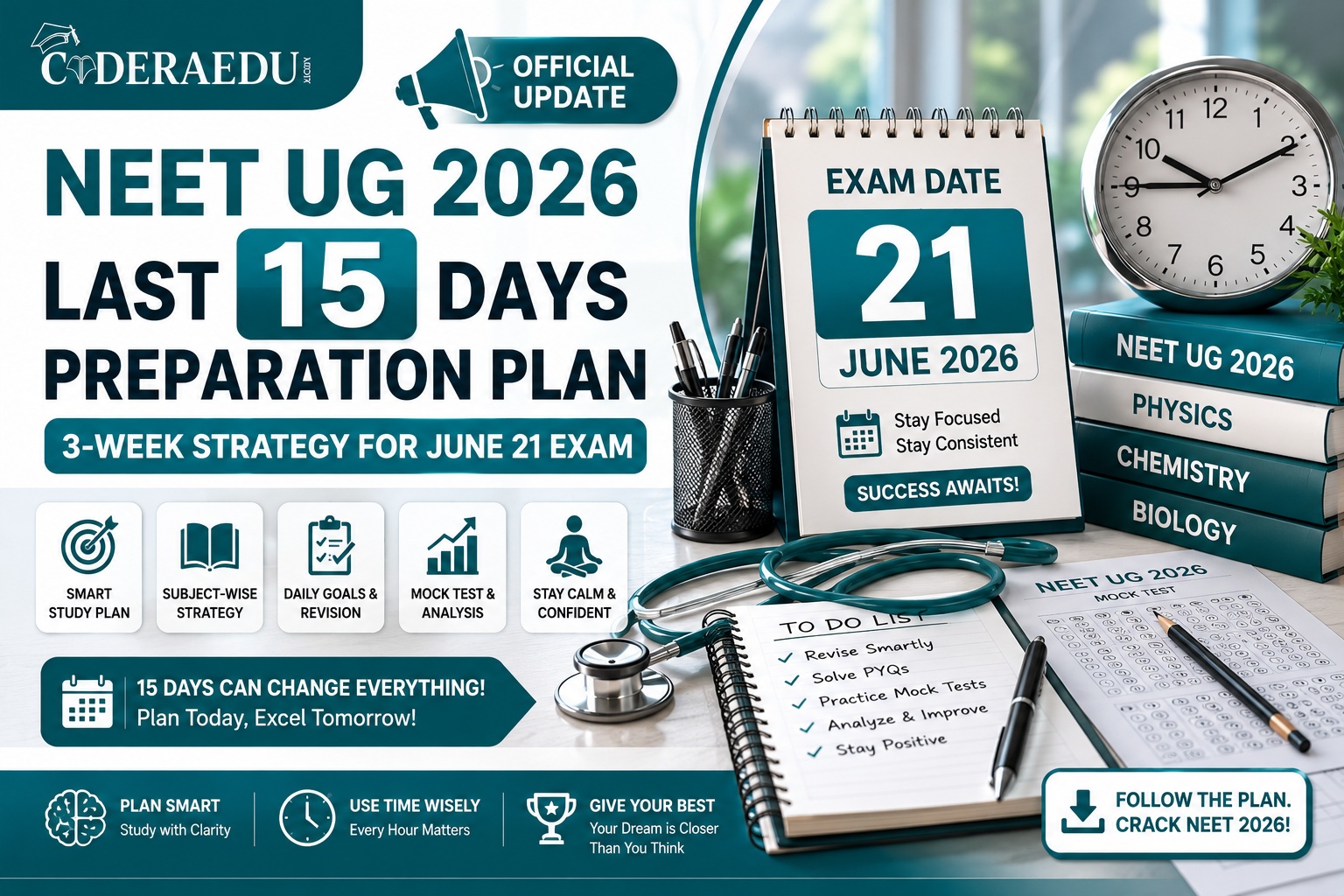
NEET UG 2026 Last 15 Days Preparation Plan: 3-Week Strategy for June 21 Exam

Click to enlarge
Introduction: Why the Last 15 Days Before NEET 2026 Are the Most Critical
With Re-NEET UG 2026 confirmed for June 21, 2026, the final 15-day window is your single most powerful preparation period of the entire cycle. This is not the time to learn new topics or attempt marathon study sessions — it is the time to sharpen what you already know, fix specific weak spots, and build the exam-day composure that separates good scores from great ones. Your NEET UG 2026 Last 15 Days Preparation Plan must be deliberate, focused, and structured around one goal: maximum marks on June 21.
The good news is that NTA has officially confirmed no syllabus change for Re-NEET 2026 — same 200 questions, same 720-mark scale, same +4/-1 marking scheme. Every chapter you have studied, every mock test you have attempted, and every formula you have memorised is fully valid. What this 15-day plan does is help you convert that preparation into a structured, high-output final sprint.
This guide breaks down the last 15 days into three distinct 5-day phases, each with a specific focus. It covers subject-wise prioritisation, daily study structure, mock test strategy, revision techniques, and the critical dos and don'ts for the final 48 hours. Use it alongside the NEET 2026 Chapter-wise Weightage Guide to make every revision session count.
Why This Last 15 Days Plan Matters: The Re-NEET 2026 Context
This year's NEET cycle has been unusually demanding. The original May 4, 2026 exam was cancelled following a Supreme Court directive after a paper leak was reported at select centres. Re-NEET was officially announced for June 21, 2026 — giving students an unexpected 7-week extension. While some students used this time productively, many experienced disruption to their preparation rhythm, anxiety about the rescheduling, and difficulty staying consistent.
The final 15 days are a reset opportunity. Regardless of how the past weeks went, this window is entirely yours to control. The candidates who will score highest on June 21 are not necessarily those who studied the most total hours — they are the ones who managed this final phase most intelligently. A disciplined 15-day plan built around NEET 2026 paper analysis insights and high-weightage chapters gives you a measurable edge.
The last 15 days of NEET preparation are not about how much you can cram — they are about how sharply you can recall what you already know under exam conditions. Focused revision, timed mock tests, and calm execution will always outperform frantic last-minute coverage of new topics.
NEET 2026 Subject-wise Priority: Where to Focus Your Final 15 Days
Before building a day-wise plan, you need to know where your marks are. Based on NEET chapter-wise weightage data, Biology (Botany + Zoology) carries 360 of 720 marks and is consistently the highest-leverage subject for score improvement. Chemistry and Physics carry 180 marks each. Here is how to prioritise each subject in your final sprint.
Table
| Subject | Total Marks | Last 15 Days Priority | Key Focus Areas |
|---|---|---|---|
| Biology (Botany + Zoology) | 360 (50%) | HIGHEST — spend 50% of study time | Human Physiology, Genetics & Evolution, Cell Biology, Plant Physiology, Ecology |
| Chemistry | 180 (25%) | HIGH — spend 30% of study time | Organic Chemistry mechanisms, Chemical Bonding, Electrochemistry, Thermodynamics, Coordination Compounds |
| Physics | 180 (25%) | MODERATE — spend 20% of study time | Electrostatics, Modern Physics, Optics, Current Electricity, Laws of Motion |
4 columns · 4 rows
This allocation is designed for the average NEET aspirant. If you are already strong in Biology and weak in Chemistry, adjust accordingly. The principle remains: the subject carrying the most marks deserves the most revision time. For a detailed chapter-by-chapter breakdown with question frequency data, refer to the NEET 2026 Syllabus and Weightage Guide.
The 3-Phase 15-Day NEET 2026 Preparation Plan: Day-wise Structure
The last 15 days are divided into three phases of 5 days each. Phase 1 (Days 1–5) focuses on targeted chapter revision and error correction. Phase 2 (Days 6–10) shifts to full-length mock tests and deep analysis. Phase 3 (Days 11–15) is about consolidation, light revision, and exam-day readiness. Each phase builds on the one before it.
Phase 1 (Days 1–5): Targeted High-Weightage Chapter Revision
This phase is pure revision — no new topics, no new books. Pick the 5 highest-weightage chapters in Biology, 3 in Chemistry, and 2 in Physics that you are least confident in. Spend each day on 2 subjects, rotating across them. Use NCERT as your primary source — in NEET, at least 70–80% of Biology and Inorganic Chemistry questions come directly from NCERT text, diagrams, and examples.
- Day 1: Human Physiology (Digestion, Respiration, Circulation) + Organic Chemistry (Reaction Mechanisms, Named Reactions)
- Day 2: Genetics and Evolution (Mendelian Genetics, Molecular Basis of Inheritance, Darwinism) + Electrostatics and Current Electricity
- Day 3: Cell Biology and Cell Division (Mitosis, Meiosis, Cell Cycle) + Chemical Bonding and Thermodynamics
- Day 4: Plant Physiology (Photosynthesis, Respiration, Plant Hormones) + Modern Physics (Photoelectric Effect, Atomic Models, Nuclear Physics)
- Day 5: Ecology (Ecosystems, Biodiversity, Environmental Issues) + Coordination Compounds and Electrochemistry
At the end of each day, solve 20–30 previous year questions (PYQs) from the chapters you revised that day. PYQ practice is non-negotiable — NEET consistently repeats concepts and question formats from previous years. Reviewing PYQ errors the same evening (not the next morning) is the most effective retention technique at this stage.
Phase 2 (Days 6–10): Full-Length Mock Tests and Deep Error Analysis
This is the most demanding phase — and the most important. Attempt one full-length NEET mock test every day from Day 6 to Day 10, strictly under exam conditions: 3 hours 20 minutes, no breaks, no phone, OMR-style answer sheet. Use the NTA Abhyas App or reputable free mock test platforms that use real NEET-level questions. After each test, spend 2–3 hours analysing every wrong answer.
- Categorise every error: knowledge gap (did not know the concept), reading error (misread the question), calculation error (knew the concept but made arithmetic mistake), or time pressure error (rushed and guessed)
- Knowledge gap errors: revisit the NCERT page or chapter note for that concept immediately — do not let it stay unresolved overnight
- Reading errors: practice slower, more deliberate question reading in tomorrow's test — most NEET options are designed to trap fast readers
- Calculation errors: identify whether your formula recall is weak or your arithmetic is slow — both have different fixes
- Track your section-wise scores across all 5 mock tests to identify which subject is dragging your total and adjust Phase 3 revision accordingly
Do not take more than one mock test per day. The analysis after each test is more valuable than the test itself. A candidate who attempts 5 fully analysed mocks in Phase 2 will outperform one who hastily completes 10 unanalysed tests. For guidance on mock test strategy, the NEET 2026 Mock Test Guide covers this in detail.
Phase 3 (Days 11–15): Consolidation, Light Revision, and Exam-Day Readiness
The final 5 days are not for intensive study — they are for consolidation. Reduce daily study hours to 6–7 hours maximum. Spend this phase reviewing your personal error log from Phase 2, revisiting short notes and NCERT diagrams for high-yield chapters, and maintaining your sleep and eating routine. Attempting one or two timed section tests (not full mocks) on Days 11–13 is sufficient.
- Day 11–12: Review your Phase 2 error log — revisit all knowledge gap errors identified across 5 mock tests
- Day 13: Attempt one half-length section test (Biology only or Chemistry + Physics only) — timed, under exam conditions
- Day 14: Light revision of NCERT diagrams — Human Heart, Nephron, Chloroplast, Mitochondria, Reflex Arc, Alimentary Canal — these diagrams generate 4–6 questions every NEET paper
- Day 15 (June 20 — day before exam): No new study. Review your formula sheet and short notes for 2–3 hours maximum in the morning. Afternoon and evening: rest, verify your exam centre location and travel plan, prepare all documents (admit card, photo ID, photographs), sleep by 10 PM
Biology Revision Strategy: Maximising Your 360-Mark Subject
Biology is the single most important determinant of your NEET rank. The difference between a 600-mark score and a 660-mark score is almost always decided in Biology. In the last 15 days, every Biology revision session should be NCERT-anchored. Read the text — not just the summaries or notes — because NEET frequently quotes NCERT verbatim and tests whether you recall exact definitions, exceptions, and examples.
Human Physiology (Class 11) and Genetics and Evolution (Class 12) together contribute 22–26 questions every NEET paper. These two units alone can add or take away 88–104 marks from your total. Prioritise them above everything else in Biology. For the complete chapter-frequency breakdown, the NEET 2026 Syllabus Weightage Guide provides exact data from recent papers.
- Read NCERT Biology Class 11 and 12 chapters — especially Human Physiology, Genetics, Cell Biology, and Ecology — cover to cover at least once in Phase 1
- Redraw key diagrams from memory: Human Heart, Nephron, Synapse, Chloroplast, Mitochondria, Reflex Arc, Spermatogenesis, Oogenesis, DNA replication fork
- Memorise all NCERT tables: hormone functions, enzyme actions, vitamins and deficiencies, ecological terms — these are high-frequency direct-recall questions
- Solve chapter-wise PYQs (2017–2025) for every Biology chapter you revise — patterns repeat more in Biology than in any other subject
- In Ecology and Biodiversity, focus on definitions and examples — NEET tests exact terminology (e.g., parasitism, mutualism, endemic species, hotspots)
Chemistry and Physics Strategy for the Final 15 Days
Chemistry in the last 15 days is primarily about Organic Chemistry and Inorganic. Organic reactions — named reactions, conversion mechanisms, and product identification — appear in every NEET paper and reward pattern recognition. Practise writing reaction mechanisms from memory. For Inorganic, NCERT is again your primary weapon: periodic trends, chemical bonding, p-block, d-block, and coordination compounds are tested through direct NCERT recall.
Physics is the subject where most NEET aspirants lose marks unnecessarily. The questions are not conceptually harder than Class 12 level — but they require formula accuracy and quick numerical execution under time pressure. In the last 15 days, do not attempt to learn new Physics concepts. Instead, build a compact formula sheet covering Electrostatics, Current Electricity, Optics, Modern Physics, and Mechanics, and revise it every morning. Solve 10–15 numerical PYQs per day, focusing on speed and accuracy, not volume.
Daily Time Table Template for NEET 2026 Last 15 Days
Table
| Time Slot | Phase 1 (Days 1–5) | Phase 2 (Days 6–10) | Phase 3 (Days 11–14) |
|---|---|---|---|
| 6:00 AM – 7:00 AM | Light warm-up: formula/diagram review | Formula sheet revision | Formula and diagram quick review |
| 7:00 AM – 9:00 AM | Biology high-priority chapter revision | Mock test preparation: NCERT skim | Error log review (Phase 2 mistakes) |
| 9:00 AM – 12:30 PM | Chemistry chapter revision + PYQs | Full-length mock test (3h 20m strictly) | Biology NCERT diagrams + light revision |
| 12:30 PM – 2:00 PM | Break, lunch, rest | Break, lunch, rest | Break, lunch, rest |
| 2:00 PM – 5:00 PM | Physics chapter revision + numericals | Mock test analysis — categorise all errors | Chemistry Inorganic + Organic quick notes |
| 5:00 PM – 6:00 PM | Break / light walk | Break / light walk | Break / light walk |
| 6:00 PM – 8:30 PM | Biology PYQs (chapter-wise) | Revise concepts from error analysis | Physics formula drills + 10 numericals |
| 8:30 PM – 9:30 PM | Dinner + downtime | Dinner + downtime | Dinner + downtime |
| 9:30 PM – 10:30 PM | Short notes review + next day planning | Short notes update + next day planning | Light reading only — no intensive study |
| 10:30 PM | Sleep (8 hours minimum) | Sleep (8 hours minimum) | Sleep (8 hours minimum) |
4 columns · 11 rows
Adjust this template to your personal peak-performance hours. If you focus better in the afternoon, move your intensive sessions accordingly. The structure matters more than the exact timings — but maintain consistency across all 15 days. Sleep is non-negotiable: 7–8 hours every night improves retention, reaction time, and composure on exam day.
Common Mistakes Students Make in the Last 15 Days Before NEET
The last-minute phase is where well-prepared students lose marks to poor decisions, not lack of knowledge. Here are the most critical mistakes to avoid in your final 15 days.
- Starting new chapters or new books: Any topic you have not already studied will not be mastered in 15 days. Attempting it creates confusion and takes time away from chapters you already know well.
- Skipping mock test analysis: Taking mock tests without analysing errors is one of the most common — and most damaging — preparation mistakes. Every error tells you something specific. Ignoring it means repeating it on June 21.
- Over-studying in the final 3 days: Fatigue on exam day is a real score-killer. Reduce intensity from Day 13 onwards. A fresh, rested mind performs better than an exhausted, over-cramped one.
- Relying on WhatsApp groups for last-minute 'important questions': These lists are unreliable and often lead candidates away from NCERT-based content that NEET actually tests.
- Not attempting mock tests under real exam conditions: If you solve mock tests with breaks, a calculator, or with notes beside you, the practice is not preparing you for the actual exam environment.
- Ignoring NCERT diagrams: NEET consistently includes 4–6 questions based on labelled diagrams from NCERT Biology. If you cannot reproduce these diagrams from memory, you are leaving marks on the table.
- Changing study material in the last week: Switching to a new book or a new coaching institute's notes 7 days before the exam disrupts your revision flow. Stick with what you know.
Expert Guidance: What Toppers Do Differently in the Final 2 Weeks
Medical admissions experts and NEET toppers consistently point to a set of behaviours that separate top scorers in the final phase. These are not shortcuts — they are disciplined habits that compound over the 15 days.
NEET toppers maintain a personal error log throughout their preparation, and in the last 15 days, this log becomes their most valuable revision tool. Every wrong answer from every mock test is recorded with the concept that was missed and the correct reasoning. By Day 10, this log contains every pattern of error specific to that individual — which is far more valuable than any generic 'important questions' list. For guidance on the best books and resources for NEET 2026, stick to what you have already been using — this is not the time for new resources.
Simultaneously, use this period to begin planning your post-exam strategy. Once Re-NEET is done on June 21, the official answer key will be released within 2–3 days. Use it to calculate your estimated score, then immediately use the CaderaEdu free NEET College Predictor to shortlist colleges based on your expected rank. Check NEET 2026 expected cutoffs category-wise and state-wise cutoff trends so you understand your options the moment results drop.
For rank estimation before the official result, the NEET 2026 Rank Predictor Guide explains how to convert your estimated score to an approximate AIR. And when counselling opens — expected August 2026 — have the NEET UG Counselling 2026 Complete Guide ready. Planning these steps now, while you still have time, means you will not be making rushed decisions after the exam.
Conclusion: Execute Your NEET UG 2026 Last 15 Days Plan with Purpose
The NEET UG 2026 Last 15 Days Preparation Plan outlined here is built on one principle: clarity over volume. You do not need to study more — you need to study smarter. Three focused phases — targeted revision, mock test immersion, and calm consolidation — will carry you into June 21 in the sharpest mental state possible.
Keep your study anchored in NCERT, your mock tests fully analysed, your error log updated daily, and your final 48 hours reserved entirely for rest and light review. The Re-NEET on June 21 is a fresh start for every candidate. Your admit card is ready — download it from neet.nta.nic.in if you have not already, and verify your exam centre in advance.
After June 21, move swiftly. Use the NEET 2026 Score vs Rank Analysis to estimate where you stand, run your rank through the CaderaEdu NEET College Predictor, and bookmark the NEET Counselling 2026 Guide for the admission process. For NEET 2026 result date updates, check CaderaEdu and neet.nta.nic.in. You have done the preparation. Now execute it.
Topics:
Share this article
Copy
Frequently Asked Questions
Is 15 days enough to improve my NEET 2026 score significantly?
Yes — if used correctly. The last 15 days are not about covering new material; they are about maximising the marks from what you already know. Focused revision of high-weightage chapters, daily mock tests with error analysis, and strong exam-day composure can realistically add 20–40 marks to your score compared to unstructured studying in the same period.
How many mock tests should I attempt in the last 15 days before NEET 2026?
Ideally 5–7 full-length mock tests, each followed by thorough error analysis. Do not attempt more than one full mock per day. Quality of analysis matters far more than the number of tests attempted. Use the NTA Abhyas App or reputable free platforms that use NEET-level questions. Avoid low-quality question sets that do not reflect actual NEET difficulty.
Which chapters should I prioritise in Biology in the last 15 days?
Prioritise Human Physiology (12–14 questions per paper), Genetics and Evolution (10–12 questions), Cell Biology and Cell Division, Plant Physiology, and Ecology in that order. Together these units contribute approximately 45–55 questions — more than 180 marks. All revision must be NCERT-anchored, and NCERT diagrams must be practised from memory.
Should I start new topics in the last 15 days before NEET?
No — this is one of the most common and costly mistakes in the final phase. A new chapter studied in the last 15 days has no retention foundation and disrupts revision of chapters you already know. Every hour spent on new topics is an hour taken from strengthening your existing preparation. Stick entirely to chapters you have already covered.
How should I handle the Re-NEET 2026 exam day on June 21?
Wake up at your normal time — do not change your sleep routine on exam day. Have a light, familiar breakfast. Review your formula sheet for 30 minutes maximum in the morning — no intensive study. Reach the exam centre at least 30 minutes before gate closure. Carry your printed NEET UG 2026 admit card (newly issued — not the old May 4 one), a passport-size photograph, and a valid original photo ID. Biometric verification will be done at entry.
What is the best strategy for Physics in the last 15 days of NEET preparation?
Physics strategy in the final 15 days should focus on formula recall and numerical accuracy, not conceptual learning. Build a compact formula sheet for Electrostatics, Current Electricity, Optics, Modern Physics, and Mechanics — revise it every morning. Solve 10–15 PYQ-based numericals per day focusing on speed and accuracy. Avoid attempting new Physics topics — mastery of high-weightage chapters is more valuable than surface-level coverage of unfamiliar ones.
How do I manage stress and anxiety in the last 15 days before NEET 2026?
Structure reduces anxiety more than any other technique. A clear daily plan eliminates the paralysis of 'what should I study now'. Sleep 7–8 hours every night — cognitive function degrades sharply with sleep deprivation and exam pressure rewards sharp thinking. Limit your exposure to social media groups spreading rumours about the paper or unreliable 'important questions' lists. Treat each mock test as a data-collection exercise, not a judgment of your readiness.
What should I do in the 48 hours before Re-NEET on June 21?
June 19 (48 hours before): Light subject-wise revision — NCERT diagrams and formula sheet only. No full mock tests. Confirm your exam centre location on Google Maps. Prepare your exam-day documents. June 20 (day before): Study no more than 2–3 hours in the morning — formula sheet and key diagrams only. Afternoon and evening: complete rest. Prepare and keep ready your admit card, passport photo, and photo ID. Eat a familiar, light dinner. Sleep by 10 PM.
What should I do immediately after Re-NEET on June 21 to plan my college admission?
Once the exam is done, wait for the NTA official answer key (expected within 2–3 days). Calculate your estimated score, then use the CaderaEdu free NEET College Predictor to shortlist colleges by rank and category. Check NEET 2026 expected cutoffs and state-wise cutoff trends on CaderaEdu. NEET 2026 results are expected in July 2026, with MCC counselling from August 2026. Having your college shortlist ready before results are declared gives you a crucial head start.
Is the NEET 2026 Re-NEET syllabus different from the original exam?
No. NTA officially confirmed that the Re-NEET 2026 syllabus, exam pattern, marking scheme (+4/-1), and duration (3 hours 20 minutes) are completely unchanged from the original NEET UG 2026 announcement. Same 200 questions, 180 to attempt, 720 marks. Everything you prepared for the May 4 exam is fully valid for June 21.
Confused About College Admissions?
Get expert advice on college selection, admission chances, and career path in a personalized counselling session.
Book a Counselling Slot
Select Date
Pick a Slot