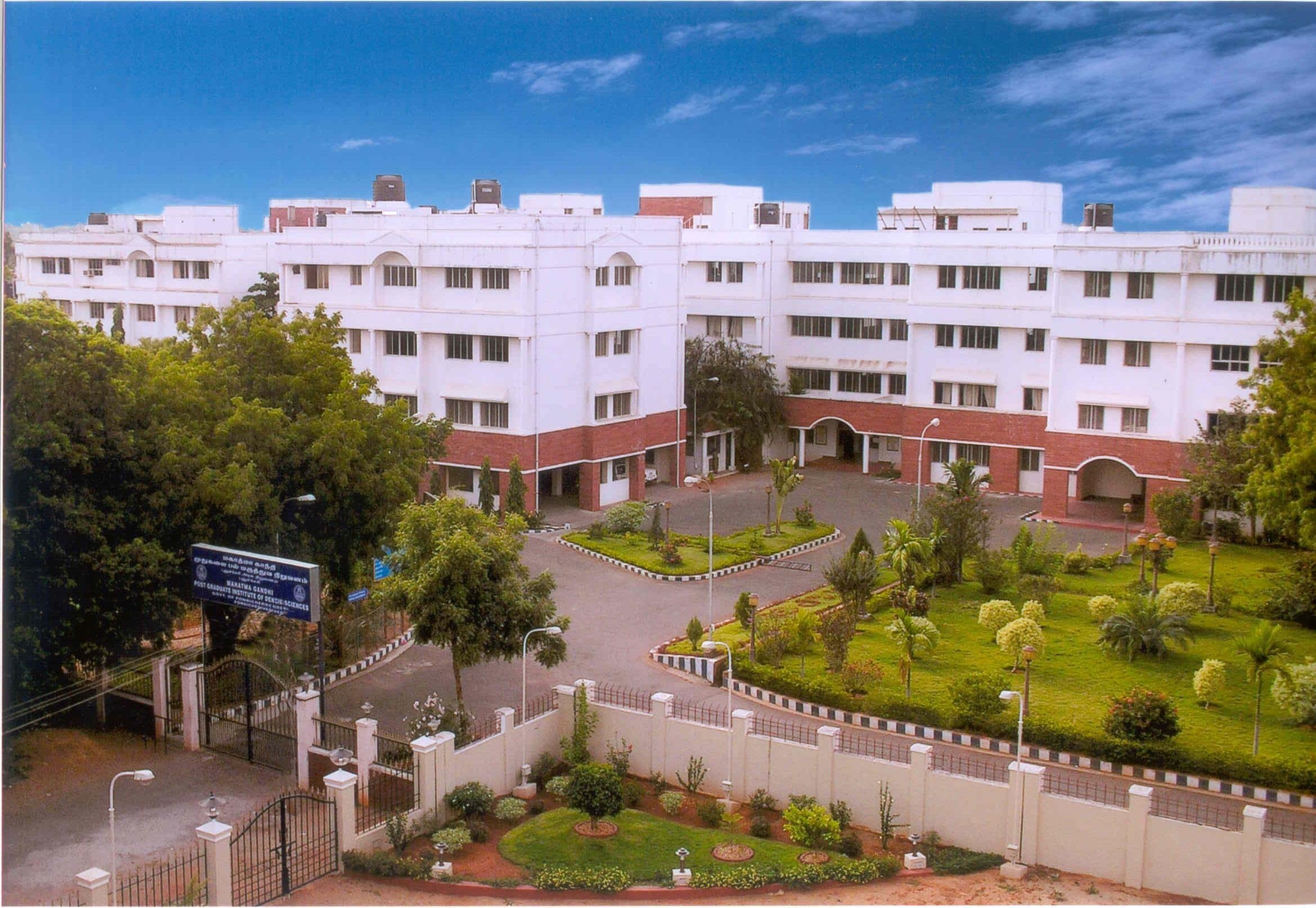
Mahatma Gandhi Postgraduate Institute of Dental Sciences Courses & Fees 2026 Course-wise Fees, Payment Schedule & Eligibility
Institute Type
Public
Accredited
Total Courses
2 Courses
Approved Curriculum
MGPGIDS offers two main programmes, the Bachelor of Dental Surgery and the Master of Dental Surgery. The BDS lasts five years, which means four years of academic study followed by one year of compulsory rotatory internship, and 125 students are admitted every year. The MDS lasts three years and admits 19 students across seven clinical specialities. Both programmes are recognised by the Dental Council of India and are conducted under Pondicherry University.
Explore the comprehensive list of courses offered by Mahatma Gandhi Postgraduate Institute of Dental Sciences, including detailed fee structures, specializations, and eligibility criteria:
Mahatma Gandhi Postgraduate Institute of Dental Sciences Courses
2 CoursesBDS degree recognised by the Dental Council of India with completed internship; qualifying score in NEET MDS; admission through CENTAC / central counselling.
10+2 with Physics, Chemistry and Biology, minimum 50% marks; qualifying score in NEET UG; admission through CENTAC / central counselling.
| Course | Fee Range | Eligibility |
|---|---|---|
| MDS 7 specializations | ₹ 1.27L - 3.82L Check Fee Details | BDS degree recognised by the Dental Council of India with completed internship; qualifying score in NEET MDS; admission through CENTAC / central counselling. |
| BDS 1 specialization | ₹ 83.1K - 1.72L Check Fee Details | 10+2 with Physics, Chemistry and Biology, minimum 50% marks; qualifying score in NEET UG; admission through CENTAC / central counselling. |
Counselling Updates
View allLoading updates...
Courses Offered at MGPGIDS, Puducherry
| MDS Speciality | Seats |
|---|---|
| Conservative Dentistry and Endodontics | 3 |
| Oral and Maxillofacial Pathology and Oral Microbiology | 3 |
| Oral and Maxillofacial Surgery | 3 |
| Oral Medicine and Radiology | 2 |
| Pediatric and Preventive Dentistry | 2 |
| Periodontology | 3 |
| Prosthodontics and Crown and Bridge | 3 |
For BDS, a candidate must have passed 10+2 with Physics, Chemistry and Biology, with at least 50 percent marks, and must qualify in NEET UG. The BDS curriculum begins with basic sciences such as anatomy, physiology and biochemistry, moves to dental materials, pathology and microbiology, and then to clinical subjects such as oral medicine, periodontology, conservative dentistry, prosthodontics, orthodontics and oral surgery. Students gain early hospital exposure and treat patients under supervision in the clinical years.
The MDS programme needs a BDS degree recognised by the Dental Council of India, completion of the internship and a qualifying score in NEET MDS. Half of the seats are meant for candidates from Puducherry, and the rest are filled through the all-India process. The three years combine advanced clinical training, a research dissertation, seminars, journal clubs and teaching exposure in the chosen speciality, and they prepare graduates for specialist practice and for academic posts.
Clinical work is spread across the seven main departments, and students rotate through them in the later years of the BDS. In the oral surgery department they learn extractions, minor surgical procedures and the management of dental emergencies, while in the conservative dentistry and endodontics department they learn fillings and root canal treatment. In prosthodontics they make dentures, crowns and bridges, and in periodontology they learn the care of gums and supporting tissues. Pediatric dentistry and oral medicine and radiology complete the clinical picture.
Examinations for the BDS are conducted by the university in the pattern of the Dental Council of India, with theory papers, practical examinations and viva voce at the end of each professional year. A student must also complete the prescribed number of clinical requirements in each department to be eligible for the examination. Postgraduate students submit a dissertation and appear for a final examination in their speciality, after three years of training.
The institute also supports research, and students of both programmes take part in projects, case presentations and conferences. A strong alumni network supports the students with guidance and with contacts in teaching, public health and private practice. Fees for each programme are described on the fee structure page.
Explore Related Resources
Expert Guidance
Need help choosing this college?
Tell us your rank and preferences and our counselling team will help you weigh Mahatma Gandhi Postgraduate Institute of Dental Sciences against your options.
Get Expert Guidance

Upcoming Exams
IISER
IISER Aptitude Test • June 2026
NEST
NEST Entrance Exam • June 2026
CUET
CUET UG Exam • 11-31 May 2026
PGIMER
BSc Nursing Exam • July-August 2026