MBBS Admission Process After NEET Counselling 2026

Click to enlarge
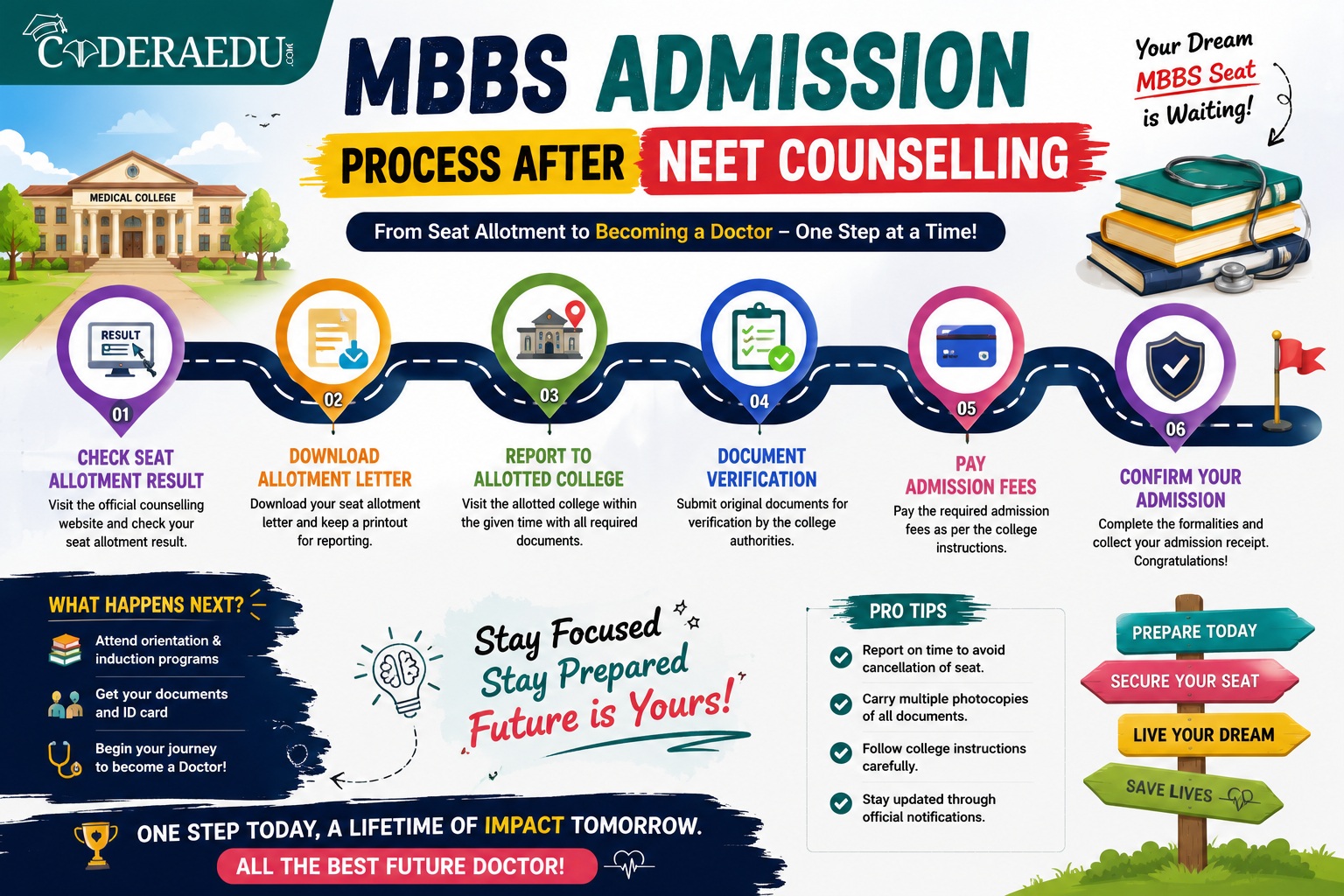
Clearing NEET UG is only the first step toward becoming a doctor. Between your result and your first day at a medical college lies a multi-stage admission process involving counselling registration, choice filling, seat allotment, document verification, fee payment, and in some cases a service bond. Missing or mishandling any one of these stages can cost you a seat you genuinely earned. This guide walks through the entire journey in order, from checking your NEET UG 2026 result at neet.nta.nic.in to settling into your MBBS course.
The process for MBBS admission in India is fully centralised now. No individual medical college, government or private, conducts its own entrance exam or direct-merit admission outside this system. Every seat, including at AIIMS and JIPMER, is filled only through NEET UG followed by centralised counselling.
India currently has roughly 1.1 lakh MBBS seats spread across more than 700 NMC-approved colleges, government and private combined. Converting your NEET score into one of those seats is a multi-layered process that typically spans four to six months from result declaration to final admission confirmation, running across several counselling rounds rather than a single event.
Overview: The Full Admission Sequence
Table
| Stage | What Happens |
|---|---|
| NEET UG result | Check AIR, category rank, and qualifying status |
| Counselling registration | Register separately on MCC and your state authority's portal |
| Choice filling and locking | Rank colleges and courses in order of preference |
| Seat allotment | Provisional result, objection window, then final allotment |
| Reporting and document verification | Physical reporting at the allotted institute with original documents |
| Fee payment and bond execution | Pay admission fee; sign service bond where applicable |
| Admission confirmation | Seat is locked for the academic session |
2 columns · 8 rows
This entire cycle repeats across multiple rounds, since not every seat is filled in Round 1. Understanding the full sequence in advance means you're never caught off guard by what comes next, whether that's a fresh registration for Round 2 or a bond you weren't expecting at a government college. Treat each stage as a checkpoint to prepare for ahead of time, not something to figure out reactively once it's already in front of you.
Step 1: Confirm Your NEET UG 2026 Result and Eligibility
Before anything else, you need your official scorecard showing your marks, percentile, All India Rank, and category rank. Download this from neet.nta.nic.in the moment it's live. If you haven't tracked the release yet, our NEET 2026 result date tracker covers the expected timeline.
There's no upper age limit for NEET UG candidates under current NMC guidelines, and candidates need to have completed 10+2 with Physics, Chemistry, Biology or Biotechnology, and English as core subjects. Beyond meeting the qualifying percentile for your category, this is the point to double-check that your basic eligibility documents, like Class 12 mark sheets, are in order before counselling registration opens.
It's also worth understanding your category rank alongside your overall AIR at this stage, since reserved-category candidates are ranked within a smaller competing pool and this significantly changes what's realistically achievable in counselling. Our NEET Marks vs Rank 2026 analysis breaks down how this plays out across categories in more detail.
Step 2: Register for Counselling on MCC and Your State Portal
Two separate systems run in parallel. The Medical Counselling Committee handles the 15% All India Quota seats plus 100% of seats at AIIMS, JIPMER, and central and deemed universities, through mcc.nic.in. State counselling authorities handle the remaining 85% of government seats and private or deemed seats within their state, each through their own separate portal.
- Register on mcc.nic.in for AIQ using your NEET roll number, application number, name, and date of birth
- Register separately on your state's counselling portal for state quota seats
- Pay the registration fee, which is typically non-refundable, along with a refundable security deposit
- Upload the documents requested at this stage, usually your scorecard and basic identity proof
- Set your login credentials and confirm your profile details before choice filling opens
Registering for only one system is one of the most common and costly mistakes candidates make. Missing state registration while waiting on AIQ results, or vice versa, means permanently losing access to that quota's seats for the round in question. The NEET UG Counselling 2026 complete guide covers the full registration timeline for both tracks side by side.
Each state also runs its own reservation categories on top of the central ones, and its own domicile rules determining who's even eligible for state quota seats. Since state authorities like Maharashtra's DMER, Uttar Pradesh's DGME, and Rajasthan's DME each operate independently, it's worth checking your specific state's counselling notice directly rather than assuming the process is identical to a neighbouring state's.
Step 3: Fill and Lock Your Choices Strategically
Choice filling is arguably the most consequential step in the whole process, since allotment is based entirely on your rank matched against the order you've listed. A poorly built list, either too narrow or too optimistic, is the single biggest reason candidates end up unallotted or unhappy with their seat.
- Use the NEET College Predictor 2026 to generate a data-backed shortlist based on your AIR, category, and quota
- Sort colleges into three buckets: reach, realistic, and safe, rather than filling only aspirational options
- Fill a broad list, ideally 25 to 40 or more choices, not just 5 to 10
- Put your most preferred colleges at the top, since you can always decline a lower allotment by floating
- Don't skip private and deemed colleges if you're open to them, since good seats there fill up fast in later rounds
- Cross-check closing ranks in the NEET 2026 expected cutoff guide before finalising your order
Choices should be in order of preference, as the allotment is done on the basis of choices submitted by the qualified candidate in order of preference.
Once you lock your choices, they generally cannot be edited, even by the counselling authority itself. Review your list carefully before the final submission, since a locked list is treated as final for that round regardless of second thoughts afterward.
It's also worth remembering that fresh choice filling is usually required for every new round, even Round 2 onward. Candidates sometimes assume their earlier list stays active if they didn't get allotted anything, but in most states and under MCC rules, you need to log back in and refill your preferences each round, adjusting based on updated seat matrices and closing ranks from the previous round.
Step 4: Check Your Seat Allotment Result
Once choices are locked, the counselling authority runs its matching algorithm and publishes a provisional allotment result first, followed by an objection window, and then the final allotment list. This is the result that tells you which college and course you've been allotted, if any.
For a detailed breakdown of how to check this result, what provisional versus final means, and how to decide between freeze, float, and slide, see our dedicated NEET Seat Allotment Result 2026 guide. Getting this decision right at each round has a direct impact on where you end up admitted.
Step 5: Report to the Allotted Institute for Document Verification
Provisional seat allotment is not confirmed admission. You must physically travel to the allotted institute within the given window, typically 48 to 72 hours, with all original documents and photocopies for verification. This is the only offline step in the entire process.
- NEET UG admit card and scorecard
- Counselling allotment letter
- Class 10 and Class 12 mark sheets and certificates
- Category certificate in the correct format for AIQ or state quota
- Domicile certificate, for state quota seats
- Valid photo ID and passport-size photographs matching your NEET application photo
Our full documents checklist for MBBS college reporting covers this stage in detail, including the category certificate format distinction that trips up the most candidates and a state-by-state breakdown of domicile requirements.
Step 6: Pay the Admission Fee and Execute Any Service Bond
Once documents clear verification, you'll be asked to pay the admission fee specified in your allotment letter to lock the seat. Government medical college fees are relatively modest, while private and deemed college fees run considerably higher, so knowing which type of seat you've been allotted before reporting day helps you arrange funds in advance.
Under current NMC rules, fees for 50% of seats in private medical colleges and deemed universities are required to match the government college fee structure in that state, with the remaining seats charged at the institution's own rate. This is worth checking against your specific allotted college, since it directly affects your total cost for the course.
This fee-cap rule is a relatively recent regulatory shift aimed at making private medical education more accessible on merit rather than purely on ability to pay. In practical terms, it means two students at the same private college, both admitted through NEET merit-based counselling, can end up paying meaningfully different fees depending on which half of the seat matrix they were allotted into. Always confirm the applicable fee bracket for your specific seat before making any payment.
Some government medical colleges, particularly in certain states, require candidates to sign a service bond at the time of admission, committing to a period of rural or underserved-area service after graduation, typically executed on stamp paper. Breaking this bond usually carries a significant financial penalty. Bond terms vary by state and are generally not applicable to private college admissions, so check your specific state counselling authority's rules rather than assuming a uniform policy across India.
Step 7: Complete Institute-Level Admission Formalities
After fee payment, most colleges run through a set of final formalities before your admission is fully confirmed for the academic session: a medical fitness check, submission of an anti-ragging affidavit from both candidate and parent, issuance of your student ID card, and hostel allocation where applicable.
This is also typically when you'll get your class and orientation schedule. Academic sessions across NMC-approved colleges tend to start close together, so once your seat is confirmed, the transition into actual classes usually happens within a short window.
Understanding the MBBS Course Structure You're Joining
MBBS in India runs for 4.5 years of academic study, divided into pre-clinical, para-clinical, and clinical phases, followed by a mandatory one-year rotating internship, bringing the total to 5.5 years before you're eligible for full registration to practice.
Table
| Phase | Approximate Duration | Focus |
|---|---|---|
| Pre-clinical | First 1.5 years | Anatomy, Physiology, Biochemistry |
| Para-clinical | Next phase | Pathology, Microbiology, Pharmacology, Forensic Medicine |
| Clinical | Final phase before internship | Medicine, Surgery, Obstetrics & Gynaecology, Paediatrics, and other clinical postings |
| Compulsory rotating internship | 1 year | Hands-on hospital postings across departments |
3 columns · 5 rows
Before starting clinical postings and the internship year, you'll need provisional registration with your State Medical Council, which allows you to practice under supervision during this period. After completing the internship and clearing any applicable licensing requirement under the current NMC framework, you become eligible for permanent registration, which is what allows independent practice and appears on both the state and national medical registers.
It's worth being aware early that a national exit examination now sits at the end of the MBBS journey under NMC's newer framework, functioning as both a licensing requirement and a factor in postgraduate admission ranking. This isn't something to worry about at the admission stage, but knowing the shape of the full course upfront helps you plan realistically for the years ahead rather than being surprised by it in your final year.
The compulsory internship year that follows your academic phase is not optional and cannot be skipped or shortened, regardless of your performance during the earlier years. It involves rotating postings across departments like Medicine, Surgery, Obstetrics and Gynaecology, and Paediatrics, giving you hands-on clinical exposure before you're allowed to register for independent practice. Many colleges also offer a small stipend during this year, which varies by institute and state.
Management Quota: What to Know If Government Rounds Don't Work Out
If you're not allotted a seat through AIQ or state quota rounds, management quota at private medical colleges is a separate, direct-admission route that typically opens only after the main government counselling rounds close, usually in September or October. NEET qualification is still mandatory, with no exemption for any candidate, but the selection here is handled by the college's own admission cell rather than a centralised algorithm. This route usually accounts for around 15 to 25 percent of seats at private medical colleges, and fees here are generally the highest across the entire admission landscape, so it's worth treating it as a genuine backup rather than a first choice.
- Only consider NMC-approved colleges; verify recognition status independently before paying anything
- Never make cash payments without an official receipt
- Be cautious of unauthorised agents promising guaranteed seats
- Compare fee structures carefully, since management quota fees tend to run considerably higher than state quota
If a government MBBS seat is genuinely out of reach at your rank, browsing options in our top 20 best medical colleges in India 2026 list and comparing them against the state-wise cutoff guide gives you a clearer, verified starting point than relying on unofficial sources.
If Your Allotted Seat Isn't What You Hoped For
Not every candidate ends up at their dream college, and it's worth thinking through your options clearly rather than reacting impulsively at reporting stage. A drop year is one option, but it only tends to make sense if your rank was reasonably close to what you needed and you genuinely believe there was room for a significantly better score, not simply because the process felt disappointing this time around.
Before deciding either way, it helps to see the full range of what's realistically available to you right now. Run your confirmed AIR through the NEET College Predictor 2026 across every quota and state you're eligible for, since a seat that looks unremarkable at first glance can sometimes be a strong option once you account for a state quota advantage or a private college's genuine strengths. If MBBS at your current rank stays out of reach even after exploring every round, it's also worth knowing that the same journey eventually leads to postgraduate specialisation later, and bookmarking the NEET PG College Predictor for a few years down the line is a reasonable long-term reference point.
Common Mistakes Across the Admission Process
- Registering for only AIQ or only state counselling instead of both simultaneously
- Filling too few choices, which sharply reduces allotment chances
- Treating provisional seat allotment as confirmed admission and skipping document preparation
- Not researching a college's infrastructure, bond terms, and fee structure before ranking it highly
- Relying on unofficial cutoff data instead of checking official MCC and state portals
- Missing reporting deadlines because travel and documents weren't arranged in advance
- Assuming Round 1 choices automatically carry over to later rounds without re-registering
Document discrepancies deserve particular caution. Minor errors, like a name spelled differently across your Class 10, Class 12, and NEET application documents, can hold up or even disqualify your admission at the verification stage. It's worth cross-checking every document for consistency well before your reporting date.

Click to enlarge
Topics:
Share this article
Copy
Frequently Asked Questions
What is the complete MBBS admission process after NEET?
It involves checking your NEET result, registering for AIQ and state counselling separately, filling and locking choices, checking seat allotment, reporting for document verification, paying fees, and completing institute-level formalities.
Do I need to register for both AIQ and state quota counselling?
Yes, if you want to maximise your options. AIQ and state quota are separate systems run in parallel, and registering for only one means missing seats under the other.
Is provisional seat allotment the same as confirmed admission?
No. Provisional allotment must be followed by physical reporting and document verification at the allotted institute, along with fee payment, before admission is confirmed.
How long does the MBBS course take to complete?
MBBS runs for 4.5 years of academic study across pre-clinical, para-clinical, and clinical phases, followed by a mandatory 1-year rotating internship, totalling 5.5 years.
What is a service bond in MBBS admission?
Some government medical colleges require candidates to sign a bond committing to a period of rural or underserved-area service after graduation. Terms vary by state and generally don't apply to private college admissions.
What is management quota and when does it open?
Management quota is a direct-admission route at private medical colleges, typically opening after AIQ and state quota rounds close. NEET qualification is still mandatory.
When do I need to register with the State Medical Council?
Provisional registration with your State Medical Council is required before starting clinical postings and your internship year. Permanent registration follows after internship completion and any applicable licensing requirement.
What are the most common mistakes in the MBBS admission process?
Registering for only one counselling system, filling too few choices, treating provisional allotment as final, missing reporting deadlines, and relying on unofficial cutoff information.
Does the fee differ between 50% of seats and the rest at private medical colleges?
Yes. Under current NMC rules, fees for 50% of seats in private colleges and deemed universities must match the government college fee structure in that state, while the remaining seats are charged at the institution's own rate.
Should I take a drop year if I'm unhappy with my allotted seat?
Only if your rank was reasonably close to what you needed and you genuinely believe there's room for meaningful improvement. Explore every available quota and round first using a college predictor before deciding.
Confused About College Admissions?
Get expert advice on college selection, admission chances, and career path in a personalized counselling session.
Book a Counselling Slot
Select Date
Pick a Slot