Which State Has the Cheapest MBBS Colleges in India? 2026 Guide

Click to enlarge
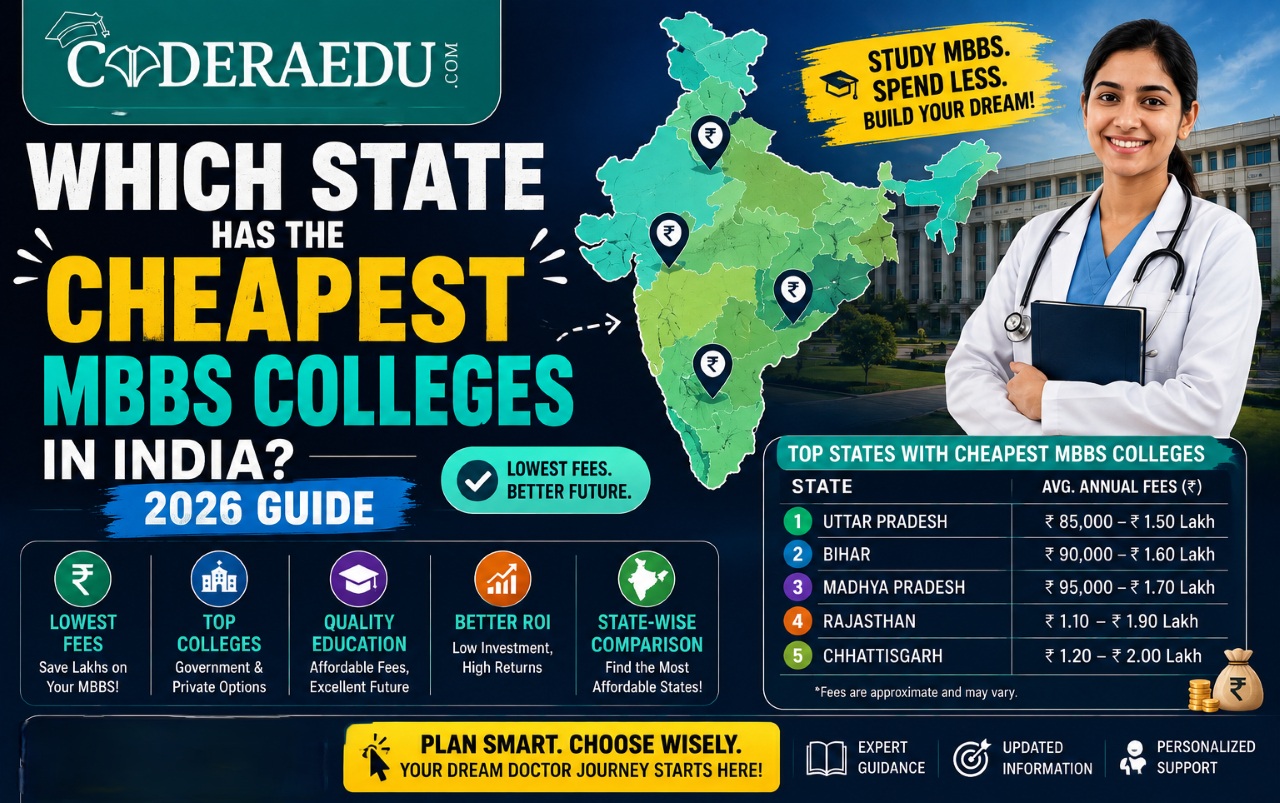
West Bengal and Bihar currently offer the cheapest government MBBS colleges in India, with annual tuition fees as low as 5,800 to 40,000 rupees at several state medical colleges, followed closely by Tamil Nadu. These figures apply only to government quota seats filled through NEET UG counselling, and they stand in sharp contrast to private and deemed university fees that can run into several lakh rupees a year in the very same states. This guide compares government MBBS fees across major states for 2026, explains why the gap is so wide, and shows how to realistically target an affordable seat instead of just chasing the lowest number on a list.
Which State Has the Cheapest MBBS Colleges in India: Quick Answer
Based on the latest available fee notifications from state medical education departments, government MBBS fees are lowest in West Bengal and Bihar, followed by Tamil Nadu, Uttar Pradesh, Rajasthan, Karnataka and Maharashtra in roughly that order. The table below gives an approximate annual fee range for general category government quota seats in each state, excluding hostel, mess and one-time charges.
Table
| State | Approximate Annual Government MBBS Fee | Relative Affordability |
|---|---|---|
| West Bengal | 9,000 to 40,500 rupees | Very Low |
| Bihar | 5,856 to 1,00,000 rupees (most colleges near 40,800) | Very Low |
| Tamil Nadu | 13,500 to 30,000 rupees | Low |
| Uttar Pradesh | 36,000 to 54,600 rupees | Low to Moderate |
| Rajasthan | 23,100 to 74,000 rupees | Moderate |
| Karnataka | About 64,350 rupees | Moderate |
| Madhya Pradesh | 1,00,000 to 1,20,000 rupees | Moderate to High |
| Maharashtra | 0 for reserved categories, up to 1,62,100 rupees for open category | Varies Sharply by Category |
3 columns · 9 rows
These figures are drawn from recent state directorate of medical education notifications and counselling portals, and individual colleges within the same state can still differ. Always confirm the exact current fee on the official prospectus of your target college before counselling, since committees revise fees from year to year.
How Government MBBS Fees Are Decided
Unlike private colleges, government medical colleges do not set their own fees freely. Each state runs its tuition fee through a Fee Regulatory Committee or an equivalent Directorate of Medical Education, which fixes tuition based on the state's education budget and subsidy policy rather than the actual cost of running the course. This is why a five and a half year MBBS degree can cost less than a laptop in some states, while the same degree at a private college nearby costs as much as a flat in a metro city.
Central institutions follow a separate, uniform fee structure set by the Ministry of Health and Family Welfare rather than any state committee. This is why every AIIMS campus, regardless of which state it sits in, charges a broadly similar and extremely low fee, unconnected to the surrounding state's own fee policy.
State-Wise Government MBBS Fee Comparison 2026
West Bengal
West Bengal runs one of the largest government medical college networks in the country, with 26 government colleges offering more than 4,100 MBBS seats. Tuition fees at most of these colleges start from around 9,000 rupees a year, making the state one of the most consistently affordable options for NEET UG aspirants, alongside a genuinely large seat count that improves realistic admission chances at a state quota rank.
Bihar
Bihar's government medical colleges charge fees ranging from about 5,856 rupees a year at AIIMS Patna, which follows the central AIIMS fee structure, to around 1,00,000 rupees a year at a few institutions with more specialised facilities. Most standard state government colleges settle around 40,800 rupees annually, keeping Bihar firmly among the cheapest states for a genuine government MBBS seat.
Tamil Nadu
Tamil Nadu's pure government medical colleges charge annual fees in the range of roughly 13,500 to 30,000 rupees, regulated by the Directorate of Medical Education. Government quota seats inside self-financing colleges carry a noticeably higher fee, commonly between 4.3 lakh and 5.4 lakh rupees a year, so it is worth checking whether a Tamil Nadu seat is at a fully government college or a self-financing institution before assuming it will be cheap.
Uttar Pradesh
Government and autonomous state medical colleges in Uttar Pradesh charge approximately 36,000 to 54,600 rupees a year, regulated by the state Directorate of Medical Education and Training. ESIC medical colleges in the state charge somewhat more, close to 1,00,000 rupees annually, while private and minority medical colleges run into several lakh rupees a year.
Rajasthan
Government and RajMES semi-government medical colleges in Rajasthan charge tuition in the range of roughly 23,100 to 74,000 rupees a year for All India Quota and state quota seats, according to recent Directorate of Medical Education notifications. This keeps Rajasthan among the more budget-friendly states, though management and NRI quota seats at RajMES and private colleges are considerably costlier.
Karnataka
Karnataka's government medical colleges charge approximately 64,350 rupees a year, placing the state in the moderate range rather than among the very cheapest. Private colleges under the state quota charge considerably more, and management or NRI quota seats at the same institutions can run several times higher, so the fee gap between quota types is unusually steep in Karnataka.
Madhya Pradesh
Several government medical colleges in Madhya Pradesh, including newer institutions, charge close to 1,00,000 to 1,20,000 rupees a year in tuition, which is noticeably higher than West Bengal or Bihar despite being a fully government-funded seat. This makes Madhya Pradesh a useful reminder that government status alone does not guarantee the lowest possible fee.
Maharashtra
Maharashtra's government medical college fee structure varies sharply by category. Open category students pay around 1,62,100 rupees a year, EWS and OBC candidates pay a reduced fee near 86,050 rupees, while SC, ST and VJ or NT category students often have tuition fully exempted. This means the real answer to how cheap Maharashtra is depends heavily on which category a student falls under, more than in most other states.
Delhi and Kerala: Where They Stand
Delhi is a special case rather than a typical state comparison, since it hosts AIIMS New Delhi and several other central and Delhi government colleges with fees in the low thousands, pulling its average down sharply even though the city itself has a small number of purely state-run seats. Kerala's government medical colleges sit in the moderate range overall, but the state is better known for having some of the lowest private and deemed university fees in India under its government quota arrangement, which is a different comparison from the pure government college fee this guide focuses on.
Why West Bengal and Bihar Are the Cheapest States for MBBS
- Both states have historically prioritised heavy tuition subsidy over cost recovery in their government medical college fee policy.
- Both maintain a large number of well-established government colleges, spreading the subsidy burden across a wide seat base rather than a handful of institutions.
- Fee revisions in both states have stayed comparatively conservative in recent years compared to states like Madhya Pradesh and Karnataka.
- Central AIIMS campuses located within these states, such as AIIMS Patna and AIIMS Kalyani, follow the uniform low AIIMS fee structure, further pulling down the overall state average when compared casually.
AIIMS Fees vs State Government College Fees
AIIMS institutions sit in a fee category of their own, separate from every state's own fee policy. Because every AIIMS MBBS seat is filled purely through All India Quota with no domicile requirement, the extremely low fee applies to every candidate nationwide rather than being restricted to residents of the state the campus happens to be located in.
Table
| Institution Type | Approximate Annual Fee | Admission Route |
|---|---|---|
| AIIMS campuses (all locations) | 5,000 to 6,500 rupees | NEET UG All India Quota only |
| JIPMER Puducherry | Approximately 5,000 rupees | NEET UG All India Quota |
| Cheapest state government colleges (West Bengal, Bihar) | 9,000 to 40,800 rupees | State quota and AIQ |
| Mid-range state government colleges (Rajasthan, UP) | 36,000 to 74,000 rupees | State quota and AIQ |
| Higher-fee government colleges (Madhya Pradesh, Karnataka) | 64,000 to 1,20,000 rupees | State quota and AIQ |
3 columns · 6 rows
Total 5-Year Government MBBS Cost: A Realistic Estimate
Tuition is only part of the total cost. Hostel charges, mess fees, examination fees, uniform and instrument costs, and university registration charges add up over the course, even at government colleges. A realistic full-course estimate, including tuition, for the cheapest states looks like this.
Table
| State Category | Approximate Total Tuition (5 to 5.5 years) | Approximate Total With Hostel and Other Charges |
|---|---|---|
| Cheapest states (West Bengal, Bihar) | 50,000 to 2,00,000 rupees | 1,50,000 to 3,50,000 rupees |
| Moderately affordable states (Tamil Nadu, UP, Rajasthan) | 1,50,000 to 4,00,000 rupees | 2,50,000 to 5,50,000 rupees |
| Higher-fee government colleges (MP, Karnataka) | 3,50,000 to 6,00,000 rupees | 5,00,000 to 8,00,000 rupees |
| Private and deemed colleges (any state) | 50,00,000 rupees and above | 60,00,000 rupees and above |
3 columns · 5 rows
Even the higher end of the government college range across every state remains a fraction of a single year's fee at most private medical colleges, which is exactly why government seats stay the most fiercely contested outcome of NEET UG counselling every year regardless of which state a student is targeting.
Examples of Genuinely Low-Fee Government Medical Colleges
Table
| College | State | Approximate Annual or Total Fee |
|---|---|---|
| AIIMS Patna | Bihar | About 5,856 rupees per year |
| North Bengal Medical College and Hospital, Siliguri | West Bengal | About 40,500 rupees for the total course |
| Most standard state government colleges | Bihar | Around 40,800 rupees per year |
| Standard government medical colleges | Tamil Nadu | 13,500 to 30,000 rupees per year |
3 columns · 5 rows
These figures illustrate the range rather than an exhaustive list, and new colleges are added to state counselling most years, so it helps to check the latest prospectus for any specific institution rather than relying only on a fee figure from a previous admission cycle.
Is Cheapest Always Best? Factors Beyond Fees to Consider
- Clinical exposure and patient inflow at the attached teaching hospital, which shapes practical training far more than the fee amount.
- Faculty strength and NMC recognition status, since a lapsed or conditional recognition can create serious complications later.
- Hostel quality, safety and distance from the main campus, especially for outstation students.
- Placement and further study outcomes, including how graduates from that college typically perform in NEET PG.
- Rural service bond conditions attached to some low-fee government seats, which can require a mandatory posting after internship or postgraduation.
- Overall infrastructure and bed strength of the attached hospital, which affects hands-on learning quality regardless of how low the tuition is.
How to Target a Low-Fee Government MBBS Seat
- Check your domicile eligibility carefully, since 85 percent of government MBBS seats in any state are reserved for candidates with valid domicile in that state.
- Compare your expected NEET UG rank against recent state quota closing ranks for your target colleges before counselling begins.
- Register for both All India Quota and your home state counselling simultaneously, since missing one while waiting on the other is a common and costly mistake.
- Shortlist a wide list of colleges within your state rather than only the two or three most well-known names.
- Read each college's current fee notification directly from the state Directorate of Medical Education rather than relying only on aggregator websites.
- Factor in hostel, mess and other recurring charges when comparing colleges, not just the headline tuition figure.
- Consider whether a rural service bond or compulsory posting applies to a particular low-fee seat before locking your preference.
Common Mistakes When Choosing Based on Fees Alone
- Assuming every government college in a cheap state charges the same fee, when self-financing and semi-government colleges within the same state can charge far more.
- Confusing government quota seats inside private colleges with genuinely government-run colleges, which have very different fee structures despite similar-sounding names.
- Ignoring category-based fee differences, particularly in states like Maharashtra where reserved category students may pay little to nothing while open category students pay considerably more.
- Overlooking hostel and non-tuition charges, which can add a meaningful amount to the total cost even at the cheapest colleges.
- Choosing a college purely on fee without checking NMC recognition status, faculty strength or hospital bed capacity.
- Not verifying the latest fee notification before counselling, and relying on outdated figures from a previous academic year.
What to Do Next
Once you have a sense of which states offer the most affordable government MBBS seats, the next step is checking where your expected NEET UG rank realistically places you within those states. Run your rank, category and home state through a predictor tool to see genuine college options rather than working off national averages alone, and cross-check any shortlisted college's current fee directly against its official prospectus before counselling choices are due.
Useful Internal Links
- NEET UG College Predictor 2026
- Medical College Predictor 2026
- Government MBBS colleges state wise
- Top 20 best medical colleges in India 2026
- NEET rank vs college guide
- NEET rank required for AIIMS
- North Bengal Medical College and Hospital, Siliguri
- Deben Mahata Government Medical College, Purulia
- Atal Bihari Vajpayee Government Medical College, Vidisha
- Bundelkhand Medical College, Sagar
- NEET 2026 state-wise cutoff guide
Official External Resources
- National Medical Commission official website
- MCC official counselling portal
- National Testing Agency official website
- Directorate General of Health Services, Ministry of Health and Family Welfare
- West Bengal University of Health Sciences official website
- Tamil Nadu Medical Selection Committee official website
- Ministry of Education, Government of India
Topics:
Share this article
Copy
Frequently Asked Questions
Which state has the cheapest MBBS colleges in India?
West Bengal and Bihar currently offer the cheapest government MBBS colleges in India, with annual tuition as low as 5,800 to 40,800 rupees at several state medical colleges, followed closely by Tamil Nadu.
What is the cheapest government medical college in India?
AIIMS institutions have the lowest fees in the country, with a total course cost of roughly 5,000 to 6,500 rupees, but they admit purely through All India Quota rather than state domicile.
Is MBBS free in any Indian state?
Not entirely, but some states like Maharashtra fully exempt tuition fees for SC, ST and VJ or NT category candidates in government medical colleges, effectively making the course free for those categories.
Why is government MBBS so much cheaper than private MBBS in India?
Government medical colleges are heavily subsidised by central and state governments, with tuition fixed by regulatory committees based on subsidy policy rather than the actual cost of running the course, unlike private colleges which must recover costs independently.
Does a cheaper MBBS fee mean lower quality education?
Not necessarily. Several of the cheapest government colleges, including older institutions in West Bengal and Bihar, have strong clinical exposure and established teaching hospitals, so fee alone should not be used as a quality indicator.
Can students from other states get admission in West Bengal or Bihar government colleges at low fees?
Only through the 15 percent All India Quota, since the remaining 85 percent of state quota seats require valid domicile in that specific state.
Are there hidden costs in low-fee government MBBS colleges?
Yes. Hostel, mess, examination and university registration charges apply on top of tuition even at the cheapest colleges, so the total yearly cost is usually higher than the tuition figure alone suggests.
Which state has the highest number of affordable government medical colleges?
West Bengal has one of the largest government medical college networks in India, with 26 government colleges and more than 4,100 seats at consistently low tuition fees.
Confused About College Admissions?
Get expert advice on college selection, admission chances, and career path in a personalized counselling session.
Book a Counselling Slot
Select Date
Pick a Slot