How Many Times Has the NEET Paper Leaked? Complete History of NEET UG Paper Leak Cases, Investigations & Government Action (2015–2026)

Click to enlarge
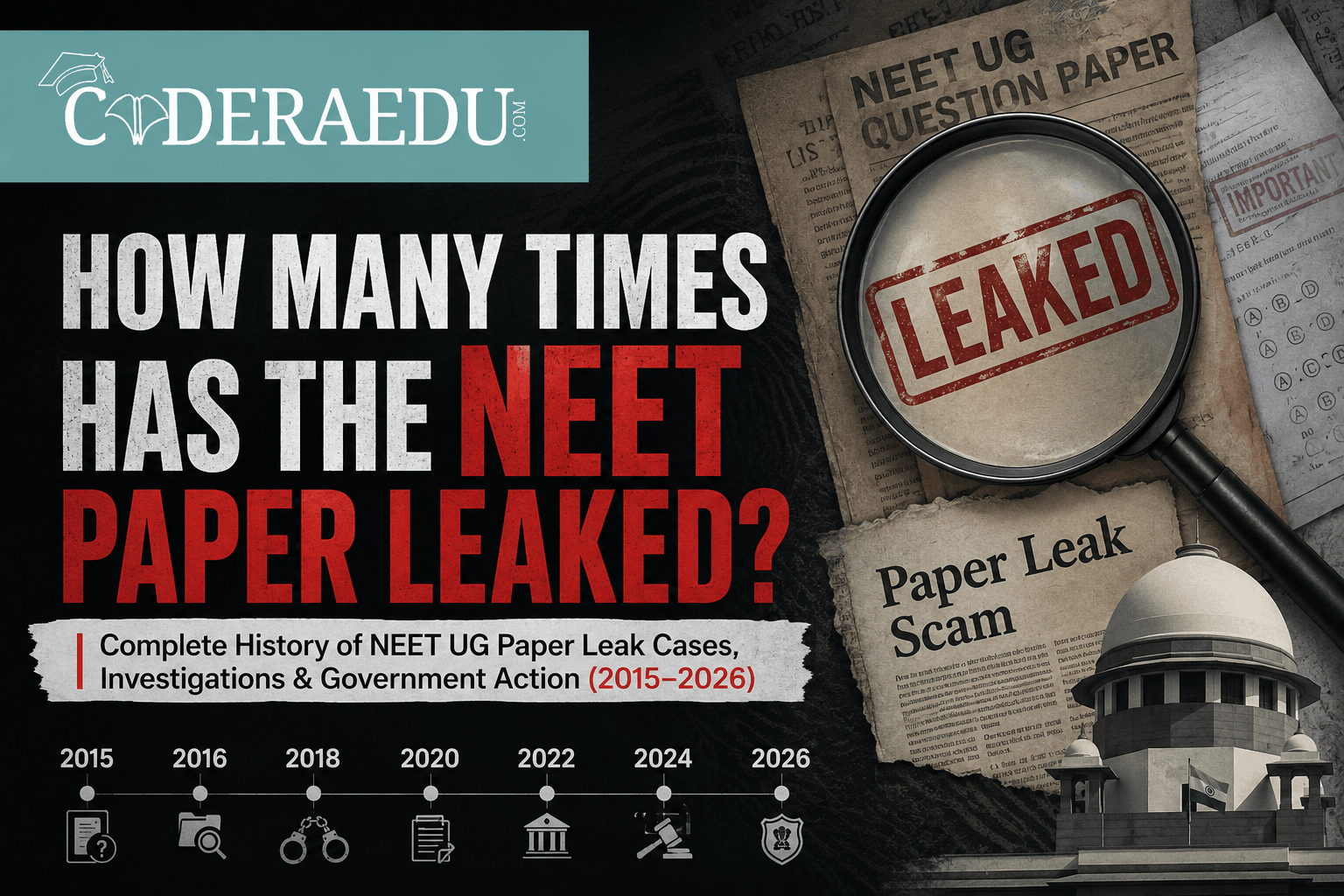
NEET, and its predecessor AIPMT, has faced at least five major, well-documented paper leak controversies since 2015: the 2015 AIPMT Bluetooth scam, the 2016 NEET Phase II inter-state leak allegations, the 2021 Rajasthan leak allegations, the 2024 NEET-UG Bihar paper leak, and the 2026 Nashik-Sikar case that led to a full re-examination. This is a factual, chronological look at each incident, the investigations that followed, and the legal and policy reforms that emerged in response, drawn from court records, government notifications and verified news reporting.
NEET and AIPMT Paper Leak Timeline at a Glance
Table
| Year | Exam | What Happened | Outcome |
|---|---|---|---|
| 2015 | AIPMT | Bluetooth vest and micro-SIM device scam used to relay answers to candidates during the exam | Supreme Court cancelled the entire exam on 15 June 2015, over 6.3 lakh candidates retook it |
| 2016 | NEET Phase II | Uttarakhand Police uncovered an inter-state network allegedly selling leaked papers | CBSE denied a systemic leak, arrests made in Bihar and Delhi, no full retest ordered |
| 2021 | NEET-UG | Allegations of paper leak linked to a Jaipur exam centre, with answers relayed via WhatsApp | Arrests made, matter probed, government maintained there was no systemic breach |
| 2024 | NEET-UG | Paper theft from an NTA trunk in Hazaribagh, Jharkhand, and distribution in Patna, Bihar | CBI investigation, multiple arrests and chargesheets, Supreme Court declined to order a full retest |
| 2026 | NEET-UG (Re-NEET) | Alleged leak traced to Nashik, Maharashtra, with links to Sikar, Rajasthan, distributed via Telegram and WhatsApp | Original 3 May 2026 exam cancelled, Re-NEET conducted 21 June 2026, result declared 16 July 2026 |
4 columns · 6 rows
Each of these incidents differs in scale, method and eventual outcome, and it is worth looking at them individually rather than treating them as one continuous story, since the facts, investigating agencies and court findings varied considerably each time.
2015: The AIPMT Bluetooth Vest Scandal
Before NEET existed under that name, the exam was called the All India Pre-Medical Test, conducted by CBSE. In May 2015, Haryana Police uncovered a scam in which candidates wore vests fitted with micro-Bluetooth devices and hidden SIM cards, allowing solvers outside the exam hall to transmit answers directly to them during the test.
Investigators found that more than 350 mobile phones were used to coordinate the racket, and at least 44 to 54 people were found to have directly benefited from it. On 15 June 2015, the Supreme Court cancelled the entire AIPMT exam, calling the episode a matter of serious concern for the integrity of medical admissions, and ordered CBSE to conduct a fresh exam. More than 6.3 lakh candidates had to retake the test as a result, and the investigation was later transferred to the CBI.
2016: NEET Phase II Inter-State Leak Allegations
The exam was rebranded as NEET in 2016, conducted in two phases that year. Ahead of NEET Phase II, held on 24 July 2016, Uttarakhand Police arrested several individuals connected to an alleged inter-state network operating out of Bihar and Delhi, accused of selling access to leaked question papers.
Reports at the time described candidates being charged large sums, reportedly in the range of several lakhs of rupees, in exchange for advance access to papers through temporary safe houses. CBSE, the conducting body at the time, denied that a large-scale systemic leak had occurred and maintained that the racket had primarily involved fraudulent papers rather than the genuine question set. No full nationwide retest was ordered for this exam.
2021: NEET-UG Rajasthan Leak Allegations
In 2021, allegations surfaced around an exam centre in Jaipur, Rajasthan, where question papers were reportedly photographed and answers relayed to candidates through WhatsApp. Arrests were made in connection with the case, and the matter was investigated by relevant state authorities.
The central government at the time maintained that the incident did not point to a systemic compromise of the exam nationally, a position that mirrors how several other alleged leaks that year, including in other national-level exams, were characterised by officials. A broader government-appointed panel was later set up to examine paper leak concerns across several exams from this period, though the detailed findings of that panel were not made public.
2024: The NEET-UG Bihar Paper Leak, the Biggest Controversy Yet
The 2024 case became one of the most significant examination controversies in India's recent history. NEET-UG 2024 was held on 5 May 2024, with more than 23 lakh candidates appearing nationwide. Allegations soon emerged that question papers had been stolen from an NTA trunk in Hazaribagh, Jharkhand, and subsequently leaked in Patna, Bihar.
The CBI took over the investigation and registered multiple FIRs, eventually arresting at least 14 people, including the principal and vice-principal of a school in Hazaribagh allegedly involved in facilitating the theft. Investigators identified individuals who allegedly stole papers from the transport trunk before the exam and passed them to a wider network. The agency filed its first chargesheet naming 13 accused shortly before the matter reached its conclusion in the Supreme Court.
Separately, a controversy also emerged over grace marks awarded to candidates at six exam centres to compensate for lost time. After the matter reached the Supreme Court, the government scrapped these grace marks and offered an optional retest to the 1,563 affected candidates, of whom 813 chose to appear.
The Supreme Court's Verdict on NEET-UG 2024
A bench led by then Chief Justice of India D.Y. Chandrachud heard multiple petitions seeking either a full cancellation of the exam or individual retests for affected candidates. The Court acknowledged that a leak had genuinely occurred at Hazaribagh and Patna, calling it an undisputed fact, but examined whether this amounted to a systemic breach affecting the integrity of the entire national exam.
On 23 July 2024, the Supreme Court declined to order a full re-examination, holding that available evidence, including CBI findings, indicated only around 155 students from Hazaribagh and Patna had directly benefited from the leak, not a scale sufficient to vitiate results for the more than 23 lakh candidates who had appeared nationally. The Court noted that ordering a fresh exam for the entire candidate pool would carry serious consequences and disrupt the academic calendar. It also directed NTA to revise results following an expert panel review of a disputed Physics question, which affected marks for roughly four lakh candidates. A review petition against this verdict was later filed but did not overturn the original decision.
There is absence of material to conclude that the result of the NEET-UG 2024 exam is vitiated or that there was a systemic breach in the conduct of the exam.
2026: The Nashik-Sikar Case and Re-NEET
The original NEET UG 2026 exam was scheduled for 3 May 2026, with more than 24 lakh candidates registered to appear. Allegations of a large-scale leak emerged, with investigators tracing the origin to Nashik, Maharashtra, and finding connections extending to Sikar, Rajasthan, a city widely known for its concentration of medical entrance coaching institutes.
According to investigation reports, a courier employee allegedly provided temporary access to the trunks carrying question papers, which were then digitally copied using portable scanners and routed through what were described as shadow servers. A document running to roughly 150 pages, containing around 410 questions and framed as a guess paper, was reportedly circulated through Telegram and WhatsApp groups ahead of the exam.
Given the scale of the allegations, the Centre cancelled the entire NEET-UG 2026 exam and handed the investigation to the CBI. Union Education Minister Dharmendra Pradhan announced a re-examination, held on 21 June 2026, and stated that the government had adopted what he described as a zero tolerance approach toward examination malpractice. The Re-NEET UG 2026 result was declared on 16 July 2026, with Aryan Gupta from Punjab and Panshul Bansal from Haryana jointly securing All India Rank 1.
What Investigations Have Typically Found Across These Cases
Looking across all five incidents, a few patterns recur. Leaks have generally originated from a small number of points in the exam's physical or digital supply chain, printing presses, transport of question paper trunks, coaching networks, or individuals with temporary access to sealed materials, rather than from a single systemic failure repeated identically each time.
- Physical leaks, as in 2015, 2016 and 2024, generally involved theft or unauthorised access during transport or storage of question papers
- Digital distribution, most visible in the 2026 case, has become a more prominent method as scanning and messaging apps make wide circulation faster and harder to trace
- Courts and investigating agencies have generally distinguished between a leak affecting a small, geographically limited group of beneficiaries and one large enough to compromise the exam nationally, a distinction that shaped the outcome in the 2024 case specifically
- Full nationwide retests have been ordered only when the evidence pointed to a truly systemic and widespread compromise, as in 2015 and 2026, rather than in every case where a leak was confirmed to have occurred
Government Response: NTA's Formation and Earlier Reforms
The National Testing Agency was established in 2017, partly to reduce the administrative burden on CBSE and centralise the conduct of major entrance exams including NEET and JEE. Despite this, paper leak allegations have continued to surface periodically across several NTA-conducted exams, including NEET-UG, JEE Mains, and UGC-NET, in the years since the agency's formation.
The Public Examinations (Prevention of Unfair Means) Act, 2024
In direct response to the 2024 NEET-UG controversy, Parliament passed the Public Examinations (Prevention of Unfair Means) Act, 2024, cleared by the Lok Sabha on 6 February 2024 and the Rajya Sabha on 9 February 2024, receiving presidential assent on 12 February 2024. The Act was brought into force on 21 June 2024.
The law introduced specific criminal offences related to exam malpractice, including question paper leaks, impersonation of candidates, and tampering with computer systems used in exam administration. It set penalties of three to five years imprisonment and fines up to ten lakh rupees for individual offences, rising to five to ten years imprisonment and a minimum fine of one crore rupees for cases classified as organised crime. Service providers found complicit face fines up to one crore rupees and can be barred from conducting public examinations for four years.
Several states, including Uttar Pradesh, have since passed their own parallel legislation modelled on this central Act. Further legislative detail and the bill's progress through Parliament are documented by PRS Legislative Research, an independent parliamentary tracking organisation.
The Move Toward Computer-Based Testing
Following the 2026 controversy, Union Education Minister Dharmendra Pradhan announced that NEET UG would transition to a fully online, Computer-Based Test format starting the following academic year, a significant departure from the paper-based format used since the exam's inception. The stated rationale is that digital delivery, with encrypted, decentralised distribution of question sets, removes the physical transport and storage vulnerabilities that have been implicated in multiple past leaks, including 2015, 2016 and 2024.
This shift mirrors the approach already used for exams like JEE Main, which has been conducted in a computer-based, multi-shift format for several years. Whether a similar model can be scaled to NEET's far larger candidate pool, well over 20 lakh applicants annually, without introducing new logistical or equity concerns, particularly for candidates in areas with limited digital infrastructure, remains an open question that the transition will need to address.
Official Confirmation of the 2024 Law's Enforcement
The Act's enforcement date and penalty structure were confirmed through an official government announcement on 21 June 2024, reported by All India Radio's official news service. The notification specifically named the National Testing Agency, UPSC, SSC, Railway Recruitment Boards and banking recruitment bodies as institutions covered under the law's provisions.
How the 2024 Case Reached the Supreme Court
The path to the Supreme Court's final verdict involved several hearings over roughly two months. The Court initially declined to stay the declaration of results in May 2024, then issued formal notices to the NTA and Centre in June, before a full bench heard detailed arguments in July examining whether the leak met the threshold of a systemic breach.
Detailed proceedings from these hearings, including the Court's specific questions to petitioners and the government's counsel, are documented by the Supreme Court Observer, an independent legal reporting platform that tracks constitutional bench proceedings.
Checking Current Official Sources
Because investigations into more recent cases, particularly 2026, remain active, the most reliable ongoing source for confirmed developments is the exam authority itself. Exam and result details are published on the NTA NEET portal, counselling-related updates are issued through mcc.nic.in, and any changes to medical college recognition tied to admission integrity are confirmed via the National Medical Commission.
How This History Affects Current Aspirants
For candidates navigating NEET UG 2026 admissions specifically, the immediate practical effect of this year's case is the compressed counselling timeline that followed the nearly two-month delay between the original exam date and the eventual result. Beyond this cycle, candidates preparing for future NEET exams should expect continued changes to exam format and security protocol as the transition to computer-based testing unfolds. Once your own result and rank are confirmed, focus shifts to admission planning, and tools like the NEET UG College Predictor can help translate your rank into realistic college options across government, private and deemed institutions.
Whatever cycle you are appearing in, the practical admission process itself, AIQ and state counselling registration, document verification, and choice filling, remains governed by MCC and state authorities regardless of exam format changes. Reviewing options on the MBBS college directory, and checking individual institutions such as Santosh Medical College and Hospital, Ghaziabad, Grant Medical College, Mumbai, or Dayanand Medical College and Hospital, Ludhiana, remains a sound way to plan regardless of how the underlying exam evolves. If you are also exploring postgraduate pathways further ahead, the NEET PG Predictor works on a similar principle for later in your medical career.
Candidates preparing for a NEET repeat attempt, or younger students just beginning preparation, may also find it useful to understand how exam security concerns have shaped recent counselling timelines, since a delayed exam cycle, as seen in 2026, cascades into a delayed and compressed counselling process affecting choice filling deadlines across every state.
For a sense of the scale involved each year, government colleges alone, such as Osmania Medical College, Hyderabad and Gandhi Medical College, Bhopal, admit thousands of MBBS students annually through the same counselling machinery that has had to absorb repeated shocks from exam integrity issues over the past decade, underlining why exam security reform carries consequences well beyond the exam day itself.
A Note on Confirmed Facts Versus Ongoing Investigations
Some details in cases still under investigation, particularly the 2026 Nashik-Sikar case, are based on reported investigation findings that may be refined as the CBI probe and any resulting court proceedings continue. Court-concluded matters, such as the 2015 Supreme Court order and the 2024 verdict, represent settled factual and legal findings as of this writing. Readers following any ongoing case closely should treat news of arrests, chargesheets or court hearings as developing rather than final until a court has ruled conclusively.
Share this article
Copy
Frequently Asked Questions
How many times has the NEET paper leaked?
NEET and its predecessor AIPMT have faced at least five major, well-documented paper leak controversies since 2015: 2015, 2016, 2021, 2024, and 2026, though the scale, confirmed impact, and court findings differed significantly across these cases.
Was NEET-UG 2024 fully cancelled due to the paper leak?
No. While the Supreme Court acknowledged that a leak occurred at Hazaribagh and Patna, it declined to order a full re-examination, finding that only around 155 candidates were confirmed beneficiaries, not enough to establish a systemic breach affecting all 23 lakh plus candidates.
Why was NEET UG 2026 fully cancelled and re-conducted?
The original 3 May 2026 exam was cancelled after investigators traced an alleged large-scale leak to Nashik, Maharashtra, with connections to Sikar, Rajasthan, involving digital distribution of question content before the exam. The government conducted a fresh Re-NEET on 21 June 2026.
What is the Public Examinations (Prevention of Unfair Means) Act, 2024?
It is a central law passed in response to the 2024 NEET-UG controversy, criminalising exam malpractice including paper leaks and impersonation, with penalties ranging from three years imprisonment and fines up to ten lakh rupees for individuals, to ten years imprisonment and fines of at least one crore rupees for organised crime.
Is NEET moving to computer-based testing because of the leaks?
Yes. Following the 2026 controversy, the government announced that NEET UG will transition to a fully online, Computer-Based Test format from the next academic year, aiming to remove the physical paper transport and storage vulnerabilities linked to past leaks.
Who investigates NEET paper leak cases?
Cases have typically been investigated by state police initially, with the CBI taking over larger or more serious cases, as seen in both the 2024 Bihar case and the 2026 Nashik-Sikar case, both of which were handed to the CBI.
Did the 2015 AIPMT leak affect all candidates?
The 2015 scandal, involving Bluetooth vest devices, was found serious enough that the Supreme Court cancelled the entire AIPMT exam and ordered a full retest, requiring more than 6.3 lakh candidates to reappear.
Confused About College Admissions?
Get expert advice on college selection, admission chances, and career path in a personalized counselling session.
Book a Counselling Slot
Select Date
Pick a Slot