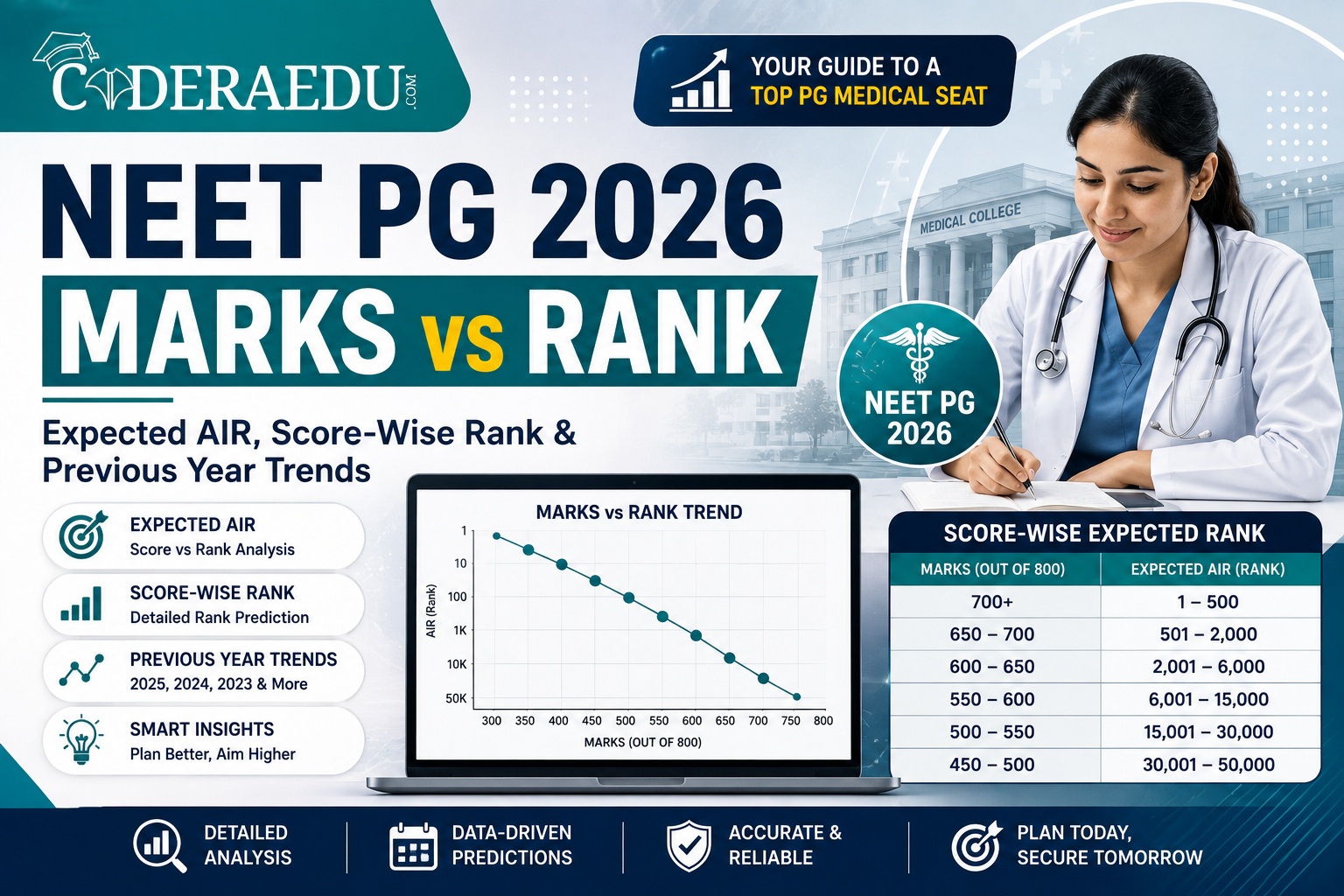
NEET PG 2026 Marks vs Rank: Expected AIR, Score-Wise Rank & Previous Year Trends

Click to enlarge
Here's what most marks vs rank guides on the web will not tell you: that comparing your neet pg 2026 score directly to last year's rank table is wrong because of a built-in change this year. The nbems has cut the number of questions from 200 to 180 this year, and thus the total scoring has changed from 800 to 720. A score of 600 would mean something completely different to you on the 800-mark scale of 2025 than it does on the 720-mark scale of 2026, if you treat the two scores as equal. This guide will discuss the verified previous-year trends, the tie-breaking rules that dictate how the ties between candidates are broken, and how to apply them to adjust historical data for this year's changed scoring system.
NEET PG 2026: Latest Status
Table
| Particular | Details |
|---|---|
| Exam Date | August 30, 2026 (single shift) |
| Total Marks (2026) | 720 (180 questions × 4 marks each) |
| Total Marks (2025, for comparison) | 800 (200 questions × 4 marks each) |
| Result Status | Awaited , expected around September 30, 2026 (not officially confirmed) |
| Marks vs Rank Data | Not yet available for 2026; this guide uses verified 2023–2025 trends, adjusted for the scale change |
2 columns · 6 rows
Why NEET PG 2026 Marks Can't Be Compared Directly to Previous Years
This is the single most important thing to understand before looking at any rank table on this page or anywhere else. NEET PG 2025 was conducted for 200 questions worth 800 total marks. NEET PG 2026 dropped to 180 questions worth 720 total marks — a structural change, not a minor tweak. A candidate scoring 600 out of 800 in 2025 achieved 75% accuracy. A candidate scoring 600 out of 720 in 2026 would be at roughly 83% accuracy , a meaningfully stronger performance despite the identical raw number. Any marks-vs-rank comparison that lines up a 2026 raw score against a 2025 raw score without adjusting for this is comparing two different scales as if they were one, and will mislead you about where you actually stand.
NEET PG 2025 Marks vs Rank (Verified)
NEET PG 2025 was conducted on August 3, 2025, with results declared on August 18. A total of 2,42,493 candidates appeared, and since the exam ran in a single shift, NBEMS did not apply score normalisation. The topper scored 707 out of 800. Here's how marks translated to rank last year, based on the official result data.
Table
| Marks (out of 800) | Approximate Percentage | Approximate AIR Range (2025) |
|---|---|---|
| 707 (topper) | 88.4% | AIR 1 |
| 695 | 86.9% | AIR 5 |
| 650+ | 81%+ | Top 500–700 |
| 600 | 75% | ~3,000–4,000 |
| 550–580 | 69–72% | ~5,000 range |
| 500 | 62.5% | ~21,000–25,000 |
3 columns · 7 rows
NEET PG 2024 and 2023 Marks vs Rank (Verified Trend)
Looking at more than one year matters here, because a single year's data can make a difficulty spike or dip look like a permanent pattern. NEET PG 2024's topper scored 725, noticeably higher than 2025's 707, and candidates scoring 700 in 2024 generally landed a rank below 2,000. NEET PG 2023, by comparison, was seen as a comparatively easier paper , candidates needed 710+ marks that year to reach a rank similar to what 700 achieved in 2024. The takeaway isn't a fixed number; it's that the same rank has required different raw marks in every recent cycle, purely based on that year's difficulty and competition.
Table
| Year | Total Marks | Topper's Score | Score Needed for ~Top 2,000 Rank |
|---|---|---|---|
| 2023 | 800 | Not directly comparable due to difficulty variance | 710+ (paper seen as comparatively easier) |
| 2024 | 800 | 725 | 700+ |
| 2025 | 800 | 707 | ~695 and above |
| 2026 | 720 | Awaited | Not yet available , use percentage-equivalent method below |
4 columns · 5 rows
How to Estimate Your NEET PG 2026 Rank Using the Percentage-Equivalent Method
Since raw marks aren't directly comparable across the 800-mark and 720-mark scales, the more reliable approach is converting both your expected 2026 score and the historical data into percentages, then comparing on that common basis.
- Calculate your NEET PG 2026 percentage: (your marks ÷ 720) × 100.
- Compare that percentage against the equivalent percentage from the 2025 table above (marks ÷ 800 × 100), not the raw marks number.
- Use the rank associated with that matching percentage band as your rough starting estimate.
- Adjust further based on this year's reported difficulty level and candidate volume once more data becomes available after results.
- Treat the result as a directional estimate, not a precise prediction an actual 2026 rank depends on the full distribution of scores, which isn't known until NBEMS declares the result.
For example, a candidate scoring 580 out of 720 in 2026 is at roughly 80.5% , comparable to a candidate who scored around 644 out of 800 in 2025's scale, not to someone who scored 580 out of 800 in 2025 (which was only 72.5%). Skipping this conversion is the most common mistake candidates make when using last year's data to gauge this year's performance.
NEET PG Tie-Breaking Criteria
Because thousands of candidates can land on identical raw scores, NBEMS applies a defined sequence of tie-breaking rules to assign a distinct AIR to each candidate, rather than leaving ties unresolved.
- Fewer negative (incorrect) responses overall.
- Fewer negative responses in the later sections of the paper.
- Higher marks scored in the later sections of the paper.
- Higher aggregate marks across professional MBBS examinations, where required as a final tiebreaker.
The practical implication: two candidates with the same total score don't get the same rank, and accuracy — not just raw attempts — increasingly decides who comes out ahead in a tie, especially in the tightly packed 550–650 mark zone where thousands of candidates often cluster within a narrow band.
NEET PG 2026 Category-Wise Qualifying Cutoff
NEET PG qualifying cutoff works on a percentile basis, not a fixed mark, which is a separate concept from the rank-vs-marks trend discussed above. Meeting the qualifying percentile makes a candidate eligible for counselling; it does not indicate where they'll actually rank.
Table
| Category | Qualifying Percentile (typical structure) |
|---|---|
| General / EWS (UR) | 50th percentile |
| OBC-NCL / SC / ST | 40th percentile |
| PwBD (relaxed) | Category-specific relaxed percentile, typically 5 percentage points below the equivalent non-PwBD threshold |
2 columns · 4 rows
The exact marks equivalent to these percentiles shifts every year based on that year's overall score distribution, and will only be confirmed once NBEMS declares the NEET PG 2026 result , any specific mark number attached to this year's qualifying cutoff before that point is an estimate, not an official figure.
Good Score vs Safe Score: What They Actually Mean
Table
| Score Band (as % of total marks) | What It Has Historically Meant |
|---|---|
| Top ~1–2% | Elite clinical branches (Radiology, Dermatology, General Medicine) at premier government colleges like AIIMS-level institutes |
| ~80–85% | Strong government medical college and specialty options in most states |
| ~68–75% | Reasonable state government college and specialty access, competitive but realistic |
| ~60–65% | Private, DNB or less-competitive government seat range, depending on category and state |
2 columns · 5 rows
These bands are based on percentage of total marks specifically so they remain usable regardless of whether the exam is scored out of 720 or 800 , a more durable reference than any single year's raw-mark figure.
Factors That Shift Marks vs Rank Every Year
- Exam difficulty: a tougher paper compresses the score range, which can improve relative rank for a given score compared to an easier year.
- Total candidates appearing: more applicants generally means more competition at every score band.
- Total marks/question count: as seen this year, a change in exam structure directly shifts what a given raw score represents.
- Preparation level trends: as coaching and preparation quality improves year on year, the marks needed for the same rank have generally trended upward when measured on a like-for-like scale.
- Seat and branch additions: new colleges or specialities gaining accreditation can shift how competitive a given rank actually is for admission purposes, separate from the marks-to-rank relationship itself.
Category-Wise Rank Shifts: Same Marks, Different AIR
The All India Rank published by NBEMS is a single overall merit position across every candidate, regardless of category , but category-wise rank (used specifically for reserved-category seat allotment within AIQ and state quota) works differently. A candidate's category rank reflects their position only among candidates of the same reservation category, which is why two candidates with an identical overall AIR but different categories can end up with very different practical outcomes in counselling. An OBC candidate, for instance, competes against the OBC merit pool for OBC-reserved seats, which typically means a meaningfully better category rank than their overall AIR for that specific pool , this is a structural feature of the reservation system, not a scoring difference.
Rank vs College Type: What Different Rank Bands Have Typically Meant
Rank alone doesn't determine outcome category, quota (AIQ vs state), and counselling round all interact with it. Still, historical patterns across recent cycles give a useful directional sense of what different rank bands have generally translated to.
Table
| Approximate AIR Range (General Category, historical) | Typical Access Level |
|---|---|
| Top 100 | AIIMS, JIPMER and the most sought-after clinical branches nationally |
| Top 500–1,000 | Premier government medical colleges, strong branch choice within them |
| 1,000–5,000 | Good state government medical colleges, reasonable branch flexibility |
| 5,000–20,000 | State government colleges with more limited branch choice, or strong private/deemed options |
| 20,000+ | Private medical colleges, DNB seats, and state-quota options depending on category and domicile |
2 columns · 6 rows
These bands shift meaningfully by category, state and counselling round, so they should be read as a rough orientation rather than a guarantee , the same rank can mean noticeably different outcomes for a General-category AIQ candidate versus an OBC-category state-quota candidate in a state with a large reserved seat pool.
Using Your Estimated Rank With a College Predictor
Once you have a percentage-adjusted rank estimate, the next practical step is running it through a college predictor to see which MD, MS, PG Diploma or DNB options are realistically in range for your category and preferred quota , AIQ or state. Predictor tools typically work on rank rather than raw marks, so completing the percentage-equivalent conversion above before using one will give you a meaningfully more accurate shortlist than plugging in your raw 2026 score against old benchmarks.
Quick Glossary: Marks vs Rank Terms
- AIR (All India Rank): a candidate's overall merit position among everyone who appeared for the exam.
- Normalisation: a statistical adjustment applied only when an exam runs in multiple shifts with varying difficulty; not applied when NEET PG runs in a single shift.
- Percentile: the percentage of candidates a given score outperforms , the basis for the qualifying cutoff, distinct from raw marks or rank.
- Percentage-equivalent method: converting marks to a percentage of total marks to compare performance across years with different total-mark scales.
- Tie-breaking criteria: the defined sequence of rules NBEMS uses to assign distinct ranks to candidates who score identical marks.
Related Reads
- NEET PG College Predictor 2026
- NEET PG College Predictor: Predict MD/MS/Diploma Colleges
- NEET PG 2026 Exam Date, City Slip & Admit Card Dates
- NEET PG Admit Card 2026: Release Date & Exam Guidelines
- MD/MS Seat Matrix in Gujarat 2026: College-Wise PG Seats
- NEET Marks vs Rank 2026: Score to Rank Predictor
- NEET 2026 Rank Predictor Guide
- NEET 2026 Rank vs College: Expected MBBS Colleges by AIR
- NEET UG College Predictor: Fees, Admission & Cutoff
- NEET UG Counselling 2026: Complete Guide
- Top 20 Best Medical Colleges in India 2026 (NIRF Ranking)
Official Sources
Topics:
Share this article
Copy
Frequently Asked Questions
Can I compare my NEET PG 2026 marks directly with NEET PG 2025 rank data?
Not directly. NEET PG 2025 was scored out of 800 marks (200 questions), while NEET PG 2026 is scored out of 720 marks (180 questions). Convert both to percentages before comparing, rather than lining up raw mark numbers.
What rank did 600 marks get in NEET PG 2025?
In NEET PG 2025 (out of 800), a score around 600 marks corresponded to an approximate AIR range of 3,000–4,000, based on the official result data.
Is there normalisation in NEET PG scoring?
No, when the exam is conducted in a single shift, as it was in 2025 and 2026, NBEMS does not apply score normalisation.
What are the NEET PG tie-breaking rules?
NBEMS assigns rank to tied scores based on fewer negative responses overall, fewer negative responses in later sections, higher marks in later sections, and finally higher aggregate MBBS marks where needed.
What is the qualifying percentile for NEET PG?
The typical structure is 50th percentile for General/EWS candidates and 40th percentile for OBC-NCL/SC/ST candidates, with a relaxed percentile for PwBD candidates. The exact marks equivalent varies by year.
When will NEET PG 2026 marks vs rank data be available?
Only once NBEMS declares the official NEET PG 2026 result, expected around September 30, 2026 based on current reporting but not yet officially confirmed.
What score is considered good for NEET PG 2026?
Based on historical patterns measured as a percentage of total marks, roughly 80%+ has generally indicated strong government college access, though the exact 2026 equivalent will depend on this year's overall score distribution.
Confused About College Admissions?
Get expert advice on college selection, admission chances, and career path in a personalized counselling session.
Book a Counselling Slot
Select Date
Pick a Slot