AIQ vs State Quota in NEET Counselling 2026 – Differences, Eligibility & Strategy
NishaUpdated on 01 Oct 2026, 09:05 AM IST
18 minutes read
Click to enlarge
You cleared NEET. The exam is done. Now comes the part that trips up more students than the exam itself — the counselling process. Two terms you'll keep seeing everywhere: AIQ and State Quota. Most students have a rough idea that one is national and one is state-level, but the specifics matter a lot when you're deciding where to register, what documents to keep ready, and which colleges to put in your choice list.
This guide breaks down exactly what All India Quota and State Quota mean, how the two counselling systems work, which colleges fall under each, and — the part most guides skip — how to run both tracks simultaneously without making mistakes that cost you a seat. The 15 colleges linked throughout this guide cover a range of states and score brackets so you can see the real picture of what's accessible under each quota.
The Basic Split: What AIQ and State Quota Actually Mean
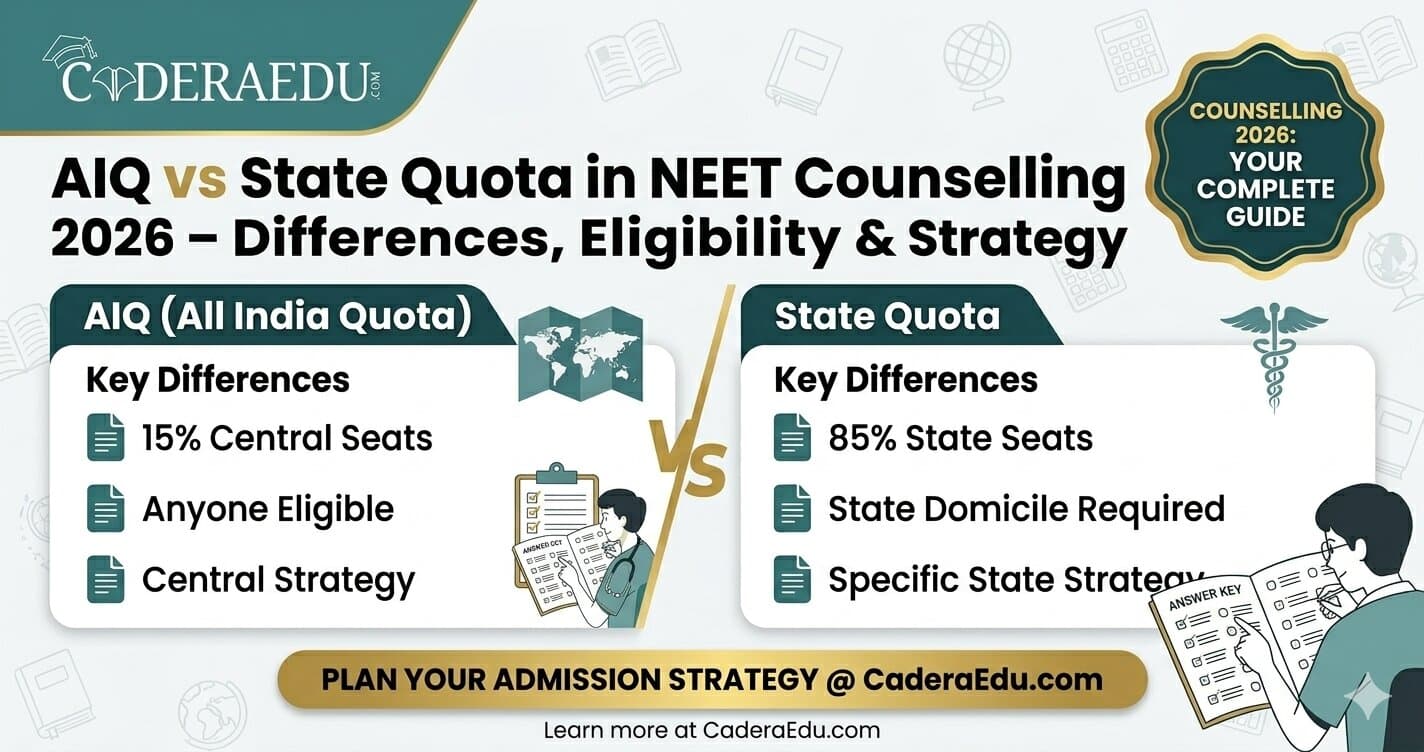
Every MBBS seat in a government medical college is split between two pools. 15% of seats in every government medical college go into the All India Quota — open to students from any state in India. The remaining 85% go to State Quota — reserved for students who have domicile in that particular state. For deemed universities and central institutions like AIIMS and JIPMER, 100% of seats fall under AIQ counselling. No state quota exists there.
Table
| Parameter | All India Quota (AIQ) | State Quota |
|---|---|---|
| Seat share in Govt colleges | 15% | 85% |
| Who conducts counselling | MCC (Medical Counselling Committee) | State DME / State Counselling Authority |
| Domicile requirement | No – open to all states | Yes – must match state domicile |
| Competition level | National – higher cutoffs | State-level – generally lower cutoffs |
| Deemed / Central University seats | 100% under AIQ | Not applicable |
| AIIMS / JIPMER seats | 100% under AIQ | Not applicable |
| Reservation system | Central government categories (SC/ST/OBC/EWS/PwD) | State-specific categories and percentages |
| Where to register | mcc.nic.in | Respective state portal (DMER, KEA, etc.) |
3 columns · 9 rows
All India Quota (AIQ) – How It Works
AIQ counselling is run by the Medical Counselling Committee (MCC) under the Directorate General of Health Services (DGHS). The entire process is online through mcc.nic.in. Any NEET-qualified student from any state (except those opting out of AIQ — historically J&K candidates, though this changed in 2026) can apply. Your All India Rank is the only thing that matters. No state preference, no local advantage.
AIQ covers a specific set of institutions: the 15% government college seats nationwide, all AIIMS campuses, JIPMER, all deemed universities, ESIC medical colleges, and AFMC Pune. This is why AIQ is where scores of 620+ tend to go — the competition is drawn from 22+ lakh candidates across the country, and the colleges in this pool include the most sought-after ones in India.
AIQ Counselling Rounds 2026
- Round 1 – Registration, choice filling, seat allotment. Free exit allowed (no penalty for not joining).
- Round 2 – Fresh registration required. Choice filling opens again. No free exit — if allotted and you don't join, you lose the security deposit.
- Mop-Up Round – For seats vacant after Round 2. Tighter timelines. Registration is fresh.
- Stray Vacancy Round – Final round for any remaining seats. Fast turnaround, usually 2–3 days.
A mistake many students make: they think their Round 1 choice list carries over to Round 2. It doesn't. You must re-register and re-fill choices every round. Skipping Round 2 registration after a Round 1 free exit is one of the most common ways students lose time-sensitive seat opportunities.
State Quota – How It Works
State Quota covers 85% of MBBS and BDS seats in government medical colleges. Each state runs its own counselling authority — Maharashtra has DMER, Karnataka has KEA, UP has DGME-UP, Tamil Nadu has TN MRB, and so on. These authorities have their own portals, their own timelines, and their own reservation categories that often go beyond the central categories. Maharashtra, for example, uses SC/ST/NT/OBC/EWS, while Karnataka uses GM/OBC/SC/ST. Tamil Nadu has BC/MBC/DNC sub-categories unique to the state.
The core eligibility: you need valid domicile in the state to apply for its state quota seats. The domicile rules vary — some states require 3 years of residence or schooling, others require your parents' employment or property records. Check the specific domicile criteria for your state early — do not assume your school-leaving address is enough.
Why State Quota Cutoffs Are Lower Than AIQ
State quota cutoffs are consistently lower than AIQ for the same college because competition is restricted to domicile candidates only. If a government college in UP has 100 MBBS seats, 15 go to AIQ (national competition) and 85 go to UP state quota (only UP domicile students compete). The pool is smaller, so the cutoff is lower. Based on 2025 trends, state quota cutoffs run 50–80 marks below AIQ cutoffs for the General category in most competitive states. In lower-competition states, the gap is even wider.
Colleges That Fall Under AIQ – Private, Deemed & Central
Deemed universities are a specific category that many students get confused about. They are private institutions that have been granted university status, but their MBBS admissions go through AIQ counselling on the MCC portal not through state counselling. This means a student from any state can apply, there is no state domicile requirement, and the central reservation policy applies (or in many cases, no reservation at all per MCC norms for deemed universities). The tradeoff: fees at deemed universities are significantly higher than government colleges.
Here are priority colleges to look at during AIQ deemed counselling, covering a range of states and score brackets:
- Jamia Hamdard, New Delhi – Central university, minority institution; AIQ seats available; strong research reputation in pharmacy and medicine.
- Amrita School of Medicine, Faridabad – Deemed university under Amrita Vishwa Vidyapeetham; AIQ deemed counselling; accessible from NCR; NAAC A++ accredited parent university.
- Sharda School of Medical Sciences, Greater Noida – Private deemed university; NCR location; MBBS seats through MCC deemed counselling route.
- Geetanjali Medical College, Udaipur – One of Rajasthan's more established private medical colleges; accessible via both AIQ deemed and Rajasthan state quota depending on seat type.
- Dr. D.Y. Patil Medical College, Navi Mumbai – Deemed university; 100% AIQ MCC counselling; no state quota; high fees but strong clinical exposure in Mumbai metro.
Colleges That Fall Under State Quota – Region-Wise Breakdown
State quota private colleges are also filled through state counselling authorities — not MCC. This is where students with mid-range scores (400–580) tend to find viable MBBS options. The colleges below span several states and score ranges, giving you a realistic map of what state quota counselling opens up.
Uttar Pradesh State Quota
UP has one of the largest state quota pools in the country, with government and private medical colleges spread across the state. UP state counselling is managed by DGME-UP. For private colleges in UP under state quota, the counselling goes through the UP state portal. Students with UP domicile and scores in the 400–560 range find several private options.
- Saraswati Medical College, Unnao – Private MBBS college in UP; accessible under UP state quota counselling; fees moderate relative to UP private colleges.
- Teerthanker Mahaveer Medical College, Moradabad – Part of TMU, a well-established private university in UP; MBBS seats filled via UP state counselling; has its own 1,000-bed hospital for clinical training.
- Santosh Medical College, Ghaziabad – Located in Ghaziabad (NCR fringe); fills MBBS seats through UP state quota; accessible to students from Delhi-NCR with UP domicile.
- NIMS (Noida International Institute of Medical Sciences), Greater Noida – MBBS admissions via UP state quota; Greater Noida location offers good clinical access within the NCR healthcare network.
Rajasthan State Quota
Rajasthan has a large number of private medical colleges, most of which fill seats through Rajasthan state quota counselling (managed by RUHS — Rajasthan University of Health Sciences). Students with Rajasthan domicile and scores in the 380–550 range have multiple options.
- Pacific Medical College, Udaipur – Private medical college in Rajasthan; MBBS seats through Rajasthan state quota; Udaipur location with attached hospital.
- Ananta Institute of Medical Sciences, Rajsamand – Private MBBS college in Rajsamand, Rajasthan; accessible under state quota; relatively newer college with growing infrastructure.
- JNU Institute of Medical Sciences, Jaipur – Part of Jaipur National University; MBBS admissions via Rajasthan state quota; Jaipur city location with hospital access.
Delhi NCR and Haryana State Quota
Delhi is one of the most competitive state quota pools in India — General category closing marks for Delhi state quota government MBBS colleges can exceed 620–630. For students with Delhi or Haryana domicile and scores in the 450–580 range, private medical colleges under state counselling become the realistic target.
- SGT Medical College, Gurgaon – Part of SGT University; MBBS seats through Haryana state counselling; Gurgaon location with attached multi-specialty hospital; accessible from Delhi NCR.
- Amrita School of Medicine, Faridabad – Haryana location but deemed university status means seats primarily through AIQ/MCC; useful option for NCR students without strong state quota options.
Madhya Pradesh and Uttarakhand State Quota
- Netaji Subhash Chandra Bose Medical College, Jabalpur – Government medical college in MP; MBBS seats fill via MP state quota counselling (DMER-MP); strong clinical exposure at Jabalpur hospital; one of the more competitive MP government college options.
- Graphic Era Institute of Medical Sciences, Dehradun – Private medical college in Uttarakhand; MBBS seats through Uttarakhand state counselling; Dehradun location; part of Graphic Era University group.
AIQ vs State Quota Cutoff Comparison – 2026 Expected Ranges
Table
| Category | AIQ Safe Score (Govt MBBS) | State Quota Safe Score (Competitive States) | State Quota Safe Score (Low Competition States) |
|---|---|---|---|
| General / UR | 650 – 680+ | 580 – 620 | 450 – 520 |
| EWS | 620 – 650+ | 560 – 600 | 420 – 490 |
| OBC-NCL | 600 – 630+ | 540 – 580 | 400 – 470 |
| SC | 480 – 520+ | 420 – 460 | 320 – 390 |
| ST | 440 – 480+ | 380 – 430 | 280 – 350 |
4 columns · 6 rows
Competitive states for General category include Delhi, Maharashtra, Karnataka, Tamil Nadu, and Kerala — these have many high scorers competing for limited state quota government seats. Low competition states include smaller northeastern states, J&K (which was added to AIQ from 2026), and some less-populous states where the demand-supply gap for government seats is narrower. The state you have domicile in heavily determines whether your score is competitive for state quota government seats.
Can You Apply for Both AIQ and State Quota Simultaneously?
Yes. This is one of the most important things to understand, and many students don't act on it. AIQ and State Quota counselling are completely separate processes running in parallel. You can register on mcc.nic.in for AIQ and simultaneously register on your state's counselling portal for state quota. There is no rule that prevents this. You can receive allotments in both — if that happens, you pick one seat and withdraw from the other within the stipulated window.
Failing to register for both is a strategic mistake. If your AIQ allotment doesn't come through or you get a college you don't want, having your state quota application active gives you a fallback. Many students with scores in the 540–580 range get good state quota government seats that they would have missed if they'd only registered on MCC. Use the CaderaEdu NEET UG College Predictor to see which colleges are realistic under both AIQ and state quota for your specific score, category, and state.
- UP domicile: typically requires 3–5 years of residence or parents' government employment in UP
- Rajasthan domicile: Class 10 or 12 from Rajasthan school is often accepted, or 3 years residence
- Maharashtra domicile: more complex — 15 years of residence or birth in Maharashtra typically required
- Delhi domicile: 3 years of residence in Delhi, or parents' employment in Delhi government
- Haryana domicile: 3 years of residence, or parents with Haryana government employment
- Always obtain a domicile certificate from the competent authority (SDM office, District Collector) before counselling starts — don't leave it to the last week
Students who have been studying in coaching hubs like Kota, Hyderabad, or Delhi for 2–3 years often assume they have domicile there. They don't. Coaching city residence doesn't establish domicile unless it's alongside your parents' established residence in that state. Verify your domicile status before registering for any state quota counselling.
Reservation in AIQ vs State Quota – They Are Different
This catches many students off guard. The reservation percentages and categories under AIQ are set by central government policy. Under state quota, each state applies its own reservation structure, which often includes state-specific categories not recognized at the central level.
Table
| Reservation Category | AIQ (Central Policy) | State Quota (Varies by State) |
|---|---|---|
| SC | 15% | Varies (e.g., 15% in UP, 17% in Karnataka) |
| ST | 7.5% | Varies (e.g., 7.5% in UP, higher in tribal states) |
| OBC-NCL | 27% | Varies widely (27% in some states, up to 50% in Tamil Nadu including sub-categories) |
| EWS | 10% | 10% in most states (if implemented) |
| State-specific categories | Not applicable | NT (Karnataka), BC/MBC/DNC (Tamil Nadu), etc. |
| Deemed University reservation | No SC/ST/OBC/EWS per MCC norms | Not applicable (deemed = 100% AIQ) |
3 columns · 7 rows
Deemed university seats under AIQ are particularly notable — per MCC norms, deemed universities do not apply SC/ST/OBC/EWS reservations to MBBS seats. This means the same college has a very different admission equation depending on your category. For reserved category students, government college seats (both AIQ and state quota) are significantly more accessible than deemed university seats.
Private Medical College Seats Under State Quota
Private medical colleges (non-deemed) fill their seats entirely through state counselling — not through MCC. This is often where scores in the 380–520 range find their admission path. The state counselling authority includes private colleges in its seat matrix, and students participating in state counselling can fill these in their choice list.
The fees at private colleges under state quota are regulated to some extent by state fee committees, though they are still substantially higher than government college fees. Here's how different private colleges across states fit into this picture:
- Pacific Medical College, Udaipur (Rajasthan) – Rajasthan state quota private seat; fees regulated by Rajasthan state fee committee; good option for Rajasthan domicile students in the 400–520 range.
- Ananta Institute of Medical Sciences, Rajsamand (Rajasthan) – Rajasthan state quota; newer institution; useful for students who need more choice options in Rajasthan counselling.
- Saraswati Medical College, Unnao (UP) – UP state quota; part of UP private college pool; fees in the mid-range for UP private MBBS.
- Teerthanker Mahaveer Medical College, Moradabad (UP) – UP state quota; well-established TMU hospital for clinical training; consistent placement in UP state counselling rounds.
- Santosh Medical College, Ghaziabad (UP) – UP state quota; NCR location; closing ranks for state quota rounds typically fall in the 80,000–1,50,000 AIR range.
- SGT Medical College, Gurgaon (Haryana) – Haryana state quota; university-level infrastructure; Gurgaon location with good hospital access.
- Graphic Era Institute of Medical Sciences, Dehradun (Uttarakhand) – Uttarakhand state quota; Dehradun city location; accessible option for Uttarakhand domicile students.
- JNU Medical Sciences, Jaipur (Rajasthan) – Rajasthan state quota; university medical college; accessible via Rajasthan state counselling for Rajasthan domicile students.
Management Quota – The Third Track Nobody Talks About Clearly
Beyond AIQ and State Quota, private medical colleges also have a management quota — typically 15% of their total seats. These seats are not part of state counselling and are filled directly by the college management. Fees for management quota seats are higher than state quota seats at the same college, and admission is through the college's own process (sometimes just based on NEET score and a direct application).
Management quota is the last resort for students who did not get a seat through state counselling rounds. The scores needed can be lower, but the fees are higher. NRI quota is a separate subset — typically 15% of seats filled at international fee rates (USD 50,000–80,000 for the full course in some institutions). This is distinct from state and AIQ processes entirely.
Step-by-Step: How to Run Both AIQ and State Quota Together
- After NEET result: Note your AIR and category rank from your scorecard. Enter your rank into the CaderaEdu NEET UG Predictor to get an initial college list under both AIQ and state quota.
- Register on mcc.nic.in: Create your MCC login. Pay the registration fee (₹1,000 for government seats, ₹5,000 for deemed). This covers AIQ counselling.
- Register on your state's DME portal: Each state has its own registration, timeline, and fee. Do this simultaneously — don't wait for AIQ results before applying to state.
- Choice filling for AIQ: List colleges in order of preference. Study previous year's opening and closing ranks. Do not leave out colleges where your rank is close to last year's cutoff — these are often the ones that come through.
- Choice filling for state quota: Similar process, but the college list is different and restricted to colleges in your state. Private colleges appear here too.
- Lock your choices before the deadline: Both portals have strict deadlines. An unlocked choice list defaults to the order you entered — that may not be your actual preference order.
- Seat allotment results: Check both portals. If allotted in both, compare the options — college quality, location, fees, clinical exposure.
- Decide and report: You can only join one seat. Vacate the other within the resignation window. Do not delay this step — holding two seats past the deadline has penalties.
The CaderaEdu NEET PG Predictor works similarly for postgraduate admissions if you're planning ahead for MD/MS after MBBS — the AIQ vs state quota split applies at the PG level too, where AIQ covers 50% of government PG seats (compared to 15% at UG level).
Documents Required for NEET Counselling 2026
Both AIQ and State Quota counselling require a core set of documents. The state may ask for additional ones. Prepare all of these before registration opens:
- NEET UG 2026 Admit Card
- NEET UG 2026 Result / Scorecard
- Class 10 mark sheet and passing certificate (for date of birth proof)
- Class 12 mark sheet and passing certificate
- ID proof (Aadhaar, Passport, or Voter ID)
- Category certificate (SC/ST/OBC/EWS) issued by competent authority – must be in central government format for AIQ; some states have their own format for state quota
- PwD certificate (if applicable) – issued by a government hospital
- Domicile certificate (for state quota only) – check your state's format requirements
- Passport-size photographs
- Online payment receipts for registration fees
OBC-NCL certificates are particularly important: the central OBC-NCL list and state OBC lists differ. Your caste may be in the state OBC list but not the central OBC-NCL list — in which case you get OBC reservation in state quota but not in AIQ. Check this before assuming you have OBC reservation in both tracks.
Common Mistakes to Avoid in NEET 2026 Counselling
- Registering only on MCC and ignoring state quota registration – costs you 85% of government seat options
- Not locking choice list before the deadline – system defaults may not match your actual preferences
- Thinking Round 1 choices carry to Round 2 – they don't; fresh registration and choice filling required
- Using state OBC certificate for AIQ OBC reservation – AIQ requires central OBC-NCL certificate specifically
- Not resigning a seat within the stipulated window after getting a better allotment – results in deposit forfeiture
- Skipping the Mop-Up round registration assuming everything filled in Rounds 1 and 2 – many seats open up in Mop-Up
- Filling choices based on college name alone without checking previous year closing ranks – your rank may not clear the cutoff
Which Should You Prioritise – AIQ or State Quota?
There is no single answer because it depends on your score, your state, and what kind of college you want. Here's a practical breakdown:
If your score is 650+ (General): Prioritise AIQ. You're competitive for top government colleges including AIIMS campuses, JIPMER, and the better government medical colleges nationally. Also register for state quota as backup, but AIQ is your primary track.
If your score is 550–650 (General): Run both in parallel with equal priority. State quota may give you a better government college than AIQ at this score range, depending on your state. Delhi state quota at 600 marks is harder than UP state quota at 600 marks, for example.
If your score is 400–550 (General): State quota private colleges are your most realistic path to MBBS. AIQ is worth registering for (especially if you're flexible on state), but state counselling should be your primary focus. Colleges like NIMS Greater Noida, Sharda School of Medical Sciences, and Geetanjali Medical College Udaipur are examples of colleges where this score range finds admission through state quota or AIQ deemed routes.
Read the CaderaEdu NEET 2026 Rank Predictor Guide for a detailed walkthrough of how to read your AIR and translate it into a college shortlist across both tracks.
Topics:
Share this article
Copy
Frequently Asked Questions
What is the difference between AIQ and State Quota in NEET 2026?
AIQ (All India Quota) covers 15% of MBBS seats in government colleges plus 100% of AIIMS, JIPMER, and deemed university seats. Any NEET-qualified student from any state can apply for AIQ through mcc.nic.in. State Quota covers the remaining 85% of government college seats and is managed by each state's counselling authority. You need valid domicile in that state to apply for state quota seats. AIQ has higher cutoffs because competition is national; state quota cutoffs are lower because only domicile candidates compete.
Can I apply for both AIQ and State Quota counselling simultaneously?
Yes. You can register on the MCC portal for AIQ and on your state's counselling portal for state quota at the same time. Both processes run in parallel and are completely independent. If you receive seat allotments in both, you choose one and resign from the other within the deadline. Not registering for both is a common strategic mistake — it reduces your options significantly.
Is domicile required for AIQ counselling?
No. AIQ counselling has no domicile requirement. Any NEET-qualified student from any state can apply for AIQ seats. Domicile is only required for State Quota seats, where you must have valid domicile in the state whose counselling you are participating in.
Why are AIQ cutoffs higher than State Quota cutoffs?
AIQ seats face national competition — all 22+ lakh NEET-qualified students can compete for the same pool of seats. State quota seats face only domicile candidates from that one state, which is a much smaller pool. With less competition for the same seats, the cutoff naturally falls. Based on 2025 data, state quota cutoffs in most states run 50–80 marks below AIQ cutoffs for General category.
Do deemed universities have state quota seats?
No. Deemed universities do not have state quota seats. 100% of seats in deemed universities are filled through AIQ MCC counselling. Per MCC norms, deemed university seats also do not carry SC/ST/OBC/EWS reservations. This makes deemed universities accessible from any state without domicile requirement, but the lack of reservation means reserved category students may find government college seats more accessible.
What is management quota in NEET counselling?
Management quota is a set of seats (typically 15% in private medical colleges) that are not part of state counselling and are filled directly by the college management. These seats require a NEET score but the process is run by the college, not the state authority. Fees for management quota seats are higher than state quota seats at the same college. This is a third option beyond AIQ and state quota for students who don't clear counselling rounds.