How to Prepare for Re-NEET 2026 in 5 Weeks — Study Plan

Click to enlarge
The Re-NEET 2026 exam is scheduled for June 21, 2026 — and that gives you exactly 5 weeks from today. Whether you walked out of the May 4 exam feeling confident or completely deflated, this is a fresh start on a clean slate. The syllabus has not changed, the paper pattern has not changed, and most importantly — your preparation is not starting from zero. What you need right now is not more content. You need a sharp, structured, week-by-week plan that converts everything you have already studied into marks. This is that plan. For context on the rescheduled exam, read: Re-NEET 2026 Exam Date: June 21 — Full Details.
Before You Start — Know Your Baseline
The single most important thing you can do before building any study plan is honest self-assessment. Go back to your May 4 experience — which subjects felt shaky? Which chapters cost you marks? Which sections did you run out of time on? Write it down. Your 5-week plan should be built around closing those specific gaps — not covering the entire syllabus uniformly. For a full subject-wise breakdown of the Re-NEET 2026 syllabus and chapter weightages, read: Will Re-NEET 2026 Syllabus Change? Official NTA Update.
The students who improve the most between two attempts are not the ones who studied the hardest — they are the ones who studied the most specifically. Target your gaps, not the entire syllabus.
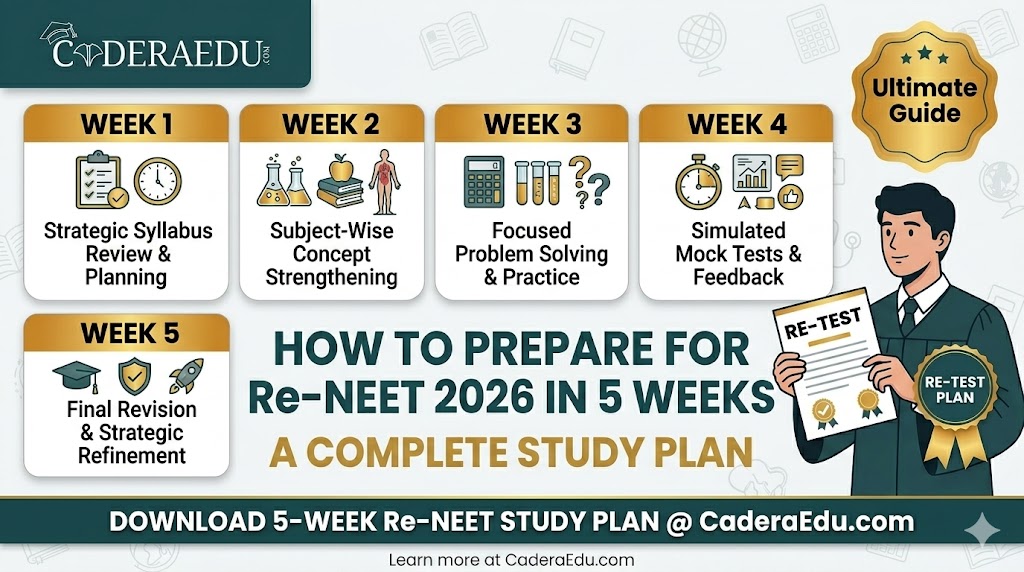
The 5-Week Re-NEET 2026 Study Plan — Week by Week
Table
| Week | Focus | Daily Hours |
|---|---|---|
| Week 1 (May 16–22) | Targeted revision of weakest chapters across all subjects | 8–10 hrs |
| Week 2 (May 23–29) | Biology full revision — NCERT line by line (Botany + Zoology) | 8–10 hrs |
| Week 3 (May 30–Jun 5) | Chemistry full revision + Physics conceptual chapters | 8–10 hrs |
| Week 4 (Jun 6–12) | Full-length mock tests — minimum 4 tests, full analysis | 9–11 hrs |
| Week 5 (Jun 13–20) | Light revision of formulas, diagrams, high-yield facts. Rest well. | 5–6 hrs |
3 columns · 6 rows
Week 1 — Attack Your Weakest Chapters First
Most students make the mistake of starting from Chapter 1 again. Do not. In Week 1, go straight to the chapters that cost you the most marks in May. For Biology, common weak areas include Genetics, Biotechnology, and Ecology. For Chemistry, Organic reactions and Electrochemistry are frequent pain points. For Physics, Modern Physics and Electrostatics trip up most students. Dedicate 3 hours per weak chapter — read NCERT, solve 50 past questions on that chapter, and move on. For the best book recommendations to support this targeted revision, read: Best Books for NEET 2026: Physics, Chemistry, Biology.
Week 2 — Biology: Your Highest-Scoring Subject
Biology carries 360 out of 720 marks in NEET — making it your single biggest scoring opportunity. In Week 2, dedicate yourself entirely to Biology. Botany and Zoology must both be covered chapter by chapter using NCERT. Every diagram, every bold term, every table in NCERT is fair game. High-priority chapters: Cell Biology, Human Physiology, Genetics, Reproduction, and Ecology. Solve at least 30–40 Biology-only questions from NEET Previous Year Papers every evening to reinforce your reading.
Week 3 — Chemistry & Physics: Build Speed and Accuracy
Chemistry responds well to structured revision — Physical Chemistry first (numerical-heavy, needs practice), then Organic (reaction mechanisms and named reactions), then Inorganic (direct NCERT memory work). For Physics, focus on chapters with the highest question frequency: Electrostatics, Current Electricity, Modern Physics, and Optics. Use the NEET 2026 Chapter-wise Weightage Guide to prioritise which chapters deserve the most time in Week 3.
Week 4 — Mock Tests: This Is Where Marks Are Made
Week 4 is the most critical week of your Re-NEET 2026 preparation. Sit for at least 4 full-length mock tests — one every two days — under strict exam conditions. No phone, no breaks mid-test, no checking answers during the paper. After every test, spend equal time analysing your mistakes as you did taking the test. Identify error patterns — are you making silly mistakes? Running out of time in Physics? Guessing too many Biology questions? For the best free mock test platforms, read: NEET 2026 Mock Test: Best Free Online Test Series.
Week 5 — Wind Down, Sharpen, Rest
The week before Re-NEET 2026 is not for learning new things. It is for consolidation. Spend 5–6 hours a day maximum — revising your personal formula sheet, going through diagrams you have marked, re-reading summary notes of high-yield chapters. Solve a few chapter-wise quizzes to stay sharp but avoid any new full-length tests. Sleep at least 7–8 hours every night. Download your Re-NEET 2026 Admit Card the moment it is released (expected June 14–16) and verify all details.
Daily Schedule Template for Re-NEET 2026 Preparation
Table
| Time Slot | Activity |
|---|---|
| 6:00 AM – 6:30 AM | Wake up, light exercise, breakfast |
| 6:30 AM – 9:30 AM | High-focus subject study — Biology or Chemistry |
| 9:30 AM – 10:00 AM | Short break |
| 10:00 AM – 1:00 PM | Second subject — Physics or targeted chapter revision |
| 1:00 PM – 2:00 PM | Lunch and rest |
| 2:00 PM – 5:00 PM | Previous year questions — chapter-wise practice |
| 5:00 PM – 6:00 PM | Break — walk, relax, no screens |
| 6:00 PM – 9:00 PM | Revision, formula sheets, NCERT re-reading |
| 9:00 PM – 10:00 PM | Dinner and wind down |
| 10:00 PM – 10:30 PM | Quick review of the day's key points |
2 columns · 11 rows
Know Your Target — Use the NEET College Predictor
One of the most powerful motivational tools during preparation is knowing exactly what your target score can get you. Use the CaderaEdu Free NEET UG College Predictor to enter your target score and instantly see which medical colleges are within reach. Then use the NEET Medical College Predictor for a deeper college-by-college analysis. Seeing your dream college become achievable with a specific score makes every study session feel more purposeful.
Top Medical Colleges to Keep as Your Target
- Geetanjali Medical College & Hospital, Udaipur — Top Rajasthan MBBS college with 1,850-bed hospital.
- Amrita School of Medicine, Faridabad — Research-driven MBBS under Amrita Vishwa Vidyapeetham.
- Sharda School of Medical Sciences, Greater Noida — Globally benchmarked MBBS in NCR.
- Santosh Medical College & Hospital, Ghaziabad — Established private MBBS in UP.
- Pacific Medical College & Hospital, Udaipur — Strong infrastructure and experienced faculty.
- SGT Medical College, Gurgaon — Haryana's leading MBBS destination in the NCR belt.
- Dr. DY Patil Medical College, Pimpri, Pune — Maharashtra's top NEET-accepting private college.
- NIMS — Noida International Institute of Medical Sciences — Fast-growing NCR MBBS college.
Related Reads
- Best Books for NEET 2026: Physics, Chemistry, Biology
- NEET 2026 Mock Test: Best Free Online Test Series
- NEET 2026 Syllabus: Chapter-wise Weightage & Important Topics
- NEET 2026 Previous Year Papers: Download Free PDFs
- Top 10 Mistakes NEET Aspirants Make — And How to Avoid Them
- Re-NEET 2026 Exam Date: June 21 — Full Details
Share this article
Copy
Frequently Asked Questions
Is 5 weeks enough to prepare for Re-NEET 2026?
Yes — especially since you already appeared for the May 4 exam and have a full syllabus base. 5 weeks of targeted, structured revision with regular mock tests is more than enough to significantly improve your score.
How many hours should I study daily for Re-NEET 2026?
Aim for 8–10 hours daily in Weeks 1–4, reducing to 5–6 hours in Week 5 as you wind down. Quality matters more than quantity — focused, distraction-free study beats long unfocused sessions.
Should I start from scratch for Re-NEET 2026?
No. Your existing preparation is your foundation. Start with a gap analysis of your May 4 performance and target weak chapters first. Do not cover the entire syllabus from page one again.
How many mock tests should I attempt before Re-NEET 2026?
A minimum of 4–5 full-length mock tests in Week 4, plus chapter-wise practice throughout Weeks 1–3. Always analyse your mistakes after every test — that analysis is where the real improvement happens.
What is the best way to use the Re-NEET 2026 preparation time?
Week 1: weak chapter targeting. Week 2: Biology full revision. Week 3: Chemistry and Physics. Week 4: Mock tests and analysis. Week 5: Light revision and rest. Set a target score using CaderaEdu's NEET College Predictor to keep your motivation concrete.
Confused About College Admissions?
Get expert advice on college selection, admission chances, and career path in a personalized counselling session.
Book a Counselling Slot
Select Date
Pick a Slot