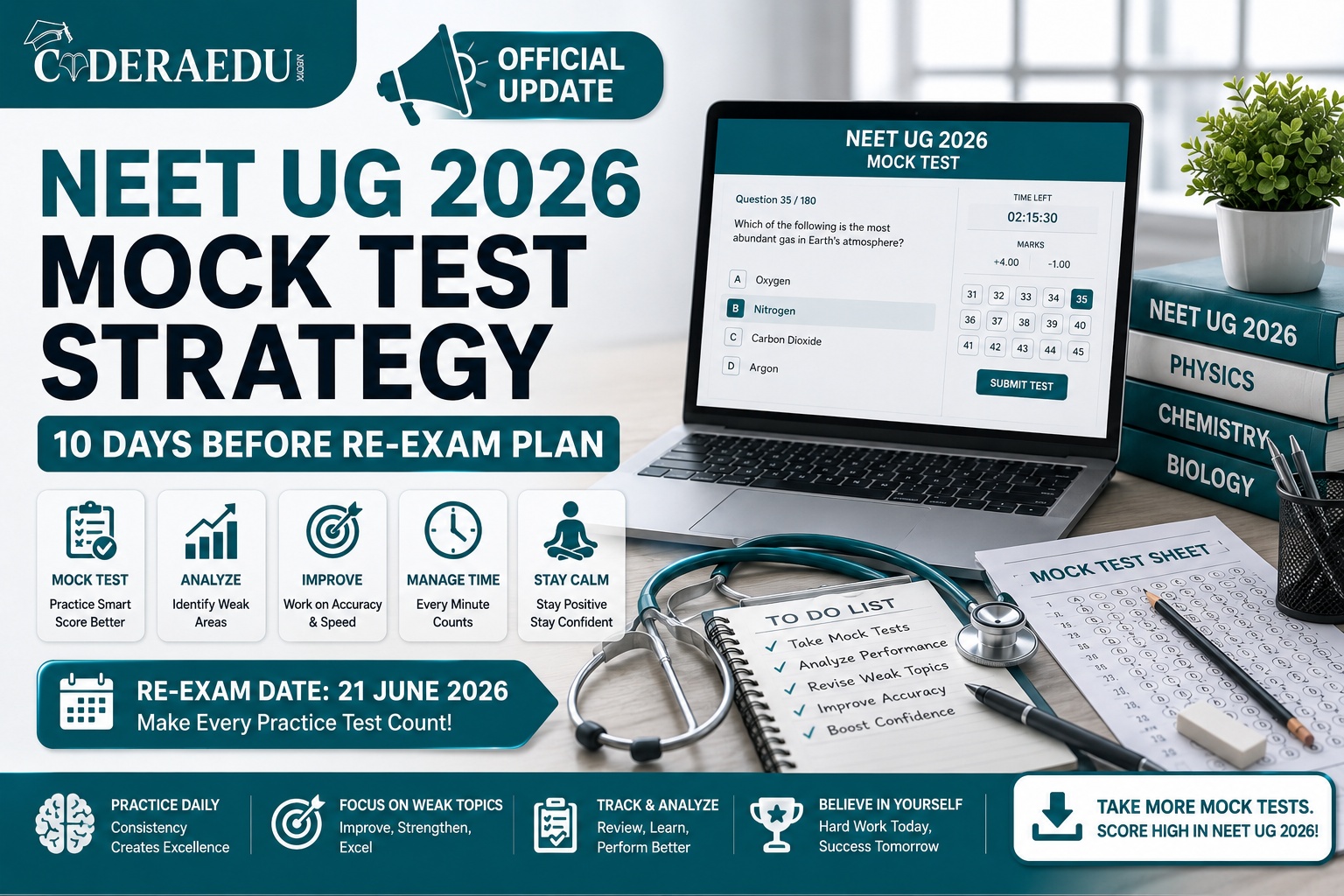
NEET UG 2026 Mock Test Strategy: 10 Days Before Re-Exam Plan

Click to enlarge
NEET UG 2026 Mock Test Strategy: Make Every Day Count in the Final 10
With Re-NEET 2026 scheduled for June 21, 2026, aspirants have a narrow but powerful window to sharpen their performance. If you have already covered the syllabus — even partially — these final 10 days are not for new learning. They are for converting preparation into marks. The right NEET UG 2026 mock test strategy at this stage can realistically add 20 to 40 marks to your score. That difference can shift your rank by tens of thousands of positions — and with it, your college options. This guide gives you a practical, day-by-day plan backed by what actually works in the final stretch before a high-stakes medical entrance exam.
The cancellation of the May 3 exam and the rescheduling to June 21 has given students additional preparation time — but it has also created anxiety. Those who use this period strategically will outperform those who simply study more hours without direction. Whether you scored 400 in your mock tests or 580, this plan is built to work for you. Start by checking Re-NEET 2026 full exam details to confirm the schedule, then come back and follow this guide from Day 10 to Day 1.
Why the Final 10 Days Are the Most High-Return Period in NEET Preparation
Most students underestimate what the final 10 days can do. This phase is not about learning — it is about optimisation. Your brain already holds the information. What mock tests do in this window is train your recall speed, reduce anxiety responses, fix negative marking habits, and build a settled exam temperament. Research consistently shows that students who take 4 to 6 full-length mock tests in the final two weeks score measurably better than those who spend the same time reading textbooks. The reason is simple: NEET is a timed, high-pressure exam. The only way to prepare for timed, high-pressure conditions is to practice under timed, high-pressure conditions.
This is especially important for Re-NEET 2026. Many students appeared on May 3, got a sense of their real performance, and now have a second chance. That experience is actually an advantage — you know which sections slowed you down, where you second-guessed yourself, and which chapter types consistently gave you problems. Use that knowledge to structure your mock test analysis in these 10 days. For background on the Re-NEET timeline and what changed, read the Re-NEET 2026 syllabus update — the short answer is: nothing changed, which is actually good news.
A mock test without analysis is just a score. A mock test with deep correction becomes an improvement plan. In the final 10 days before NEET, your rank is decided not by how many tests you take, but by how well you learn from each one.
Before You Begin: Set Your Target Score Using the College Predictor
Before Day 10 begins, spend 15 minutes on one essential task: use the CaderaEdu Free NEET UG College Predictor to input your current mock test score and see which colleges are realistic for you. This is not about discouraging you — it is about setting a concrete target. When you know that a score of 560 opens up a specific set of government and private colleges, and 580 unlocks significantly better options, you have a reason to push in every mock. Abstract preparation goals do not motivate as well as specific outcomes do. Your target score then becomes the anchor for every day of this plan.
Also check the NEET 2026 expected cutoff category-wise to understand what qualifying marks look like for your category, and what scores are realistically needed for government MBBS seats versus private MBBS seats. This context keeps your preparation grounded in real admission data rather than guesswork.
NEET UG 2026 Mock Test Strategy: Complete 10-Day Day-by-Day Plan
The following plan is structured so that mock tests are concentrated in the first half, analysis and correction dominate the middle, and light revision with mental preparation anchors the final days. Do not rearrange the sequence. Each phase builds on the one before it.
Table
| Day | Primary Activity | Focus Area | Duration |
|---|---|---|---|
| Day 10 | Full-Length Mock Test 1 | Baseline Performance Check | 3 hrs test + 2 hrs analysis |
| Day 9 | Deep Error Analysis + Biology Revision | Identify concept gaps from Mock 1 | 4–5 hrs |
| Day 8 | Full-Length Mock Test 2 | Time management & accuracy | 3 hrs test + 2 hrs analysis |
| Day 7 | Chemistry Revision + PYQ Practice | Organic Chemistry & Physical Chemistry | 4–5 hrs |
| Day 6 | Full-Length Mock Test 3 | Simulate exam-day conditions strictly | 3 hrs test + 2 hrs analysis |
| Day 5 | Physics Targeted Practice + Error Log Review | Weak chapters from all 3 mocks | 4 hrs |
| Day 4 | Full-Length Mock Test 4 | Peak performance attempt | 3 hrs test + 2 hrs analysis |
| Day 3 | NCERT Biology Flashcards + Formula Revision | High-yield factual recall | 3–4 hrs |
| Day 2 | Sectional Mock: Biology Only + Light Chemistry | Confidence building, no new topics | 2–3 hrs |
| Day 1 (Eve of Exam) | Documents, Light Revision of Notes, Early Sleep | Mental preparation only | 1–2 hrs max |
4 columns · 11 rows
Day 10 — Full-Length Mock Test 1: Establish Your Baseline
Take your first full-length mock test on Day 10 under strict conditions: no phone, no interruptions, timer set for 200 minutes, question paper attempted in the actual exam slot (afternoon, 2:00 PM to 5:15 PM as per Re-NEET 2026 timing). Do not check answers during the paper. Submit when the timer ends. After the test, spend two hours in analysis — not just checking right and wrong, but categorising every error: Was it a concept gap? A reading mistake? A time-pressure guess that went wrong? This categorisation is the most important step in the entire 10-day plan. Use the best free NEET 2026 mock test platforms for realistic question sets.
Day 9 — Deep Error Analysis and Biology High-Yield Revision
Day 9 is not a test day. It is a repair day. Go through every Biology question you got wrong or guessed on in Mock 1. Return to the relevant NCERT pages — not your notes, the actual NCERT — and re-read those sections. Biology accounts for 360 of 720 marks and is the highest-impact subject in NEET. A single Biology chapter like Human Physiology or Reproduction can alone yield 12 to 15 questions. Make a quick reference card of the facts you repeatedly miss. This card will be your Day 3 revision material. For weightage data, check the NEET 2026 chapter-wise weightage guide.
Days 8, 6, and 4 — The Three Core Mock Tests
These three mock tests form the core of your strategy. Each should be taken under exam conditions — same time slot, same silence, no mid-test breaks. Between each test and the next, the analysis day (Day 7 and Day 5) is where your score actually improves. The pattern is: test → analyse → revise → test again. This cycle, done three times in 10 days, is what converts your preparation into actual exam performance. Track your subject-wise scores across all three mocks. If Chemistry consistently pulls your total down, that is your Day 5 priority. If Physics is improving test over test, that is a sign your approach is working. Use the NEET 2026 score vs rank analysis to understand what each score increment means for your rank.
Day 5 — Physics Targeted Practice and Mistake Log
By Day 5, you will have three mock tests worth of error data. Sort all Physics errors across all three tests by chapter. The chapters with the most repeat errors are your target. For each, spend 20 minutes revising the core concept from your notes or NCERT, then solve 10 to 15 questions from that chapter using previous year papers. Physics questions in NEET are heavily conceptual with numerical applications — the errors are almost always one of three things: wrong formula recall, wrong unit conversion, or poor reading of the question. Identifying which type dominates your errors tells you exactly what to practice. For a solid question bank, the best books for NEET 2026 include DC Pandey for Physics numericals.
Days 3 and 2 — NCERT Recall, Flashcards, and Light Sectional Practice
Day 3 is entirely NCERT Biology and Chemistry. Go through diagrams, bold terms, tables, and chapter-end questions. Do not attempt any new full-length mock on Day 3 — your brain needs to consolidate, not be stressed again. Day 2 is a light sectional test — Biology only, full 100 questions, then a brief Chemistry revision of inorganic reactions and periodic properties. Avoid any new content. The goal on Days 2 and 3 is retrieval practice, not new input. Your NEET 2026 result and rank will reflect how well you have retained what you already know, not what you tried to cram at the last moment.
Day 1 — Exam Eve: Prepare Your Documents, Not More Content
The evening before the exam is not for studying. Lay out your admit card, a valid government photo ID, passport-size photographs, and a blue or black ballpoint pen. Revise your quick reference cards from Day 9 for 30 to 45 minutes — not full chapters, just your personalised error patterns. Eat a regular dinner, avoid social media anxiety triggers, and aim for 7 to 8 hours of sleep. Arriving at the exam centre calm, well-rested, and with documents in order has a measurable impact on performance. Students who sleep well the night before consistently outperform those who cram until midnight.
How to Analyse a Mock Test: The Method That Actually Improves Your Score
Most students check the answer key, note the total marks, and move on. That is not analysis — that is just scoring. Real analysis takes at least 90 to 120 minutes for a full-length mock and follows a specific process. Start with subject-wise scoring — which subject gave you the most marks and which cost you the most. Then go question by question through every wrong answer and every unattempted question. For each wrong answer, decide: Did I not know the concept? Did I know it but read the question wrong? Did I run out of time? Did I guess and get unlucky? Each category needs a different fix.
- Concept gap errors: Return to NCERT, revise the specific paragraph, write a 2-line summary of the concept
- Reading errors: Mark these separately — they are usually fixable by slowing down 10 seconds per question
- Time-pressure errors: Review your section sequence — are you starting with your strongest subject or your weakest?
- Negative marking errors: Count how many -1 marks you took on guesses that were wrong — if it's more than 8 per test, you are over-guessing
- Unattempted questions: These are zero-cost — review whether you should have attempted them based on difficulty
Maintain a running error log across all four mock tests. By Day 5, you will have a personalised list of your 10 to 15 highest-frequency error patterns. Eliminating half of those is enough to add 30 to 50 marks to your score. This approach, combined with the insights from the NEET UG 2026 counselling guide, helps you approach the exam with a clear target rather than vague hope.
Subject-Wise Focus Areas for the Final 10 Days
Not all subjects need equal attention in the final 10 days. Your mock test data should drive time allocation — but here is a general starting framework based on NEET's mark distribution and where most students lose marks.
Table
| Subject | Total Marks | Key Focus Chapters (Final 10 Days) | Common Error Type |
|---|---|---|---|
| Biology (Botany + Zoology) | 360 marks | Human Physiology, Reproduction, Genetics & Evolution, Ecology, Plant Physiology | NCERT factual recall errors, diagram labelling mistakes |
| Chemistry | 180 marks | Organic Reactions (Class 12), Coordination Compounds, Chemical Bonding, Equilibrium, Electrochemistry | Reaction mechanism confusion, periodic table property gaps |
| Physics | 180 marks | Mechanics, Electrostatics, Modern Physics, Optics, Current Electricity | Formula application errors, unit conversion mistakes, numerical reading errors |
4 columns · 4 rows
Biology must get at least 50% of your preparation time in these 10 days. With 90 questions worth 360 marks, even a 5% accuracy improvement in Biology adds 18 marks — more than most students gain from an hour of Physics revision. The chapters that consistently appear across NEET papers can be confirmed by reviewing the NEET 2026 chapter-wise weightage data.
The Right Conditions for Meaningful Mock Tests
A mock test taken at 11 PM with your phone beside you and music playing in the background is not a mock test — it is a reading exercise. For a mock to improve your actual exam performance, it must replicate actual exam conditions as closely as possible. Re-NEET 2026 is scheduled from 2:00 PM to 5:15 PM. That means your mock tests should also be taken in the afternoon. Many students study effectively at night but underperform in afternoon exams because their body and brain are not conditioned for peak performance at that time.
- Start every mock at 2:00 PM to match the actual Re-NEET 2026 exam slot
- Sit at a desk — not on a bed or sofa — for the full 200-minute duration
- Keep your phone in another room during the test
- Do not check answers or reference notes during the test
- Use the NTA Abhyas App for the most accurate NEET interface simulation
- Submit the paper when the timer ends, not before — practice using the full time
- After submission, do not immediately check the answer key — take a 10-minute break first
Common Mistakes Students Make in the Final 10 Days
The most common preparation mistakes in the final stretch are not about studying too little — they are about studying the wrong things in the wrong way. Recognising these patterns early is the difference between a productive final week and a stressful, unproductive one.
- Starting new topics that were not covered earlier — this almost never pays off and creates new confusion without consolidating existing knowledge
- Taking 6 or more full-length mock tests in 10 days without adequate analysis time — more tests without learning from them does nothing
- Focusing exclusively on strong subjects to boost confidence while weak subjects continue to drag down the total
- Skipping Biology revision because it feels 'already done' — Biology requires active NCERT recall, not passive familiarity
- Ignoring negative marking patterns — many students lose 15 to 25 marks per test from incorrect guesses alone
- Abandoning the exam slot timing — practicing mocks at night when the actual exam is in the afternoon is a preparation mismatch
- Comparing preparation with friends on social media — every student's gap profile is different; their strategy should not be yours
- Leaving admit card and document preparation to the morning of the exam — logistical stress before the exam directly impacts performance
For a broader view of preparation pitfalls that apply across the entire NEET journey, the NEET 2026 best books guide also covers common book selection and study habit mistakes that affect final-stage performance.
Mock Test Resources: Where to Practice for Re-NEET 2026
Choosing the right mock test source matters more than most students realise. Low-quality question sets with errors, out-of-syllabus questions, or incorrect answer keys actively harm your preparation by teaching you wrong answers or creating false confidence. The following sources are reliable for Re-NEET 2026 preparation:
- NTA Abhyas App — the official NTA practice platform; the interface exactly replicates the actual NEET CBT environment; free and the single best resource for timed practice
- NEET Previous Year Question Papers (2015–2025) — solving the last 10 years of NEET papers as timed mocks is highly effective; questions repeat in modified form regularly
- Coaching institute full-length tests (Allen, Aakash, FIITJEE Medical) — well-calibrated difficulty; suitable for students who have already exhausted PYQs
- NCERT Exemplar Problems — particularly for Biology and Chemistry; difficulty level is appropriate for NEET and questions are fully syllabus-aligned
For a detailed comparison of free online mock test platforms for Re-NEET 2026, refer to the NEET 2026 free mock test series guide on CaderaEdu. It covers the NTA Abhyas App and other resources in detail, including how to use them effectively.
Score Targets and What They Mean for College Admission
Your mock test scores in the final 10 days are the most reliable predictor of your actual NEET performance. Use them honestly. If your last three mock test scores average 520, your NEET score is likely to fall in the 490 to 550 range, depending on the paper's difficulty. Plan your college list around that realistic range rather than around your best-ever mock performance or your most optimistic estimate. The NEET 2026 score vs rank analysis provides a clear conversion table so you can see exactly which rank range corresponds to your current mock average.
Table
| Expected NEET Score Range | Approximate AIR (General) | Realistic College Category | Counselling Route |
|---|---|---|---|
| 620–720 | Under 10,000 | AIIMS, Top Government Colleges (MAMC, KGMU, GMC Chandigarh) | MCC AIQ + State Quota |
| 560–619 | 10,000–50,000 | Government Colleges (State Quota) + Top Private Deemed | State Quota Priority + MCC Deemed |
| 480–559 | 50,000–1,50,000 | Private Medical Colleges, Deemed Universities | State Quota + Deemed Counselling |
| 420–479 | 1,50,000–3,50,000 | Private Colleges (Mid-Tier), AYUSH Options | Deemed + State Private Counselling |
| Below 420 (General) | Above 3,50,000 or Not Qualifying | Consider AYUSH, BDS, or Next Attempt | AYUSH Counselling or Re-attempt Planning |
4 columns · 6 rows
Once you have your target score range, use the CaderaEdu Free NEET UG College Predictor to build a specific shortlist of colleges. Input your estimated rank and category, and the tool will show you which government, private, and deemed colleges are realistic options. This allows you to prepare your counselling preference list in advance rather than scrambling after results. For NEET PG planning post-MBBS, the NEET PG Predictor is also available on CaderaEdu.
Expert Guidance: What NEET Toppers Do Differently in the Final 10 Days
Students who score above 650 in NEET consistently do a few things that average performers do not. First, they treat the analysis phase as more important than the test itself. A three-hour mock followed by two hours of analysis is not an eight-hour day — it is a five-hour day that produces more improvement than eight hours of reading. Second, they have a written question order strategy before they enter the exam hall: which section to attempt first, how much time to allocate per subject, at what point to mark a question for review versus skip it entirely.
Third, top scorers control their attempt rate deliberately. They know their accuracy rate per subject from mock data and use that to decide how aggressively to attempt borderline questions. A student whose Chemistry accuracy is 62% should be more conservative with uncertain Chemistry questions than one whose accuracy is 80%. Fourth, they do not change their preparation strategy in the final three days. Panic-driven strategy changes in the final 72 hours — new resources, new methods, new timings — almost always hurt performance. Your strategy is set by Day 4. Days 3, 2, and 1 are execution and consolidation only.
For a detailed view of the full preparation framework these insights come from, the Re-NEET 2026 preparation guide covers the 6-week strategy that top scorers follow from the point of the May cancellation to exam day. If you started late or want to verify your current approach against a proven framework, that guide is worth reading alongside this one.
After the Exam: Counselling and College Predictor Strategy
Your mock test strategy does not end at the exam gate. The moment Re-NEET 2026 results are declared, the counselling clock starts immediately. MCC AIQ counselling typically begins 3 to 4 weeks after results. State counselling runs in parallel with its own registration dates, fee requirements, and deadlines. Missing either registration window means losing seats you genuinely earned. Begin researching the counselling process now, before the exam, so you are not reading the basics under time pressure after results. The NEET UG 2026 counselling complete guide covers MCC AIQ rounds, state quota processes, document requirements, and seat allotment in detail.
Also review the category-wise expected NEET cutoffs to understand the qualifying threshold for your category and the realistic admission cutoffs at different college types. After results, use the NEET 2026 rank predictor guide to calculate your AIR precisely and refine your college list before counselling rounds open.
Conclusion: Your Final 10 Days Are Enough — If You Use Them Right
The NEET UG 2026 mock test strategy laid out in this guide is built on a single principle: quality of preparation beats quantity of hours. Four well-analysed mock tests with targeted error correction will do more for your rank than ten tests taken without reflection. In these final 10 days, every decision — which subject to revise, when to rest, how to analyse your errors — compounds. Small, consistent improvements across Biology, Chemistry, and Physics add up to the score jump that changes which colleges are available to you.
Start with a clear target from the CaderaEdu NEET College Predictor. Follow the 10-day schedule without skipping the analysis days. Use the best free mock test resources for quality question sets. And go into June 21, 2026 with your documents ready, your notes reviewed, and your exam strategy locked. The preparation you have done over the past months is fully valid — this 10-day plan is about making sure all of it shows up in your score. You can also review the NEET 2026 fee refund guide if you have outstanding queries on the rescheduled exam process.
Topics:
Share this article
Copy
Frequently Asked Questions
How many mock tests should I take in the 10 days before Re-NEET 2026?
Four full-length mock tests across 10 days is the recommended approach. Quality of analysis after each test matters more than volume. Taking more than five tests in this window without adequate analysis time tends to increase stress rather than improve performance. Each mock should be followed by at least 90 to 120 minutes of deep error analysis.
Should I attempt a mock test on the day before the NEET exam?
No. The day before the exam (Day 1 in this plan) should be used for light revision of quick reference notes, document preparation, and rest. Attempting a full-length mock the evening before the exam creates performance anxiety and does not leave time for meaningful correction. Your last full mock should be taken no later than Day 4.
What time should I take my mock tests to prepare for Re-NEET 2026?
Re-NEET 2026 is scheduled from 2:00 PM to 5:15 PM. All your full-length mock tests should also be taken in this afternoon slot. Many students study effectively at night but underperform in afternoon exams because their brain is not conditioned for peak performance at that time. Consistent afternoon practice resolves this by the time of the actual exam.
How do I analyse a NEET mock test effectively?
After completing a mock test, categorise every wrong and unattempted question into one of three buckets: concept gap (did not know the answer), reading or silly error (knew the concept but made a mistake), or time pressure guess (had to rush or guess). Each category needs a different correction approach. Spend at least 90 to 120 minutes per mock on this analysis. Track your error patterns across all four mocks to identify your 10 to 15 highest-frequency mistakes.
Which subject should I focus on most in the final 10 days?
Biology should receive at least 50% of your preparation time. With 360 of 720 marks in NEET coming from Biology, even a modest improvement in Biology accuracy has more impact than equivalent improvement in Physics or Chemistry. Prioritise NCERT recall, diagrams, and factual accuracy in Biology. Use your mock test data to identify which Physics and Chemistry chapters are costing you the most marks.
Is it useful to start new chapters in the final 10 days before NEET?
No, starting new chapters in the final 10 days is almost never worth it. Incomplete chapters create confusion and take time away from consolidating what you already know. The only exception is a very short, high-weightage chapter that you have genuinely never studied and can complete in one focused session. In all other cases, revision and error correction from mock tests is more valuable than new learning.
What is the best free mock test resource for Re-NEET 2026?
The NTA Abhyas App is the single best free resource for Re-NEET 2026. It is the official NTA practice platform and replicates the actual NEET CBT interface exactly, including question navigation, marking for review, and time display. Previous year NEET question papers (2015 to 2025) solved as timed mocks are also highly effective, as NEET questions follow identifiable patterns across years.
How do I calculate which colleges I can get based on my mock test scores?
Use the CaderaEdu Free NEET UG College Predictor to input your current mock test score and see a realistic college shortlist based on previous year counselling data. Your average across the last three mocks is a more reliable predictor than your single best performance. Cross-reference with the NEET 2026 score vs rank analysis guide on CaderaEdu to understand the rank range your score corresponds to.
How should I manage negative marking in NEET in the final days of preparation?
Track your negative marking pattern in every mock test. Count how many -1 marks you received from incorrect guesses, and whether those guesses were necessary or avoidable. A useful rule is: attempt a question if you can eliminate at least two of the four options confidently. If you cannot eliminate any option, marking the question for review and returning to it is often better than an uninformed guess. Adjusting your guessing threshold based on per-subject accuracy data from your mocks is the most effective way to manage negative marking.
What should I do if my mock test scores are not improving as the exam approaches?
First, check whether you are doing genuine analysis after each mock or just reviewing the answer key. Scores improve from correcting patterns, not from taking more tests. Second, review your subject allocation — if one subject is consistently weak and you are not spending proportionally more time on it, that is the gap. Third, ensure your mocks are taken under proper exam conditions; environment has a significant impact on performance. If your Biology is the limiting factor, intensive NCERT revision combined with targeted PYQ practice typically produces the fastest improvement in the final week.
Confused About College Admissions?
Get expert advice on college selection, admission chances, and career path in a personalized counselling session.
Book a Counselling Slot
Select Date
Pick a Slot