
July 20 became a pivotal day in one of the largest youth-led protest movements India has seen in years. Thousands of demonstrators, organised under the banner of the Cockroach Janta Party (CJP), attempted to march from Jantar Mantar toward Parliament on the opening day of the Monsoon Session, demanding the resignation of Union Education Minister Dharmendra Pradhan over irregularities in this year's NEET-UG medical entrance exam.
The protest traces back to a NEET-UG paper leak reported ahead of the exam held in May, which affected more than two million aspiring medical students competing for a limited pool of college seats. Candidates were reportedly informed of the leak roughly two weeks after they had already taken the exam, and local reports linked at least a dozen student suicides to the fallout of being told they would have to sit a re-exam after years of preparation.
How the Movement Started
The Cockroach Janta Party began as satire. In May, Chief Justice of India Surya Kant, speaking during a Supreme Court hearing, compared unemployed young people and government critics turning to activism or social media to "cockroaches" and "parasites." He later said his comments had been misunderstood. Within days, 30-year-old public relations graduate Abhijeet Dipke launched an online collective mocking the remark, and it grew rapidly, reportedly crossing 22 million Instagram followers, more than twice the ruling Bharatiya Janata Party's own following, according to NBC News. A detailed explainer on how the remark evolved into a movement is available via BOOM's fact-check coverage, and a broader overview is documented on Wikipedia.
"Satire as Strategy: What the Placards Say"
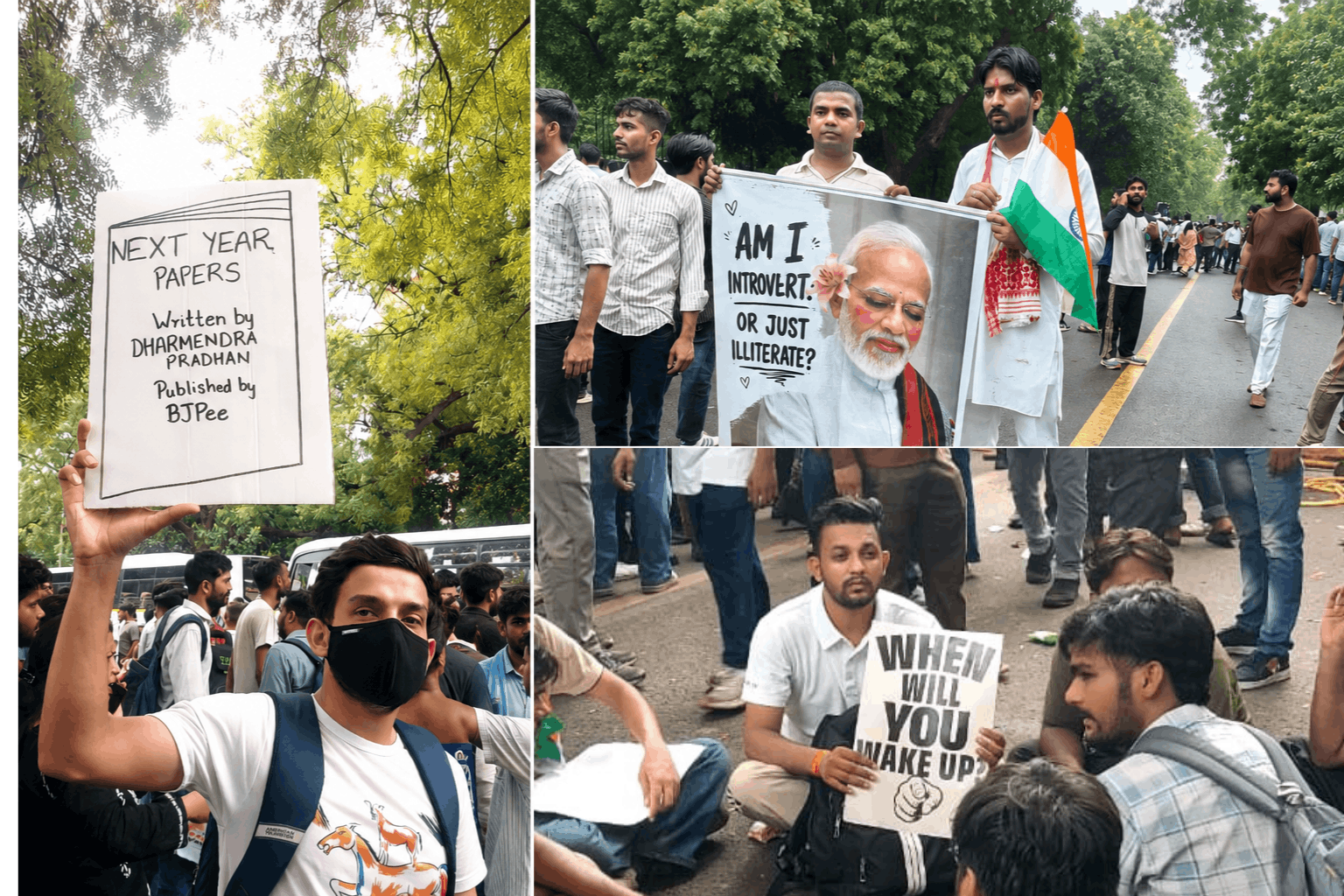
The signs at the march said a lot. One person was holding a placard that said "Next Year Papers, Written by Dharmendra Pradhan, Published by BJPee". This was making fun of the fact that exams got leaked over and over when Dharmendra Pradhan was in charge of education. Nearby some people were carrying a picture of Prime Minister Modi that said "Am I Introvert or Just Illiterate?". They were also carrying the flag. They were trying to say that just because you disagree with something it does not mean you are not loyal. Some people sat away from the march holding hands to show they were together. They were holding up a sign that asked a question: "When Will You Wake Up?" These pictures show that the people protesting are using humor and straight talk to make their point. They are using signs and slogans to keep pushing for what they want. The signs are just as important, as the things they are chanting.
What Happened on July 20
According to NPR's on-the-ground reporting, authorities cut mobile internet access, put up barricades, and shut nearby metro stations before protesters attempted their march. Riot police then moved in with batons and shields. NPR's own correspondents reported directly witnessing police firing tear gas and striking demonstrators with wooden sticks at multiple points in central Delhi, even as the Delhi Police's official account publicly denied that any violence had occurred, describing the operation as being "handled professionally."
Protesters alleged that police struck dozens of them, including reports of officers hitting people on the head, and one witness described seeing a woman kicked while on the ground. In turn, some demonstrators threw stones, injuring an estimated 50 police personnel according to local reporting cited by Gulf News. Live coverage throughout the day, including crowd movements and negotiation updates, was tracked in detail by ThePrint's live blog and Outlook India's rolling coverage.
The Sonam Wangchuk Factor
Environmental and education activist Sonam Wangchuk had joined the sit-in roughly two weeks earlier and began an indefinite hunger strike, reportedly losing significant weight over the course of it. Days before July 20, plain-clothes police reportedly removed him from the protest site and took him to Safdarjung Hospital. On the morning of the march, Wangchuk wrote a handwritten letter to hospital administrators stating his health parameters were normal and requesting temporary release so he could join the march. The release of Wangchuk, alongside Pradhan's resignation, remained among the movement's central demands going into the day.
A First Crack in the Standoff
Amid the clashes, there were also signs of movement toward dialogue. CJP spokespersons reported that Union Health Minister J.P. Nadda met with them briefly at his residence, marking what appeared to be the government's first direct outreach to the movement, according to NPR's reporting. Meanwhile, Education Minister Pradhan continued to reject calls to step down, reportedly describing protesters in strong terms in a television interview, while CJP's founder publicly rejected that characterisation. Coverage of the day's political fallout, including reactions from opposition leaders, was also tracked by IBTimes UK and Deccan Chronicle.
We are not anti-nationals. We are students. Listen to us.— 22-year-old protester, quoted by NPR
Student Reactions
For many students at the protest, the frustration went beyond a single exam cycle. One 20-year-old who had prepared for two years told NPR the leak had shaken his confidence in the exam process even after taking a re-test, and said it had pushed some of his peers to consider studying medicine abroad instead. Several young demonstrators described travelling hours from neighbouring states to join the march, with some wearing masks specifically to keep their participation hidden from family members. Parents of aspirants were also present in visible numbers, with organisers noting that many had brought younger children along, saying they hoped to see a fairer system in place before their kids eventually faced the same exams.
The Bigger Picture: Jobs and Trust
Economists cited by NPR point to a structural backdrop behind the anger: close to 40% of Indian university graduates under 25 are estimated to be unemployed, one of the highest rates in decades, even as the broader economy has continued to grow. Analysts say repeated examination controversies, layered on top of a tight job market, have combined to produce a level of youth frustration that a single exam-related climbdown may not fully resolve. A wider analysis of what the movement signals for Indian politics is available via Al Jazeera's opinion coverage.
Where Things Stand
As of the latest reporting, Education Minister Pradhan has not resigned, and the core demands around Wangchuk's release, compensation for families affected by exam-related deaths, and structural reform to India's competitive examination system remain unresolved. With Parliament's Monsoon Session now underway and the CJP's spokespersons reporting a first round of contact with a Cabinet minister, the coming days are likely to determine whether the standoff moves toward negotiation or further escalation.
The Takeaway
July 20 marked the sharpest confrontation yet in a protest movement that began as internet satire and has since grown into a genuine political flashpoint, driven at its core by anger over exam integrity and limited opportunity. For NEET aspirants and their families following this story alongside their own admission cycle, the safest approach is to rely on verified reporting rather than social media claims, and to keep tracking official NEET UG updates through the NEET UG College Predictor. For continuously updated, verified coverage, follow the CaderaEdu education news section, and candidates needing guidance on their own admission planning amid this uncertainty can book a free session through CaderaEdu's counselling programme or visit the CaderaEdu homepage for more resources.