How to Prepare for AIIMS BSc Nursing 2027: Complete Strategy, Syllabus & 6-Month Study Plan

Deeksha MishraUpdated on 01 Oct 2026, 09:37 PM IST
11 minutes read
Click to enlarge
AIIMS BSc Nursing is a national-level entrance exam conducted directly by AIIMS New Delhi, not by NTA, and it is one of the most reliable routes into a genuinely well-resourced nursing education at one of India's AIIMS campuses. If you are targeting the 2027 cycle, six months of structured preparation is enough to build real command over the syllabus, provided you follow a clear plan rather than random, scattered revision. This guide lays out the exam pattern, the subject-wise syllabus, and a practical month-by-month study plan you can start today.
Understanding AIIMS BSc Nursing: Two Different Exams
AIIMS actually conducts two separate nursing entrance exams under one umbrella, and it is important to know which one applies to you before you start preparing, since the syllabus and pattern differ meaningfully between them.
- AIIMS BSc (Hons) Nursing: a 4-year undergraduate programme for candidates who have just completed or are completing Class 12 with Physics, Chemistry, and Biology
- AIIMS BSc Nursing (Post-Basic): a 2-year programme meant for candidates who already hold a GNM diploma and are registered nurses, typically working professionals looking to upgrade their qualification
This guide focuses primarily on the BSc (Hons) Nursing track, since that is the route most fresh Class 12 candidates are preparing for, though the general study discipline described here applies to the Post-Basic track as well.
AIIMS BSc Nursing Exam Pattern: What to Expect
Based on the pattern followed in recent years, including the 2026 cycle, the AIIMS BSc (Hons) Nursing exam has been remarkably stable, with no structural changes reported over the last several years. Until AIIMS releases its official 2027 prospectus, it is reasonable to prepare against this established pattern, while keeping an eye out for the official notification closer to the exam.
Table
| Exam detail | BSc (Hons) Nursing pattern (based on recent cycles) |
|---|---|
| Mode | Online, computer-based test (CBT) |
| Duration | 2 hours (120 minutes) |
| Total questions | 100 multiple-choice questions |
| Total marks | 100 |
| Marking scheme | +1 for a correct answer, -1/3 for an incorrect answer |
| Subjects covered | Physics, Chemistry, Biology, and General Knowledge |
| Medium | English or Hindi, candidate's choice |
2 columns · 8 rows
The Post-Basic exam follows a different, two-stage structure: a written examination first, followed by a personal interview or assessment round for candidates who clear the written stage. There is no separate interview stage for the Hons exam.
Eligibility Criteria You Should Confirm Early
- Completed or appearing in Class 12 with Physics, Chemistry, Biology, and English as a compulsory subject
- Minimum aggregate marks generally around 55 percent for General and OBC candidates, with a relaxation to around 50 percent for SC and ST candidates in most recent cycles
- Minimum age of 17 years by 31 December of the admission year, with no fixed upper age limit for the Hons track in most recent notifications
- For the Post-Basic track, a valid GNM diploma along with current registration as a nurse and midwife is required, in addition to any specified minimum work experience
Eligibility conditions can shift slightly from year to year, so always cross-check the exact figures in the official 2027 information bulletin once it is released, rather than relying only on the previous year's criteria.
Subject-wise Syllabus: What Actually to Study
AIIMS does not release a highly detailed, topic-by-topic official syllabus document the way some other entrance exams do. Instead, the exam draws its questions broadly from the Class 11 and Class 12 NCERT curriculum in Physics, Chemistry, and Biology, with an additional General Knowledge component that has no fixed syllabus boundary.
- Physics: mechanics, heat and thermodynamics, optics, current electricity, magnetism, and modern physics basics, largely at Class 11 and 12 NCERT depth
- Chemistry: physical chemistry fundamentals, organic chemistry basics, and inorganic chemistry, again anchored to the Class 11 and 12 NCERT syllabus
- Biology: this is typically the highest-weightage section for a nursing-focused exam, covering human anatomy and physiology, genetics, reproduction, ecology, and plant and animal biology from Class 11 and 12 NCERT textbooks
- General Knowledge: current affairs, general science awareness, basic history and polity, and static GK, with no officially fixed boundary, so a broad and consistent reading habit matters more here than any single source
Because the syllabus overlaps heavily with the NEET UG syllabus in Physics, Chemistry, and Biology, candidates who have already been preparing for NEET have a meaningful head start and mainly need to add the General Knowledge component and adjust to AIIMS's specific question style.
Within the syllabus, weightage is not spread evenly. Based on the pattern of recent years, Biology tends to carry the largest share of questions, given that this is fundamentally a nursing entrance exam rather than a pure physical sciences test. Physics and Chemistry typically carry a smaller, roughly comparable share each, while General Knowledge fills the remaining portion. This is a useful guide for how to allocate your study hours, but it should not become an excuse to neglect Physics or Chemistry entirely, since even a modest number of lost marks in either section can be the difference between qualifying and missing the cutoff by a narrow margin.
How AIIMS BSc Nursing Differs From Other Nursing Entrance Routes
Many BSc Nursing seats across India, particularly at private and state government nursing colleges, are filled through NEET UG scores rather than a separate entrance test. AIIMS is a notable exception, running its own independent exam and its own separate counselling process rather than routing admissions through NEET. This matters practically in two ways. First, your AIIMS BSc Nursing preparation timeline and NEET UG preparation timeline can run in parallel without one directly determining the other, since they are entirely separate applications and exams. Second, because it is a smaller, dedicated applicant pool sitting a dedicated exam, the AIIMS Nursing cutoff and competition dynamics behave somewhat differently from NEET UG's much larger candidate base, so comparing the two cutoffs directly is not particularly meaningful.
Building a Realistic Daily Study Routine
A six-month plan only works if the daily routine underneath it is sustainable. Rather than planning marathon 10-hour study days that collapse within two weeks, a steadier 4 to 6 hours of focused daily study, consistently maintained across all six months, tends to produce far better results than short bursts of intense effort followed by long gaps. If you are still in Class 12 and preparing alongside board exam pressure, it helps to treat NCERT-based study as doing double duty for both board exams and AIIMS Nursing preparation, since the overlap in source material is substantial.
- Morning or whichever slot has your highest natural focus: use it for the subject you find most difficult, typically Physics or Chemistry for many nursing aspirants
- A dedicated, protected slot for Biology every single day, since it carries the most weight and rewards steady daily exposure over occasional long sessions
- A short, fixed 15 to 20 minute slot for General Knowledge reading, ideally at a consistent time so it becomes a habit rather than an afterthought
- One weekly slot, ideally on a lighter day, dedicated purely to reviewing your error log rather than learning anything new
Handling Exam Stress and Staying Consistent
A six-month preparation window is long enough that motivation will naturally dip at points, particularly around month three or four when the initial momentum of starting has faded but the exam still feels far away. This is normal and expected, not a sign that your plan is failing. Building in small, regular checkpoints, such as a short mock test every couple of weeks with visible score tracking, gives you concrete evidence of progress during the stretch where motivation alone is not enough. It also helps to keep your daily study load realistic enough that you are not constantly falling behind your own schedule, since a plan you cannot sustain does more harm to confidence than a slightly smaller but consistently completed one.
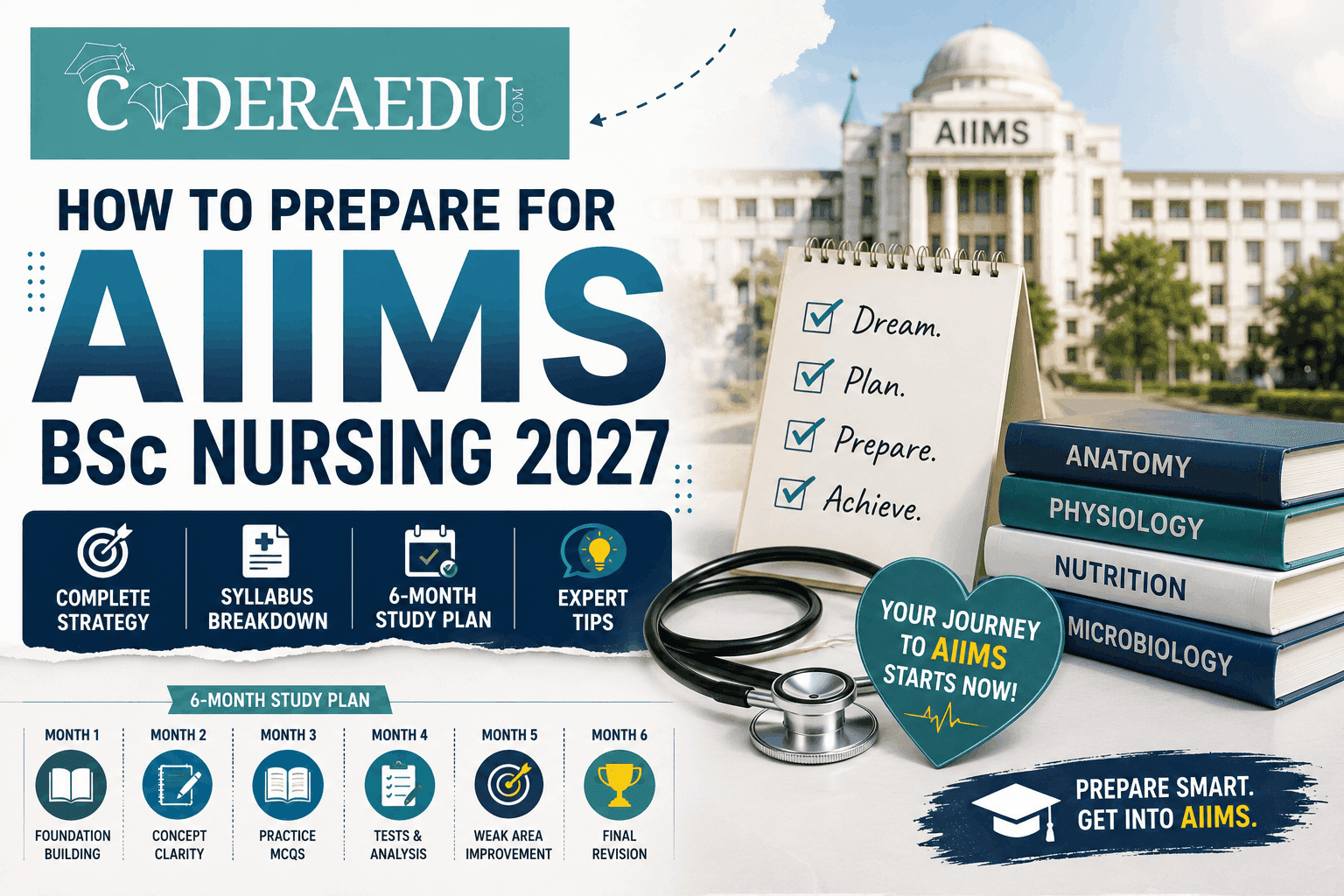
The 6-Month Study Plan
This plan assumes you are starting roughly six months before your expected exam window and can dedicate consistent daily study time. Adjust the pace slightly if you are starting earlier or later, but keep the same sequence and proportions.
Month 1: Foundation and NCERT First Pass
- Complete a first full read-through of NCERT Class 11 and 12 Biology, since it carries the most weight in the exam
- Begin NCERT Class 11 Physics and Chemistry alongside Biology, at a slower, understanding-first pace
- Start a simple daily newspaper or news-digest habit for General Knowledge, even just 15-20 minutes a day, rather than cramming GK later
- Avoid jumping into mock tests this early; focus on building a solid conceptual base first
Month 2: Complete NCERT, Begin Chapter-wise Practice
- Finish NCERT Class 12 Physics and Chemistry
- Start solving chapter-wise multiple-choice questions for every completed topic, rather than waiting until the whole syllabus is done
- Maintain a running error log of questions you got wrong, along with the specific concept gap that caused the mistake
- Continue the daily GK habit, and start a simple static GK notebook alongside current affairs
Month 3: First Round of Full Revision
- Revise all of Class 11 and 12 Biology using short, self-made or standard revision notes rather than re-reading full chapters
- Do the same revision pass for Physics and Chemistry
- Take your first full-length mock test under timed conditions to establish a baseline score and identify weak sections
- Review every mock test thoroughly, not just the score, and update your error log
Month 4: Weak Area Focus and Increased Practice Volume
- Use your error log from the last three months to identify your two or three weakest topics and give them dedicated, focused study time
- Increase mock test frequency to roughly one full-length test every week to ten days
- Practice previous years' AIIMS BSc Nursing question papers specifically, since question style and difficulty patterns tend to repeat
- Keep the daily GK habit going without gaps; consistency matters far more than intensity for this section
Month 5: Full-Syllabus Mock Tests and Speed Building
- Take full-length, full-syllabus mock tests at least twice a week under strict timed conditions
- Work specifically on speed and negative-marking strategy, since the -1/3 penalty means guessing on questions you are unsure of can hurt more than it helps
- Do a second complete revision pass across Physics, Chemistry, and Biology, this time faster than the Month 3 revision
- Compile a final, consolidated GK revision sheet from your notebook built over the previous months
Month 6: Final Revision, Full Mocks, and Exam-Day Readiness
- Shift almost entirely to full-length mocks and previous year papers rather than fresh topics
- Do a rapid, final revision of your error log and short notes rather than re-reading full textbooks again
- Practice the exact exam-day sequence: attempt order, time allocation per section, and a clear plan for how much time to spend before marking a question for review
- In the final week, taper down mock test volume and focus purely on light revision and rest, rather than cramming new material
Common Mistakes to Avoid
- Starting mock tests too early, before the syllabus is even partially covered, which mostly damages confidence rather than building skill
- Ignoring General Knowledge until the final month, when it actually needs the longest runway of consistent daily habit
- Over-relying on guesswork given the negative marking, rather than developing a clear personal rule for when to attempt versus skip a question
- Treating mock test scores as the only feedback, instead of reviewing every incorrect answer for the underlying concept gap
- Preparing purely from memory of a friend's older AIIMS Nursing notes without cross-checking against the current NCERT syllabus
After the Exam: What Comes Next
AIIMS typically releases the BSc Nursing result as a public merit list, followed by a counselling process where candidates fill and lock institute choices across the participating AIIMS network, currently spanning roughly 18 operational AIIMS campuses under the Ministry of Health and Family Welfare. Reservation norms for centrally administered institutions generally apply, including seats for SC, ST, OBC-NCL and PwBD candidates as per government policy. Keep your documents, including your Class 10 and 12 certificates, category certificate, and photographs, ready well before counselling begins, since the reporting window at each stage tends to be short.
Related Resources
The links below are grouped for reference. Internal links point to CaderaEdu predictor tools and individual college profiles across the AIIMS and broader nursing/medical network; external links point to official examination and regulatory websites.
- NEET UG College Predictor
- Medical College Predictor
- NEET PG Predictor
- AIIMS New Delhi
- AIIMS Rishikesh
- AIIMS Mangalagiri
- AIIMS Bhubaneswar
- SRM College of Nursing, Kattankulathur
- M S Ramaiah Medical College, Bangalore
- Lady Hardinge Medical College, New Delhi
- SRM Medical College Hospital and Research Centre, Kattankulathur
- Dayanand Medical College & Hospital, Ludhiana
- MS Colleges in India (Postgraduate Programmes)
- Top Private Medical Colleges in India
- CaderaEdu Homepage
Official Resources
Topics:
Share this article
Copy
Frequently Asked Questions
Is AIIMS BSc Nursing conducted by NTA?
No. Unlike NEET UG, AIIMS BSc Nursing is conducted directly by AIIMS New Delhi through its own examination portal, not by the National Testing Agency.
What is the exam pattern for AIIMS BSc (Hons) Nursing?
Based on the pattern followed in recent cycles, it is a 2-hour, 100-question, 100-mark online multiple-choice exam covering Physics, Chemistry, Biology, and General Knowledge, with +1 for a correct answer and -1/3 for an incorrect one. Always confirm against the official 2027 prospectus once released.
Is there an official AIIMS BSc Nursing syllabus PDF?
AIIMS does not publish a detailed topic-by-topic syllabus document. Preparation is generally based on the Class 11 and 12 NCERT syllabus for Physics, Chemistry, and Biology, along with a broad General Knowledge component.
Can NEET UG preparation help with AIIMS BSc Nursing?
Yes, significantly. The Physics, Chemistry, and Biology syllabus overlaps closely with NEET UG, so candidates who have prepared for NEET mainly need to add General Knowledge and adjust to the specific AIIMS question style.
Is there an interview for AIIMS BSc (Hons) Nursing?
No, the Hons track is a single-stage written exam. The Post-Basic track, meant for registered nurses with a GNM diploma, follows a two-stage process with a written exam followed by a personal interview or assessment.
How many AIIMS campuses can I get through this exam?
Admission is possible across the AIIMS network of participating campuses, which currently includes around 18 operational institutes under the Ministry of Health and Family Welfare, though the exact number of institutes offering BSc Nursing seats in a given year should be confirmed from the official prospectus.
Should I start mock tests from month one of preparation?
It is generally better to hold off on full mock tests until you have covered a meaningful part of the syllabus, typically around month three in a six-month plan, so that mocks measure genuine progress rather than gaps you have not yet studied.