NEET Counselling 2026: Complete Step-by-Step Guide
S
Super AdminAuthor
22 June 2026
13 minutes read
Click to enlarge
Over 24 lakh students appeared for NEET 2026 — the largest cohort in the exam's history — competing for approximately 1,09,000 MBBS seats across India. You cleared the exam. Now comes the part that determines which college you actually attend: NEET Counselling 2026. This guide walks you through every step of the process — from MCC AIQ registration to state quota counselling, from choice filling to reporting at your allotted college — so you go into counselling with a clear head and no costly surprises.
What is NEET Counselling 2026?
NEET Counselling is the centralised admission process through which MBBS, BDS, and AYUSH seats across India are allotted based on your NEET UG rank. Two parallel systems run simultaneously, and registering for both is non-negotiable if you want to maximise your chances.
The Medical Counselling Committee (MCC) manages the All India Quota (AIQ), which covers 15% of government medical college seats and 100% of seats at AIIMS, JIPMER, and all deemed universities. Any NEET-qualified student from any state can apply through the MCC portal. State counselling bodies — such as DGHS (Delhi), DMER (Maharashtra), DMET (UP), DME (MP), and RUHS (Rajasthan) — manage the remaining 85% of government seats, restricted to domicile candidates of that state.
For a quick check of which colleges you can realistically target, use the free NEET UG College Predictor on CaderaEdu — it covers both AIQ and state quota in one place, no login required.
NEET Counselling 2026 — Expected Schedule and Important Dates
Due to the NEET 2026 paper leak controversy and Re-NEET conducted on June 21, 2026, the counselling calendar has shifted by approximately 6–8 weeks from its usual timeline. Based on historical MCC patterns (MCC typically begins counselling 3–4 weeks after results), the following schedule is expected. Always verify on mcc.nic.in — do not rely on WhatsApp forwards for dates.
Table
| Event | Expected Timeline (2026) |
|---|---|
| NEET UG 2026 Result Declaration | July 2026 (expected) |
| MCC AIQ Round 1 — Registration & Choice Filling | Late July / Early August 2026 |
| MCC AIQ Round 1 — Seat Allotment Result | August 2026 |
| MCC AIQ Round 1 — Reporting at Allotted College | August 2026 |
| MCC AIQ Round 2 — Registration & Choice Filling | August / September 2026 |
| MCC AIQ Round 2 — Seat Allotment & Reporting | September 2026 |
| MCC Mop-Up Round (if applicable) | September / October 2026 |
| State Counselling Rounds (parallel to MCC) | August–October 2026 |
| Stray Vacancy Round | October 2026 |
2 columns · 10 rows
Who Conducts NEET Counselling 2026?
Understanding who manages which seats prevents one of the most common mistakes in counselling — missing a registration deadline because you assumed one body covers everything.
- MCC (Medical Counselling Committee): Manages AIQ seats in government colleges, 100% seats in all AIIMS campuses, JIPMER Puducherry, JIPMER Karaikal, all deemed universities, and ESIC/AFMC seats. Portal: mcc.nic.in.
- State Counselling Authorities: Each state runs its own process. Maharashtra uses DMER, Uttar Pradesh uses DMET, Delhi uses DGHS, Madhya Pradesh uses DME MP, Rajasthan uses RUHS, and Karnataka uses KEA. Domicile proof is mandatory.
- AACCC (Ayush Admissions Central Counselling Committee): Handles All India Quota seats in government AYUSH colleges (BAMS, BHMS, BUMS, BNYS). State counselling bodies handle state quota AYUSH seats.
- INI CET: For AIIMS, PGIMER, JIPMER, and NIMHANS postgraduate seats — relevant for MBBS students planning ahead for MD/MS.
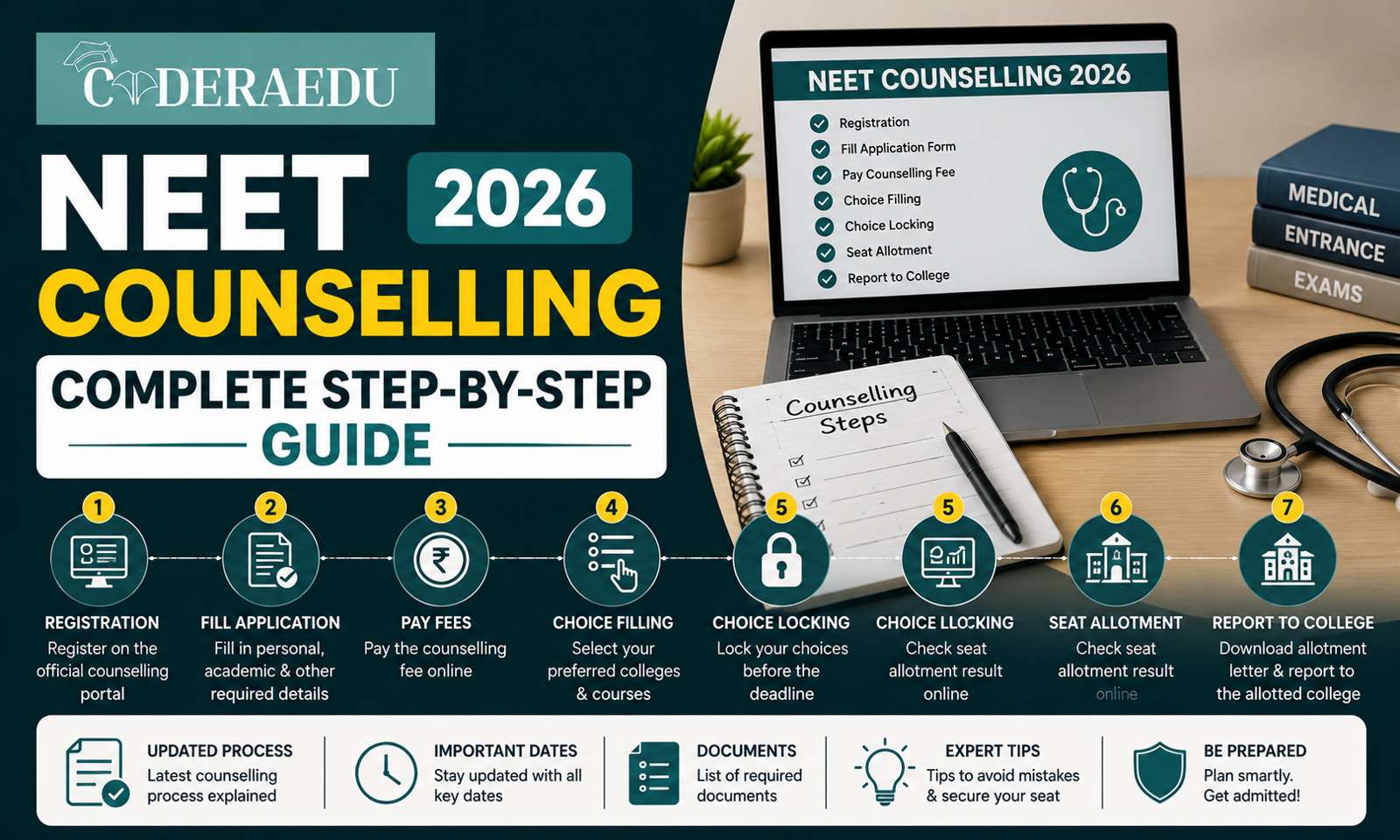
Step-by-Step NEET Counselling 2026 Process
The counselling process follows the same broad structure across MCC and most state authorities. Here is a detailed walkthrough of each stage.
Step 1: Registration and Fee Payment
Visit mcc.nic.in and register using your NEET 2026 roll number and date of birth. Pay the registration fee online — ₹1,000 for General/OBC and ₹500 for SC/ST/PwD for MCC AIQ (fee amounts may be revised; confirm on the official portal). Simultaneously, register on your state's counselling portal. Do not wait for MCC results before registering for state counselling — both processes run in parallel and have separate, often short, registration windows.
Step 2: Choice Filling and Locking
Choice filling is the most critical step in the entire counselling process — your allotment depends entirely on how intelligently you fill your preference list. You can add as many colleges as you want; there is no penalty for listing more. Add your top choices first, including AIIMS New Delhi and other AIIMS campuses at the top if your rank permits, followed by JIPMER, top government colleges, then private and deemed universities. Do not list only 5–10 colleges — a broader list significantly improves your allotment outcome. Lock your choices before the deadline. The MCC portal faces heavy traffic near the deadline; locking early eliminates the risk of a crash costing you your choices.
A broader choice set almost always leads to better allotment. Students who list 30–50 colleges consistently get better outcomes than those who limit to 10–15 out of brand loyalty or unfamiliarity with other options.
Step 3: Seat Allotment Result
The seat allotment result is published on the MCC portal. It assigns you one seat from your submitted preference list, based on your rank, category, and availability. In Round 1, a 'free exit' is permitted — you can choose not to join the allotted seat without losing your security deposit. From Round 2 onward, if a seat is allotted and you do not report, you forfeit the security deposit. Check NEET 2026 expected cutoff scores to calibrate which allotments to accept and which to upgrade in subsequent rounds.
Step 4: Reporting to the Allotted College
Once a seat is allotted and you decide to accept it, you must physically report to the college within the stipulated window — typically 3–5 days. Carry original documents and their self-attested photocopies. The college verifies documents and confirms admission. If you are also allotted a seat through state counselling for the same round, you must resign from one before the deadline. Holding two seats past the resignation window carries penalties.
Documents Required for NEET Counselling 2026
Prepare this set before registration opens. For state quota, your state authority may ask for additional documents — check their specific notification. For MCC AIQ, category certificates must be in the central government format; state-issued OBC certificates are not accepted at the MCC level.
- NEET UG 2026 Admit Card and Scorecard/Rank Letter
- Class 10 Mark Sheet and Certificate (for date of birth proof)
- Class 12 Mark Sheet and Passing Certificate (PCB marks)
- Transfer Certificate and Migration Certificate from last attended school/college
- ID Proof: Aadhaar Card / Passport / Voter ID
- Passport-size photographs (minimum 10, recent, white background)
- Category Certificate for SC/ST/OBC-NCL/EWS — must be in central government format for AIQ; separate state format for state quota
- PwD Certificate (if applicable) — issued by a government medical board
- Domicile / Residence Certificate (mandatory for state quota; must meet state's specific residency duration requirement)
- Income Certificate (for EWS category — issued by a gazetted officer)
- NRI/OCI documents (if applicable for deemed university NRI quota)
- Medical Fitness Certificate (from a registered medical practitioner)
State Quota vs All India Quota — Key Differences
Most students have a rough understanding that one is national and one is state-level — but the specifics determine your strategy. Read the detailed breakdown on AIQ vs State Quota in NEET Counselling 2026 for the complete picture. Here is a concise comparison:
Table
| Parameter | All India Quota (AIQ) | State Quota |
|---|---|---|
| Seat Coverage | 15% of government MBBS/BDS seats + 100% AIIMS, JIPMER, Deemed | 85% of government MBBS/BDS seats |
| Conducted By | MCC (mcc.nic.in) | State counselling authority (DMER, DMET, DGHS, DME, RUHS, KEA, etc.) |
| Eligibility | Any NEET-qualified student from any state | Valid domicile of that specific state mandatory |
| Competition | National — all 24+ lakh qualifiers compete | State-level — only domicile candidates compete |
| Cutoff Level | Higher (national competition) | Lower by 30,000–80,000 ranks for same college (General category) |
| Reservations | SC/ST/OBC/EWS/PwD as per central norms | SC/ST/OBC as per state norms — may vary significantly (e.g., NT/SBC in Maharashtra) |
| Deemed Universities | Yes — 100% of deemed seats are AIQ only | No — deemed universities have no state quota |
| Can Register for Both? | Yes — both run in parallel; register separately | Yes — both run in parallel; register separately |
3 columns · 9 rows
NEET 2026 Cutoff and Merit List
The NEET 2026 cutoff operates at two levels that students often conflate. The qualifying cutoff — set by NTA — is the minimum percentile to become eligible for counselling: 50th percentile for General, 40th for OBC/SC/ST. For 2026, this translates to roughly 135–140 marks for General. Passing this threshold simply means you can register for counselling. The admission cutoff is the actual closing rank of the last student who received a seat in a specific college during a specific counselling round — and this is what actually determines whether you get in.
For General category students, a government MBBS seat through AIQ typically requires 620–680+ marks depending on the college. State quota cutoffs are 30,000–80,000 ranks lower than AIQ for equivalent colleges. Check NEET 2026 category-wise expected cutoffs for a detailed breakdown across General, OBC-NCL, SC, ST, and EWS categories, and state-wise NEET 2026 cutoffs to understand what your score means in your home state specifically.
To understand which colleges are realistic for your rank, explore the full top MBBS colleges in India list on CaderaEdu — filtered by state, fees, government vs private, and NEET cutoff history. Individual college pages show round-wise opening and closing ranks across all categories. For private and deemed options, the top private medical colleges in India page covers 200+ institutions ranked by NIRF, fees, and outcomes.
Understanding the MCC Counselling Rounds
MCC AIQ typically runs across four rounds: Round 1 (free exit permitted — no penalty for not joining), Round 2 (security deposit forfeited if allotted seat not joined), Mop-Up Round (for seats vacant after Round 2; fresh registration required), and Stray Vacancy Round (final round, fast turnaround of 2–3 days). A critical point many students miss: your Round 1 choice list does not carry over to Round 2. Fresh choice filling is required in every subsequent round.
Tips to Maximise Your Chances During NEET Counselling 2026
The counselling process rewards students who are informed and organised. These are the patterns that make the difference between a good outcome and a missed seat.
- Register for both MCC and state counselling simultaneously, not sequentially. They run in parallel. Missing state registration while waiting for MCC results is the single most common and costly mistake in NEET counselling.
- Fill your choice list comprehensively — list 30 to 50 colleges, not 5 to 10. Always put aspirational choices (AIIMS campuses, JIPMER, top government colleges) at the top. You can always decline a seat you don't want.
- Use rank-based data, not marks. Admission cutoffs are in ranks, not scores. Use the NEET College Predictor to convert your marks to rank and see realistic college options before the portal even opens.
- Check state-specific domicile requirements well in advance. States like Maharashtra and Tamil Nadu enforce strict domicile norms. Ensure your certificate format matches what the state authority accepts.
- For AIQ, your OBC/SC/ST/EWS certificate must be in the central government format — not the state revenue format. Get both versions issued before counselling begins.
- Lock your choices early. MCC portal traffic spikes in the final hours before the deadline and crashes are common. Locking even 6–12 hours before deadline eliminates this risk.
- If allotted a seat in Round 1 that isn't your first choice, keep your options open. In Round 2, upgrade your choice list — better seats often open up as candidates with multiple allotments surrender one.
- If government MBBS seats are not within reach, evaluate private and deemed colleges carefully on fee structure across all 5.5 years before choice filling. The difference between a ₹12L/year and a ₹20L/year college over 5 years is ₹40L.
Exploring Your College Options: Where CaderaEdu Helps
Good choice filling requires knowing your colleges well before the portal opens — not during the 2-day window when you're under pressure. CaderaEdu's college database gives you round-wise cutoff history, fee breakdowns, infrastructure details, and admission data in one place.
For students targeting AIIMS, the AIIMS New Delhi admission page covers the full MBBS program, fee structure, hostel details, and cutoff trends. AIIMS New Delhi requires a top-50 AIR for General category — a score of 690+ out of 720 is typically needed. Other AIIMS campuses have progressively lower cutoffs, with several accessible at AIR 1,500–2,500 in the General category.
Students who qualify NEET but don't secure an MBBS seat should note that BDS admissions use the same NEET rank — top BDS colleges in India are accessible at significantly lower cutoffs than MBBS, and the career pathway through MDS is strong. Similarly, if MBBS in India at an accessible fee is proving difficult, exploring the complete NEET UG counselling guide covers all quota options including deemed universities and private colleges in detail.
Common Mistakes to Avoid in NEET Counselling 2026
- Not registering for state counselling because you were waiting for MCC results — both registration windows are independent and often open at the same time.
- Assuming your Round 1 choice list carries over to Round 2 — it does not. Fresh choice filling is mandatory in every round.
- Submitting your choice list without locking it — an unlocked list is treated as empty by the system.
- Holding two allotted seats (one from MCC, one from state) past the resignation deadline — this carries financial penalties and can result in cancellation.
- Relying on unofficial sources for counselling dates — bookmark mcc.nic.in and your state authority's official portal.
- Ignoring mop-up and stray vacancy rounds — good seats open up in later rounds as candidates upgrade or withdraw.
NEET Counselling 2026: Final Checklist
- Bookmark mcc.nic.in and your state counselling authority's portal
- Keep your NEET 2026 scorecard and all original documents ready
- Ensure category certificates are in both central government and state formats
- Use the CaderaEdu NEET College Predictor to shortlist colleges before registration opens
- Register on MCC portal immediately when registration window opens
- Register on state portal simultaneously — do not wait
- Research round-wise cutoffs for your shortlisted colleges on CaderaEdu
- Fill 30–50 choices on MCC; put aspirational colleges first
- Lock your choice list at least 12 hours before the deadline
- Check allotment result on the MCC portal, not third-party sites
- Report to allotted college within the stipulated window with original documents
Conclusion
NEET Counselling 2026 is where preparation meets strategy. The seat you get is not solely a function of your rank — it is equally a function of how well you navigate the two-track counselling process, how comprehensively you fill your choices, and how meticulously you prepare your documents. With the counselling calendar shifted by 6–8 weeks due to the Re-NEET 2026 rescheduling, you have a window right now to research colleges, understand cutoffs, and build your preference list before the pressure of the registration window begins.
Use CaderaEdu's free NEET UG College Predictor to get a realistic shortlist based on your rank and category — no login required, and it covers both AIQ and all major state quotas. Explore individual college pages for round-wise cutoff data, fee structures, and infrastructure details so your choice filling is grounded in real data, not guesswork. The National Medical Commission (NMC) also publishes the approved list of medical colleges annually — a useful cross-check when evaluating private and deemed options.
Topics:
Share this article
Copy
Frequently Asked Questions
When will NEET Counselling 2026 start?
MCC AIQ counselling 2026 is expected to begin in late July or early August 2026, approximately 3–4 weeks after the NEET UG 2026 result is declared. Due to the NEET 2026 cancellation and Re-NEET held on June 21, 2026, the entire calendar has shifted by 6–8 weeks from the original schedule. Results are expected in July 2026. Always check mcc.nic.in for the official schedule — do not rely on unofficial sources.
Can I register for both MCC AIQ and state counselling at the same time?
Yes, and you must. MCC AIQ and state counselling run in parallel with separate registration processes, separate portals, and separate deadlines. Registering for only one significantly reduces your options. If you receive a seat allotment from both, you choose one and resign from the other within the resignation deadline. Not registering for state counselling while waiting for MCC results is the most common strategic mistake in NEET counselling.
What is the difference between qualifying cutoff and admission cutoff in NEET 2026?
The qualifying cutoff is the minimum percentile set by NTA to be eligible for counselling — approximately 135–140 marks for General category (50th percentile). Clearing this just means you can register. The admission cutoff is the closing rank of the last candidate who actually received a seat at a specific college in a specific counselling round. For a General category government MBBS seat through AIQ, the admission cutoff typically requires 620–680+ marks. These are two entirely different numbers and the confusion between them causes many students to underestimate the competition.
How many college choices should I fill during NEET counselling?
As many as possible — ideally 30 to 50 colleges, not 5 to 10. There is no penalty for listing more colleges. Put your most preferred colleges at the top (AIIMS campuses, JIPMER, top government colleges) and work downward to private and deemed options. A broader list consistently produces better allotment outcomes because the system matches you to the highest preference for which your rank qualifies. Students who list only their top 10 dream colleges risk no allotment at all if they fall short of all 10 cutoffs.
What happens if I get a seat in Round 1 but want to try for a better college in Round 2?
In MCC counselling, Round 1 allows free exit — you can choose not to join an allotted seat without losing your security deposit, and re-enter Round 2 with fresh choice filling. From Round 2 onward, if a seat is allotted and you do not report to the college, you forfeit the security deposit. You can still participate in subsequent rounds by paying fresh registration. Note that your Round 1 choice list does not carry forward — you must fill choices again for every round. Use the interval between rounds to update your list based on what seats opened up.
Confused About College Admissions?
Get expert advice on college selection, admission chances, and career path in a personalized counselling session.
Book a Counselling Slot
Select Date
Pick a Slot