NEET Protests 2026: Why Students Are Protesting and What the Crisis Means for India's Education System

Click to enlarge
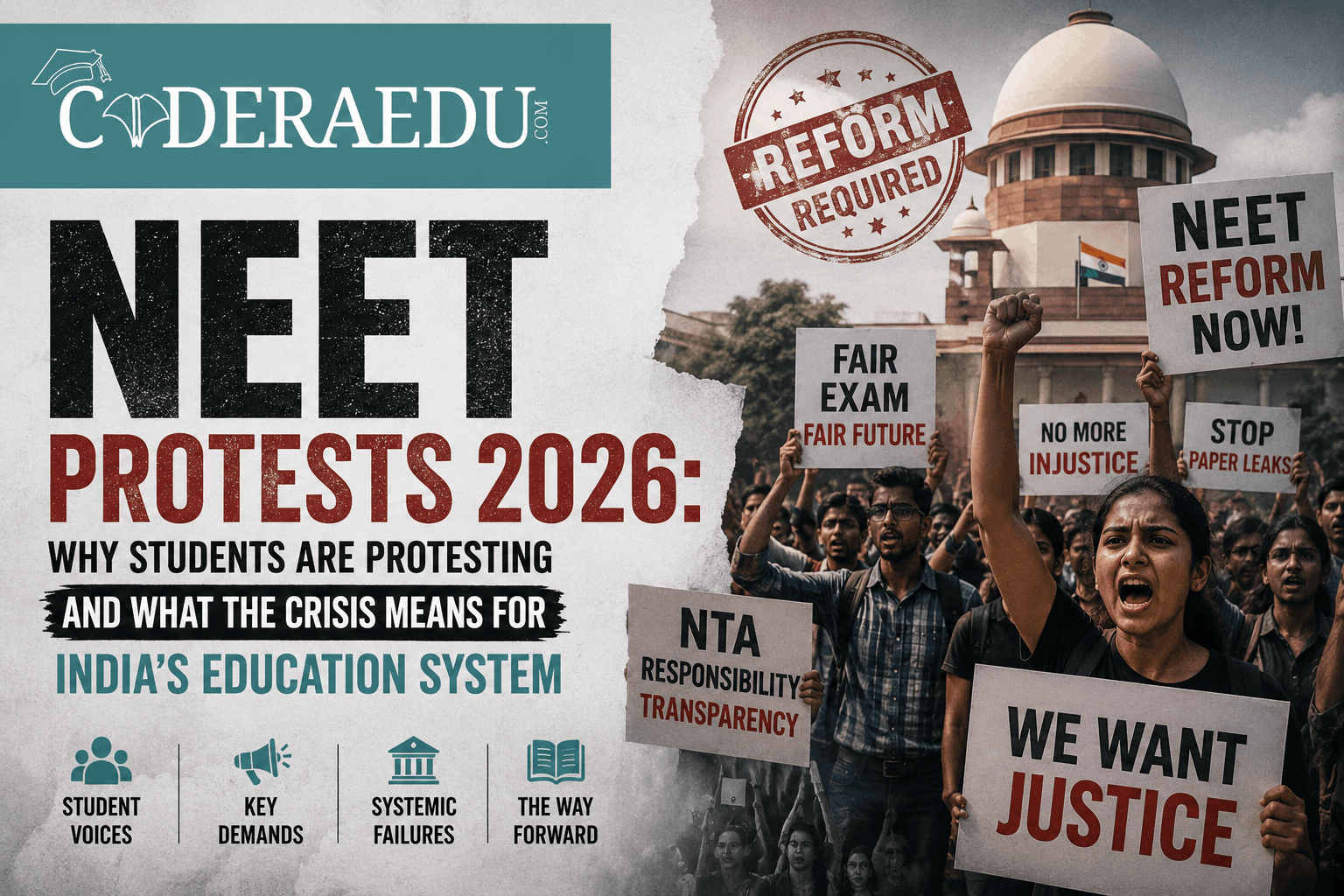
NEET UG 2026 has moved well beyond being just an entrance exam this year. What began as a paper leak controversy in May has turned into months of protests, a CBI investigation, Supreme Court hearings, and, by July 2026, street demonstrations at Jantar Mantar that pulled in opposition leaders and a prominent hunger strike. This piece lays out what actually happened, why students are still protesting even after the result has been declared, and what the episode signals about the state of India's largest entrance examination system.
What Triggered the NEET UG 2026 Crisis
NEET UG 2026 was originally held on 3 May 2026 across roughly 551 cities in India and 14 centres abroad, with more than 22 lakh candidates appearing. On 12 May 2026, the National Testing Agency cancelled the examination entirely after credible allegations surfaced of a coordinated paper leak, and a re-examination was announced for later in the year. The cancellation, rather than resolving the anger, became the spark for weeks of sustained protest.
NEET UG 2026 Timeline: From Paper Leak to Result
Table
| Date | Development |
|---|---|
| 3 May 2026 | NEET UG 2026 conducted; over 22 lakh candidates appear |
| 12 May 2026 | NTA cancels the exam over alleged paper leak; CBI case registered |
| 14-15 May 2026 | CBI arrests alleged kingpin and accomplices in Pune |
| 25 May 2026 | Supreme Court issues notices to Centre and NTA on reform pleas |
| 1 June 2026 | AISA protest outside Ministry of Education; demands NTA overhaul |
| 21 June 2026 | Re-examination conducted |
| 16 July 2026 | NEET UG 2026 result declared; around 11.21 lakh qualify |
| 20-21 July 2026 | Jantar Mantar protests intensify under the Sansad Chalo movement |
2 columns · 9 rows
The CBI Investigation: Where It Stands
The Central Bureau of Investigation registered its case on 12 May 2026 on a complaint from the Department of Higher Education, and moved quickly. Within days it identified a chemistry lecturer allegedly involved in the exam process as the source of the leak, and an accomplice who helped arrange coaching sessions where questions were reportedly dictated to a small group of students in Pune. By late May, the number of arrests had risen to 13 individuals across Delhi, Jaipur, Gurugram, Nashik, Pune, Latur and Ahilyanagar.
- Case registered on 12 May 2026 following a complaint from the Ministry of Education
- Alleged kingpin, a chemistry faculty member with access to the paper, arrested on 15 May 2026
- Searches conducted at 49 locations; laptops, phones and documents seized
- 13 total arrests confirmed by the CBI as of late May 2026
- Investigation described by the agency as ongoing, with the full conspiracy chain still being mapped
For official updates on the case, the CBI's press statements are relayed through the Press Information Bureau, which remains the most reliable primary source rather than second-hand social media claims.
Why Students Are Protesting
The anger did not stay confined to the leak itself. Student groups have used the episode to reopen a broader complaint that has followed the NTA since the 2024 controversy: that a single, centralised agency with no independent statutory backing is handling an exam that decides the fate of millions of aspirants every year.
- Dissolution of the NTA and its replacement with a statutory body created through an Act of Parliament, rather than one registered under the Societies Registration Act
- A court-monitored or judicially supervised committee to oversee future examinations
- Faster transition to a fully computer-based test format, rather than the pen-and-paper mode that critics say is easier to compromise
- Accountability for the delay and disruption caused to an entire academic year
- Resignation of Union Education Minister Dharmendra Pradhan, a demand raised repeatedly by student groups and opposition leaders since May
It is worth noting that most of these demands, including scrapping the NTA and moving to computer-based testing, are not new. Similar demands followed the 2024 NEET-UG controversy as well, which is part of why the Supreme Court's response this time has been sharper.
The July 2026 Protests: Sansad Chalo and Jantar Mantar
Even after the result was declared on 16 July 2026, protests did not stop. On 20 July 2026, demonstrations at Jantar Mantar, organised under what was described as the Sansad Chalo movement, brought together student groups and farmer organisations. The protest turned confrontational, with police using a lathi-charge to disperse the crowd. Ladakhi engineer and activist Sonam Wangchuk, who had been on a hunger strike for close to 20 days over the issue, was taken into custody shortly before the demonstration and was later hospitalised after his health deteriorated.
The following day, 21 July 2026, opposition leaders Rahul Gandhi and Priyanka Gandhi Vadra held a sit-in outside the Prime Minister's residence in a show of solidarity with the protesting students. Representatives of student groups also met Union Health Minister J.P. Nadda around the same time to present their demands, though no firm commitments were announced at that meeting.
The Supreme Court's Role and the Push for Reform
Separately from the street protests, the matter has been playing out in court. In late May 2026, the Supreme Court issued notices to the Centre and the NTA on petitions filed by medical professional bodies seeking structural reform of the agency, including a shift to computer-based testing, encrypted digital transmission of question papers, and an independent, statute-backed oversight framework. The bench remarked that the NTA appeared not to have learnt lessons from the 2024 controversy, and directed both the agency and the chairman of the earlier reform committee to file compliance affidavits on how far past recommendations had actually been implemented.
In its own affidavit, the NTA told the court that a High-Powered Steering Committee had recommended a set of security measures for this year's exam and re-exam, including mandatory CCTV checks with footage preserved for at least 90 days, mock drills at centres, and forensic review of footage after the exam to catch irregularities that might not be visible in real time. The agency also said it had created 16 new senior posts and set up state and district-level coordination committees.
The Human Cost: Student Distress Amid the Uncertainty
Beyond the political and legal fallout, the months of uncertainty have taken a visible toll on aspirants. Media reports have linked the prolonged disruption, including the cancellation, the delayed re-exam, and the anxious wait for results, to instances of student distress, with at least one reported case of a candidate taking their own life after the outcome did not go as hoped. This is a genuinely difficult period for lakhs of young people whose entire academic year has been thrown off schedule, and it deserves to be treated with care rather than as a side note to the political story.
What This Means for India's Education System
The 2026 episode is unlikely to be the last word on NTA reform, but it has pushed the conversation further than it went even after 2024. The government has already indicated an intent to move NEET-UG to a computer-based test format from 2027, a shift that the Supreme Court noted amounts to an implicit admission that the current paper-based system carries real security risk. Whether that transition, along with encrypted digital paper transmission and stronger third-party oversight, actually rolls out on schedule will likely determine whether 2026 becomes a genuine turning point or another cycle repeated in a future year.
For the roughly 11.21 lakh candidates who did qualify this year, the more immediate concern is that counselling and admission timelines have already been compressed by nearly two months because of the rescheduled exam. That makes it more important than ever to move quickly and accurately once counselling registration opens, rather than losing further time to confusion.
What Should NEET UG 2026 Candidates Do Right Now
Regardless of how the reform debate plays out, the practical admission process still has to run its course. Candidates should keep tracking official counselling announcements and use the time productively rather than waiting anxiously for updates. Entering your rank into the NEET College Predictor gives an early, realistic sense of which colleges are within reach.
It also helps to look at individual college profiles directly rather than relying on rumours about how this year's disruption might affect cut-offs. Institutions such as AIIMS New Delhi, the Jantar Mantar protest venue's own neighbourhood institution Lady Hardinge Medical College, and newer campuses like AIIMS Mangalagiri and AIIMS Bhubaneswar each show real fee and seat data you can plan around.
If a government MBBS seat does not work out this year, a state-level college like Government Medical College, Buldhana or a listing from the Top Private Medical Colleges in India directory are worth reviewing early, so you are not scrambling for options during an already compressed counselling window.
Students who are already thinking beyond MBBS, toward postgraduate specialisation, can also use this waiting period productively by checking the NEET PG Predictor to understand how undergraduate college choice tends to affect postgraduate options later. It is a small step, but it turns an anxious wait into at least some useful planning.
How 2026 Compares With the 2024 NEET Controversy
This is not the first time NEET-UG has been at the centre of a national controversy. The 2024 exam faced allegations of grace marks being awarded unevenly and a cluster of unusually high scores from a single centre, which also triggered protests, a CBI probe, and a Supreme Court-monitored review through a high-powered committee headed by former ISRO chairman K. Radhakrishnan. The Centre told the court in 2025 that it had accepted almost all of that committee's recommendations.
What makes 2026 feel different to many observers is the nature of the lapse. In 2024, the dispute centred on scoring and evaluation. In 2026, it involves an alleged breach of the question paper itself, which is a more fundamental failure of exam security. That is also why the Supreme Court's tone this time has been notably sharper, with the bench directly asking why lessons from 2024 had not translated into a leak-proof system less than two years later.
For students, the practical effect of this repeated pattern is a growing sense that the exam calendar itself cannot be trusted to run on time. Two disruptions in three admission cycles have real consequences: delayed counselling, compressed reporting windows, and added pressure on an already stressful transition from school to medical college. That is part of why student groups are pushing for structural change now rather than accepting another round of committee recommendations that may or may not be implemented.
Where to Follow Verified Updates
Given how much misinformation has circulated around this year's exam, rely only on verified sources. The National Testing Agency and the official NEET UG result portal remain the primary sources for exam and result updates, while the National Medical Commission is the regulatory body overseeing medical college approvals. A detailed, sourced timeline of the protest movement itself is also documented on Wikipedia's entry on the 2026 Delhi Jantar Mantar protests. For admission planning through the rest of the cycle, the CaderaEdu homepage brings predictors and college data together in one place.
Share this article
Copy
Frequently Asked Questions
Why did NTA cancel NEET UG 2026?
The National Testing Agency cancelled the exam held on 3 May 2026 after credible allegations emerged of a coordinated paper leak involving a chemistry faculty member and a group of students in Pune. The CBI registered a case the same day and made its first arrests within days.
When was the NEET UG 2026 re-examination held?
The re-examination was conducted on 21 June 2026, and the result for it was declared on 16 July 2026, with around 11.21 lakh candidates qualifying.
What are protesting students actually demanding?
The core demands include dissolving the NTA in favour of an independent statutory testing body created by Parliament, faster transition to computer-based testing, a court-monitored oversight mechanism, and accountability for the disruption caused to this year's academic calendar. Some student groups and opposition leaders have also called for the Union Education Minister's resignation.
Is NEET UG moving to computer-based testing?
The government has indicated an intent to shift NEET-UG to a computer-based test format from 2027. The Supreme Court has noted that this intent itself reflects an acknowledgement that stronger digital security is needed for the exam.
How many people have been arrested in the NEET UG 2026 paper leak case?
As of late May 2026, the CBI had arrested 13 individuals across Delhi, Jaipur, Gurugram, Nashik, Pune, Latur and Ahilyanagar in connection with the case, and the investigation remained ongoing.
Did the protests affect NEET UG 2026 counselling dates?
Yes. Because the exam was cancelled and re-conducted nearly two months later than originally scheduled, the entire counselling and admission calendar for 2026 has shifted later than in a typical year.
Who is Sonam Wangchuk and why was he involved in the NEET protests?
Sonam Wangchuk is a Ladakh-based engineer and activist known for education and environmental advocacy. He joined the NEET-related protests in July 2026 with an extended hunger strike and was hospitalised after his health declined during the fast.
Confused About College Admissions?
Get expert advice on college selection, admission chances, and career path in a personalized counselling session.
Book a Counselling Slot
Select Date
Pick a Slot