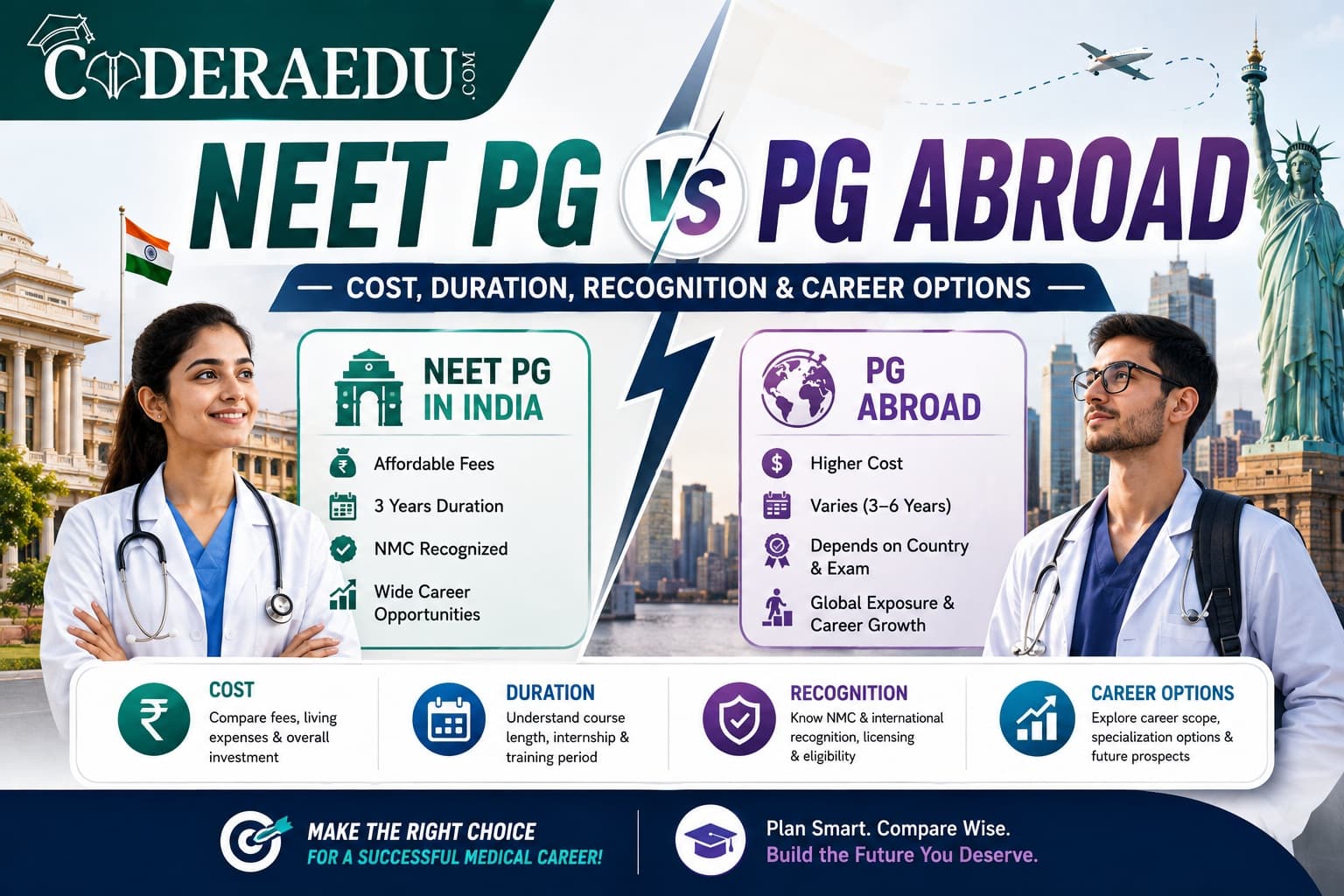
NEET PG vs PG Abroad: Cost, Duration, Recognition & Career Options

AditiUpdated on 01 Oct 2026, 04:10 PM IST
10 minutes read
Click to enlarge
About 2.66 lakh candidates appeared for NEET PG 2026, competing for roughly 28,000 seats in MCC's centrally counselled AIQ, Deemed University and DNB pool, which is exactly why PG abroad searches spike every result season. But before you compare brochures, there's a fact almost no consultant leads with: only postgraduate degrees from five specific countries have a clearly documented NMC recognition pathway back into Indian specialist registration, and Russia, Georgia and the Philippines, the cheapest and most heavily marketed destinations, are not among them. This guide compares NEET PG in India against PG abroad on cost, duration, actual recognition rules and career outcomes, so you can decide with facts rather than a sales pitch.
NEET PG in India vs PG Abroad: Quick Comparison
Table
| Factor | NEET PG (India) | PG Abroad |
|---|---|---|
| Entrance route | NEET PG, a single national exam, followed by MCC (AIQ) and state counselling | Varies by country: PLAB/MRCP/MRCS (UK), USMLE (USA), language plus Approbation (Germany), direct or local licensing exams (Russia, Georgia, Philippines) |
| Duration | 3 years for MD/MS, 2 years for PG Diploma | 2 to 8 years depending on country and specialty, often longer than India's fixed 3-year structure |
| Cost (government seat, India) | Roughly ₹25,000 to ₹2 lakh for the full course at most government medical colleges, with a government stipend during training | Not applicable; this column compares only Indian options |
| Cost (private/deemed seat, India) | Can run into several tens of lakhs per year, often with a service bond | Not applicable |
| Cost (abroad) | Not applicable | Roughly ₹10 lakh to ₹80 lakh depending on country, pathway and specialty |
| Recognition in India | Automatic; an NMC-recognised Indian MD/MS allows State Medical Council registration as a specialist with no further exam | Conditional; depends on the country, the specific qualification, and whether it meets NMC's documented equivalence criteria |
| Career path if you want to practise in India | Direct, since the degree is already India-recognised | Requires separate verification, and in several countries, no clear path to Indian specialist registration |
| Career path if you plan to practise abroad | Would typically need that country's own licensing exam regardless of the Indian PG degree | Usually the most direct route to practising in that specific country |
3 columns · 9 rows
NEET PG 2026: Current Status and Category-Wise Cutoff
NBEMS declared the NEET PG 2026 result on September 24, 2026, following the exam on August 30 and a re-exam on September 5 for candidates affected at two Jaipur centres. The qualifying cutoff, which decides eligibility to enter counselling, was set at 262 marks out of 720 (50th percentile) for General and EWS, 244 marks (45th percentile) for General-PwBD, and 226 marks (40th percentile) for SC, ST and OBC including their PwBD candidates.
Clearing this cutoff only makes you eligible for counselling; it says nothing about which branch or college you can actually get. Branch-wise closing ranks in India vary enormously by speciality and category, and if you want the detailed breakdown, including how General, OBC, SC, ST and EWS candidates compare rank for rank across Radiology, Dermatology, General Medicine, Surgery and other specialities, see the dedicated branch-wise cutoff guide linked in the resources below. This is also the single biggest reason doctors start researching PG abroad: a competitive score and a wide-open rank still may not match the speciality or city you want in India.
Country-Wise PG Abroad: Cost, Duration and Entry Pathway
Costs and durations below are approximate ranges compiled from multiple published fee structures and vary by university, speciality and the exact year of application; always confirm current figures directly with the institute and its country's medical regulator before committing.
Table
| Country | Common PG Pathway | Typical Duration | Approximate Cost | Entry Requirement |
|---|---|---|---|---|
| United Kingdom | MRCP / MRCS / PG Diploma / Specialty Training via GMC registration | 2 to 8 years depending on specialty | ₹15 lakh to ₹75 lakh | PLAB or Royal College exams, GMC registration |
| United States | Residency after USMLE | 3 to 7 years | ₹15 lakh to ₹80 lakh in exam and application costs; residency itself is salaried | USMLE Steps 1, 2 and 3, Residency Match |
| Germany | Facharzt (Specialist Training) | 3 to 6 years | Minimal tuition; training is salaried, though preparation costs apply | German language proficiency plus Approbation (medical licence) |
| Canada | Residency via CaRMS | 3 to 5 years | Significant application and exam costs; residency is salaried | MCCQE and IELTS, CaRMS match |
| Russia | Clinical residency (Ordinatura) | 2 to 3 years | ₹4 lakh to ₹6 lakh per year | MBBS foundation, university-based admission |
| Georgia | Residency programme | 2 to 3 years | ₹6 lakh to ₹8 lakh per year | Direct admission |
| Philippines | MD-pattern postgraduate programme | 3 to 4 years | ₹4 lakh to ₹6 lakh per year | University-based admission |
5 columns · 8 rows
Notice the inverse relationship: Russia, Georgia and the Philippines are the cheapest and fastest to enter, while the UK, USA and Canada cost considerably more and demand a separate licensing exam. That cost gap is exactly where the recognition question becomes critical, because the cheaper destinations are also the ones without a documented Indian recognition pathway.
Is a Foreign PG Degree Recognised in India? What's Actually Verified
There is no blanket rule that says PG degrees from an entire country are automatically valid in India. The clearest, documented basis for recognition traces back to a Ministry of Health and Family Welfare notification dated March 7, 2008, under the erstwhile Indian Medical Council Act, which included postgraduate medical qualifications awarded in the USA, UK, Canada, Australia and New Zealand, where that qualification is recognised for enrolment as a medical practitioner in the relevant specialty in that country, within the Act's Third Schedule of recognised qualifications.
NMC's subsequent Teachers Eligibility Qualifications (TEQ) Regulations reaffirmed a similar equivalence specifically for faculty eligibility, with country-specific conditions. For example, a PG qualification from the USA or Canada needs to carry an MD along with a Residency Training Certificate in that same specialty to be treated as equivalent to an Indian MD/MS/DM/MCh. This is the most verifiable basis for any claim that these five countries' PG degrees have an established route into India, and it is conditional on meeting the exact criteria, not automatic simply because the degree was awarded in that country.
For Russia, Georgia, the Philippines, Germany, Ukraine, China and most other common MBBS/PG-abroad destinations, no equivalent blanket provision exists in current NMC regulations. A PG qualification from these countries sits outside the Third Schedule listing above, and recognition, if sought at all, would need to be examined case by case against current NMC rules at the time of application. Treat any claim that these countries' PG degrees are guaranteed Indian recognition with caution, and verify directly with the NMC before relying on it.
Recognition vs Registration: Two Separate Questions
Table
| Recognition | Registration/Licensing |
|---|---|
| Whether India treats the qualification as equivalent to an Indian MD/MS/DM/MCh | Whether you are legally permitted to practise medicine or use a specialist title in India |
| Governed by NMC regulations, the 2008 Third Schedule notification and TEQ equivalence criteria | Governed by the relevant State Medical Council and NMC's Ethics and Medical Registration Board |
| Matters for academic standing, faculty eligibility and specialist title use | Matters for the legal right to treat patients and practise as a specialist |
| Check before you enrol in a foreign PG programme | Check again before you return and attempt to register, since rules can change |
2 columns · 5 rows
A degree can, in principle, meet recognition criteria and still require a separate registration process with the State Medical Council where you intend to practise. Never assume one automatically grants the other.
Career Options After NEET PG vs After PG Abroad
- After NEET PG in India: direct eligibility to register as a specialist with your State Medical Council, practise in India immediately, and pursue DM/MCh super-speciality through NEET-SS without any additional recognition hurdle.
- After PG from the UK, USA, Canada, Australia or New Zealand: a documented, though conditional, pathway exists for recognition in India, alongside strong local career prospects and typically higher international salaries if you choose to stay abroad.
- After PG from Russia, Georgia, the Philippines or similar destinations: a realistic, usually lower-cost route to a postgraduate qualification and local or regional practice, but without a confirmed pathway back into Indian specialist registration, so most doctors in this position plan to practise where they trained or pursue further exams rather than assume an India return is automatic.
- DNB as a middle path: Diplomate of National Board qualifications, earned in India through NEET PG counselling, carry the same clinical recognition as MD/MS and are worth comparing directly against a PG-abroad plan before ruling either out.
Before You Choose: A Verification Checklist
- Identify the exact qualification name and specialty, not just the country, since titles like MD mean different things in different systems.
- Verify the awarding university's standing with that country's own medical regulator.
- Check whether the qualification meets NMC's documented equivalence criteria, if your goal is eventual recognition in India.
- Confirm current NMC rules directly on nmc.org.in before paying any admission fee, since regulations are revised periodically.
- Decide honestly whether your goal is to practise in India or abroad, since the two paths call for very different verification before you commit.
- Keep every degree certificate, transcript, internship or residency completion certificate, and registration document safely, since these are what any future verification process will ask for.
Common Mistakes When Comparing NEET PG and PG Abroad
- Assuming any foreign MD or MS is automatically valid in India simply because of the degree title.
- Treating a country's overall reputation as proof of recognition, when recognition in India depends on the specific regulation, not national reputation.
- Confusing FMGE/NExT, which applies to foreign MBBS graduates seeking Indian registration, with the separate question of foreign PG recognition for someone who already holds an Indian MBBS.
- Comparing only tuition cost abroad against NEET PG's low government-seat fee without factoring in the additional exam, visa, and years of lower or no income in several pathways.
- Finalising admission abroad based on a consultancy's claims instead of checking NMC's current regulations directly.
Conclusion
NEET PG remains the more straightforward route if returning to practise in India is the goal, since recognition and registration are never in question once you hold an Indian MD/MS or DNB. PG abroad can still make sense, financially and professionally, especially in the UK, USA, Canada, Australia or New Zealand, where a documented, if conditional, recognition pathway exists, or simply as a route to practising in that country rather than India. What doesn't hold up is treating a cheaper, faster PG abroad destination as an automatic backup plan for Indian practice; verify the specific regulation before you commit, not after. For more updates on NEET PG 2026, counselling and career planning, keep checking CaderaEdu.
Related CaderaEdu Resources
- NEET PG College Predictor 2026
- NEET PG 2026 DNB General Medicine Cutoff Guide
- Best NEET PG Branches 2026: Salary, Cutoff & Demand
- FMGE 2026: Eligibility & Exam Details
- NEET 2026 Rank vs College: MBBS Abroad Options Explained
- MBBS/PG Fees at AIIMS 2026: Campus-Wise Structure
- Kakatiya Medical College, Warangal: Government MD Fee Example
- North Bengal Medical College: Government MD Fee Example
- RCSM Government Medical College, Kolhapur (PG Seat Example)
Official External Sources
Share this article
Copy
Frequently Asked Questions
Is NEET PG necessary if I want to study MD/MS abroad?
No. NEET PG is required only for postgraduate admission within India through MCC and state counselling. Studying PG abroad follows that country's own entrance and licensing process instead.
Which countries' PG degrees have a documented recognition pathway in India?
The clearest documented basis covers the UK, USA, Canada, Australia and New Zealand, under a 2008 notification and NMC's Teachers Eligibility Qualifications framework, and even this is conditional on meeting specific criteria for each country, not automatic.
Is a PG degree from Russia or Georgia recognised in India?
There is no documented blanket recognition provision for Russia, Georgia, the Philippines or similar countries in current NMC regulations. Any recognition would need to be examined case by case, so treat claims of automatic recognition with caution.
How much cheaper is PG abroad compared to a private PG seat in India?
Destinations like Russia, Georgia and the Philippines can cost roughly ₹4 lakh to ₹8 lakh per year, often less than private or deemed PG seats in India, which can run into several tens of lakhs per year. However, cost should be weighed against the recognition and career-path differences.
Does a foreign PG degree automatically let me practise in India?
No. Recognition of the qualification and registration to practise are separate steps, both governed by NMC and your State Medical Council. Even a qualification that meets recognition criteria still requires separate registration.
Is DNB a good alternative to PG abroad?
For doctors prioritising guaranteed Indian recognition, DNB, earned through NEET PG counselling, carries the same clinical standing as MD/MS and avoids the recognition uncertainty that can come with PG abroad in non-listed countries.
How long does PG abroad take compared to NEET PG in India?
NEET PG in India is a fixed 3-year MD/MS or 2-year PG Diploma. PG abroad varies widely, from around 2 to 3 years in Russia or Georgia to 3 to 8 years in the UK, USA, Germany or Canada, depending on the specialty and pathway.
Should I confirm NMC rules before or after enrolling in a PG programme abroad?
Always before. NMC regulations are revised periodically, and verifying current rules only after enrolling, or after completing the programme, can leave you with a qualification that does not meet India's recognition criteria at the time you need it.