NEET Safe Score for MBBS 2026 - Category-Wise Marks You Actually Need

Manisha Updated on 17 Sept 2026, 06:54 PM IST
17 minutes read
Click to enlarge
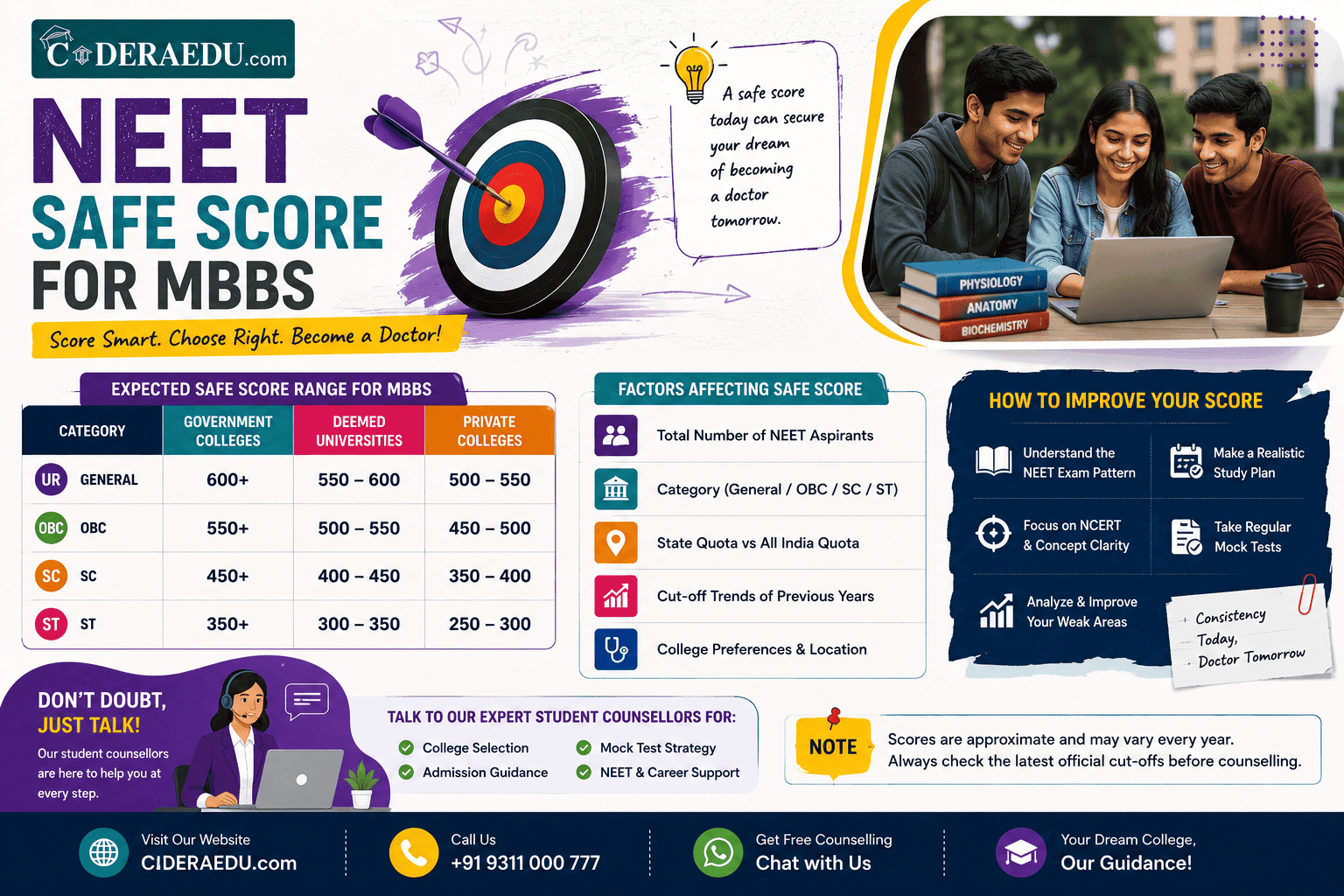
You walked out of the exam hall, checked the answer key three times, and now you are staring at a number on your screen wondering one thing: is this enough? "Safe score" is the most searched phrase in every NEET aspirant's browser history the week results drop, and yet almost nobody explains it properly. Most guides throw a single number at you - 600, maybe 650 - and call it a day. That number means nothing without context. A safe score for a General category student chasing AIIMS Delhi is a completely different number from a safe score for an SC candidate chasing a state government seat in a smaller state. This guide breaks the question down the right way: category by category, quota by quota, college tier by college tier, so you walk away knowing exactly where your score actually places you.
What Does Safe Score Actually Mean in NEET?
Before any numbers, one distinction has to be nailed down because it trips up more students than the exam itself. There are two completely different cutoffs in NEET. The qualifying cutoff is the bare minimum percentile set by the NTA - clear it and you become eligible to register for counselling. The admission cutoff is the actual score the last admitted candidate scored in a specific college during a specific counselling round. Qualifying is the entry ticket. Admission is the real competition. A safe score is neither of these in isolation - it is the score that gives you a realistic, low-risk chance of landing an MBBS seat in a college tier you would actually be happy with, accounting for your category, your home state, and which quota you are applying under.
Confusing the two is the single biggest mistake aspirants make right after results. Scoring above the qualifying cutoff (expected around 135-145 marks for General category in 2026) only means you can fill counselling forms. It does not mean a government MBBS seat is anywhere close. For the full breakdown of where these two numbers diverge, read the detailed NEET 2026 expected cutoff category-wise guide on CaderaEdu.
NEET Safe Score for MBBS 2026 - General Category
General category candidates face the steepest competition because they compete in the largest, most contested pool with no rank relaxation anywhere in the system. Here is what the data tells us heading into 2026 counselling.
Table
| Target | Safe Score (out of 720) | Approx. AIR Needed |
|---|---|---|
| AIIMS New Delhi | 690+ | Top 50-70 |
| JIPMER Puducherry / Other AIIMS Campuses | 650-690 | AIR 100-5,000 |
| Government MBBS via AIQ (General) | 650+ | Within ~18,000 |
| Good State Government Colleges (State Quota) | 550-630 | AIR 10,000-50,000 |
| Deemed University MBBS (Top Tier) | 560-600 | AIR 15,000-40,000 |
| Deemed/Private MBBS (Accessible Tier) | 420-520 | AIR 1,00,000-3,50,000 |
3 columns · 7 rows
If you are sitting at 650 marks and above, you are in genuinely excellent shape for AIQ government seats. AIIMS New Delhi is the one institution where even 650+ is not a guarantee - General category historically needs a near-perfect 690+ out of 720 to land inside the top 50-70 AIR. For every other AIIMS campus, the margin loosens considerably. A score between 600-650 opens up newer AIIMS campuses like AIIMS Kalyani, AIIMS Bhopal, and AIIMS Bhubaneswar, alongside several of the strongest state government colleges through AIQ.
Below 600 but above 550, the safest strategy shifts decisively toward state quota rather than AIQ. State quota cutoffs typically run 50-80 marks below AIQ for the same tier of college, simply because the competition pool shrinks to candidates with domicile in your specific state. Run your numbers through the NEET UG College Predictor on CaderaEdu to see exactly which colleges are realistic at your score, filtered by quota type and state.
NEET Safe Score for MBBS 2026 - OBC-NCL Category
OBC-NCL candidates qualify at the 40th percentile rather than the 50th percentile General category candidates need, and this relaxation carries through into admission cutoffs as well, though the gap narrows considerably once you move from qualifying to admission.
Table
| Target | Safe Score (out of 720) | Approx. AIR Needed |
|---|---|---|
| Government MBBS via AIQ (OBC-NCL) | 620+ | Within ~35,000 |
| AIIMS Campuses (OBC-NCL Reserved Seats) | 600-630 | AIR 200-400 (category rank) |
| State Government Colleges (State Quota) | 490-560 | Varies significantly by state |
| Deemed University MBBS | 480-560 | No reservation - open merit applies |
3 columns · 5 rows
There is one critical fact every OBC candidate must internalise: deemed universities do not honour OBC reservation under MCC AIQ counselling. Every seat in a deemed university is filled on pure open merit regardless of category, which means an OBC candidate competes on exactly the same cutoff as General category at institutions like Jamia Hamdard or D.Y. Patil. This makes government seats - where reservation genuinely applies - the higher-value target for OBC candidates before falling back on deemed options. The complete category-wise mechanics are explained in the AIQ vs State Quota 2026 guide on CaderaEdu.
NEET Safe Score for MBBS 2026 - SC Category
SC candidates also qualify at the 40th percentile, and the rank relaxation for admission is the most generous in the reserved category structure outside of ST.
Table
| Target | Safe Score (out of 720) | Approx. AIR Needed |
|---|---|---|
| Government MBBS via AIQ (SC) | 500+ | Within ~85,000 |
| AIIMS Campuses (SC Reserved Seats) | 480-540 | AIR 15,000-25,000 (category rank) |
| State Government Colleges (State Quota) | 400-480 | Significantly lower than General in most states |
| Deemed University MBBS | 480-540 | Open merit - no SC relaxation applies |
3 columns · 5 rows
A 500+ score for SC candidates is genuinely safe territory for an AIQ government seat - something a General category student would need 150 additional marks to achieve. This relaxation is precisely why SC candidates should prioritise the government counselling pathway aggressively before considering higher-fee private or deemed options. Check the full category-wise marks table in the NEET 2026 expected cutoff guide for state-specific SC cutoff variations.
NEET Safe Score for MBBS 2026 - ST Category
ST candidates have the most accessible cutoff structure of any category, both at the qualifying stage (expected 100-107 marks in 2026) and at admission.
Table
| Target | Safe Score (out of 720) | Approx. AIR Needed |
|---|---|---|
| Government MBBS via AIQ (ST) | 460+ | Within ~1,10,000 |
| State Government Colleges (State Quota) | 380-460 | Varies, generally the most lenient of all categories |
| Deemed University MBBS | 440-500 | Open merit - no ST relaxation applies |
3 columns · 4 rows
If you are an ST candidate sitting at 460 marks, treat that as a genuinely safe number for a government AIQ seat - a position that would require well over 150 additional marks under General category. The strategic priority remains identical to SC and OBC candidates: lock in government seats first, since deemed and many private institutions strip away reservation benefits entirely.
NEET Safe Score for MBBS 2026 - EWS Category
EWS (Economically Weaker Section) candidates qualify at the same 50th percentile threshold as General category, but receive a 10% horizontal reservation within government seats once they clear the EWS certificate requirement. In practical terms, EWS safe scores track close to General category numbers - typically within 10-20 marks lower at the same college tier - since the EWS quota operates as a parallel reserved pool rather than a steep rank relaxation like OBC, SC, or ST.
Score 500 in NEET 2026 - Is It Safe for MBBS?
This exact question gets typed into search bars more than almost any other NEET query, so it deserves a direct answer. For General category, 500 marks is not safe for a government MBBS seat through AIQ - that pathway typically needs 650+. It is also a stretch for most state quota government seats in competitive states like Maharashtra or Tamil Nadu, though smaller, less contested states may still offer a path. Where 500 marks becomes genuinely workable is the deemed and private university segment - colleges in the AIR 80,000-2,00,000 range become realistic, and several private medical colleges in states like Uttar Pradesh and Rajasthan have historically admitted General category candidates in this exact score band through later counselling rounds.
For SC and ST candidates, however, 500 marks is comfortably safe for a government AIQ seat given the relaxed cutoffs outlined above. This is exactly why a single "safe score" number floating around social media is almost always misleading - the same 500 marks means a completely different admission reality depending on category. Run your specific number through the NEET UG College Predictor with your actual category selected to get a personalised picture rather than relying on a generic benchmark.
AIQ vs State Quota - Where Should You Aim Your Safe Score?
The All India Quota covers 15% of government medical college seats nationwide plus 100% of seats at AIIMS and JIPMER, and is open to any NEET-qualified candidate regardless of home state. State Quota covers the remaining 85% of government seats and requires valid domicile in that specific state. Because AIQ pools every General category candidate in the country against a relatively small number of seats, its cutoffs run consistently higher than state quota - typically by 50-80 marks for the same tier of college.
This is precisely why a safe score strategy has to account for both tracks simultaneously. A score that is unsafe for AIQ in a competitive state might be comfortably safe through your home state's quota, where you only compete against domicile-holding candidates. Both portals run in parallel with separate registration, separate fees, and separate deadlines - missing one because you were waiting on results from the other is one of the most common and costly mistakes aspirants make. The complete mechanics of registering for both tracks without conflict are covered in the AIQ vs State Quota in NEET Counselling 2026 guide.
State-Wise Safe Score Variation - Why Your Home State Matters
A safe score is never a national constant - it shifts meaningfully depending on which state's quota you are competing in, because seat-to-candidate ratios vary dramatically across India.
- Uttar Pradesh: The most seat-rich state in India with over 7,000 MBBS seats. KGMU Lucknow, the top government college, closes around AIR 2,300-2,800 (660+ marks) for General category, while mid-tier government colleges close at AIR 10,000-29,000 (roughly 545-610 marks).
- Maharashtra: Manages over 10,145 MBBS seats under state quota - the largest in any single state - but is also highly competitive because it has the highest number of NEET qualifiers nationally. General category government MBBS closing marks are expected around 570-620 for 2026.
- Rajasthan: One of the largest states by NEET participation with 54 listed medical colleges. SMS Medical College Jaipur is the top-closing institution; General category government cutoffs are expected around 530-580.
- Delhi NCR: Government colleges here - Maulana Azad Medical College, Lady Hardinge, Vardhman Mahavir Medical College - run cutoffs close to AIQ levels, with General category closing around 600-635 for 2026. A strict 5-year domicile requirement applies.
- Madhya Pradesh: Government MBBS competition centres around Gandhi Medical College Bhopal and MGMMC Indore, with an expected General category cutoff of 520-570 for 2026.
Before locking in any safe score assumption, check your specific state's numbers in the detailed NEET 2026 state-wise cutoff guide on CaderaEdu, which covers Uttar Pradesh, Maharashtra, Rajasthan, Uttarakhand, Haryana, Madhya Pradesh and more in detail.
Marks vs Rank - Why You Cannot Judge Safety By Score Alone
A safe score is really a proxy for a safe rank, and the relationship between the two shifts every single year depending on how many students appear and how the paper was set. With 24+ lakh candidates expected to appear in NEET 2026 - the highest figure on record - even a small shift in raw marks can move your All India Rank by tens of thousands of positions, particularly in the densely packed 400-550 mark range where competition is thickest.
This is why two students scoring identical marks in different years can land in completely different colleges. The honest way to judge safety is always through rank, not raw marks in isolation. For a detailed model of how NEET marks convert to All India Rank for 2026, read the NEET Marks vs Rank 2026 guide and the companion NEET 2026 score vs rank analysis, both of which map specific score bands to expected rank ranges with college-level detail.
Your overall NEET rank is your position among all candidates regardless of category. Your category rank is your position among candidates from your own category. For reserved category counselling, your category rank is what actually determines eligibility - checking only your overall rank can give a misleadingly pessimistic picture of your safe zone.
Why NEET 2026 Safe Scores May Shift From Past Years
NEET 2026 has had an unusually disrupted cycle, and that disruption directly affects how confidently you can rely on historical safe score benchmarks. The original exam faced a cancellation following a paper leak controversy, with a rescheduled Re-NEET conducted afterward. This kind of disruption tends to compress the admission calendar and can shift candidate behaviour - some aspirants who would otherwise have prepared further may sit the exam regardless, while others opt out entirely. For the full background on how this affected the 2026 cycle and what changed procedurally, see the NEET UG 2026 cancellation explainer on CaderaEdu.
Paper difficulty is the single biggest lever on safe scores year to year. An easier paper pushes more candidates into higher score bands, which in turn pushes admission cutoffs upward across every category and quota - the qualifying cutoff might stay flat, but the admission cutoff for a government seat can climb by 20-30 marks compared to a tougher year. The detailed breakdown of how the 2026 paper was assessed for difficulty, and what that implies for cutoff direction, is covered in the NEET 2026 paper analysis on CaderaEdu. Total candidate volume matters just as much - with 24+ lakh candidates expected in 2026, the highest on record, competition density in the 400-550 mark range is tighter than in almost any previous year, meaning a small score difference there moves your rank by a wider margin than it would have a few years ago.
The practical takeaway is simple: treat every number in this guide as a directional benchmark, not a fixed law. Once the official NEET 2026 result and cutoff are declared, re-run your numbers through the predictor immediately rather than relying solely on pre-result estimates. For the expected result timeline and what to do the moment your scorecard is live, the NEET 2026 result date guide walks through the full sequence - scorecard download, rank confirmation, and immediate next steps before counselling registration opens.
Falling short of the safe score for your target college does not mean MBBS is off the table - it means your strategy needs to widen. Several genuinely strong options remain in play even well below the AIQ safe zone.
- Deemed university MBBS: 100% MCC-counselled with no domicile requirement and no category reservation. Colleges in the AIR 1,00,000-4,50,000 range fill through Mop-Up and Stray Vacancy rounds at significantly lower scores than Round 1. The complete admission pathway, fee structure, and top college list is in the dedicated NEET 2026 admission cutoff guide.
- Private MBBS through state quota or management quota: Several states, including UP and Rajasthan, have private colleges where management quota seats become accessible at scores as low as 225-350 marks in later rounds.
- BDS as a serious alternative: General category safe score for government BDS sits around 500-540 marks - a far more achievable target than MBBS at the same competitiveness, with a clear BDS-to-MDS specialisation pathway afterward.
- AYUSH programs (BAMS, BHMS, BUMS): Accessible at considerably lower scores while still being NEET-gateway medical careers with real clinical scope and government recognition.
- Re-attempting NEET the following year: A genuinely viable option for candidates whose score significantly underperformed their preparation level, particularly those who lost 50-100 marks to a single weak section.
Whatever your score, the smartest first move is always the same - run it through a predictor before making any decision driven by panic. The NEET UG College Predictor on CaderaEdu uses real previous-year counselling data from MCC and every state authority to instantly show admission probability labels - High, Moderate, or Low - across every quota and category combination, with zero login required.
What Happens If Your Score Falls Below the Safe Zone?
Falling short of the safe score for your target college does not mean MBBS is off the table - it means your strategy needs to widen. Several genuinely strong options remain in play even well below the AIQ safe zone.
- Deemed university MBBS: 100% MCC-counselled with no domicile requirement and no category reservation. Colleges in the AIR 1,00,000-4,50,000 range fill through Mop-Up and Stray Vacancy rounds at significantly lower scores than Round 1. The complete admission pathway, fee structure, and top college list is in the dedicated NEET 2026 admission cutoff guide.
- Private MBBS through state quota or management quota: Several states, including UP and Rajasthan, have private colleges where management quota seats become accessible at scores as low as 225-350 marks in later rounds.
- BDS as a serious alternative: General category safe score for government BDS sits around 500-540 marks - a far more achievable target than MBBS at the same competitiveness, with a clear BDS-to-MDS specialisation pathway afterward.
- AYUSH programs (BAMS, BHMS, BUMS): Accessible at considerably lower scores while still being NEET-gateway medical careers with real clinical scope and government recognition.
- Re-attempting NEET the following year: A genuinely viable option for candidates whose score significantly underperformed their preparation level, particularly those who lost 50-100 marks to a single weak section.
Whatever your score, the smartest first move is always the same - run it through a predictor before making any decision driven by panic. The NEET UG College Predictor on CaderaEdu uses real previous-year counselling data from MCC and every state authority to instantly show admission probability labels - High, Moderate, or Low - across every quota and category combination, with zero login required.
Safe Score Checklist - Confirming Your Number Before Counselling
- Confirm your exact category rank, not just your overall All India Rank - reserved category eligibility runs on category rank.
- Run your score through the NEET UG College Predictor separately for AIQ and for your home state quota - the results are usually very different.
- Cross-check your number against the category-wise cutoff guide for your specific category's safe zone.
- Verify your state's specific trend in the state-wise cutoff guide rather than assuming a national average applies to you.
- Read the NEET UG Counselling 2026 complete guide to register for both MCC AIQ and state counselling well before deadlines.
- If your score sits below the government safe zone, immediately research deemed and private options rather than waiting and losing valuable counselling rounds.
- Avoid making any fee payment to a private or management quota seat before official MCC Round 1 results are declared.
Final Word - There Is No Universal Safe Score
If there is one thing to take away from every table above, it is this: "safe score" is not a single number that applies to every NEET aspirant. It is a moving target shaped by your category, your home state, the quota you are applying through, and the specific tier of college you are aiming for. A 460 that is comfortably safe for an ST candidate targeting an AIQ government seat is nowhere close to safe for a General category candidate chasing the same seat. Treat every number in this guide as a starting benchmark, then verify it against your own category and state using the predictor before you build your final counselling strategy. Cutoffs respond to paper difficulty, total candidates, and policy changes every single year - the safest approach is always real data over assumption.
Once results are out, instantly check your college options using our — enter your rank and get state-wise and AIQ predictions in seconds NEET College Predictor 2026
Share this article
Copy
Frequently Asked Questions
What is a safe score in NEET for a government MBBS seat in 2026?
For General category, a safe score for a government MBBS seat through All India Quota is typically 650+ marks out of 720, translating to an All India Rank within roughly 18,000. For state quota, the safe range drops to approximately 550-630 marks depending on the specific state's competition level. Reserved categories have significantly lower safe scores due to rank relaxation - OBC-NCL around 620+, SC around 500+, and ST around 460+.
Is 500 marks safe for MBBS in NEET 2026?
It depends entirely on your category. For General category, 500 marks is not safe for a government AIQ seat and is a stretch for state quota in competitive states, though deemed and private universities become realistic in this range. For SC and ST candidates, 500 marks is comfortably safe for a government AIQ seat given the relaxed category cutoffs.
What is the difference between qualifying cutoff and safe score?
The qualifying cutoff is the minimum percentile set by NTA just to become eligible for NEET counselling - around 135-145 marks for General category in 2026. A safe score is a much higher number that gives you a realistic, low-risk chance of actually securing a seat in a specific college tier. Clearing the qualifying cutoff does not mean you are close to a safe admission score.
Do reserved categories have a different safe score than General category?
Yes, significantly. OBC-NCL, SC and ST candidates qualify at a lower percentile and also enjoy meaningfully relaxed admission cutoffs for government AIQ and state quota seats. However, deemed universities do not honour any category reservation under MCC counselling - every seat there is filled on open merit, meaning reserved category candidates compete on the same cutoff as General category at deemed institutions.
Is the safe score the same across all Indian states?
No. Safe scores vary considerably by state because seat-to-candidate ratios differ. States like Uttar Pradesh and Maharashtra are highly competitive due to large candidate pools, while smaller states with fewer NEET-qualified domicile holders typically have more accessible state quota cutoffs for the same college tier.
What should I do if my NEET score is below the safe zone for government MBBS?
Explore deemed university MBBS, which has no domicile requirement and fills through Mop-Up and Stray Vacancy rounds at considerably lower scores than Round 1. Also seriously consider private MBBS through state or management quota, BDS as a strong alternative pathway, AYUSH programs like BAMS and BHMS, or a structured re-attempt the following year if your score significantly underperformed your preparation level.
How can I check my personalised safe score for MBBS 2026?
Use the free NEET UG College Predictor on CaderaEdu, which uses real previous-year counselling data from MCC and every state authority to show admission probability labels across both AIQ and state quota, filtered by your specific category and preferred state, with no login required.