NEET 2026 State-Wise Cutoff: Which Score Gets You Government MBBS?

Click to enlarge
Every year, right after the NEET result drops, the same conversation happens in a hundred WhatsApp groups. Someone posts a screenshot of an 'expected cutoff' list and everyone starts comparing their score against it, feeling either relieved or panicked. Here's the problem: that one number almost never tells the full story. A student in Chandigarh scoring 550 might be looking at a completely different reality than a student in Bihar with the exact same score. That's the whole point of the NEET 2026 State-Wise Cutoff, and if you're only tracking the all-India figure, you're basically reading half a map and planning a full trip on it.
This happens more often than you'd think. A student assumes 540 is 'safe' because a cousin got a government seat with that score last year, without checking whether the cousin applied under state quota in Rajasthan or all-India quota from Delhi. Those are two very different games. So before you start losing sleep over a number, let's break down what actually decides whether your score gets you into a government medical college.
Why State-Wise Cutoffs Matter More Than the All-India Cutoff
The all-India NEET cutoff is really just the qualifying mark, the bare minimum score needed to be eligible for counselling at all. It has almost nothing to do with which college you'll actually get. Government MBBS admissions run through two separate quota systems, and each one behaves differently depending on where you're from.
AIQ vs State Quota, and Why the Split Changes Everything
Roughly 15 percent of government MBBS seats in every state go into the All India Quota, or AIQ, pool. This is open to candidates from anywhere in the country and is counselled centrally by the Medical Counselling Committee. The remaining 85 percent stay with the state, filled through that state's own counselling body, and here's the catch, most states reserve these seats exclusively for domicile candidates. So a 600 scorer from Maharashtra can compete for a state quota seat in Maharashtra, but not in Tamil Nadu, unless they meet very specific residency exceptions. This single rule is why the NEET 2026 state cutoff for a given state can sit far below or above the AIQ cutoff for the same college.
Domicile, Reservation Policy and Seat Matrix
Each state also runs its own reservation structure. Maharashtra's EWS percentage isn't the same as Rajasthan's. Tamil Nadu has a unique 69 percent reservation model that includes a large OBC allocation. Bihar has its own set of horizontal reservations layered on top of vertical ones. Add to that the number of MBBS seats actually available in that state, and you get wildly different cutoff behaviour even between neighbouring states with similar population sizes.
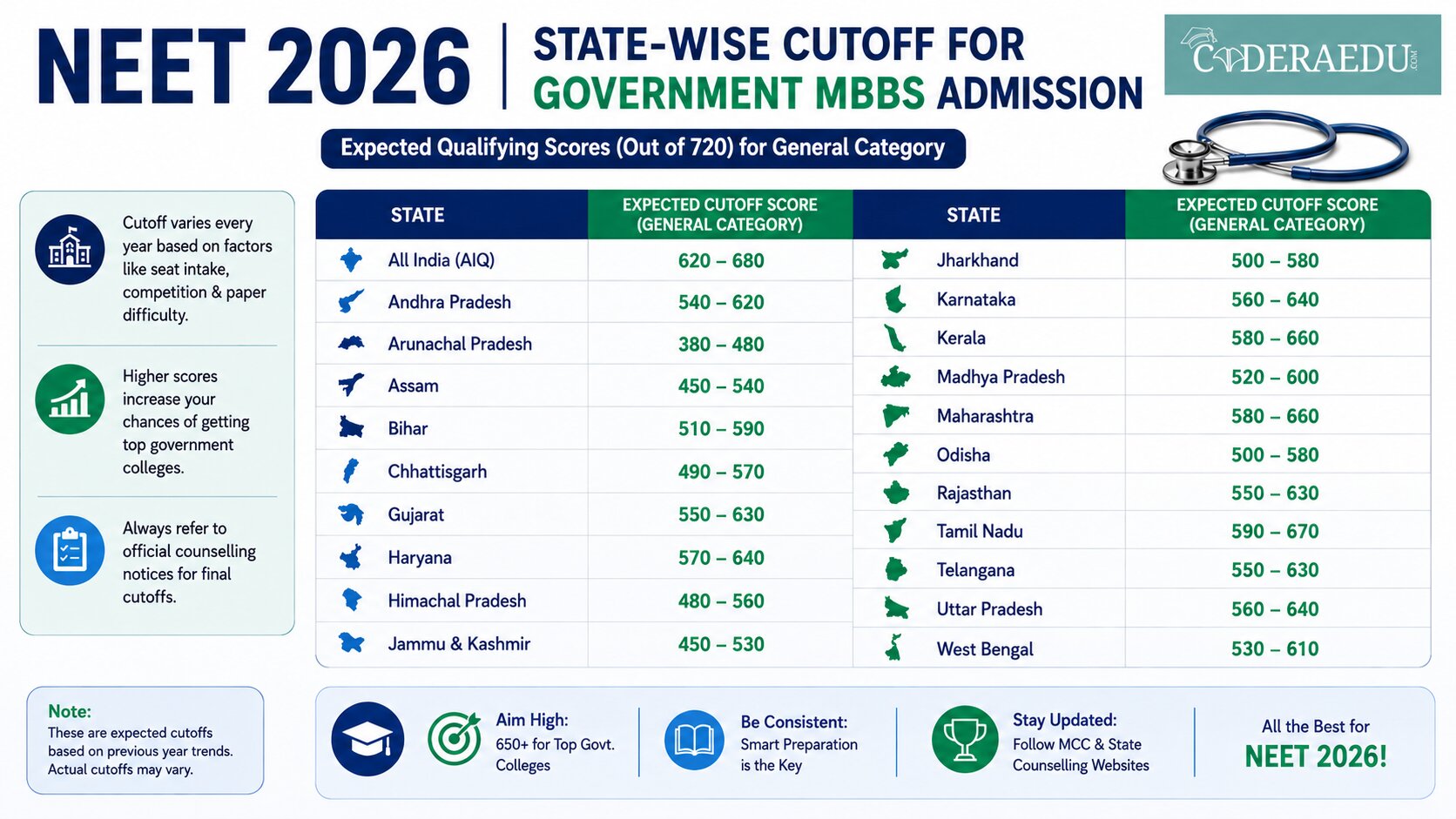
NEET 2026 Expected Cutoff, State-Wise Overview
Before you look at the table below, one honest disclaimer: these are illustrative, expected ranges built on past counselling trends, not official figures. NTA releases only the qualifying cutoff, and actual state quota closing ranks are published by each state's counselling authority after every round. Treat this as a directional guide, not gospel.
Table
| State | General Category (Expected Score/Rank Range) | OBC/SC/ST/EWS (Expected Range) |
|---|---|---|
| Delhi | 610-650 / Rank up to ~4,000 | 560-610 / Rank up to ~20,000 |
| Uttar Pradesh | 570-620 / Rank up to ~15,000 | 500-570 / Rank up to ~60,000 |
| Maharashtra | 580-630 / Rank up to ~12,000 | 510-580 / Rank up to ~50,000 |
| Tamil Nadu | 540-590 / Rank up to ~30,000 | 440-540 / Rank up to ~1,20,000 |
| Rajasthan | 560-610 / Rank up to ~18,000 | 480-560 / Rank up to ~70,000 |
| Bihar | 520-570 / Rank up to ~35,000 | 440-520 / Rank up to ~1,10,000 |
3 columns · 7 rows
Notice how Tamil Nadu's general category range sits lower than Delhi's, despite Tamil Nadu having a much larger number of MBBS seats. That's the seat-to-aspirant ratio doing its work, and it's a good example of why comparing your score against a friend from a different state rarely gives you a useful answer.
What Decides a State's Cutoff, So You Can Read the Table Correctly
If you want to actually use a table like the one above instead of just staring at it, you need to understand what's pushing those numbers up or down. Four factors do most of the work.
- Total number of MBBS seats the state has, government plus corporation-run colleges combined
- Number of domicile candidates competing that year, which fluctuates with state population and exam attempts
- Reservation percentage specific to that state, since OBC, SC, ST and EWS quotas aren't uniform nationally
- The 85:15 split between state quota and AIQ, and how many seats the state chooses to surrender to the central pool
A state with fewer seats but a huge aspirant base, think Uttar Pradesh or Bihar, tends to push its general category cutoff higher relative to its reserved category cutoffs, because competition within the open category is intense. A state with a large number of seats relative to its population, like Tamil Nadu, ends up with more breathing room even for moderate scorers.
Government MBBS vs Deemed or Private, Where Does Your Score Actually Place You?
Here's something that catches a lot of families off guard. The exact same NEET score can land you a government seat in one state and only a private or deemed seat in another. A 560 in Rajasthan's state quota might still get you a decent government college. The same 560 in Delhi's pool, competing against a much smaller number of seats and a flood of high scorers, might push you toward a deemed university instead, with fees running into lakhs per year rather than a few thousand. This is exactly why checking the NEET 2026 government MBBS cutoff by state, rather than relying on a single national figure, changes how realistic your planning is.
Before you finalise anything, it's worth running your score through the medical college predictor to see where you land across both government and private options, and comparing shortlisted colleges side by side using the college comparison tool before locking any choice.
Category-Wise Cutoff Expectations
Reservation doesn't apply as a flat discount. It stacks in a specific order within each state, and understanding that order helps you read cutoffs more accurately instead of just subtracting a fixed number from the general cutoff.
- General category candidates compete for open seats plus any unreserved seats vacated within reserved categories
- EWS candidates need an income and asset certificate specific to the counselling year, and cutoffs here usually sit closest to general
- OBC (non-creamy layer) cutoffs vary the most between states because OBC percentage itself isn't standardised nationally
- SC and ST candidates get the widest cutoff gap from general in most states, but the gap narrows in states with lower reservation percentages
- PwD candidates within each category get a further relaxation, but this comes with a mandatory disability certification process, so it's worth sorting that documentation early
If you're anxious about where exactly you fall within your category, that's completely normal, almost every aspirant goes through this exact confusion in the first week after results. The fix isn't guessing, it's checking your specific state's previous year category-wise closing ranks and adjusting for seat matrix changes this year.
State Quota vs All India Quota, Which Should You Prioritise With Your Score?
If your score comfortably clears your home state's general cutoff, state quota is usually the safer and cheaper route, since state government colleges typically charge a fraction of what AIQ seats in another state's institution might cost you in hostel and relocation expenses. AIQ makes more sense when your home state has very few seats relative to competition, in which case casting a wider net across the country through the all India quota college predictor gives you access to seats you'd never see in your own state's list. Most serious aspirants end up registering for both, and deciding round by round based on what's actually being allotted.
Common Misunderstandings About State Cutoffs
- Assuming last year's exact cutoff will repeat, when in reality it shifts every year with seat additions, paper difficulty and aspirant numbers
- Ignoring domicile and residency rules, which can disqualify an otherwise strong application from a state's quota entirely
- Confusing NEET score with NEET rank when comparing across states, since the same score can translate to very different ranks depending on that year's overall performance
- Treating deemed university cutoffs as equivalent to government cutoffs, when the two run on completely separate, non-comparable scales
This last one trips up a lot of students. A deemed college showing a 'closing score' of 480 doesn't mean government colleges are accessible at 480 too. Deemed institutions counsel separately and their cutoffs reflect a completely different applicant pool and fee structure.
How to Check Where You Stand
The most reliable way to move past guesswork is to run your actual score, category and home state through a predictor built specifically for state counselling. CaderaEdu's state-wise college predictor lets you check this properly instead of relying on forwarded screenshots. If you're from Delhi, the Delhi college predictor factors in that state's own seat matrix and past closing ranks. Students in Uttar Pradesh can use the UP college predictor, and Maharashtra aspirants have a dedicated Maharashtra college predictor for the same purpose.
While you're doing this groundwork, it also helps to get your paperwork ready early. The NEET counselling document checklist for 2026 is worth going through now rather than during the counselling rush, and if you appeared for the re-exam this cycle, you can cross-check your responses against the ReNEET 2026 answer key before result day. For candidates tracking the re-exam timeline itself, there's an update on the Re NEET UG 2026 result and final answer key release that's worth bookmarking.
It's also worth building a shortlist of consistently strong government institutions across states, so you're not choice-filling blind once counselling opens. Some of the government medical colleges worth keeping on your radar include:
- AIIMS Delhi
- AIIMS Patna
- AIIMS Guwahati
- Maulana Azad Medical College, New Delhi
- JIPMER, Puducherry
- University College of Medical Sciences & GTB Hospital, New Delhi
For a broader look beyond this shortlist, the list of top government medical colleges in India is a good next stop, organised in a way that's far easier to compare than scrolling through forums.
Bringing It Together
Chasing a single national cutoff number is a bit like packing for a trip without checking the weather at your actual destination. Your NEET 2026 state-wise cutoff picture depends on your home state, your category, the seat matrix that year, and whether you're leaning on state quota or AIQ. None of that is complicated once you break it down, it just needs a bit of patience instead of panic. Run your numbers through CaderaEdu's predictors, cross-check against real seat matrices as they're released, and build your choice list around facts rather than forwarded screenshots. That's genuinely the difference between an anxious counselling season and a controlled one.
Share this article
Copy
Frequently Asked Questions
What is a good NEET 2026 score for a government MBBS seat?
It depends entirely on your state and category. In seat-scarce states like Delhi or Maharashtra, general category candidates usually need scores above 600 for a comfortable shot, while states with a larger seat pool relative to population, like Tamil Nadu, can see government seats fill at somewhat lower scores. Always check state-specific ranges rather than a single national figure.
Is state quota cutoff lower than All India Quota cutoff?
Not always, it varies by state. States with fewer local aspirants and more seats often have a lower state quota cutoff than AIQ, while densely populated states with limited seats can see the opposite, where state quota cutoffs run higher than AIQ for the same college.
Can I apply for state quota in a state where I don't have domicile?
Generally no. State quota seats are reserved for candidates who meet that state's specific domicile or residency criteria, which usually includes schooling history or parental residence proof. A few states allow limited exceptions, so it's worth checking that state's official counselling brochure directly.
Why does the same NEET score get different colleges in different states?
Because each state runs its own counselling with its own seat matrix, reservation percentage and competing candidate pool. A score that comfortably secures a government seat in one state might only qualify for a private or deemed seat in another with tougher competition.
Will last year's NEET cutoff repeat exactly in 2026?
It's unlikely to repeat exactly. Cutoffs shift each year based on the difficulty of the paper, the number of aspirants, and any changes in seat availability or reservation policy. Use previous years as a directional reference, not an exact prediction.
Confused About College Admissions?
Get expert advice on college selection, admission chances, and career path in a personalized counselling session.
Book a Counselling Slot
Select Date
Pick a Slot