AIQ vs State Quota Explained: Step-by-Step Guide for NEET 2026

Click to enlarge
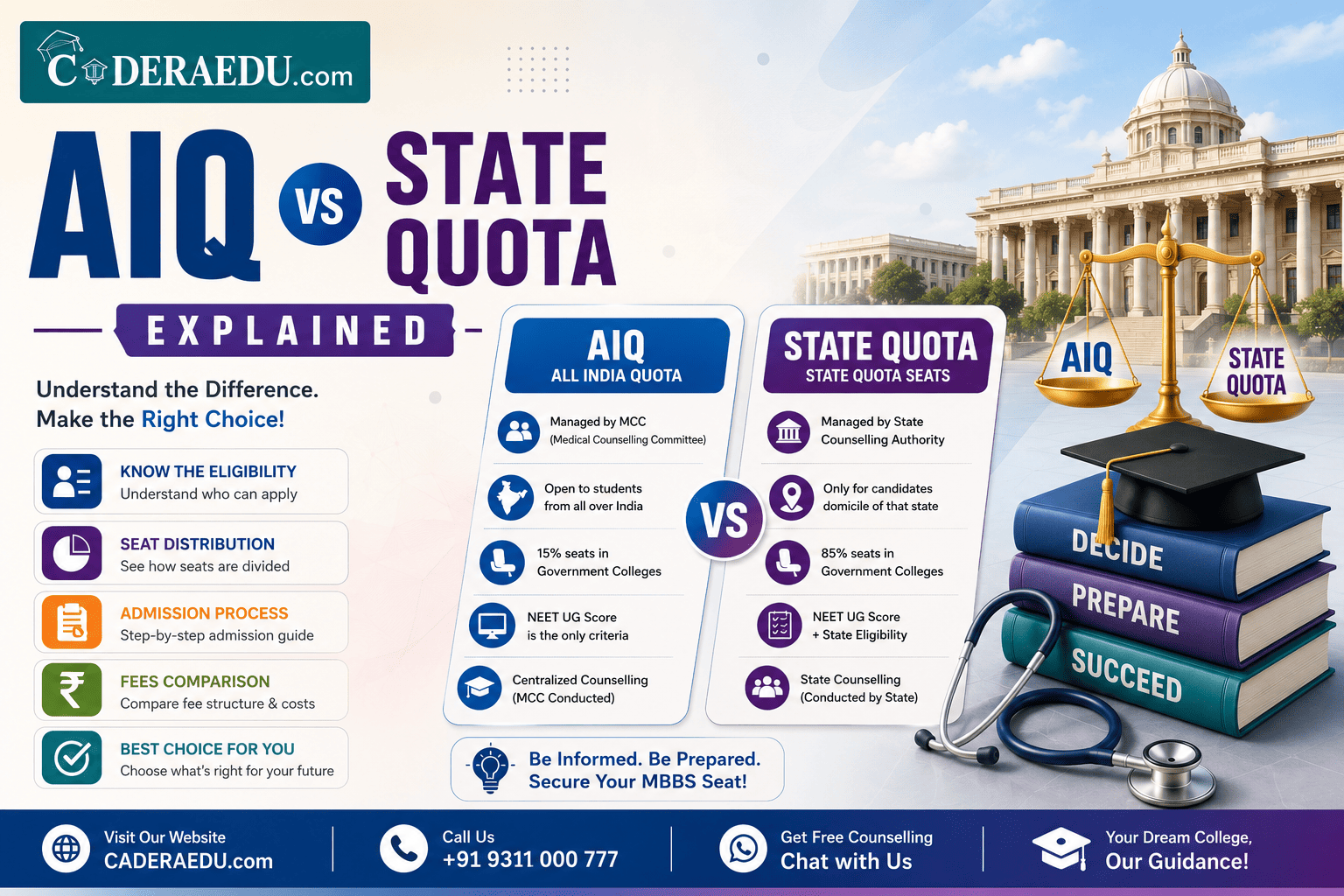
Of all the confusion that surrounds NEET counselling, none causes more last-minute panic than the AIQ vs State Quota question. Students see two different portals, two different deadlines, and two completely different sets of cutoffs for the same college — and many give up registering for one of them simply because they don't understand how the two actually fit together. This guide walks through exactly what AIQ and State Quota are, how they're structured, and the step-by-step sequence you need to follow to use both correctly instead of accidentally locking yourself out of seats you were genuinely eligible for. If you want to see where your own score lands across both tracks before reading further, the free NEET College Predictor gives you a personalised list in under two minutes.
What Is AIQ (All India Quota)?
All India Quota counselling is run centrally by the Medical Counselling Committee (MCC) under the Directorate General of Health Services, entirely online through mcc.nic.in. AIQ covers 15% of seats in every government medical college nationwide, plus 100% of seats at AIIMS, JIPMER, ESIC medical colleges, AFMC Pune, and every deemed university in the country. The defining feature of AIQ is that your All India Rank is the only thing that matters — there is no domicile requirement, no state preference, and no local advantage. A student from Kerala competes on equal footing with a student from Punjab for the same AIQ seat. This is also why AIQ tends to be where the highest scorers concentrate — top institutions like AIIMS New Delhi fill exclusively through this route.
What Is State Quota?
State Quota covers the remaining 85% of seats in every government medical college, and it is managed independently by each state's own counselling authority rather than a single national body. Unlike AIQ, eligibility here is restricted to candidates who can prove domicile in that state — meaning the competition pool shrinks dramatically compared to the 22+ lakh candidates competing nationally under AIQ. This is precisely why a college like Dr. Shankarrao Chavan Government Medical College, Nanded or ABVMGMC Rajnandgaon can have noticeably more accessible closing ranks under state quota than what the same college would require under AIQ.
State quota cutoffs run 50 to 80 marks lower than AIQ for the same college in most competitive states — and the gap widens considerably in smaller, less competitive states.
AIQ vs State Quota: Side-by-Side Comparison
Table
| Parameter | AIQ (All India Quota) | State Quota |
|---|---|---|
| Managed by | Medical Counselling Committee (MCC), mcc.nic.in | Individual state DME / health department portal |
| Seats covered | 15% of govt. college seats + 100% AIIMS/JIPMER/deemed | 85% of govt. medical college seats |
| Eligibility basis | All India Rank only | State domicile required (with limited exceptions) |
| Competition pool | 22+ lakh candidates nationwide | Restricted to candidates from that state only |
| Typical cutoff gap | Higher — most competitive seats land here | 50–80 marks lower than AIQ for the same tier of college |
| Category certificate format | Central government format mandatory | State-issued format generally accepted |
3 columns · 7 rows
Step-by-Step: How to Use Both Quotas Correctly
Understanding the difference between AIQ and State Quota is only useful once you know how to act on it in the right sequence. Here is the process, step by step, exactly as it plays out during NEET counselling.
Step 1: Register on mcc.nic.in for AIQ
Create your MCC login and pay the prescribed registration fee — typically ₹1,000 for government seats and ₹5,000 for deemed university seats. Do this regardless of how confident you are about your state quota chances, since skipping AIQ registration permanently removes access to AIIMS, JIPMER, and every deemed university seat in the country.
Step 2: Register on Your State's Counselling Portal — Simultaneously
This is the step most students get wrong — they wait for AIQ results before registering for state quota, and lose precious time in the process. Both tracks run in parallel with independent deadlines, so register for your home state immediately after AIQ, not after. The exact portal, fee, and document set differ by state, as seen on individual college admission pages such as Naraina Medical College, Kanpur for Uttar Pradesh, or GMC Jagdalpur for Chhattisgarh.
Step 3: Prepare Category Certificates in the Correct Format
This single detail catches more students off guard than almost anything else in the entire process. OBC, SC, ST, and EWS candidates need a central government format certificate specifically for AIQ counselling — a state-issued OBC certificate, even if valid for state purposes, will be rejected by MCC. Get both formats ready well in advance rather than discovering the mismatch during document verification.
Step 4: Fill Choices Separately for Each Track
Your AIQ choice list and your state quota choice list are entirely independent of each other. Build each one based on previous closing ranks specific to that track — a college's AIQ closing rank and its state quota closing rank can differ by tens of thousands of ranks, so don't assume one tells you anything reliable about the other. Cross-reference individual college cutoff histories, such as those published for Krishna Institute of Medical Sciences, Karad, before locking either list.
Step 5: Track Allotment Results on Both Portals
When results are out, check both the MCC portal and your state portal — you may be allotted seats on both simultaneously. If that happens, compare the two carefully on college reputation, location, infrastructure, and fee structure before deciding which one to accept. You can only join one seat, and holding both past the resignation window carries financial penalties.
Step 6: Understand Freeze, Float, and Slide Before You Respond
Each round gives you the option to freeze (accept and exit), float (keep the seat while staying open to an upgrade), or slide (stay within the same quota for a better option). Choosing the wrong response can cost you a confirmed seat, so understand these options properly rather than clicking through quickly. The complete round-by-round counselling sequence, including how this fits into the bigger picture, is covered in the NEET UG Counselling 2026 complete guide.
- AIQ and State Quota both require separate registration, separate fees, and separate choice lists
- Your category certificate format must match what each counselling body specifically accepts
- State quota closing ranks are almost always more accessible than AIQ for the same college
- Deemed universities, like the ones covered under AIQ, do not apply reservation policy — every candidate competes on open merit
- Mop-up and stray vacancy rounds exist under both tracks and frequently fill seats that didn't close in earlier rounds
- Holding seats under both tracks past the resignation deadline can result in financial penalties or disqualification
Where Your Score Fits: AIQ vs State Quota by Score Range
Once you understand the mechanics, the next question is practical: where does your own score actually place you? Scores of 600 and above tend to find strong options through AIQ at top government colleges and AIIMS campuses, while the 500–599 range is where state quota becomes the more reliable route, particularly in your own home state. Scores between 400 and 599 typically shift the conversation toward private and deemed colleges through the AIQ deemed route, while anything below that range is better served by exploring BDS or AYUSH alternatives. This breakdown, along with category-specific nuances for OBC, SC, ST, and EWS candidates, is laid out fully in the NEET 2026 Expected Cutoff Category Wise guide and the NEET 2026 Expected Cutoff guide.
It's also worth checking how this plays out specifically in your home state, since seat-sharing percentages and competition levels vary meaningfully across India. The NEET 2026 state-wise cutoff breakdown covers major states including Uttar Pradesh, Maharashtra, Rajasthan, Uttarakhand, and Haryana in detail, and pairs well with the NEET Marks vs Rank 2026 guide and the NEET 2026 Score vs Rank Analysis for translating your exact marks into a realistic rank range.
If Government Seats Don't Work Out at Either Level
Not every student secures a government seat through AIQ or state quota, and that's where understanding the private and deemed landscape becomes important. Comparing options through the Top Private Medical Colleges in India directory, or browsing the complete MBBS colleges list by course, helps you build a realistic backup plan well before counselling rounds begin rather than scrambling once results disappoint. If MBBS itself stays out of reach at your score, the Top BDS Colleges in India 2026 guide is genuinely worth comparing as a serious alternative, not a fallback.
Share this article
Copy
Frequently Asked Questions
What percentage of government MBBS seats fall under AIQ versus State Quota?
All India Quota covers 15% of seats in every government medical college, along with 100% of seats at AIIMS, JIPMER, and deemed universities. The remaining 85% of government college seats fall under State Quota, managed independently by each state.
Can I get a government MBBS seat through AIQ without being from that state?
Yes. AIQ has no domicile requirement at all — your All India Rank is the only criterion, so a candidate from any state can compete for and secure an AIQ seat anywhere in the country, including AIIMS and JIPMER campuses.
Why is the State Quota cutoff usually lower than AIQ for the same college?
Because State Quota competition is restricted to candidates with domicile in that specific state, while AIQ draws from the entire national pool of 22+ lakh NEET candidates. The smaller, restricted pool under State Quota naturally results in more accessible closing ranks.
Do deemed universities follow reservation policy under AIQ?
No. Deemed universities fill every seat on open merit under MCC's AIQ counselling, without applying SC, ST, OBC, or EWS reservation. Every candidate, regardless of category, competes on the same cutoff at these institutions.
Is it compulsory to register for both AIQ and State Quota?
It is not legally compulsory, but it is strongly recommended. Registering for only one track significantly limits your options, since the two run in parallel with no penalty for registering in both simultaneously.
Confused About College Admissions?
Get expert advice on college selection, admission chances, and career path in a personalized counselling session.
Book a Counselling Slot
Select Date
Pick a Slot