NEET Counselling 2026 Step-by-Step Guide: Registration to Admission

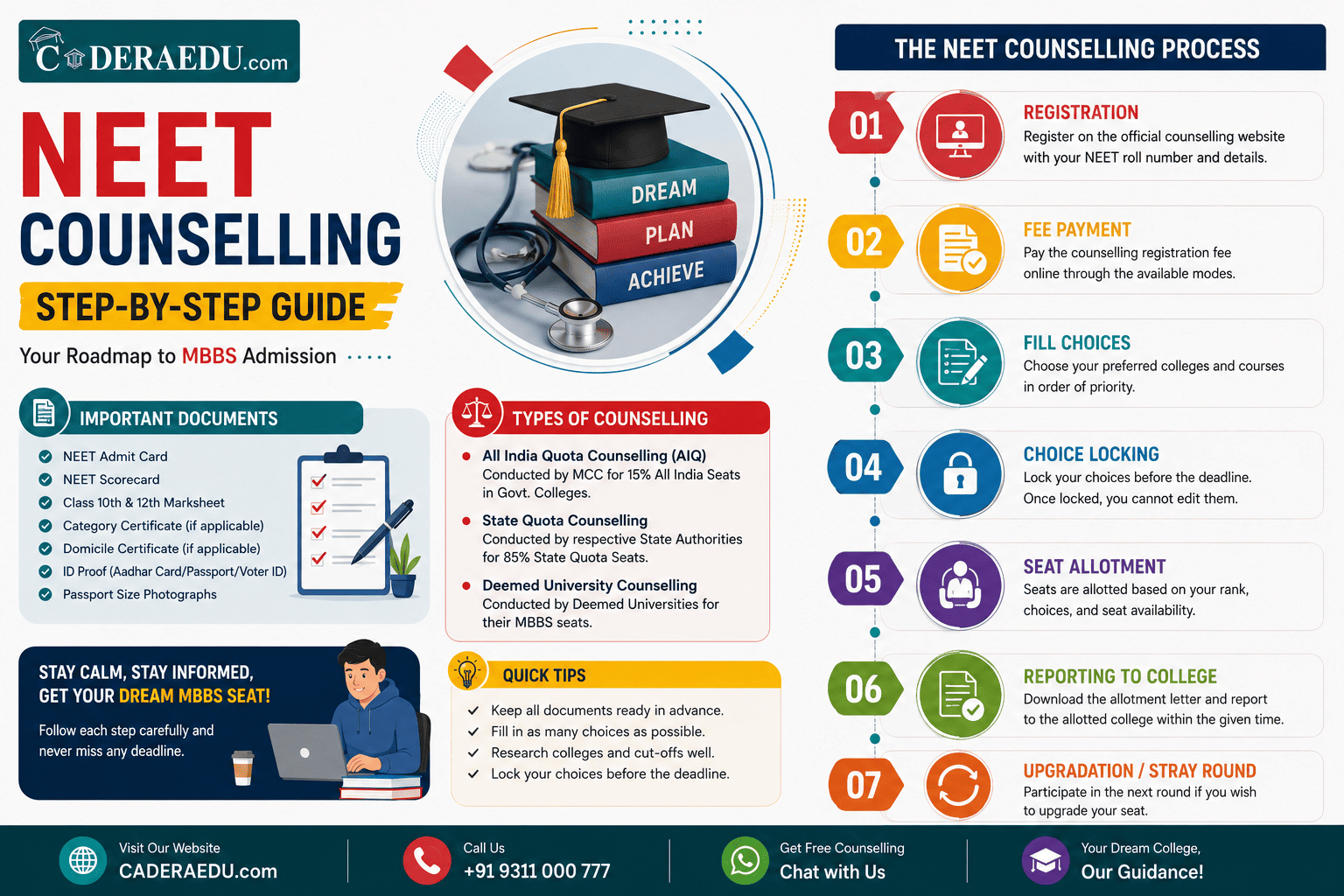
Click to enlarge
Clearing NEET is only half the journey. The other half — and the part that decides which college you actually walk into — is counselling. Every year, thousands of students with perfectly good scores end up with a seat that doesn't match their potential, simply because they misunderstood a deadline, skipped a round, or filled their choice list the wrong way. This guide walks you through NEET UG counselling 2026 exactly as it happens, step by step, so there are no surprises between your result day and your first day at medical college. If you'd rather start with a personalised estimate of where you stand before diving into the process, run your score through the free NEET College Predictor first — it takes under two minutes and gives you a realistic shortlist across both AIQ and state quota.
Understanding the Two Tracks: AIQ and State Quota
Before you register anywhere, it's worth understanding that NEET counselling doesn't run as one single process. It splits into two parallel tracks that you need to register for separately. The Medical Counselling Committee (MCC) manages the All India Quota — 15% of every government college's seats, plus 100% of AIIMS, JIPMER, ESIC, AFMC, and deemed university seats — entirely on the basis of your All India Rank, with no domicile preference involved. The remaining 85% of government seats fall under State Quota, managed independently by each state's own counselling authority, and restricted to candidates with domicile in that state. The complete mechanics of how these two interact, including how cutoffs differ between them, are explained in detail in the AIQ vs State Quota in NEET Counselling 2026 guide.
Registering for both AIQ and state quota simultaneously isn't optional strategy — it's the single biggest factor that separates students who get strong seats from those who lose time waiting on one track.
Step 1: Check Your Result and Run a Rank-Based Reality Check
The moment your NEET result is declared, your first move should not be choice filling — it should be understanding what your score actually translates to in terms of rank and realistic seats. Many students confuse marks with rank, not realising that the same score can land very differently depending on how the rest of the 22+ lakh candidates performed that year. The NEET Marks vs Rank 2026 guide and the NEET 2026 Score vs Rank Analysis both break this relationship down clearly, while the category-specific expectations — General, OBC, SC, ST, and EWS — are covered separately in the NEET 2026 Expected Cutoff Category Wise guide.
Step 2: Register for MCC (AIQ) Counselling
Registration for the All India Quota happens entirely online at mcc.nic.in. You create your login, pay the prescribed registration fee, and your candidature becomes active for AIQ rounds. This step has to be completed regardless of whether you eventually plan to rely on your home state for a seat, because skipping AIQ registration means permanently forfeiting access to AIIMS, JIPMER, and every deemed university seat in the country.
Step 3: Register for Your State Quota Counselling
Simultaneously — not afterward — register on your own state's counselling portal. Each state runs its own authority with its own timeline, fee structure, and document requirements, so it pays to check this early rather than scrambling near the deadline. A few real examples illustrate how different these state processes can be: Madhya Pradesh routes registration through the DME MP portal as shown on the Atal Bihari Vajpayee Government Medical College, Vidisha admissions page, while Chhattisgarh candidates register through dme.cgstate.gov.in, as detailed on the GMC Jagdalpur page. In Uttar Pradesh, the process runs through the UPDGME portal, illustrated on the Naraina Medical College, Kanpur admissions section.
Step 4: Document Verification
Once registered, your uploaded documents go through online verification before you're allowed into choice filling. This stage trips up far more students than it should — usually because of low-resolution scans, mismatched category certificates, or outdated formats. While the document checklist differs slightly state to state, the underlying logic stays the same across counselling bodies, including engineering counselling systems like the one detailed in the UPTAC 2026 documents checklist, which mirrors the same verification pattern NEET candidates go through.
- NEET UG scorecard and admit card — the primary entry document for both AIQ and state quota
- Class 10 and Class 12 marksheets and certificates, along with your school leaving certificate
- Category certificate (OBC/SC/ST/EWS) — must be in central government format specifically for AIQ; state-issued formats are not accepted by MCC
- Domicile or residence certificate — mandatory if you want state quota priority over outside-state candidates
- PwD certificate, where applicable, issued by a government hospital's medical board
- Passport-size photographs and signature, scanned to the exact specifications listed on the relevant portal
Step 5: Choice Filling — The Step Most Students Get Wrong
Choice filling is where strategy actually matters. The two most common mistakes are filling too few choices out of overconfidence, or filling colleges far outside realistic reach out of hope. Both approaches reduce your odds of a good allotment. The right approach is to build a three-tier list — a handful of ambitious choices, a solid block of realistic options based on last year's closing ranks, and a few safety choices you'd be comfortable accepting. Cross-check every college against its previous closing rank trend before locking your list; individual college cutoff histories, like those for Krishna Institute of Medical Sciences, Karad, are publicly available and worth reviewing college by college rather than relying on memory.
Table
| Counselling Stage | AIQ (MCC) | State Quota |
|---|---|---|
| Managed by | Medical Counselling Committee, mcc.nic.in | State DME / Health Department portal |
| Seats covered | 15% govt. seats + 100% AIIMS/JIPMER/deemed | 85% of government college seats |
| Eligibility basis | All India Rank only, no domicile needed | State domicile required (with exceptions) |
| Rounds | Round 1, Round 2, Mop-Up, Stray Vacancy | Varies by state; usually 2–3 rounds plus Mop-Up |
| Registration fee (typical) | ₹1,000 (govt.), ₹5,000 (deemed) | Varies by state, often ₹1,000–₹2,000 |
3 columns · 6 rows
Step 6: Seat Allotment — Freeze, Float, and Slide
When results are declared for each round, you'll typically be given three response options: freeze (accept this seat and exit counselling), float (keep this seat but stay eligible for an upgrade in later rounds), or slide (stay within the same quota for a better choice, without competing for a new quota). Understanding which option suits your situation matters — locking the wrong one can cost you both your current seat and a better one. The complete round-by-round breakdown, including how this plays out at the engineering counselling level too, is explained step by step in the UPTAC 2026 registration guide, which follows a comparable freeze-float-slide framework.
Step 7: Reporting and Final Admission
Getting a seat allotted is not the same as securing it. You must physically report to the allotted college (or in some cases a designated facilitation centre) within the stipulated window, carrying every original document along with self-attested photocopies. At this stage, colleges complete a final round of in-person document verification before confirming admission — a process visible on individual college pages such as Naraina Medical College, Kanpur, where the institution explicitly lists security deposit payment and certificate submission as the final reporting steps. Missing this window, even with a confirmed allotment, results in automatic forfeiture of the seat.
Mistakes That Cost Students Real Seats Every Year
- Registering for only one track (AIQ or state) instead of both, and losing time waiting on results from the other
- Filling a choice list of fewer than 15–20 colleges, which sharply narrows allotment chances
- Giving up after Round 2 and ignoring Mop-Up or Stray Vacancy rounds, where real seats consistently open up
- Submitting a state-format OBC certificate for AIQ counselling, where only the central government format is accepted
- Not verifying a college's current NMC approval status before locking it into the choice list
- Delaying document re-upload after a rejection notice, missing the correction window entirely
Planning Beyond MBBS: Why the Process Matters Long-Term
The discipline you build during NEET UG counselling — registering early, tracking deadlines, verifying documents twice — carries forward directly into NEET PG counselling years later, where the same AIQ-state split applies, just with a 50% AIQ share instead of 15%. For students still deciding between MBBS, BDS, or AYUSH alternatives depending on where their rank lands, the Top BDS Colleges in India 2026 guide and the wider NEET 2026 state-wise cutoff breakdown are worth reading before your choice list goes final. And if private colleges end up part of your realistic shortlist, comparing them properly through the Top Private Medical Colleges in India directory or the full MBBS colleges by course listing prevents last-minute panic decisions during the actual round.
If at any stage the volume of dates, portals, and document formats feels overwhelming, you're not alone — this is exactly the kind of process where a second pair of eyes catches the mistake before it becomes irreversible. CaderaEdu's free 1-on-1 counselling support exists for precisely this reason, and pairing expert guidance with the NEET College Predictor gives you both the data and the judgement to navigate counselling with confidence rather than guesswork.
Share this article
Copy
Frequently Asked Questions
Can I register for both AIQ and state quota counselling at the same time?
Yes, and you should. The two tracks run in parallel through separate portals, and registering for only one significantly limits your options. There is no rule preventing simultaneous registration, and most successful candidates do exactly this.
What happens if I miss the document verification deadline?
Missing the verification deadline locks you out of choice filling for that counselling cycle entirely. There is usually no extension, so it's important to upload documents well before the stated close date rather than the last day.
How many colleges should I include in my choice list?
There is no fixed number, but limiting yourself to fewer than 15–20 choices significantly reduces your allotment chances. A well-structured list typically includes ambitious, realistic, and safety options across both AIQ and state quota.
What is the difference between freeze, float, and slide in seat allotment?
Freeze means accepting the allotted seat and exiting counselling. Float means keeping the current seat while remaining eligible for an upgrade in a later round within the same or another quota. Slide means staying within the same quota while remaining open to a better choice in upcoming rounds.
Do mop-up and stray vacancy rounds matter if I didn't get a seat in Round 1 or Round 2?
Yes, significantly. Genuine seats open up in these later rounds, often at colleges that didn't fill completely earlier. Skipping these rounds after an early disappointment is one of the most common and avoidable reasons students lose a seat they could have secured.
Confused About College Admissions?
Get expert advice on college selection, admission chances, and career path in a personalized counselling session.
Book a Counselling Slot
Select Date
Pick a Slot