MBBS Fees in India 2026: Government vs Private Colleges Compared

Manisha Updated on 02 Oct 2026, 05:01 PM IST
5 minutes read
Click to enlarge
Every year, lakhs of NEET aspirants face the same dilemma once results are out: should they wait it out for a government MBBS seat, or settle for a private college within reach of their score? The honest answer depends entirely on the fee gap between the two — and that gap is far wider than most students expect. This guide lays out exactly what MBBS costs at government versus private colleges in India for 2026, with real figures drawn from individual college fee structures, so you can plan your counselling strategy with clear numbers instead of guesswork. If you want a personalised starting point before reading further, the free NEET College Predictor maps your score to realistic college options across both categories.
Government MBBS Fees: What You Actually Pay
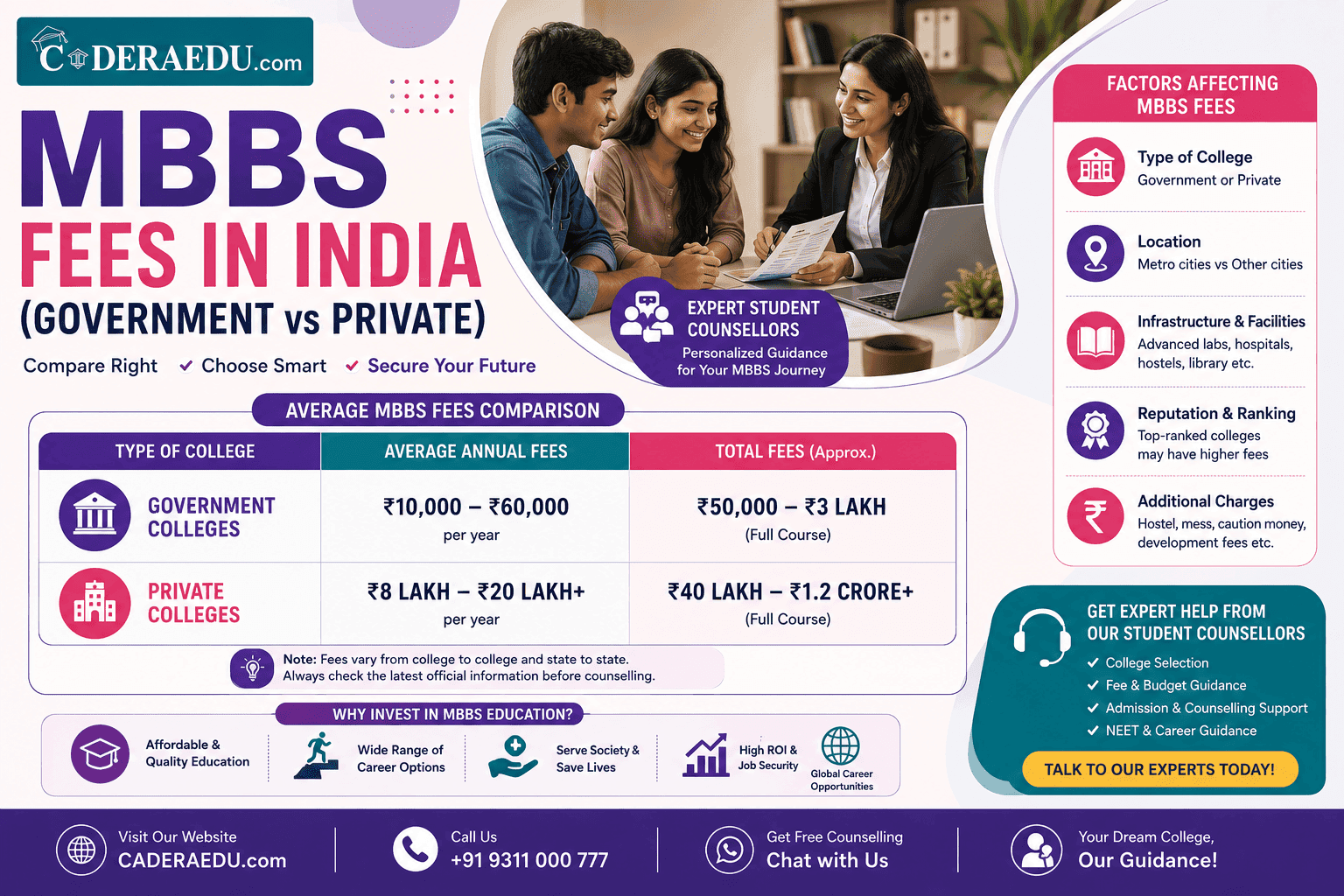
Government medical colleges in India remain heavily subsidised, and the difference shows up clearly when you compare individual college fee pages. At Seth GS Medical College & KEM Hospital, Mumbai, the full 5.5-year MBBS course costs roughly ₹5.7–7.9 lakh, with reserved-category students often eligible for a near-complete fee waiver. A similarly modest fee structure applies at Dr. Shankarrao Chavan Government Medical College, Nanded, and at the newer Government Medical College, Nashik (MPGIMER), where the total course fee comes to approximately ₹4.7 lakh for the full programme.
Even in smaller, newer state government colleges, the pattern repeats. ABVMGMC Rajnandgaon in Chhattisgarh keeps its total course fee in the ₹2.1–2.25 lakh range — confirming that government MBBS, regardless of state, stays affordable for the vast majority of students who clear state quota or AIQ counselling.
A complete 5.5-year MBBS at a top government college can cost less than a single year's tuition at most private medical colleges.
Private MBBS Fees: A Much Wider — and Steeper — Range
Private medical colleges price seats very differently depending on the quota type — and this is where students most often underestimate the real cost. At Teerthanker Mahaveer Medical College & Research Centre, Moradabad, the annual tuition fee alone is around ₹16.2 lakh, taking the full course cost close to ₹73 lakh. At Gian Sagar Medical College & Hospital, Patiala, the same MBBS degree can cost anywhere from ₹25 lakh under government quota to nearly ₹1.9 crore under NRI quota — a striking illustration of how much quota selection changes the final bill.
Government vs Private MBBS Fees — Side-by-Side Comparison
Table
| Parameter | Government MBBS | Private MBBS |
|---|---|---|
| Total course fee (5–5.5 yrs) | ₹2 lakh – ₹8 lakh (approx.) | ₹25 lakh – ₹2 crore (varies by quota) |
| Annual tuition | ₹40,000 – ₹1.6 lakh | ₹10 lakh – ₹25 lakh+ |
| Hostel charges | ₹3,000 – ₹4,000/month | Often bundled, but can add ₹1–2 lakh/year |
| Reserved category fee relief | Often near-zero tuition under domicile schemes | Rarely applicable; deemed universities skip reservation entirely |
| Funding route | Subsidised by state/central government | Self-financed, loans, or NRI/management quota |
3 columns · 6 rows
Why the Fee Gap Is So Large
- Government colleges receive direct state or central funding, which keeps tuition artificially low for students
- Private colleges operate on self-financing models, so infrastructure and faculty costs are passed directly to students
- Quota type changes the bill dramatically — government quota seats at a private college can cost a fraction of management or NRI quota seats at the same institution
- Reserved category waivers are common at government colleges but largely absent at deemed universities, which fill seats purely on open merit
- Private deemed university fees for AIQ-allotted seats often run between ₹15 lakh and ₹25 lakh per year, as detailed in the NEET 2026 category-wise cutoff guide
Does Your NEET Score Decide Which Route You Get?
Yes, almost entirely. Government MBBS seats through AIQ typically require 580–620+ marks for General category, as outlined in the NEET 2026 expected cutoff guide, while state quota seats — covering 85% of all government MBBS seats — can be considerably more accessible depending on your home state, a distinction explained in detail in the AIQ vs State Quota guide. Students scoring between 400 and 600 marks tend to land in the private college range, where the NEET 2026 score vs rank analysis and the NEET marks vs rank guide are useful for mapping a realistic college shortlist before counselling begins.
It's also worth understanding the state-by-state picture, since fee structures and seat-sharing percentages vary meaningfully across India. The NEET 2026 state-wise cutoff breakdown covers this for major states including Uttar Pradesh, Maharashtra, Rajasthan, Uttarakhand, and Haryana — each with a noticeably different government-to-private fee ratio.
How to Decide: Government Wait vs Private Commitment
This is ultimately a financial planning decision as much as an academic one. If your rank gives you a realistic shot at a government seat — even through later counselling rounds like Mop-Up or Stray Vacancy, explained in the NEET UG Counselling 2026 complete guide — it is almost always worth waiting. If government seats are clearly out of reach, comparing private colleges by fee and reputation through the Top Private Medical Colleges in India directory, or browsing the complete MBBS colleges list by course, helps avoid overpaying for a seat that doesn't match your long-term budget.
If MBBS fees remain out of reach altogether, it's worth seriously evaluating BDS as a financially lighter alternative — the Top BDS Colleges in India 2026 guide shows total course costs that are typically a fraction of even mid-tier private MBBS programmes.
Share this article
Copy
Frequently Asked Questions
What is the average total MBBS fee at a government college in India?
Most government medical colleges in India charge between ₹2 lakh and ₹8 lakh for the complete 5.5-year MBBS course, including tuition and hostel charges, depending on the state and college.
Why are private MBBS fees so much higher than government fees?
Private medical colleges are self-financed and do not receive government subsidies, so the full cost of infrastructure, faculty, and hospital facilities is recovered through student fees. The exact amount also depends heavily on the quota — government quota, management quota, or NRI quota — within the same private college.
Are scholarships available for MBBS at government colleges?
Yes. Many state governments offer full or partial fee waivers for SC, ST, OBC, and EWS candidates through schemes like the Maharashtra Mahadbt portal, often bringing effective tuition close to zero for eligible students.
Is it worth paying private MBBS fees if I can get a government seat through state quota?
In most cases, no — a government seat, even at a less prestigious college, usually offers a significantly better cost-to-degree-value ratio than a private seat, since the MBBS degree itself carries equal recognition once awarded by an NMC-approved institution.