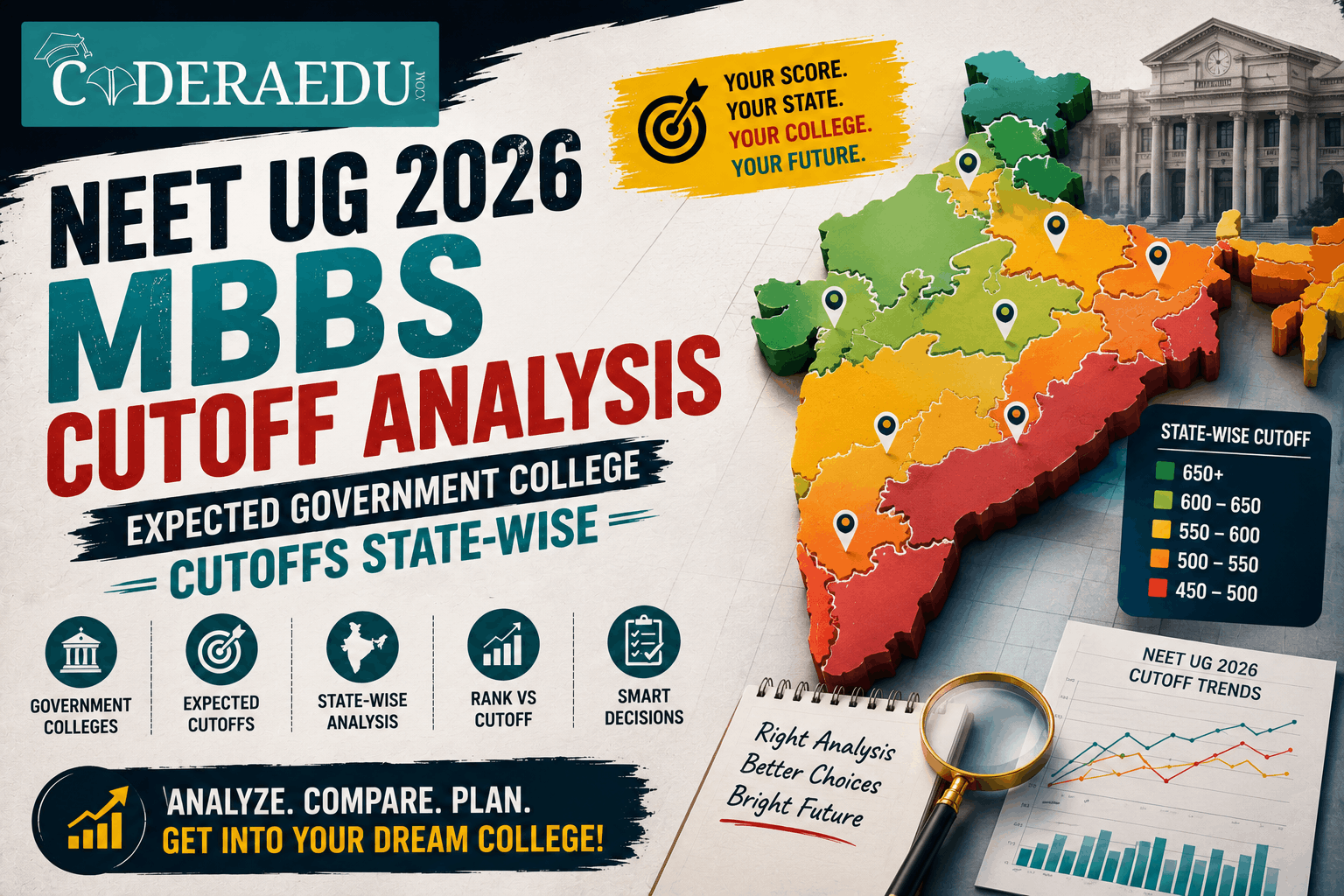
NEET UG 2026 MBBS Cutoff Analysis: Expected Government College Cutoffs State-wise

Click to enlarge
With the Re-NEET UG 2026 result declared on 16 July 2026, attention now shifts to what marks will actually translate to a government MBBS seat this year, and this varies enormously by state. This analysis walks through expected government college cutoff patterns state by state, built from 2025 closing rank data and this year's confirmed qualifying cutoff, while being clear about what is confirmed versus what remains an informed estimate until actual counselling results are declared. For a personalised estimate based on your own rank, use the NEET UG College Predictor.
What Changed This Year: Qualifying Cutoff
Before looking at state patterns, it helps to understand this year's starting point. This year's qualifying cutoff, released alongside the result, moved up noticeably compared to 2025, reflecting how the Re-NEET paper was assessed by candidates and coaching analysts.
Table
| Category | NEET UG 2026 Qualifying Cutoff | NEET UG 2025 Qualifying Cutoff (For Comparison) |
|---|---|---|
| General / EWS | 715 to 213 marks (50th percentile) | 686 to 144 marks |
| OBC / SC / ST | 212 to 177 marks (40th percentile) | 143 to 113 marks |
3 columns · 3 rows
This qualifying cutoff is only the eligibility threshold for counselling, not remotely close to what is needed for a government college seat. It is included here because it sets the baseline for understanding why comparing raw marks across years without adjusting for difficulty can be misleading. Rank, not marks, is the more reliable number to plan around.
Important Note on This Year's Admission Cutoff Data
Actual government college admission cutoffs for 2026, meaning the closing rank at each specific college, will only be known once MCC and state counselling rounds are conducted and results are declared, expected to begin shortly after this year's result. Until then, the most reliable approach is to study 2025's actual closing ranks as a reference range, adjusted for this year's higher overall qualifying marks and the increased total seat count, both of which can shift the picture in either direction depending on candidate volume.
Treat last year's closing ranks as a reference range to plan around, not as this year's confirmed cutoff, since candidate numbers, seat matrix and paper difficulty all shift the actual figure every cycle.
AIQ Government College Cutoff: 2025 Reference Data
All India Quota cutoffs apply nationally and are not tied to any particular state, making them a useful fixed reference point before looking at state-specific patterns.
Table
| Category | 2025 AIQ Closing Rank for Last Available Government MBBS Seat (Reference) |
|---|---|
| General | Around AIR 26,178 |
| OBC | Around AIR 26,231 |
2 columns · 3 rows
These figures represent the closing rank for the last government seat filled under AIQ in 2025, not the cutoff for any specific top college. Individual colleges close at vastly different ranks within this pool, AIIMS New Delhi closing under AIR 50 while a newer, less sought-after government college in the AIQ pool can close closer to this overall boundary figure.
State Quota Cutoffs Are Generally Lower Than AIQ
This is the single most important pattern to understand before reading state-wise figures. Because state quota competition is limited to candidates holding domicile in that specific state, closing ranks under state quota are almost always higher, numerically, meaning more accessible, than AIQ closing ranks for a comparable college. A rank that would not reach an AIQ government seat can very often reach the same tier of college through state quota in the candidate's home state.
Uttar Pradesh: 2026 Expected Pattern
Uttar Pradesh has one of the largest state seat pools nationally, contributing to a wide accessible rank range. Based on 2025 trends, General category state quota cutoffs for government colleges are expected in the region of AIR 15,000 to 32,000, with top institutions like King George's Medical University and Ram Manohar Lohia Institute closing considerably earlier, often under AIR 8,000. Newer Autonomous State Medical Colleges tend to close later within this range, offering more accessible options for mid-range ranks. A college such as Mahatma Vidur Autonomous State Medical College, Bijnor represents this newer tier of UP government colleges.
Maharashtra: 2026 Expected Pattern
Maharashtra runs a well-established state quota system alongside a strong AIQ presence, with government colleges spread across both major cities and smaller districts. Historically, top Maharashtra government colleges close at competitive ranks under state quota, while newer district colleges offer meaningfully more accessible options. A college like Grant Medical College, Mumbai represents the more competitive end of Maharashtra's government college tier, given its metro location and established reputation.
Bihar: 2026 Expected Pattern
Bihar has historically had a smaller government college count relative to its candidate population, which tends to push state quota closing ranks higher for General category compared to some other large states, though this also means genuine opportunities exist for candidates willing to look beyond the most well-known institutions. A government college such as Bhagwan Mahavir Institute of Medical Sciences, Pawapuri, established in 2013, closed around AIR 5,843 in Round 1 and roughly AIR 14,778 by the final round for General AIQ candidates in 2024, illustrating how closing ranks shift meaningfully across rounds at the same institution.
Chhattisgarh: 2026 Expected Pattern
Chhattisgarh has a comparatively smaller state candidate pool, which can translate into more accessible state quota closing ranks at several of its government colleges relative to larger states, even though the state has fewer colleges overall. A college such as Late Baliram Kashyap Memorial Government Medical College, Jagdalpur is a useful example of a government college in this category worth including on a state quota list for domicile candidates.
Maharashtra and Newer Colleges: A Closer Look
Maharashtra continues to add government medical colleges at the district level, and these new additions typically start with more accessible closing ranks in their early counselling years. A recently established institution like Government Medical College, Buldhana, which began its first academic session in 2024-25, had no prior-year cutoff data to reference in its first cycle, and colleges in this position are generally worth watching closely as a lower-competition entry point for domicile candidates.
Tamil Nadu: 2026 Expected Pattern
Tamil Nadu offers one of the largest state seat pools in the country, with over 11,000 MBBS seats spread across a mix of long-established and newer government colleges. Competition for the state's top government colleges remains intense, and General category candidates have historically needed scores in the 715 to 725 range to secure the very top institutions through state quota, while a wider range of colleges become accessible further down the closing rank spread. State quota counselling in Tamil Nadu is managed by the Directorate of Medical Education, separate from MCC's AIQ process.
Karnataka: 2026 Expected Pattern
Karnataka currently holds the largest total MBBS seat count of any state nationally for 2026, which generally translates into a wider realistic rank range for domicile candidates through state quota compared to states with a tighter seat-to-candidate ratio. The state's mix of long-established government medical colleges in Bengaluru and newer district-level institutions means both highly competitive and comparatively accessible options exist within the same state counselling process.
Rajasthan: 2026 Expected Pattern
Rajasthan has a strong track record of NEET performance, having produced the 2025 topper, and its state quota government college cutoffs have historically sat in a moderately competitive range, generally more accessible than Delhi or Maharashtra but tighter than some smaller states. Rajasthan's qualification rate among NEET aspirants has consistently been among the highest nationally, which can mean somewhat more competition within the state quota pool relative to its total seat count.
Reading Cutoff Trends Round by Round
A single closing rank figure for a college often hides significant movement across rounds within the same counselling year. Round 1 typically has the tightest closing ranks since the full seat pool and candidate interest are both at their peak. By Round 2 and especially Mop-Up, closing ranks for many colleges shift outward as higher-ranked candidates who were allotted elsewhere withdraw from that particular seat.
Table
| Round | Typical Cutoff Behaviour |
|---|---|
| Round 1 | Tightest closing ranks, especially for well-known government colleges and metro locations |
| Round 2 | Some outward movement as candidates from Round 1 upgrade or confirm seats elsewhere |
| Mop-Up Round | Often the most significant shift outward, as the remaining candidate pool thins considerably |
| Stray Vacancy Round | Can vary widely, sometimes offering the most accessible entry point of the entire cycle for remaining seats |
2 columns · 5 rows
This pattern is a strong argument against writing off a college purely based on its Round 1 closing rank from a previous year. A candidate whose rank falls short of a college's Round 1 figure may still have a realistic shot at the same college in Mop-Up or Stray Vacancy, provided they remain registered and active through every round rather than dropping out after an early disappointment.
Reserved category candidates should expect a substantial gap between General and category-specific closing ranks within the same state, often spanning tens of thousands of ranks for the same college. This gap tends to be largest for ST and SC categories, moderate for OBC, and smallest for EWS relative to General.
Table
| Category | Typical Cutoff Pattern Relative to General (State Quota, Illustrative) |
|---|---|
| EWS | Modestly higher accessible rank than General for the same college |
| OBC | Noticeably higher accessible rank, often extending the reach by tens of thousands of ranks |
| SC | Substantially higher accessible rank than General or OBC for the same college |
| ST | Often the most accessible rank range among all categories for the same college |
2 columns · 5 rows
Because this gap is state-specific and depends on each state's exact reservation percentages and candidate pool composition, treat this table as illustrative of the general direction rather than a fixed multiplier to apply uniformly across every state and college.
Why This Year's Cutoffs May Move From 2025 Patterns
- This year's qualifying cutoff is meaningfully higher than 2025, which shifts the overall marks distribution upward even though ranks are relative and not directly comparable across years by marks alone
- The total MBBS seat matrix grew this year to approximately 1,36,939 seats, up from roughly 1,08,931 last year, which can ease closing ranks at the margin if candidate growth does not outpace seat growth
- The compressed counselling timeline following this year's delayed exam cycle may affect how many candidates actively participate in later rounds, which can influence Mop-Up and Stray Vacancy closing patterns differently from a typical year
- Around 25 new colleges entered the matrix this cycle, adding fresh, likely more accessible options into the state and AIQ pools alike
How to Use This Analysis Practically
- Note your exact category rank alongside your overall rank once official rank lists are available
- Use last year's closing rank for your target colleges as a starting reference point rather than this year's marks alone
- Build in a margin above and below that reference figure rather than treating it as an exact prediction, given this year's shifted qualifying cutoff and seat matrix
- Prioritise state quota registration in your home state regardless of AIQ chances, since 85 percent of government seats sit there
- Track actual Round 1 results closely once declared, since these become the most reliable reference point for adjusting your Round 2 and later-round choice list
What This Means If You Are Deciding Between States
Candidates whose home state has historically tighter cutoffs sometimes explore whether a different state's private colleges or AIQ options offer a genuinely better outcome for the same rank. This decision depends heavily on individual circumstances, since it involves weighing potentially longer distance from home and a different fee structure against a possibly more accessible closing rank. There is no universally correct answer, and the right choice varies by family budget, category, and how strongly a candidate weighs proximity to home against college tier.
What is worth avoiding is assuming your home state is automatically your best option purely out of familiarity. Comparing your realistic state quota range against AIQ and neighbouring state private college options, side by side, before finalising your choice list order gives a more complete picture than defaulting to whichever state you already know best.
Real College-Wise Closing Rank Examples From 2024-25
Beyond state-level averages, looking at actual recorded closing ranks at specific colleges shows just how widely cutoffs vary even within the same broad category. These are confirmed prior-year figures, useful for calibrating expectations rather than predicting this year's exact numbers.
Table
| College | State | Recorded Closing Rank (General, AIQ Unless Noted) |
|---|---|---|
| Dayanand Medical College and Hospital, Ludhiana | Punjab | Around AIR 36,642 in 2024 Round 1 (private college) |
| Gandhi Medical College, Bhopal | Madhya Pradesh | Around AIR 10,500 in 2024 (AIQ), state quota 20,000 to 35,000 |
| Government Medical College, Nashik | Maharashtra | A relatively newer government college with closing ranks still stabilising across recent cycles |
3 columns · 4 rows
Notice how the Bihar college referenced earlier saw its closing rank nearly triple between Round 1 and the final round in the same year, reinforcing the earlier point about round-wise movement. A newer institution such as Santosh Medical College and Hospital, Ghaziabad shows how private colleges too can see meaningful shifts in applicant profile as they build their reputation over successive admission cycles, which is worth watching as a genuinely open opportunity.
AIIMS Closing Ranks as a Fixed National Reference
AIIMS campuses provide a useful fixed reference point since their seats are filled purely on national rank with no domicile weighting, unlike state quota figures which shift by geography.
Table
| AIIMS Campus | 2025 General AIQ Closing Rank (Reference) |
|---|---|
| AIIMS New Delhi | Around AIR 48 |
| AIIMS Bhopal | Around AIR 531 |
| AIIMS Rishikesh | Around AIR 685 |
| AIIMS Patna | Around AIR 1,537 |
2 columns · 5 rows
Even among AIIMS campuses, the gap between the oldest, most recognised institution and newer campuses is substantial, underlining that reputation and legacy still weigh heavily on closing rank even within a single, prestige-equivalent institution type.
Telangana and Maharashtra: Established Government College Examples
Long-established government colleges in competitive states tend to close considerably earlier than newer additions in the same state. Osmania Medical College, Hyderabad and Government Medical College, Nagpur both represent this older, well-recognised tier, where legacy and location inside a major city typically keep closing ranks tighter than at comparable but newer district-level colleges in the same state.
Comparing a Legacy Private College Against a Newer One
Fee-paying private and deemed colleges show similar variation by age and reputation. A more established name like Teerthanker Mahaveer Medical College and Research Centre, Moradabad, which has expanded its seat intake over several years, tends to attract a wider and more predictable applicant pool than a newly opened private college still building its reputation. This pattern generally holds across private colleges nationally, not just in Uttar Pradesh.
Where to Verify Official Cutoff Data as It Is Released
Once this year's actual counselling rounds begin producing results, the most reliable place to confirm real closing ranks is the official source itself rather than aggregator estimates. AIQ results are published on mcc.nic.in, the underlying exam and qualifying cutoff details remain available on the NTA NEET portal, and seat matrix or college recognition updates are confirmed through the National Medical Commission. Treat every third-party analysis, including this one, as a starting estimate to be checked against these official releases once real 2026 data is available.
A Realistic Way to Read Any Cutoff Table
Every cutoff figure, including the ones in this analysis, represents a single past data point subject to yearly variation. The safest way to use them is as a directional guide, this college tends to close early, that one tends to close later, this state tends to be more accessible than that one, rather than as an exact number to plan a choice list around. Cross-reference every figure against official round-wise results as this year's actual counselling rounds begin producing real 2026 closing ranks.
Cutoff analysis is most useful as a planning tool, not a promise, and the candidates who navigate counselling most smoothly each year tend to be the ones who treat every figure here as a starting estimate to refine as fresh, official data arrives round by round.
Topics:
Share this article
Copy
Frequently Asked Questions
What is the NEET UG 2026 qualifying cutoff for General category?
The NEET UG 2026 qualifying cutoff for General and EWS categories is 715 to 213 marks, corresponding to the 50th percentile, higher than the 2025 range of 686 to 144 marks.
Is state quota cutoff always lower than AIQ cutoff for the same college?
Generally yes, since state quota competition is limited to domicile candidates within that state, while AIQ competition draws from the entire country, which typically makes state quota closing ranks more accessible.
Which states typically have more accessible government MBBS cutoffs?
States with a smaller candidate pool relative to their seat count, such as Bihar, Chhattisgarh and some Northeastern states, have historically shown more accessible state quota closing ranks compared to highly competitive states like Delhi or Maharashtra for equivalent college tiers.
Will NEET UG 2026 cutoffs be higher or lower than 2025?
This is not yet confirmed, since actual admission cutoffs depend on this year's counselling rounds. However, the higher qualifying cutoff and increased seat matrix are both factors that could shift closing ranks in either direction depending on candidate participation.
How much does category affect the cutoff for the same college?
Category can shift accessible rank by tens of thousands of positions for the same college, with SC and ST categories typically showing the widest gap from General category cutoffs, followed by OBC, with EWS showing the smallest gap.
Should I rely only on last year's cutoff data for choice filling this year?
No. Last year's data is a useful reference range, not a guaranteed prediction. Build in a margin and update your understanding as this year's actual Round 1 results are declared.
Do new medical colleges have lower cutoffs than established ones?
Newly added colleges often have more accessible closing ranks in their first few counselling cycles, since demand and candidate awareness typically take time to catch up with newly added capacity.
Confused About College Admissions?
Get expert advice on college selection, admission chances, and career path in a personalized counselling session.
Book a Counselling Slot
Select Date
Pick a Slot