Government MBBS Colleges State Wise 2026: Complete List, Fees & Counselling Guide

Manisha Updated on 02 Oct 2026, 09:09 PM IST
11 minutes read
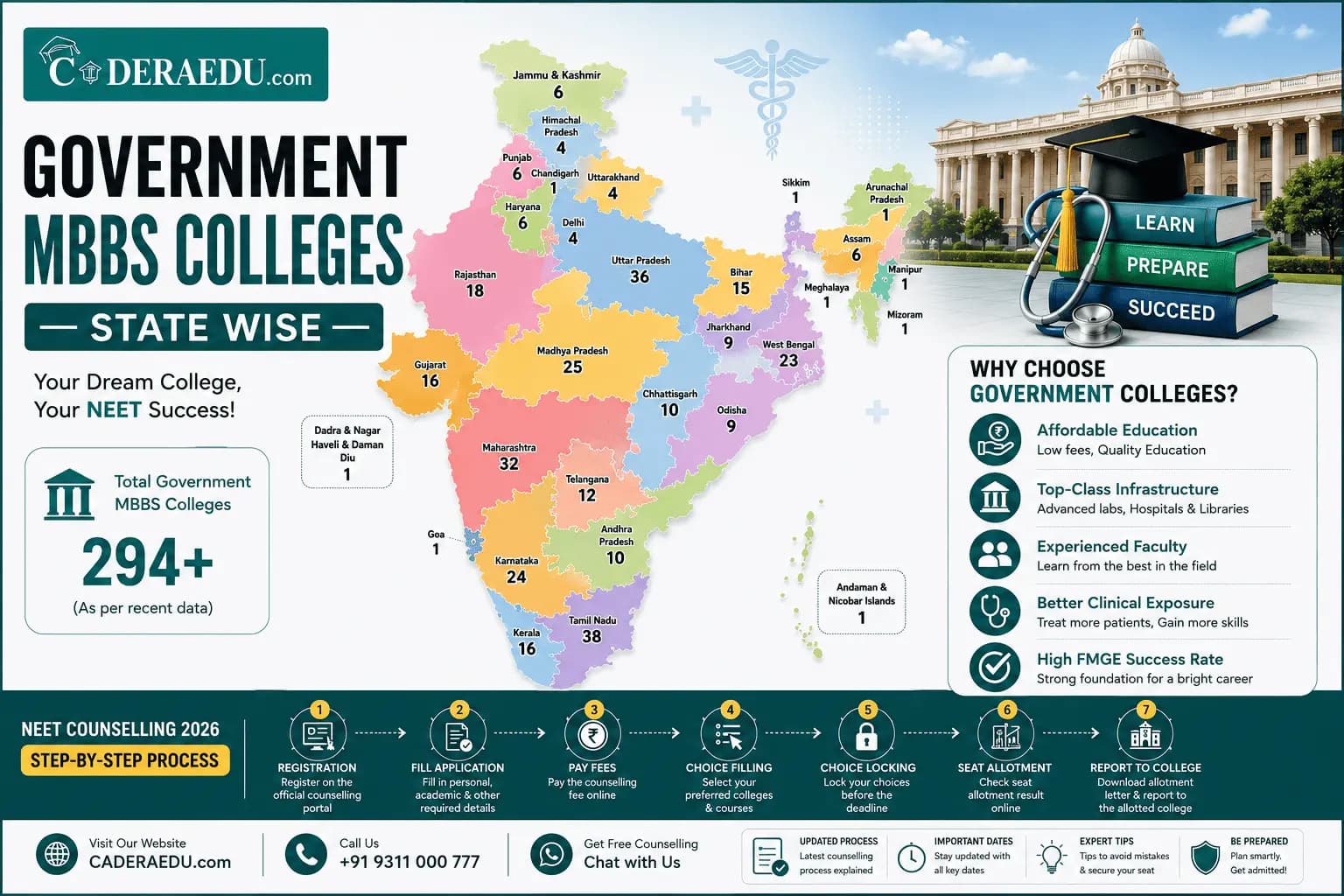
Click to enlarge
If you're chasing a government MBBS seat, you've probably already figured out that not all states are created equal. Some states run dozens of government medical colleges with thousands of affordable seats; others have a handful of institutes fighting over a much smaller pool of applicants. Knowing exactly which government colleges exist in your state, and a few neighbouring ones, changes how you approach NEET counselling entirely.
This guide walks through government MBBS colleges in India, state by state, with approximate seat numbers, counselling authorities, and direct links to predictor tools so you can check exactly where your NEET rank stands before choice-filling begins.
What Counts as a 'Government' MBBS College?
Before diving into the state list, it helps to be precise about terminology, because the word "government" gets used loosely in counselling conversations.
- State Government Medical Colleges — run and funded by individual state health departments, admitting students primarily through the 85% State Quota, with a 15% slice going to the All India Quota.
- Central Government Institutions — AIIMS, JIPMER, and a handful of central universities like AMU, BHU, and DU, which admit 100% through the All India Quota with no domicile requirement.
- Municipal Corporation Colleges — funded by city civic bodies (Mumbai's MCGM-run colleges are the best-known example), functionally similar to state government colleges for admission purposes.
- ESIC Medical Colleges — run by the Employees' State Insurance Corporation, technically central government institutions but with a distinct admission and eligibility process.
All of these fall under the broad umbrella of "government MBBS colleges," and all of them are dramatically cheaper than private or deemed institutions. For the exact admission route that applies to you, the NEET UG College Predictor separates AIQ and state quota outcomes so you're not mixing the two up.
Government MBBS Colleges in India: State Wise List
Here is a snapshot of government medical college counts and approximate MBBS seat capacity for the major states. Numbers shift slightly each year as the National Medical Commission approves new colleges.
Table
| State | Govt. Medical Colleges | Approx. Govt. MBBS Seats | Counselling Authority |
|---|---|---|---|
| Maharashtra | 30+ | 4,800+ | State CET Cell, Maharashtra |
| Tamil Nadu | 38+ | 5,200+ | Directorate of Medical Education, Tamil Nadu |
| Uttar Pradesh | 35+ | 4,300+ | Directorate General of Medical Education (DGME), UP |
| Karnataka | 22+ | 3,100+ | Karnataka Examination Authority (KEA) |
| Rajasthan | 20+ | 3,000+ | RUHS / State Medical Board |
| West Bengal | 25+ | 3,600+ | West Bengal Medical Counselling Committee |
| Madhya Pradesh | 13+ | 2,400+ | Directorate Medical Education (DME), MP |
| Andhra Pradesh | 17+ | 2,500+ | NTRUHS / DME, AP |
| Telangana | 18+ | 2,800+ | Kaloji Narayana Rao University of Health Sciences |
| Gujarat | 16+ | 2,700+ | ACPDC, Gujarat |
| Bihar | 14+ | 1,800+ | Bihar Combined Entrance Competitive Examination Board (BCECEB) |
| Delhi | 7+ | 1,200+ | GGSIPU / DU (FMSC) |
| Punjab | 9+ | 1,500+ | Baba Farid University of Health Sciences |
| Haryana | 8+ | 1,300+ | DGHS, Haryana |
| Kerala | 9+ | 1,400+ | Commissioner for Entrance Examinations (CEE), Kerala |
| Odisha | 11+ | 1,600+ | DMET, Odisha |
| Jharkhand | 7+ | 900+ | Jharkhand Combined Entrance Competitive Examination Board |
| Chhattisgarh | 6+ | 900+ | DME, Chhattisgarh |
| Assam | 8+ | 1,150+ | Director of Medical Education, Assam |
| Uttarakhand | 4+ | 550+ | HNB Uttarakhand Medical Education University |
| Himachal Pradesh | 6+ | 750+ | Himachal Pradesh University |
| Jammu & Kashmir | 6+ | 850+ | Board of Professional Entrance Examinations, J&K |
4 columns · 23 rows
Figures are approximate and based on NMC seat matrix data; new government colleges are added almost every academic year, especially in Maharashtra, UP, and Rajasthan.
To verify the live, current-year seat matrix for your own domicile state rather than relying on last year's averages, run your numbers through the NEET State Wise College Predictor.
Government Medical Colleges: State by State Breakdown
Maharashtra
Maharashtra runs one of the largest government medical college networks in the country, spanning old, well-established institutions in Mumbai and Pune alongside a wave of newer district-level colleges approved over the last few years. Flagship names include Seth GS Medical College & KEM Hospital, Mumbai and Government Medical College, Nagpur, alongside newer additions like Government Medical College, Nashik and Government Medical College, Buldhana. Counselling is run through the Maharashtra State Quota Predictor.
Karnataka
Karnataka's government medical college network is anchored by Bangalore Medical College & Research Institute (BMCRI) and Mysore Medical College & Research Institute, supported by a growing list of district-level institutes spread across the state. Check your standing through the Karnataka NEET College Predictor, and browse the broader institution list on the Karnataka medical colleges directory.
West Bengal
West Bengal is home to some of India's oldest medical colleges, and its government seat count remains among the highest nationally. Notable institutions include the Institute of Postgraduate Medical Education & Research, Kolkata, Calcutta National Medical College, Medical College and Hospital, Kolkata, Burdwan Medical College, Bankura Sammilani Medical College, Barasat Government Medical College, and Diamond Harbour Government Medical College. Run your rank through the West Bengal NEET College Predictor for an accurate read on your chances.
Telangana & Andhra Pradesh
Telangana's government college network is led by Osmania Medical College, Hyderabad and Kakatiya Medical College, Warangal, both consistently among the toughest government seats to crack in South India. Check the Andhra Pradesh NEET College Predictor for AP-specific cutoffs.
Tamil Nadu
Tamil Nadu carries one of the largest seat counts in the country, with Government Medical College and ESIC Hospital, Coimbatore and Kanyakumari Government Medical College among the well-regarded names spread across the state's three dozen-plus government institutions, run by the Directorate of Medical Education, Tamil Nadu.
Rajasthan
Rajasthan's government medical colleges range from established institutions in Jaipur and Jodhpur to newer district colleges such as Shri Kalyan Government Medical College, Sikar and Government Medical College, Chittorgarh. Use the Rajasthan NEET College Predictor to map your rank against current-year cutoffs.
Delhi
Delhi has a smaller but extremely competitive government college pool, including central university-affiliated institutions, with admissions run jointly through GGSIPU and Delhi University-linked hospitals. Use the Delhi NEET College Predictor to check your standing.
Other Major States
Several other states maintain solid government college networks worth checking individually: Gujarat, Madhya Pradesh, Punjab, Haryana, Kerala, Bihar, and Uttar Pradesh.
AIIMS and Central Government Medical Colleges
Separate from state government colleges, India's AIIMS network and a handful of central institutions admit students 100% through the All India Quota, with zero domicile requirement. There are currently around 20 active AIIMS campuses across the country, led by AIIMS New Delhi, the most competitive medical seat in India by a wide margin.
Table
| Institution | Seats | Gen. Closing Rank (approx.) |
|---|---|---|
| AIIMS New Delhi | 132 | 48 |
| AIIMS Bhopal | 125 | 531 |
| AIIMS Rishikesh | 125 | 685 |
| AIIMS Patna | 125 | 1,537 |
| AIIMS Guwahati | 125 | 3,177 |
3 columns · 6 rows
To check your AIIMS and central institution chances specifically, use the NEET UG All India Quota Predictor, which covers every AIIMS campus alongside JIPMER and deemed/central universities.
Government vs Private MBBS Colleges: Why the Distinction Matters
The gap between government and private MBBS fees in India is enormous, and it directly shapes counselling strategy.
Table
| Factor | Government Colleges | Private Colleges |
|---|---|---|
| Annual Fees | ₹10,000 – ₹1,50,000 (varies by state) | ₹5,00,000 – ₹25,00,000+ |
| Admission Route | 85% State Quota + 15% AIQ | State Quota (subsidized seats) + Management + NRI Quota |
| Competition Level | Very High (cutoffs sharper) | Moderate to Low (wider rank range) |
| Clinical Exposure | Generally high patient load | Varies by institution |
3 columns · 5 rows
If a government seat isn't realistic at your rank, exploring the broader Top Medical Colleges in India listing, which includes both government and private institutions, is a sensible next step rather than assuming you have no options at all.
How Government MBBS Seats Are Allocated
Government colleges don't fill their seats through a single process. Understanding the split changes how you plan your choice list.
- 15% All India Quota (AIQ) — open to any candidate nationwide, no domicile required, conducted centrally by MCC. Check your standing via the AIQ Predictor.
- 85% State Quota — reserved exclusively for candidates with valid domicile in that state, run by the respective state counselling authority. Use the State Wise Predictor for your own state.
- Central University & ESIC Seats — admitted entirely through MCC, covering institutions like AMU, BHU, DU, and ESIC medical colleges, with no domicile restriction.
For a complete walkthrough of how these tracks interact across counselling rounds, the Medical Counselling guide breaks down the full process from registration to reporting.
Step-by-Step: Choosing Government Colleges During Counselling
Once your NEET UG result is out, here's a practical sequence for building your government college preference list.
- Confirm domicile eligibility for your state quota before anything else — this single factor determines 85% of your realistic options.
- Run your rank through both the AIQ Predictor and your relevant state predictor separately, since the two results often diverge significantly.
- List government colleges in three tiers: ambitious, realistic, and safe, rather than fixating on a single dream college.
- Don't ignore newer government colleges — they tend to carry softer cutoffs in their first few intake years simply because they haven't built reputation yet.
- Track Round 2, mop-up, and stray vacancy rounds closely. A significant share of government seats fill only in later rounds.
Government Medical College Reservation and Category Breakdown
Government colleges in India follow a layered reservation structure that significantly affects effective cutoffs. Within both AIQ and State Quota, seats are reserved across multiple categories, and understanding this layering is often the difference between writing off a college too early and actually qualifying for it.
Table
| Category | Typical AIQ Reservation | Notes |
|---|---|---|
| General / UR | No reservation (open competition) | Highest competition, sharpest cutoffs |
| EWS | 10% | Economically Weaker Section, income/asset criteria apply |
| OBC-NCL | 27% | Central OBC list; certificate must be central-government format for AIQ |
| SC | 15% | Scheduled Caste reservation |
| ST | 7.5% | Scheduled Tribe reservation |
| PwD | 5% horizontal | Applies across all categories, requires disability certificate from a designated centre |
3 columns · 7 rows
State Quota reservation structures vary considerably and often go beyond these central categories. Maharashtra, for instance, layers in NT and VJ categories on top of the standard SC/ST/OBC/EWS split, while Karnataka uses a more granular GM/1G/2A/2B/3A/3B system. Always check your specific state authority's category list rather than assuming the central AIQ structure applies uniformly.
Documents Typically Required for Government MBBS Counselling
Regardless of which state or AIQ track you're counselling through, government medical college admission requires a fairly standard document set. Missing even one of these at the verification or reporting stage can cost you a seat, so it's worth preparing this checklist well before counselling rounds open.
- NEET UG admit card and final scorecard
- Class 10 and Class 12 marksheets and passing certificates
- Valid government-issued photo ID (Aadhaar, passport, or similar)
- Domicile or residence certificate (for State Quota seats specifically)
- Category certificate (SC/ST/OBC/EWS) in the correct format for the counselling body you're registering with
- Provisional seat allotment letter generated after each counselling round
- Passport-size photographs as specified by the counselling authority
- PwD certificate from a designated medical board, if applicable
Common Mistakes Students Make While Choosing Government Colleges
After years of watching counselling cycles play out, a handful of avoidable mistakes show up again and again among aspirants targeting government seats.
- Registering only for AIQ and skipping state counselling, or vice versa — both tracks run in parallel and missing one halves your realistic options.
- Filling too few choices in the preference list, sometimes just 5 to 10 colleges, when there's no real limit on how many you can add.
- Ignoring newer government colleges because they lack brand recognition, even though their cutoffs are often considerably softer in the first few intake years.
- Giving up after Round 1 instead of tracking Round 2, mop-up, and stray vacancy rounds, where a meaningful share of government seats are eventually filled.
- Assuming last year's cutoff is fixed, when seat matrix changes (new colleges, increased intake) can shift cutoffs noticeably from one year to the next.
Frequently Asked Questions
Government MBBS colleges remain the most sought-after route into medicine in India, and the right strategy starts with knowing exactly what exists in your state and how the AIQ and state quota tracks actually work together. Once your NEET UG 2026 result is declared, run your numbers through the Medical College Predictor for both tracks and build a government-college-first preference list that's realistic, tiered, and round-aware.
Share this article
Copy
Frequently Asked Questions
How many government MBBS colleges are there in India?
India currently has roughly 360+ government medical colleges across all states and union territories, accounting for a little over half of the country's total MBBS seat capacity.
Which state has the most government MBBS colleges?
Tamil Nadu and Maharashtra currently lead with 30+ government medical colleges each, followed closely by Uttar Pradesh and West Bengal.
Can I get admission to a government college outside my home state?
Yes, through the 15% All India Quota, which is open to candidates nationwide regardless of domicile. The remaining 85% State Quota seats require a valid domicile certificate for that specific state.
What is the average fee at a government MBBS college?
Government MBBS fees typically range from ₹10,000 to ₹1,50,000 per year depending on the state, compared to ₹5 lakh to ₹25 lakh or more annually at private institutions.
Are AIIMS colleges considered government colleges?
Yes, all AIIMS campuses are central government institutions, but they admit students exclusively through the All India Quota with no state domicile requirement.
How can I check government college cutoffs for my state?
The most reliable way is to use a state-specific NEET predictor that reflects the current year's seat matrix and previous closing ranks, rather than relying on outdated averages.